Two temples in Himachal Pradesh share a goddess’s name, a royal patron story, and a spot on countless travel lists — and a fair number of websites can’t seem to tell them apart.
If you search for “Bhima Kali Temple” online, you’ll quickly run into a strange, recurring mix-up: article after article describes a riverside temple in Mandi town as the ancestral shrine of the Bushahr royal family, when the actual, historically documented Bushahr kuldevi temple sits nearly 180 km away, in Sarahan, Shimla district — a major Shakti Peeth with silver gates and a fortress-like presence overlooking the Sutlej valley. The temple in Mandi, on the banks of the Beas at Bhiuli, is a real, well-loved, and genuinely old shrine in its own right. It’s just not that one. Untangling the two turns out to be a useful way into understanding how devotional geography sometimes gets copied and pasted across the internet faster than anyone bothers to check it — and it’s a fitting starting point for a temple whose own local legend involves a buried demon’s head and a river that never quite stops murmuring past its walls.
🌄 Location & How to Reach It
Bhima Kali Temple sits in the Bhiuli area of Mandi town, Himachal Pradesh, directly on NH-20 (the Mandi–Pathankot highway), on the banks of the Beas River, roughly 1 km from the Mandi bus stand.
Google Maps: Get Directions
Being right on Mandi’s main highway and a short walk from the town’s central bus stand, this is one of the more effortlessly accessible temples in this series — no climb, no remote approach, just a riverside stop within the town itself.
- By road: Walkable or a short auto-rickshaw ride from Mandi bus stand; Mandi town itself is well connected by bus and taxi from Shimla, Kullu, Manali, and Chandigarh via NH-21 and NH-20.
- By rail: Mandi has no railway station of its own; the nearest options involve a considerable onward road journey, making bus or car the practical choice for most visitors.
- By air: Bhuntar Airport near Kullu is the nearest, with Chandigarh Airport as a longer-distance alternative offering wider flight connections.
Given its in-town setting, this temple pairs naturally with a walk through the rest of Mandi — a town proud enough of its own temple density to have earned the nickname “Chhoti Kashi,” or “Little Varanasi.”
🌸 Best Time to Visit
October and November bring Kali Puja, the temple’s most significant annual occasion, marked by night-long bhajans, havans, and community feasting. Navratri is also a major period here, with devta processions, folk performances, and special aartis drawing crowds from across the district. Reported daily timings vary slightly by source — generally somewhere between 5 and 6 a.m. through 8 to 9:30 p.m. — so it’s worth confirming locally rather than planning tightly around a single hour. Outside festival season, the attached riverside park makes this a genuinely pleasant everyday stop, popular with local families as much as pilgrims.
🕉️ The Legend: A Demon’s Head, Buried at the Gate
The temple’s core legend ties it to one of Krishna’s lesser-told battles: his war against Banasura, a powerful demon king and great-grandson of Prahlad, fought over the affair between Banasura’s daughter Usha and Krishna’s grandson Aniruddha. According to the tradition told at Bhiuli, this riverside spot in Mandi is where that battle took place, and the temple’s builders are said to have buried Banasura’s severed head directly beneath the facade of its entrance gate — a striking, specific detail that’s repeated consistently across multiple independent sources describing this temple. It’s worth noting, purely as context, that the wider Puranic tradition generally locates Banasura’s kingdom (Shonitpur) elsewhere on the subcontinent, so this is best understood as a strong local tradition specific to Bhiuli rather than something drawn directly from the classical geography of the myth — a pattern common to many regional temples that anchor a well-known epic story to their own particular ground.
The temple’s founding is credited by several sources to rulers of the Yadava lineage — a claim that lines up naturally with the Krishna connection, since Yadava is Krishna’s own clan name in the epics, and several Rajput ruling houses across North India, including dynasties in this region, have historically traced descent from that same lineage. Reported construction dates vary: one source places the temple in the 14th century, while informal visitor accounts describe worship here stretching back roughly a thousand years; neither figure comes with the kind of inscriptional evidence that pins down a temple like Baijnath’s construction with real precision, so it’s fairest to treat the exact founding century as approximate rather than settled.
What’s genuinely worth flagging, rather than repeating uncritically, is the claim — found across a surprising number of travel and tourism sites — that this temple is “the family deity of the Bushahr rulers.” That description belongs, almost certainly, to the other Bhimakali temple: the 13th-century Shakti Peeth at Sarahan, which is independently and extensively documented (including by Wikipedia and Himachal’s own tourism authorities) as the genuine ancestral kuldevi shrine of the Bushahr royal dynasty of Rampur, an entirely separate princely state from Mandi. Mandi’s own historical rulers belonged to the Sen dynasty, not the Bushahr line, and the geographic distance between Sarahan (Shimla district) and Bhiuli (Mandi town) makes it very unlikely these are describing the same royal patronage. This looks like a case of two similarly named goddesses’ histories being blended together across repeated, uncritical copying online — worth untangling here rather than passing along.
🙏 What Bhima Kali Is Known For
At Bhiuli, Bhima Kali is worshipped as a fierce, protective form of Durga, closely tied to the specific local memory of Krishna’s victory here — pilgrims come seeking her protection over the town and the river that runs beside her shrine, rather than approaching her primarily through the wider Shakti Peeth network the Sarahan temple belongs to. The distinction matters devotionally as well as historically: this is a genuinely local goddess with a genuinely local story, not a fragment of Sati’s body given cosmic significance across the subcontinent.
Daily worship includes morning and evening aarti, incense offerings, and the chanting of the Durga Saptashati. The temple’s most unusual devotional event, mentioned independently by more than one source, is the Udyapan Jag — a major ritual observed only once every hundred years, drawing enormous community participation on the rare occasions it falls within living memory. It’s a striking reminder that not every temple’s calendar runs on the annual or monthly rhythms most festivals follow.
🏛️ The Temple Itself
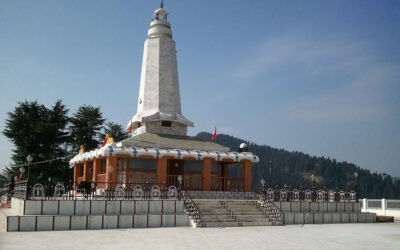
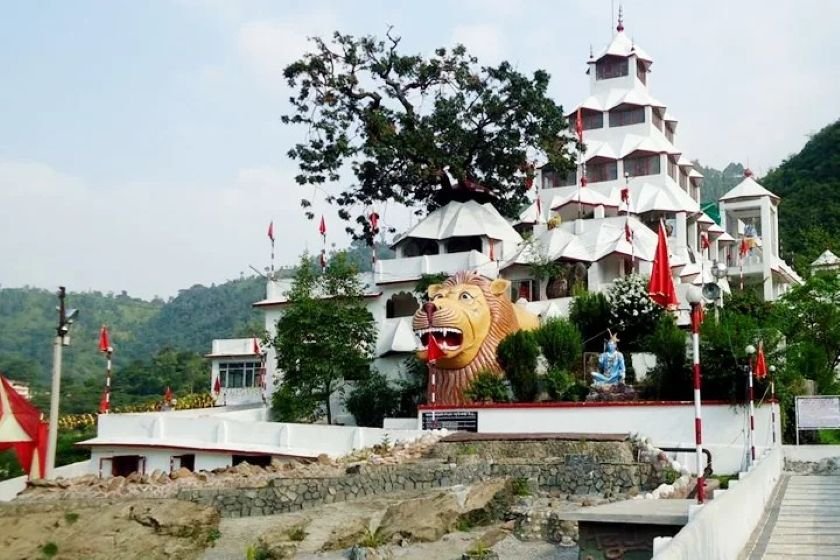
Bhima Kali’s architecture is consistently described as a blend of Hindu and Buddhist building traditions, built in a pagoda-style form typical of several older temples in this part of the Himalayan foothills, where trade and cultural exchange across mountain passes shaped a genuinely hybrid regional style. Wooden carvings throughout the structure depict episodes from the goddess’s story, and the sanctum houses her richly adorned idol. A sizeable museum within the temple complex displays statues and images of various Hindu deities, adding a browsable historical dimension beyond the sanctum itself. Around the temple grounds, a public park with play equipment for children has become as much a part of the site’s identity for Mandi locals as its devotional function — a detail that comes up again and again in casual visitor accounts, painting a picture of a temple that’s as woven into everyday town life as it is into pilgrimage itineraries.
📜 Mandi, “Chhoti Kashi,” and a Town of Temples
Bhima Kali Temple sits within Mandi town’s broader identity as “Chhoti Kashi” — Little Varanasi — a nickname earned through the sheer density of old temples packed into the town, including the Panchvaktra Mahadev temple near the Beas-Suket Khad confluence, the Bhootnath Temple built in 1527 by Raja Ajber Sen around the time Mandi’s capital shifted from Bhiuli itself to its present location, and the Madhav Rai Temple associated with 17th-century ruler Raja Suraj Sen. That last detail is a useful thread: Bhiuli was, before Mandi town’s own founding, apparently significant enough in its own right to have hosted what later became the state’s shifting capital — which helps explain why a temple of this stature ended up on this particular stretch of riverbank in the first place, independent of any connection to the Bushahr dynasty further south.
🎉 Festivals and Devotion
- Kali Puja (October–November): The temple’s major annual occasion, marked by night-long bhajans, havans, and community feasting.
- Navratri: Celebrated with devta processions, folk dances, and special aartis.
- Udyapan Jag (once every 100 years): A rare, large-scale ritual event, distinctive among Himachal’s temple festival calendars.
- Daily worship: Morning and evening aarti, incense offerings, and Durga Saptashati recitation.
🏞️ While You’re in the Area
- Panchvaktra Mahadev Temple: Nearby at the Beas–Suket Khad confluence, known for its five-faced Shiva idol and Shikhara-style architecture.
- Bhootnath Temple: In Mandi’s Chowata Bazaar, built in 1527 and central to the town’s Mahashivratri celebrations.
- Madhav Rai Temple: Associated with 17th-century ruler Raja Suraj Sen, another key stop on Mandi’s temple circuit.
- Rewalsar Lake: A sacred lake sacred to Hindu, Buddhist, and Sikh traditions alike, a short drive from Mandi town.
- Shikari Devi Temple: A roofless Shakti shrine at the highest point in Mandi district, for those extending the trip further into the hills.
❓ Quick Questions Travellers Ask
Is this the same Bhimakali Temple I’ve read about as a major Shakti Peeth? No — that’s a different, larger, and independently much better-documented temple at Sarahan in Shimla district, which is the genuine ancestral shrine of the Bushahr royal family. Mandi’s Bhima Kali Temple at Bhiuli is a distinct, local shrine that happens to share the goddess’s name.
Is the temple suitable for a family visit, not just pilgrims? Very much so — the attached park with play equipment makes it a popular everyday spot for Mandi families, alongside its devotional role.
Is there an entry fee? No entry fee could be confirmed for this article; as an active, publicly worshipped town temple, general darshan is very likely free.
What’s the significance of the Udyapan Jag ritual? It’s a major ceremony held only once every hundred years, making it one of the rarest recurring events at any Himachal temple; most visitors will never happen to be present for one, which only adds to its local significance.
How does this temple fit into a wider Mandi sightseeing day? Very easily — it’s close to the bus stand and can be combined on foot or by short auto ride with several of the town’s other well-known temples, making it a natural stop on any “Chhoti Kashi” temple walk.
A Last Word
There’s something quietly instructive about a temple whose own story keeps getting mixed up with someone else’s. Bhima Kali at Bhiuli doesn’t need the Bushahr dynasty’s history to matter — it has its own: a demon’s head buried at the gate, a town that once considered this exact riverbank important enough to be its capital, and a hundred-year ritual most people will only ever hear about rather than witness. Sometimes the more interesting temple is the one standing quietly next to the famous name everyone assumes it must be.
Fact-check note: The temple’s location at Bhiuli on the Beas River in Mandi town, its Krishna-Banasura legend, its Hindu-Buddhist architectural blend, and its Kali Puja and Udyapan Jag observances are corroborated across multiple independent sources. The widely repeated claim that this temple is the ancestral shrine of the Bushahr royal family is very likely a conflation with the separate, independently documented Bhimakali Temple at Sarahan, Shimla district — the genuine Bushahr kuldevi shrine — and is not presented as fact here. The exact founding century (14th century vs. informal “1000 years” estimates) and precise opening hours are inconsistently reported across sources and are treated above as approximate. No entry fee could be confirmed.