High on a ridge in Mandi’s Seraj region, a small wooden temple has survived for generations on almost nothing but its setting — no epic battle, no royal decree, just a view that keeps people coming back.
Most temples in these hills carry their history the way a person carries a name — inherited, specific, told the same way for generations. Jalpa Mata Temple at Saroa carries almost none of that. Ask why the shrine sits exactly here, on a 2,230-metre ridge above apple orchards and cedar forest in Mandi’s remote Seraj tehsil, and you won’t find a demon slain, a king’s vision, or a Pandava exile story waiting to answer you. What you’ll find instead is wind moving through hand-carved wooden lanterns that hang from the eaves, chiming softly enough that locals describe the goddess as someone who listens through the trees rather than through any recorded myth. It’s an unusual kind of sacred site — one that seems to have earned its devotion less through story than through sheer, accumulated atmosphere, in a part of Himachal Pradesh so quietly remote that even the surrounding villages barely register on most maps.
🌄 Location & How to Reach It
Jalpa Mata Temple — also known locally as Saroa Devi Temple — sits atop the Saroa ridge in Saroa village, near Chail Chowk, in Gohar tehsil, Mandi district, Himachal Pradesh, at an altitude of around 2,230 metres. Chail Chowk itself sits roughly 20 km south of Mandi town, on the road that continues on toward Janjehli and the wider Seraj valley — a region better known, if it’s known at all outside Himachal, as the political heartland of a former state chief minister than as a tourist circuit.
Google Maps: Get Directions
The final approach climbs well above Chail Chowk itself, and the temple’s remote, high-altitude setting means the drive up is as much a part of the experience as the shrine itself.
- By road: Regular local buses and taxis connect Mandi town to Chail Chowk via the Nerchowk–Chailchowk–Janjehli road; from Chail Chowk, a further climb by car or on foot brings you up to the temple itself.
- By rail: There’s no railway station within a reasonable distance of Chail Chowk — this is genuinely off the narrow-gauge network that serves Kangra Valley further north, so a road journey from Mandi or Sundarnagar is unavoidable.
- By air: Bhuntar (Kullu) and Shimla’s Jubbarhatti airport are the closest options in the wider region, though this is far enough into the Seraj interior that neither counts as a short transfer.
Snow closes or complicates the route in peak winter, and the high altitude makes this one of the more physically demanding temple visits in this series — pack for mountain weather rather than valley weather, whatever the season looks like lower down.
🌸 Best Time to Visit
Summer, when the surrounding apple orchards are in leaf and the cedar forest is at its greenest, offers the most comfortable conditions for the climb and the clearest long-distance views across the Seraj hills. Winter brings snow to the ridge, which is visually striking but makes the approach considerably harder. Navratri is the temple’s main devotional occasion, drawn together with bhajans and community feasting, though — as with much of the temple’s profile — the specific rituals observed here don’t diverge dramatically from general Devi worship practice across Himachal’s smaller regional shrines.
🕉️ The Legend: A Temple That Tells You Almost Nothing About Itself
It’s worth being straightforward about something unusual: Jalpa Mata at Saroa doesn’t come with the kind of origin story most temples in this region carry. There’s no scriptural episode tying it to the Devi Mahatmya, no Mahabharata-era construction claim, no named king or dreaming priest credited with founding it. What consistently appears across the handful of sources describing this specific shrine is a description of what it is and what it does — a wish-fulfilling form of Durga, understood locally as the guardian of the Saroa ridge, believed to protect the surrounding region from natural calamities and to answer devotees’ vows with peace and fertility — rather than a narrative of how that belief came to be.
This is, on its own, a genuinely interesting fact about the temple rather than a gap to apologize for. Not every sacred site in the Himalayan foothills carries a fully developed founding myth passed down in written or oral form; some simply accumulate meaning gradually, through generations of local practice, until the site itself becomes sacred by sheer weight of continued attention rather than through a single dramatic origin event. Saroa’s Jalpa Mata seems to belong to that quieter category. The nearby Shikari Devi temple, considerably higher up in the same Seraj region, does carry a well-documented Pandava-exile legend of its own — which makes Saroa’s comparative silence on its own founding feel less like an oversight in the available sources and more like a genuine, if unusual, characteristic of this particular shrine.
🙏 What Jalpa Devi Is Known For
Jalpa Mata is worshipped here as a form of Durga, specifically credited with protecting the Saroa ridge and its surrounding villages from natural disaster — a devotional focus that makes sense given the exposed, high-altitude, weather-dependent nature of life in this part of the Seraj region. Devotees bring offerings of red cloth, coconuts, sweets, and ghee lamps, and — in a practice common across many regional Devi shrines in Himachal — tie chunris (strips of cloth) onto the trees near the temple as a lasting, visible marker of a vow made or a prayer offered.
What distinguishes worship here isn’t a particular ritual specialism, as with some of the more specifically purposed temples elsewhere in this district, but rather the site’s function as a genuine local gathering point: a place where devotion is inseparable from the physical experience of reaching it — the climb, the orchards, the wind moving through the temple’s wooden lanterns — as much as from any specific request made once you arrive.
🏛️ The Temple Itself
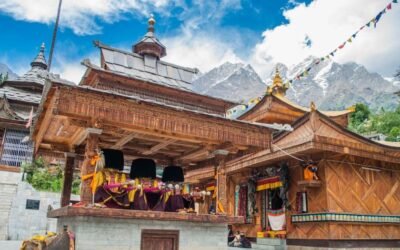
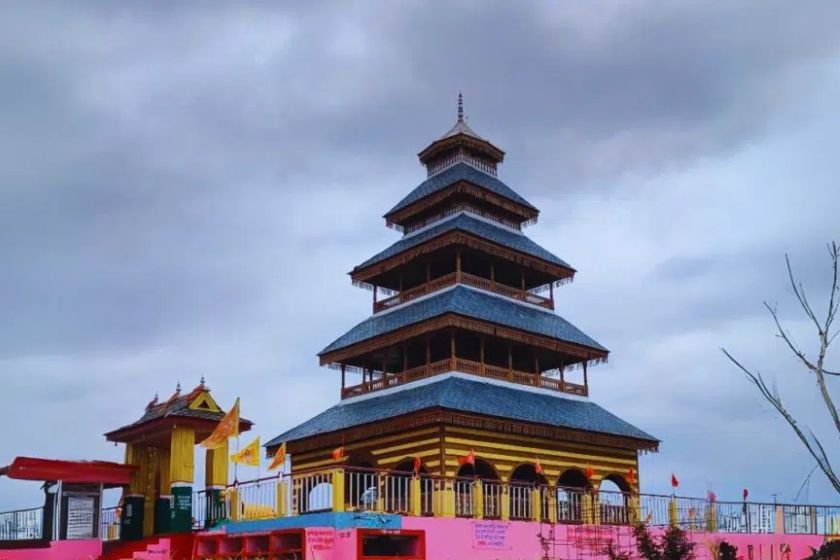
Structurally, Jalpa Mata’s shrine reflects the traditional wooden temple architecture common to Himachal’s higher-altitude regions — a style built specifically to handle heavy snow loads and sharp temperature swings, using timber and slate rather than the stone-and-shikhara forms found in the Kangra Valley further north. The temple’s most distinctive physical feature isn’t a carving or an idol, but its wooden lanterns (kandeels), suspended around the structure in a way that catches the near-constant wind at this altitude and produces a soft, bell-like chiming that visitors and locals alike describe as central to the site’s atmosphere.
The setting does much of the rest of the work. From the temple platform, the Saroa ridge opens onto sweeping views across apple orchards and cedar forest, with the wider folds of the Seraj hills visible in multiple directions — a panorama striking enough that a helipad has reportedly been built just below the temple, suggesting an awareness, even in this remote corner of Mandi district, of the site’s appeal as a scenic destination in its own right, not solely a devotional one.
📜 Seraj: A Quiet, Political Corner of Mandi District
Saroa sits within Seraj, a rugged, thinly populated tehsil of Mandi district that has, somewhat incongruously for its remoteness, produced a former chief minister of Himachal Pradesh, giving the region an outsized political profile relative to its size and infrastructure. The wider Seraj and neighbouring Karsog valleys carry a dense concentration of much older, better-documented Himachali temples — the roofless, Pandava-associated Shikari Devi shrine at the district’s highest point, and the multi-deity Mamleshwar Mahadev temple in Karsog town among them — which places Jalpa Mata within a genuinely old regional tradition of hill-shrine worship, even where its own specific founding story hasn’t been as clearly preserved or recorded as some of its neighbours’.
🎉 Festivals and Devotion
- Navratri: The temple’s primary festival period, marked with bhajans and community feasting.
- General darshan: Devotion here is described as steady and local rather than built around a single, dominant annual event beyond Navratri.
🏞️ While You’re in the Area
- Shikari Devi Temple: A striking roofless Shakti shrine at the highest point in Mandi district, with its own well-documented Pandava-era legend.
- Janjehli Valley: A quiet Himalayan hamlet with trekking trails, further into the Seraj region.
- Karsog Valley: Home to a dense cluster of ancient temples, including the multi-deity Mamleshwar Mahadev shrine.
- Chail Chowk: The practical gateway town for reaching Saroa, useful as a base for supplies or an overnight stop.
- Mandi town: Known as the “Varanasi of the Hills” for its dozens of old stone temples, about 20 km away and worth combining with a Seraj visit for a broader temple-focused trip.
❓ Quick Questions Travellers Ask
Is this temple difficult to reach for someone unfamiliar with the Seraj region? Yes, relatively — it’s a genuinely remote, high-altitude site reached via local roads rather than a major highway, so it’s best approached as a deliberate day trip from Mandi rather than a casual stop.
Why doesn’t this temple have a well-known founding legend like other Devi shrines in the region? It’s simply not well documented in the sources available — some regional shrines accumulate sanctity gradually through sustained local devotion rather than a single recorded origin story, and Saroa’s Jalpa Mata appears to be one of them.
Is there accommodation near the temple? Facilities are limited given the remote setting; Chail Chowk and Mandi town offer more practical options for staying overnight.
Is there an entry fee? No entry fee could be confirmed for this article; as a small, community-maintained hill shrine, general darshan is very likely free.
What’s the single biggest reason people visit? By most accounts, it’s as much for the panoramic view across the Seraj hills and the temple’s distinctive wind-chime lanterns as for any specific devotional request — a genuinely scenic pilgrimage as much as a spiritual one.
A Last Word
There’s a particular honesty in a temple that doesn’t reach for an elaborate story to justify its own sacredness. Jalpa Mata at Saroa doesn’t need Ravana, the Pandavas, or a demon-slaying to explain why people climb this far into Mandi’s hills to visit her — the wind in the wooden lanterns, the orchards falling away below, and generations of quiet, ongoing local devotion seem to have been more than enough. It’s a useful reminder, tucked into a corner of Himachal most guidebooks skip entirely, that not every sacred place needs a myth to earn its stillness.
Fact-check note: The temple’s location on the Saroa ridge near Chail Chowk in Mandi district, its dedication to Jalpa Mata as a form of Durga, and its Navratri observance are corroborated across the small number of independent sources available, including regional travel listings and an existing feature on this temple. Unlike most other temples covered in this series, no scriptural, epic, or dynastic founding legend for this specific shrine could be found in the sources consulted — this appears to be a genuine feature of how the site is documented rather than an oversight, and should be read as such rather than assumed to reflect an untold story. Precise distances to the nearest airport and railway station could not be confirmed and are described only in general terms above. No entry fee or verified opening hours could be confirmed. Note also that Himachal Pradesh has at least three other temples also called “Jalpa Mata” (near Jogindernagar and Dharampur in Mandi district, among others) with entirely distinct, unrelated histories — this article describes only the Saroa/Chail Chowk shrine.