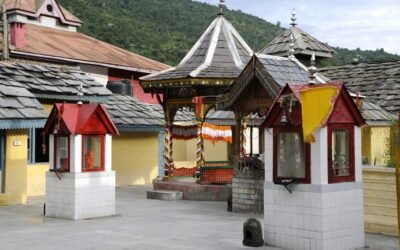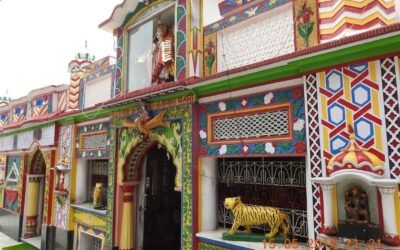
Deep in Mandi’s Seraj region, local tradition holds that a single deodar tree decided exactly where this temple should stand — and that the site it picked had been waiting for it since the age of the Mahabharata.
Most temples get built where their patrons decide to build them. Magru Mahadev’s story runs the other way around. According to the tradition kept in Chhattri village, the Pandavas had already laid a foundation here centuries before construction began, quietly waiting through generations until a master carpenter received a vision telling him to fell a particular deodar tree and build wherever its severed tip came to rest. It fell, the story goes, exactly onto that forgotten Pandava foundation — as if the site had simply been holding a reservation open. Whether or not you take that literally, it’s an unusually poetic way for a temple to explain its own location, and it sets the tone for a shrine that, in its surviving woodwork, backs up the poetry with genuinely extraordinary craftsmanship.
🌄 Location & How to Reach It
Magru Mahadev Temple stands in Chhattri village, Thunag tehsil, in the Seraj region of Mandi district, Himachal Pradesh, roughly 50 km from the Karsog valley and about 160 km from Shimla.
Google Maps: Get Directions
Like much of the Seraj region, this is a genuinely rural, interior part of Mandi district — reaching it means committing to a proper hill journey rather than a quick highway detour.
- By road: Best reached by taxi or local bus from Mandi town via Chail Chowk and the wider Thunag/Seraj road network; the final stretch into Chhattri involves the kind of winding hill roads typical of this part of the district.
- By rail: There’s no railway station within easy reach of Chhattri; a road journey from Mandi or Sundarnagar is unavoidable.
- By air: Bhuntar (Kullu) and Shimla’s Jubbarhatti airport are the nearest options in the wider region, though both still require a substantial onward drive into the Seraj interior.
Given the remoteness, this temple tends to reward travellers who are already exploring the Seraj/Karsog area rather than those looking for a quick, standalone stop.
🌸 Best Time to Visit
Summer and early autumn offer the most comfortable travel conditions for reaching this interior stretch of Mandi district, with clear hill roads and pleasant temperatures for exploring the temple’s woodwork at leisure. Winter can bring snow and more difficult access, as is typical across much of the Seraj region. Specific festival dates and daily visiting hours for Magru Mahadev don’t appear to be widely documented online, so it’s worth checking locally or with a Mandi-based guide before planning a visit around a particular occasion.
🕉️ The Legend: A Foundation Waiting Since the Mahabharata
According to local tradition, Magru Mahadev’s story begins with the Pandavas, who are said to have laid the temple’s foundation here during their period of exile — one of the most frequently recurring origin claims across this entire region’s older shrines, tying the site to the deep, epic-scale past even before any structure stood on it.
The more specific and distinctive part of the story concerns how the temple actually came to be built, generations later. A master carpenter is said to have received a divine vision instructing him to cut down a particular deodar tree, with the promise that wherever its felled tip landed, that was where the temple should rise. When the tree came down, its tip is said to have landed precisely on the long-dormant Pandava foundation — closing the gap between an ancient, unbuilt sacred site and the specific tree that would eventually become its temple. It’s a lovely piece of local storytelling, and worth treating exactly as that: a devotional tradition explaining the shrine’s origin, rather than a documented historical event.
A further claim, repeated in at least one detailed source, holds that the entire temple was carved from that single deodar tree, and that its roof is entirely jointless — an extraordinary claim of wooden engineering that goes well beyond the already-impressive, independently documented Kath-Kuni construction techniques used at temples across this region. This specific claim doesn’t appear across multiple independent sources in the way the temple’s general woodcarving reputation does, so it’s presented here as a striking local tradition rather than a verified structural fact. Similarly, the story that the temple’s intricate carvings were inspired by craftsmen spending a night observing the winding trails of ants comes from a single source and is worth enjoying as legend rather than treating as settled history.
🙏 What Magru Mahadev Is Known For
Magru Mahadev is worshipped as a form of Shiva, and locally described as the spiritual nurturer of Magrugadh and Maangadh — place names tied to the surrounding area that point to a role extending beyond a single village’s devotion, into guardianship of the wider local landscape. As with many of Seraj and Karsog’s older wooden temples, worship here is bound up closely with the region’s own identity and continuity, in a way that feels less about singular dramatic miracles and more about a long, steady relationship between a community and its temple.
The temple’s carvings themselves function almost as a devotional and cultural archive: figures from the Mahabharata appear alongside a striking image of King Janak — Sita’s father — ploughing a field, a scene from the Ramayana tradition, alongside a depiction of Brahma in the act of creating the universe, and scenes from Krishna’s life. Taken together, these carvings sketch out a kind of visual survey of Hindu epic and cosmological tradition rather than focusing narrowly on Shiva alone, reflecting the broadly inclusive religious imagination common to many of this region’s older hill temples.
🏛️ The Temple Itself
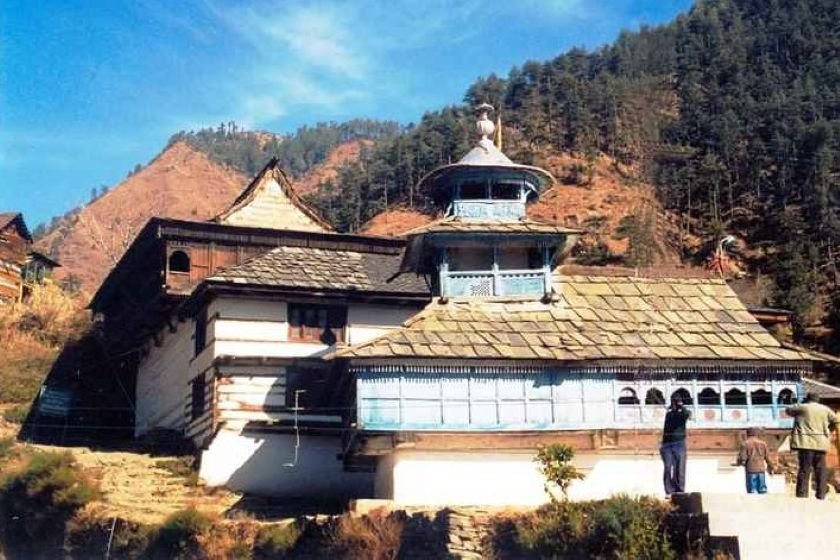
Architecturally, Magru Mahadev is a genuinely elaborate example of the pagoda-and-mandap hybrid style found across Himachal’s wooden temple tradition. The sanctum is unusually oblong rather than perfectly square, its walls built in Kath-Kuni masonry — the interlocking timber-and-stone construction method that gives many of the region’s oldest temples their earthquake resistance and longevity. The structure rises in a three-tiered pagoda form, surrounded by two circumambulatory paths of differing width, both covered by a gabled roof shared with the mandap. Each roof tier uses a different traditional covering: the topmost, conical section is finished in galvanised iron sheeting laid over four layers of wooden planks, the middle tier in stone slates over three layers of planking, and the lowest, gable-fronted section in slates over two layers of planks — a layered, carefully differentiated roofing system rather than a single uniform covering.
The real spectacle, by every account, is the woodcarving inside the mandap. Every exposed wooden surface is worked with dense, dynamic detail — serpents rendered in zigzag motion as though still slithering, horses and elephants caught mid-stride, and extended narrative scenes drawn from the Ramayana and Mahabharata, with particular energy given to battle sequences. The mandap’s ceiling is worked into a dome shape, adding a further layer of technical ambition to a structure already dense with detail. At least one visitor account notes that while the temple’s interior carvings and relics feel genuinely old, the outer structure appears to have been renovated relatively recently — a reminder that a temple’s ancient reputation and its most recently rebuilt surfaces don’t always belong to the same century, something true of many actively used wooden hill temples that face centuries of harsh mountain weather.
📜 Seraj’s Tradition of Wooden Temple-Building
Magru Mahadev belongs to a broader, remarkably rich concentration of wooden temple architecture across Mandi district’s Seraj and Karsog regions — a tradition that also includes the roofless, Pandava-associated Shikari Devi shrine at the district’s highest point, the multi-deity Mamleshwar Mahadev temple in Karsog, and the rain-deity shrine of Kamru Nag on a forested hill nearer Chail Chowk. Together, these temples reflect a distinctly Himalayan building tradition — timber-based, deeply carved, built to withstand heavy snow and seismic activity — that stands in clear architectural contrast to the stone Nagara-style temples of the Kangra Valley further north, even as both regions share many of the same underlying epic and Puranic legends.
🎉 Festivals and Devotion
- General local worship: Specific festival dates and rituals for Magru Mahadev aren’t widely documented in available sources; devotion here appears to follow the steady, community-centred pattern typical of Seraj’s village temples rather than a single headline annual event.
- Regional festival context: As elsewhere in Mandi district, Navratri and Shivratri are broadly significant periods across the region’s Shiva and Devi temples, and are likely observed here in some form, though this isn’t independently confirmed for this specific shrine.
🏞️ While You’re in the Area
- Shikari Devi Temple: A roofless Shakti shrine at the highest point in Mandi district, with its own Pandava-exile legend.
- Mamleshwar Mahadev, Karsog: A multi-deity Shiva temple in Karsog town, known for its own distinctive stone-and-wood architecture.
- Kamru Nag Temple: Dedicated to the local rain deity, set on a forested hill near Chail Chowk.
- Jalpa Mata Temple, Saroa: A scenic hilltop Devi shrine elsewhere in the same Seraj region.
- Janjehli Valley: A quiet Himalayan hamlet with trekking trails, useful as a base for exploring this part of Mandi district further.
❓ Quick Questions Travellers Ask
Is it really true the whole temple was carved from a single tree? That specific claim comes from only one detailed source and should be treated as a striking local tradition rather than a verified architectural fact; what’s more broadly documented is the temple’s elaborate Kath-Kuni timber construction and extensive woodcarving.
How difficult is it to reach Chhattri village? It’s a genuinely interior part of Mandi’s Seraj region, reached by hill roads rather than a major highway — plan for a deliberate day trip rather than a quick stop.
Is there an entry fee? No entry fee could be confirmed for this article; as a small, actively used village temple, general darshan is very likely free.
Is the temple’s current structure original, or has it been rebuilt? Visitor accounts suggest the interior carvings and relics feel genuinely old, while the outer structure appears to have undergone more recent renovation — a common pattern for actively used wooden temples exposed to harsh Himalayan weather over centuries.
What makes the carvings here distinctive compared to other Himachal wooden temples? Their range is notable — rather than focusing narrowly on Shiva, the carvings depict scenes spanning the Mahabharata, the Ramayana, and the story of Krishna, alongside cosmological imagery like Brahma’s act of creation.
A Last Word
There’s something quietly moving about a temple whose own legend imagines the site choosing itself — a foundation laid in the age of the Pandavas, left waiting through centuries until a single falling tree confirmed it was still exactly where it needed to be. Whatever you make of the story, the woodwork that greets you at Chhattri doesn’t need the legend to justify the journey. Somewhere between the Pandava foundation and the carpenter’s vision, a community in a remote fold of the Seraj hills built something genuinely extraordinary, and has kept it standing, carving by carving, for longer than anyone can precisely date.
Fact-check note: The temple’s location in Chhattri village, Thunag tehsil, its dedication to Shiva as Magru Mahadev, its Pandava-foundation legend, and its Kath-Kuni pagoda-and-mandap architecture with extensive Ramayana/Mahabharata woodcarving are corroborated across independent regional sources. Genuinely unverified and flagged above rather than repeated as fact: the claim that the entire temple was carved from a single deodar tree, the description of its roof as fully jointless, and the ant-trail origin story for its carvings — all of which appear in only one consulted source. No festival calendar, opening hours, or entry fee could be confirmed for this specific temple.