High above the Balh Valley, thousands of pilgrims climb for hours each June to throw their gold, silver, and cash into a lake — and, by every account, nobody has ever managed to take any of it back out.
There’s a particular kind of trust a place has to earn before people start throwing their wealth into it and walking away. Kamrunag Lake, cradled at over 3,300 metres in a remote fold of Mandi district, has apparently earned exactly that: centuries of devotees hauling coins, currency notes, and jewellery up a punishing mountain trek, tipping it into the water, and never once considering fishing it back out. Local tradition holds that a treasure worth untold lakhs — some say crores — sits at the bottom of that small alpine lake, guarded by forces that make theft unthinkable rather than merely difficult. Above it stands a modest wooden temple to Kamrunag, Mandi’s rain god, whose own origin story turns out to be more genuinely contested than the treasure legend itself — a Mahabharata-era figure whose exact identity depends entirely on which version of the story you happen to be told.
🌄 Location & How to Reach It
Kamrunag Temple and its adjoining lake sit at an altitude of roughly 3,334 metres (around 10,938 feet), on Kamru Hill in the Seraj/Balh Valley region of Mandi district, Himachal Pradesh, surrounded by dense deodar forest and reached most commonly via the village of Rohanda.
Google Maps: Get Directions
This is one of the more physically demanding temples in this entire series — a genuine high-altitude trek rather than a drive-up destination, and it should be planned for accordingly.
- By road: Rohanda is generally cited as somewhere between 47 and 60 km from Mandi town, depending on the specific route and source; from there, a mountain trek of roughly 6 to 8 km — taking anywhere from two to four hours depending on fitness and conditions — covers the final stretch to the temple. An alternative route via Chail Chowk and Khunda Dhar allows a vehicle (jeep, camper, or similar) to cover more of the distance, shortening the walk considerably for those who can arrange it.
- By rail: Sources disagree substantially here — some cite Joginder Nagar as the nearest railway station at around 50 km away, others put the same station over 100 km distant, likely reflecting different starting points along the journey; either way, a significant road transfer is unavoidable.
- By air: Bhuntar Airport near Kullu is generally cited as the nearest, though reported distances vary widely (from roughly 70 km to over 100 km depending on the source), again likely reflecting different measurement points.
Snow closes the area from around November through April, and even in season, the trail is steep enough that carrying water, warm layers, and sturdy footwear matters more here than at almost any other temple in this series.
🌸 Best Time to Visit
May through October offers the only realistic access window, with the trek at its most manageable and the surrounding meadows and forest at their greenest. The Kamrunag Mela, held over three days centered on June 14th and 15th, is overwhelmingly the temple’s defining event — thousands of pilgrims make the climb specifically for this window, when Kamrunag Dev is believed to grant darshan directly to his devotees. Outside the fair, the temple sees far fewer visitors, offering a quieter, more solitary version of what is otherwise a genuinely crowded pilgrimage during the June dates.
🕉️ The Legend: A Warrior’s Head, and a War He Was Never Allowed to Join
Kamrunag’s origin story is where this temple gets genuinely interesting to research, because the sources don’t agree with each other on who, exactly, Kamrunag originally was — and it’s worth laying out that disagreement honestly rather than picking one version and presenting it as settled.
The most frequently repeated account identifies Kamrunag with Barbarik, grandson of Bhima and son of Ghatotkacha, a minor but powerful figure from the Mahabharata famous for vowing to fight on behalf of whichever side was losing the war. Krishna, recognising that this vow alone could end the battle in an afternoon and unbalance the entire conflict, is said to have asked Barbarik for his own head as an act of devotion before the war began. Barbarik agreed, and his severed head was placed on a hilltop, where — as a final blessing — it was granted the ability to watch the entire eighteen-day war unfold from start to finish. In several parts of India, this same figure is worshipped as Khatu Shyam Ji, most famously at a major temple in Rajasthan, and multiple sources describing Himachal’s Kamrunag explicitly draw that same identification.
A noticeably different version, also repeated across independent sources, doesn’t mention Barbarik or a severed head at all. In this telling, Kamrunag was a Yaksha warrior who either fought Bhima directly and was defeated, or was simply denied permission to join the war despite wanting to fight — and who, either way, ended up watching the battle to its conclusion. One version of this account has the Pandavas, on their journey home after Kurukshetra, travelling together with Kamrunag, who grew so attached to this particular stretch of Himalayan forest that he chose to remain here permanently rather than continue onward — which is offered as the specific explanation for why his shrine sits on this exact hill above the Balh Valley.
Rather than force these two accounts into a single story, it’s worth being upfront: they share a clear common thread — a Mahabharata-era figure granted the unusual fate of witnessing the entire war rather than fighting in it, who subsequently became associated with this specific Himalayan site — but they diverge meaningfully on his exact identity and how he came to settle here. The Barbarik/Khatu Shyam identification in particular deserves a note of caution, since that figure’s most historically documented shrine and devotional tradition is centered in Rajasthan, a considerable distance from Mandi district; whether Himachal’s Kamrunag is genuinely the same figure, a regional variant, or a separate local deity that later absorbed elements of the more famous story, isn’t something the available sources resolve with confidence.
What both traditions do agree on is Kamrunag’s transformation, after the war, into the deity most locals actually come to see him as today: not primarily a warrior or a symbol of sacrifice, but the rain god of the region, and a figure believed to preside over justice for the people of Mandi, Kullu, and Sundernagar.
🙏 What Kamrunag Is Known For
Above all, Kamrunag is worshipped as the region’s rain god — devotees make the climb specifically to secure favourable weather for the growing season, and local tradition holds that the monsoon doesn’t properly establish itself over the valley until prayers have been offered here. That agricultural, weather-bound devotion sits alongside a second, quite different reputation: Kamrunag as a figure of moral justice, believed to hear the grievances of the wronged and act against those who’ve behaved unjustly, giving the temple something closer to the function of a divine court than a purely devotional shrine for some visitors.
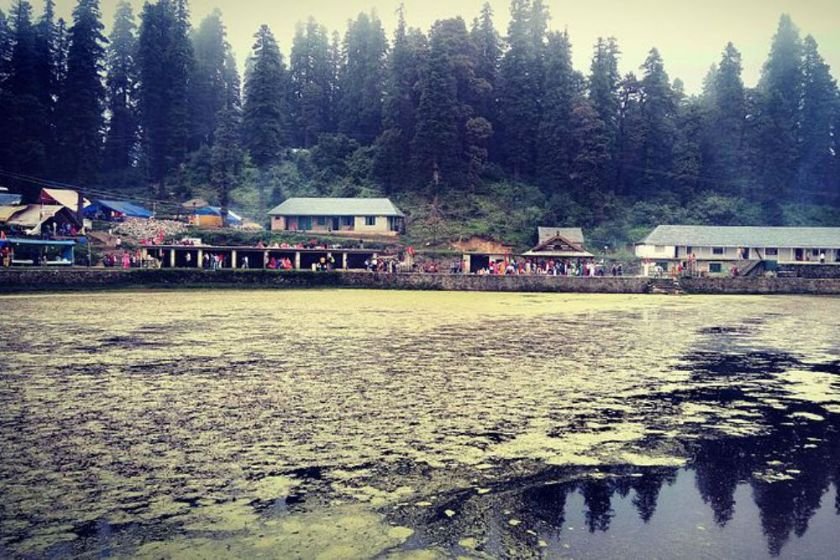
The lake itself carries the temple’s most distinctive devotional practice. Rather than being deposited with temple authorities or a bank, offerings of gold, silver, coins, and currency notes are thrown directly into Kamrunag Lake, where they remain — by long-standing local belief, never retrieved by anyone, ever. The lake is popularly said to connect to Patal Lok, the netherworld, making its accumulated wealth the treasure of the gods rather than anything a mortal could reasonably lay claim to; a guardian Nag (serpent deity) is credited with visiting misfortune on anyone who tries. No priest resides at the temple year-round — worship and mediation with the deity happen primarily during the annual fair, when a priest serves as a channel for the Nag Devta on Kamrunag’s behalf.
🏛️ The Temple Itself
Physically, Kamrunag’s temple is modest and unassuming relative to the scale of devotion it draws — a small, pent-roofed wooden structure in the hill style typical of Mandi’s higher-altitude shrines, standing directly beside the lake rather than at any remove from it. At least one source describes the current structure as having been renovated in 1963, though this detail appears in only a single account and shouldn’t be taken as a settled fact about the building’s full history.
The setting does far more of the work here than any architectural detail. Deodar forest presses close around both temple and lake, opening onto genuinely spectacular views across the Balh Valley and toward the Dhauladhar range on clear days. The lake itself, small and still against that dense green backdrop, freezes over completely in winter, adding a further layer of stark, seasonal drama to a site that’s already remote enough to feel genuinely apart from the rest of Himachal’s more accessible temple circuit. Visitors during the June mela describe the water’s surface dotted with floating currency notes and glinting coins — an image striking enough that it’s become the single most repeated detail in nearly every account of the temple.
📜 Mandi’s Yaksha and Naga Traditions
Kamrunag’s story of Yakshas — wealth-associated semi-divine beings said to have once inhabited this region — and its Nag (serpent deity) guardianship both tie the temple into a broader, older layer of Himachal folk religion that predates and runs alongside its more visible Hindu epic framing. This dual identity, part Mahabharata legend and part older regional Yaksha-Naga tradition, is fairly typical of Mandi district’s high-altitude shrines, several of which — Shikari Devi among them — carry similarly layered stories that blend classical Sanskrit epic material with older, more local devotional frameworks specific to these mountains.
🎉 Festivals and Devotion
- Kamrunag Mela (June 14–15): The temple’s overwhelmingly dominant annual event, a three-day fair drawing thousands of pilgrims who trek up specifically for this window, when Kamrunag Dev is believed to give darshan directly.
- Devta processions: Local deities from surrounding villages are brought to the lake during the fair as part of the wider regional celebration.
- Off-season worship: Limited, given the lack of a resident priest outside the fair period and the area’s inaccessibility for much of the year.
🏞️ While You’re in the Area
- Shikari Devi Temple: A roofless Shakti shrine at the highest point in Mandi district, connected to Kamrunag by a well-known trekking route.
- Rohanda village: The practical starting point for most treks up to Kamrunag, useful for arranging guides and supplies.
- Jalpa Mata Temple, Saroa: Another remote Seraj-region shrine, reachable via the same general network of Chail Chowk-area roads.
- Magru Mahadev Temple, Chhattri: A richly carved wooden Shiva temple further into the Seraj/Thunag area.
- Parashar Lake: A sacred high-altitude lake with its own temple and a floating island, elsewhere in Mandi district’s trekking circuit.
❓ Quick Questions Travellers Ask
Is the trek to Kamrunag suitable for beginners? It’s described as moderately challenging by most accounts — manageable for a reasonably fit beginner with some preparation, but genuinely steep in places, and best avoided by anyone with significant health concerns.
Is it really true no one has ever removed anything from the lake? That’s the strong and consistent local belief, reinforced by a guardian-serpent tradition said to punish anyone who tries; it’s presented here as devotional tradition rather than something independently verifiable.
Who exactly was Kamrunag — is he the same figure as Khatu Shyam Ji? Sources genuinely disagree. Some identify him directly with Barbarik/Khatu Shyam Ji, a figure more famously associated with a major shrine in Rajasthan; others describe a distinct Yaksha warrior tied to Bhima without that specific identification. Both traditions agree he witnessed the entire Mahabharata war.
When is the best single time to visit if I can only go once? The June 14–15 mela is the temple’s defining moment and worth planning around if you want to see the site at its most alive, though it also means trekking alongside the year’s largest crowds.
Is there an entry fee? No entry fee could be confirmed for this article; as a remote, seasonally staffed pilgrimage site, general darshan is very likely free.
A Last Word
There’s a particular kind of faith required to walk hours up a mountain carrying your savings, and then walk back down without them — no receipt, no ledger, nothing but the shared, centuries-old confidence that the lake will hold what’s given to it and that no one, ever, will try to take it back. Whatever you make of Kamrunag’s tangled origin story — warrior, sacrifice, or wandering Yaksha who simply loved this particular hillside enough to stay — that’s the detail that lingers longest: a fortune sitting quietly at the bottom of a small alpine lake, protected by nothing but belief, for as long as anyone can remember.
Fact-check note: The temple’s location on Kamru Hill near Rohanda in Mandi district, its dedication to Kamrunag as rain deity, its Kamrunag Mela (June 14–15), and its treasure-lake offering tradition are well corroborated across independent sources. Genuinely unsettled and flagged above rather than resolved with false precision: Kamrunag’s precise mythological identity (Barbarik/Khatu Shyam Ji vs. a distinct Yaksha warrior tied to Bhima), and reported distances to Rohanda, Bhuntar Airport, and Joginder Nagar railway station, all of which vary substantially across sources. A 1963 renovation date for the current temple structure appears in only one source and hasn’t been independently cross-verified. No entry fee could be confirmed.