Sacked by invaders at least five times, converted into a mosque, torn down again by a sultan, and finally flattened by an earthquake — and still, after every single collapse, rebuilt on the exact same spot.
Most sacred sites earn their reputation through continuity — an unbroken line of worship stretching back centuries. Brajeshwari Devi Temple in Kangra has something almost the opposite: a history so repeatedly interrupted by violence and disaster that its survival feels less like continuity and more like sheer stubbornness. This is one of India’s fifty-one Shakti Peeths, the network of shrines said to mark where fragments of the goddess Sati’s body fell to earth, and for much of its history it was also one of the wealthiest temples in North India — gold, silver, and precious stones accumulated over centuries of devotion, which made it an irresistible target for exactly the kind of conquerors who leave nothing standing. What’s remarkable isn’t that Brajeshwari was attacked. It’s that every single time, someone came back and rebuilt it.
🌄 Location & How to Reach It
Brajeshwari Devi Temple sits in Kangra town (historically known as Nagarkot), Kangra district, Himachal Pradesh, close to Kangra Fort, at an elevation of roughly 738 metres.
Google Maps: Get Directions
The temple sits right in Kangra town itself, making it one of the more centrally located and easily reached major temples in the district — no hill climb or remote approach involved.
- By road: The temple lies just over 1 km from the Kangra bus stand, directly on National Highway 88 (the Shimla–Kangra route); it’s roughly 20 km from Dharamshala and around 220 km from Chandigarh, with HRTC and private buses connecting Kangra to major regional cities.
- By rail: Both Kangra Mandir and Kangra railway stations are close by, around 3 km from the temple.
- By air: Kangra (Gaggal) Airport is the nearest, only about 9 km away — one of the shorter airport transfers among Kangra’s major temples.
Given its in-town location on a national highway, Brajeshwari is one of the easiest of Kangra’s major shrines to fold into a single day’s temple circuit alongside Kangra Fort, which sits nearby.
🌸 Best Time to Visit
Navratri — celebrated in both its spring (Chaitra) and autumn (Sharada) forms — is by far the temple’s most significant occasion, marked by nine nights of recitation, music, and fasting that build toward Kanya Pujan on the final day. Makar Sankranti, in mid-January, brings a distinctive week-long ritual of its own: the deity is anointed with ghee and then ceremonially washed with a hundred buckets of cold water, commemorating a legend in which the goddess was wounded while battling the demon Mahishasura and healed by an application of ghee. October through March generally offers the most comfortable weather for a visit to Kangra town.
🕉️ The Legend: A Body Divided, A Grief That Made the World Shake
Brajeshwari’s sanctity traces back to one of Shaktism’s foundational stories. According to the legend, Sati — daughter of King Daksha and the wife of Shiva — immolated herself after her father deliberately insulted her husband by excluding him from a great yagna. Grief-stricken and enraged, Shiva lifted her body and began the Tandava, his dance of cosmic destruction, with a fury so total that the gods feared it would unmake creation itself. To stop him, Vishnu used his Sudarshana Chakra to cut Sati’s body into fifty-one pieces, each of which fell to a different location across the subcontinent — and each of those sites became a Shakti Peeth, a place where the goddess’s power is believed to remain permanently anchored in the earth. At Kangra, tradition holds that Sati’s left breast fell at the exact spot where the temple now stands — though it’s worth noting that at least one source describes this as her right breast instead, a small but genuine inconsistency across otherwise similar retellings of the same legend.
A second, distinctly Himalayan layer of the story ties the temple to the Mahabharata. According to this account, the Pandavas received a vision of Goddess Durga during their exile, instructing them to build a temple to her in Nagarkot — the old name for Kangra — for protection and eventual victory in the great war to come. They are said to have built the temple that very night, cementing the site’s association with divine protection granted directly to the epic’s heroes. The goddess’s specific name here, Vajreshwari (from which “Brajeshwari” and “Bajreshwari” derive), refers to a further, separate legend: that she once slew a demon named Kalikala using a divine thunderbolt, or vajra — giving her the title “goddess of the thunderbolt” still used today. Interestingly, this isn’t purely a folk name — ancient tantric texts independently corroborate the site’s antiquity and identity: the Jnanarnava Tantra refers to this Shakti Peeth as “Bhrigupuri,” while the Brihad Nila Tantra names its goddess directly as “Brajeshwari,” giving the temple’s core legend genuine textual roots rather than leaving it as purely oral tradition.
The temple’s more recent, documented history reads almost like a list of survivals. Mahmud of Ghazni plundered the temple repeatedly beginning in 1009 CE — sources describe at least five separate raids — reportedly converting it into a mosque and stationing a garrison there for roughly 35 years before local rulers regained control and restored it. Firoz Shah Tughlaq destroyed it again in 1360. It was later rebuilt under Mughal emperor Akbar, with his finance minister Todar Mal personally overseeing the restoration. At least one source also mentions a 15th-century raid by Sikander Lodhi, though this detail doesn’t appear across the wider set of sources consulted and should be treated as a less certain addition to an otherwise well-corroborated pattern of repeated destruction and rebuilding. The temple’s final major blow came from the catastrophic 1905 Kangra earthquake, which flattened it completely, as it did much of the surrounding region; sources disagree on exactly how quickly it was rebuilt afterward, with some describing reconstruction the very same year through the Kangra Restoration Committee, and at least one other citing 1920 as the completion date.
🙏 What Brajeshwari Devi Is Known For
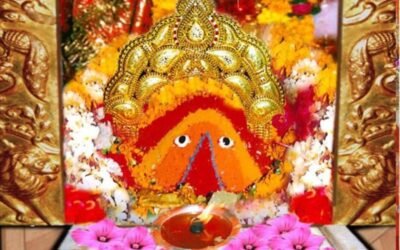
Brajeshwari is worshipped as a fierce form of Durga, embodying the maternal, protective, and formidable qualities associated with Shakti Peeth goddesses generally. In the inner sanctum, the deity is present in the form of a Pindi — a natural stone representation rather than a carved anthropomorphic image — a form common to several of India’s oldest Devi shrines and generally understood to predate the more elaborate iconographic traditions that developed later.
Pilgrims come here seeking the specific blessings associated with Shakti Peeths broadly — protection, maternal grace, and a sense of connection to one of the subcontinent’s most sacred, ancient devotional networks — as well as, more specifically, healing and renewal, reflected directly in the Makar Sankranti ghee ritual. A temple to Bhairava stands within the complex, understood in Shakti Peeth tradition as Shiva’s own fierce form and, by extension, the consort presiding alongside the goddess at each of the fifty-one Peeth sites; a smaller shrine to Dhyanu Bhagat, a historical devotee associated with the temple, is also noted at the site by at least one source. During Navratri, tantric rituals are occasionally performed here by ascetic groups, a practice tied to the Shakti Peeth tradition’s roots in tantric as well as devotional worship.
🏛️ The Temple Itself
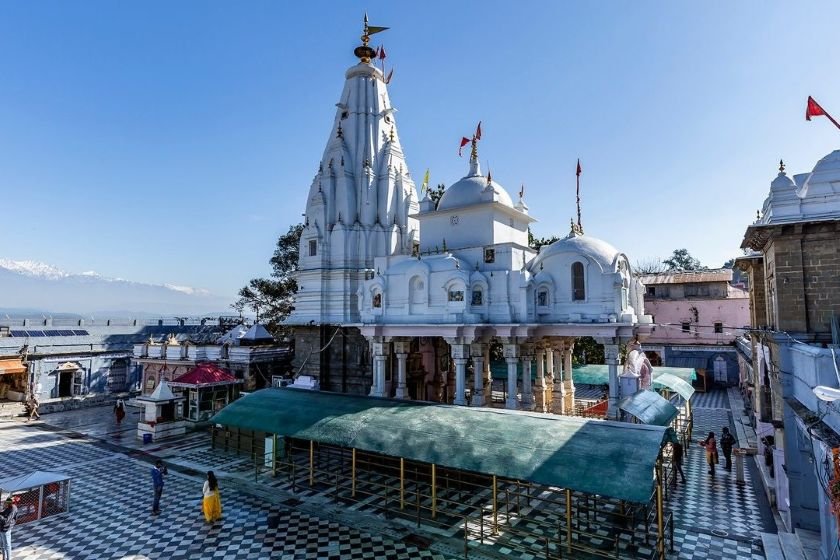
The temple complex follows a regional Nagara architectural idiom, with a sanctum (garbhagriha), vestibule (antarala), and assembly hall (mandapa) enclosed within fortified precincts — a layout that echoes Kangra’s broader historical identity as a heavily defended, frequently contested valley. Robust enclosure walls and gateways surround the complex, with a circumambulatory path allowing devotees to walk the sanctum’s perimeter as part of ritual practice. What stands today is, necessarily, largely a 20th-century reconstruction rather than an unbroken original structure, given the temple’s repeated destruction — but the site’s continuous re-consecration on the same ground across roughly a millennium is itself part of what visitors describe as giving the place its distinctive, weighted atmosphere. One frequently repeated, if hard to independently verify, claim holds that the temple is visible from the control tower at Gaggal Airport — a detail that speaks more to local pride in the shrine’s prominence than to anything easily confirmed from outside the region.
📜 Kangra’s Layered History of Conquest and Devotion
Brajeshwari’s history is, in many ways, a condensed version of Kangra Valley’s broader story: a region wealthy and sacred enough to draw the attention of Ghaznavid raiders, Delhi Sultanate armies, and Mughal emperors in turn, each leaving their mark on the valley’s temples, forts, and towns. Its proximity to Kangra Fort — itself besieged repeatedly across the same centuries — underlines how closely this temple’s fate has always been tied to the fort’s, both of them repeatedly fought over, damaged, and restored across nearly a thousand years of shifting regional power. Maharaja Sansar Chand Katoch’s later rule over Kangra, well known for its patronage of the Kangra school of miniature painting, belongs to this same broader story of a valley that has continuously rebuilt its religious and artistic identity even through repeated upheaval.
🎉 Festivals and Devotion
- Navratri (Chaitra and Sharada): The temple’s principal festival period, with nine nights of ritual recitation, music, and fasting culminating in Kanya Pujan.
- Makar Sankranti: A distinctive week-long observance featuring the ghee-anointment and hundred-bucket cold water ritual, commemorating the goddess’s mythic healing after battle.
- Occasional tantric rites: Performed by ascetic groups during major festival periods, reflecting the site’s roots in both devotional and tantric Shakti worship.
🏞️ While You’re in the Area
- Kangra Fort: Just nearby, one of the largest and oldest forts in India, with its own ancient Ambika Devi shrine.
- Chamunda Devi Temple: Roughly 16 km away, another major Shakti shrine in the Kangra Valley, uniquely paired with Shiva worship.
- Masroor Rock Cut Temple: A monolithic 8th-century complex elsewhere in the district, part of a broader Kangra temple circuit.
- Baglamukhi Temple, Bankhandi: A tantric Shakti shrine with a very different devotional focus, further along the valley.
- Dharamshala and McLeodGanj: About 20 km away, offering a Tibetan-influenced contrast to Kangra town’s older Hindu pilgrimage character.
❓ Quick Questions Travellers Ask
Is this the same temple sometimes called Nagarkot Mata Mandir or Vajreshwari Devi Temple? Yes — Brajeshwari, Bajreshwari, Vajreshwari, and Nagarkot Mata Mandir all refer to the same shrine; the variation reflects different transliterations and historical names for both the goddess and the town (Kangra was formerly known as Nagarkot).
How much of the current structure is original? Very little in the strictest sense — given the temple’s repeated destruction by invaders and, finally, the 1905 earthquake, most of what stands today reflects 20th-century reconstruction on a site whose sanctity, in the tradition’s own terms, doesn’t depend on any particular physical structure surviving.
Is there an entry fee? No entry fee could be confirmed for this article; as an active, publicly worshipped Shakti Peeth rather than a ticketed monument, general darshan is very likely free, though it’s worth confirming locally.
How crowded does the temple get during Navratri? Very — as one of Himachal’s most significant Shakti Peeths, Navratri here draws large numbers of pilgrims, so visitors seeking a quieter darshan may prefer visiting outside the festival period.
Can non-Hindu visitors or those primarily interested in history visit the temple? Yes — the temple welcomes visitors of all backgrounds, and its dense historical layering (Ghaznavid raids, Mughal restoration, tantric textual references, the 1905 earthquake) makes it of genuine interest well beyond purely devotional visitors.
A Last Word
There’s a particular kind of resilience that doesn’t come from being left alone, but from being destroyed and rebuilt so many times that the destruction itself becomes part of the story. Brajeshwari’s sanctity was never really housed in any single structure — Ghazni could burn it, Tughlaq could tear it down, an earthquake could flatten it completely, and each time, the ground itself remained sacred enough that someone came back to build again. That’s arguably the most honest thing a Shakti Peeth can demonstrate: that the goddess’s presence, in this tradition, was never really about the stone at all.
Fact-check note: The temple’s status as one of the 51 Shakti Peeths, its identification with Sati’s breast, its Vajreshwari/thunderbolt naming legend, the historically documented raids by Mahmud of Ghazni (1009 onward) and Firoz Shah Tughlaq (1360), its restoration under Akbar and Todar Mal, and its destruction in the 1905 Kangra earthquake are well corroborated across independent government, encyclopedic, and historical sources, including references in the Jnanarnava and Brihad Nila Tantras. Genuinely unsettled and flagged above rather than resolved with false precision: whether Sati’s left or right breast fell here (sources differ), the exact year of post-1905 reconstruction (accounts range from the same year to 1920), and a reported 15th-century raid by Sikander Lodhi, which appears in only one consulted source. The claim that the temple is visible from Gaggal Airport’s control tower could not be independently verified. No entry fee could be confirmed.