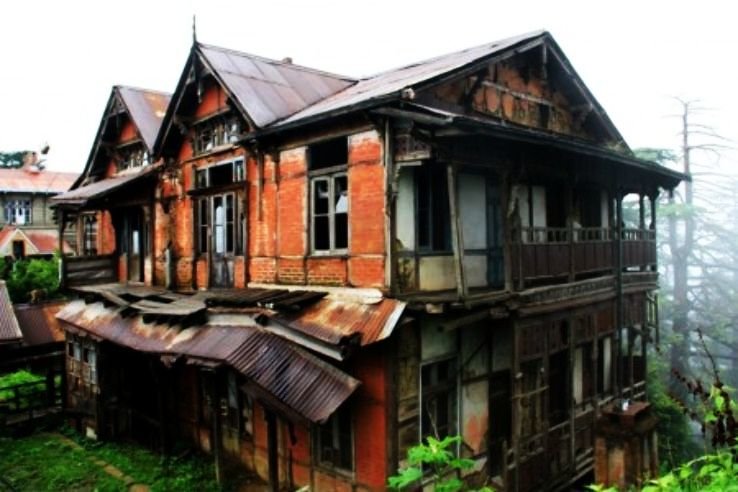
The mansion stands behind a boundary wall, separated from the road by an old gate and a garden that has grown around decades of silence.
Its steep roofs, timber-framed windows and weathered verandas belong to the Shimla of another age—a hill station of British officials, summer residences and forest roads that disappeared into mist after sunset.
During the day, Charleville Mansion looks like an ageing colonial home.
At night, the windows become black.
The upper rooms disappear beneath the roofline, and every movement of the trees creates a shadow across the walls.
The mansion’s best-known story begins with one of those upper rooms.
A British railway official heard that something violent lived inside the house. Rather than accept the rumours, he decided to test them.
He placed furniture inside the room.
He locked the door.
By morning, the room had been destroyed.
Chairs lay overturned. Objects had been thrown across the floor. The locked door showed no sign that anyone had entered.
According to the legend, the family left Charleville soon afterwards.
No reliable evidence proves that a poltergeist haunted the mansion. The story survives through colonial folklore and repeated travel accounts rather than a complete historical record.
Yet among Shimla’s many ghost stories, Charleville remains different.
Its spirit is not described as a silent figure seen at a window.
It is something that moves furniture, strikes walls and becomes most violent when someone challenges it.
Charleville Mansion at a Glance
| Detail | Information |
|---|---|
| Location | Shimla, Himachal Pradesh |
| Type of place | Colonial-era private residence |
| Architectural character | Victorian hill-station mansion |
| Famous resident | British railway official Victor Bayley |
| Main haunted story | A locked upper room found violently disturbed |
| Type of haunting | Poltergeist activity |
| Present status | Renovated private residence |
| Public access | Not open as a regular tourist attraction |
| Important rule | Do not trespass or disturb residents |
The House the Bayleys Chose
In 1913, British railway official Victor Bayley was posted to Shimla as an Assistant Secretary to the Railway Board.
Bayley and his wife began searching for a suitable home in the hill station. Charleville Mansion attracted them because of its location, spacious rooms and comparatively affordable rent.
The house appeared ideal.
It stood away from the busiest parts of town, surrounded by trees and open mountain air. Its large rooms, wooden details and broad verandas offered the kind of summer residence sought by British officials working in Shimla.
But people familiar with the property reportedly warned the couple.
The mansion had a reputation.
Previous occupants were said to have heard violent noises from empty rooms. Doors opened without explanation. Furniture appeared to move, and something seemed to pass through the house after everyone had gone to bed.
Bayley did not immediately accept the stories.
Old houses produced sounds.
Wood shifted in the cold.
Wind moved through chimneys and loose window frames.
He wanted proof.
The mansion would give him something much harder to explain.
The Locked Room
The most famous Charleville legend centres on an upper room where the strange activity was believed to be strongest.
Bayley decided to test the story.
Before retiring for the night, he inspected the room. Furniture and ordinary household objects were left inside.
The windows were closed.
The room was locked from the outside.
No servant or member of the household was supposed to enter.
During the night, noises reportedly came from the upper floor.
Heavy objects struck the walls.
Something crashed against the floor.
The disturbance continued as though several people were fighting inside the room.
No one opened the door.
By morning, the house had become quiet.
Bayley returned with the key.
The door was still locked.
Inside, the room had been violently disturbed.
Furniture was overturned. Objects lay scattered across the floor, and household items appeared to have been thrown against the walls.
There was no person inside.
The windows remained secured.
No simple point of entry could be found.
The test had been designed to disprove the haunting.
Instead, it became the central evidence used to support it.
The Thing That Did Not Like Being Challenged
Poltergeist stories differ from ordinary ghost legends.
A traditional apparition may be seen walking through a corridor or standing beside a window. It often repeats the same movement without directly interacting with the living.
A poltergeist is described through physical disturbance.
Doors slam.
Furniture moves.
Objects fall or are thrown.
Walls shake even when no one is touching them.
At Charleville Mansion, the supposed presence appeared to respond aggressively when its room was deliberately locked.
In some versions of the legend, the entity had already tolerated the household before Bayley’s test. It became violent only after he challenged it.
That detail transformed the story.
The haunting was no longer an old sound caused by the building.
Something inside the mansion appeared to understand that it was being tested.
And it answered.
The Family Leaves Charleville
According to the legend, the locked-room incident convinced Victor Bayley and his wife that the mansion’s reputation was more than superstition.
They did not remain at Charleville for long.
Some versions say they left immediately. Others claim they continued living there briefly before the disturbances became impossible to tolerate.
Historical accounts confirm that the Bayleys occupied the mansion during the period around 1913, but the exact length of their stay and the reason they left are not documented consistently.
They may simply have moved at the end of Shimla’s summer season.
The dramatic departure belongs mainly to the ghost story.
Still, the image has endured:
A family arrives believing they have found an ideal home.
An upper room is locked.
Something destroys it from within.
The family abandons the mansion.
The Officer Who Lived There Before
Several retellings claim that a British army officer occupied Charleville before the Bayleys.
He too was said to have experienced unexplained activity inside the house.
One story describes the officer hearing heavy footsteps moving through empty rooms. Another says doors opened after being bolted and furniture changed position during the night.
Some versions attach a name to the supposed spirit, including that of an officer who died under mysterious circumstances. These identities vary between sources and are not supported by a consistent historical record.
The most credible approach is therefore to avoid naming a particular dead officer as the confirmed ghost.
Charleville’s haunting is best understood as an unidentified poltergeist legend.
The story does not clearly explain who the spirit was.
It explains only what it supposedly did.
The Night the Furniture Moved Again
Later versions of the Charleville legend describe another occupant attempting to use the mansion after the Bayleys had gone.
The new resident did not believe the stories.
For several nights, nothing happened.
Then came a sound from an empty room.
A chair scraped across the floor.
The person entered and found everything in place.
A few minutes later, the sound returned.
This time it was followed by a heavy impact against the wall.
When the door was opened again, the chair stood in the centre of the room.
No one had moved it.
The story continues with furniture changing position night after night. Objects disappeared and reappeared elsewhere. A door repeatedly opened despite being closed and secured.
Eventually, this resident also left.
There is no dependable documentation identifying the person or confirming the incidents. The account appears to be a later addition to the mansion’s folklore.
But it strengthened Charleville’s reputation as a house that rejected its occupants.
The Sound in the Walls
Not every story from the mansion involves visible destruction.
Some accounts speak of knocking sounds from inside the walls.
The sound begins in one part of the house and moves slowly through the rooms.
Three knocks.
A pause.
Then three more from another wall.
People search for pipes, animals or loose timber but find nothing obvious.
The knocking continues until someone speaks or approaches the wall.
Then it stops.
Later that night, it begins beside a bedroom.
Old houses frequently produce unexplained knocks. Timber contracts when the temperature falls. Pipes shift, roof sheets move, and animals enter wall spaces or attics.
Yet ordinary building sounds tend to be irregular.
A repeated knock feels deliberate.
When it seems to move through the house, it begins to feel like communication.
The Figure Behind the Window
Although Charleville is mainly known for poltergeist activity, later stories also mention a figure watching from an upper window.
The figure is seen from outside, standing behind the glass after the room has become dark.
It appears tall and motionless.
No features can be identified.
When someone inside checks the room, it is empty.
The curtains are still.
The window is locked.
This story may have developed from the mansion’s appearance. Its upper windows, timber divisions and roof shadows can easily resemble a person when viewed from a distance.
Reflections from trees and changing daylight add to the illusion.
But once a house is believed to be haunted, an empty window never looks completely empty.
A Mansion Built for Colonial Shimla
Charleville Mansion belongs to Shimla’s colonial architectural landscape. Its pitched roofs, broad verandas, decorative timberwork and stone construction reflect the residential style developed for the hill station’s climate.
British officials moved to Shimla during summer when the town functioned as the seasonal administrative capital of British India.
Large houses were built along forested slopes, away from the crowded bazaar areas. They offered privacy, views and cooler temperatures, but their isolation also created the conditions in which ghost stories flourished.
A house could stand only a short distance from another residence yet remain hidden behind trees.
After dark, roads had little lighting.
Mist covered familiar landmarks.
Servants and residents heard animals, wind and falling branches without seeing what caused them.
In such surroundings, an unexplained sound inside a house easily became something supernatural.
The House After Independence
After the British period, Charleville passed into private ownership.
For many years, accounts described the mansion as neglected, largely unused or deteriorating. Its empty appearance strengthened its haunted reputation, and photographs of the ageing structure circulated through travel articles and paranormal lists.
More recent accounts describe the property as renovated and privately occupied.
It should therefore not be presented as an abandoned house open for exploration.
Whatever its condition may appear to be from old photographs, Charleville Mansion is private property.
The ghost story belongs to public folklore.
The building itself does not belong to ghost hunters.
What People Reportedly Experience
Accounts connected with Charleville Mansion commonly mention:
- furniture moving inside locked rooms;
- objects thrown or scattered without an obvious cause;
- doors opening after being secured;
- heavy footsteps in empty upper passages;
- repeated knocks from inside walls;
- windows and shutters moving without visible contact;
- a dark figure standing behind upper-floor glass;
- sudden coldness inside particular rooms;
- the feeling of being watched from another part of the house.
None of these experiences has been independently verified as paranormal.
The most famous account—the locked room disturbed during Victor Bayley’s stay—survives mainly through repeated retellings rather than a surviving official report written at the time.
Why Charleville Feels Haunted
Charleville Mansion contains the architectural features that make old houses seem alive.
Timber beams contract when the temperature changes. Floorboards creak even when no one walks across them. Roof sheets and window frames move in strong mountain wind.
Chimneys and wall cavities carry sounds between rooms.
Air pressure can cause doors to open or slam, particularly in a house with several windows, passages and levels.
Animals may enter attics, roof spaces or unused sections.
Reflections can create figures behind glass when the interior is dark.
Human expectation adds the final layer.
Once a person knows the locked-room story, every sound becomes part of the same haunting.
A moving chair is not blamed on an uneven floor.
A slammed door is not blamed on the wind.
The mansion has already supplied another explanation.
Was the Locked-Room Story Proven?
No surviving evidence available to the public conclusively proves that a locked room at Charleville Mansion was destroyed by a paranormal force.
Modern versions of the story repeat broadly similar details, but they often differ about the date, room, damage and sequence of events.
It is possible that an unexplained disturbance occurred and grew more dramatic through retelling.
It is also possible that the story began as local folklore attached to an imposing colonial residence.
What gives the legend strength is its association with Victor Bayley, a real British railway official who lived in Shimla during the period.
The historical person anchors the supernatural story.
The haunting itself remains unverified.
Can Charleville Mansion Be Visited?
Charleville Mansion is a private residence and should not be treated as a public tourist attraction.
Visitors must not enter its grounds, climb the gate, photograph through windows or disturb the occupants.
Do not rely on unofficial map pins or directions shared by paranormal channels. Publishing an exact private address may encourage trespassing and should be avoided.
The mansion can be discussed as part of Shimla’s colonial folklore, but responsible interest must stop at the property boundary.
No haunted story gives anyone the right to enter another person’s home.
Exploring Shimla’s Haunted Heritage Responsibly
Travellers interested in Shimla’s dark colonial atmosphere can visit public heritage areas instead of searching for private houses.
Suitable places include:
- The Ridge;
- Christ Church;
- Gaiety Theatre;
- Viceregal Lodge;
- Chaura Maidan;
- Annandale;
- publicly accessible heritage walks;
- forest roads and viewpoints where entry is legally permitted.
These places help visitors understand why Shimla produced so many mansion, tunnel and roadside legends.
The city combines old architecture, steep forested slopes, rapid weather changes and a long colonial history.
A ghost story feels at home here before it has even been told.
How to Reach Shimla
By Road
Shimla is connected with Chandigarh, Kalka, Solan, Delhi and other parts of Himachal Pradesh by road.
Approximate distances include:
- Solan: around 45 kilometres;
- Chandigarh: around 115 kilometres;
- Kalka: around 90 kilometres;
- Delhi: around 340 kilometres.
Traffic restrictions, one-way systems and limited parking are common within Shimla. Follow current traffic directions and use designated parking areas.
By Train
Shimla railway station is connected with Kalka by the UNESCO-listed narrow-gauge railway.
Kalka has broader rail connections with Chandigarh, Delhi and other cities.
By Air
Shimla Airport at Jubbarhatti is the nearest airport, although services are limited and weather-dependent.
Chandigarh Airport offers more regular connectivity, followed by a road journey to Shimla.
Best Time to Explore Shimla’s Colonial Heritage
March to June and September to November generally provide comfortable weather for heritage walks and sightseeing.
The monsoon creates dramatic mist but may also bring slippery roads, low visibility and landslide disruption.
Winter can transform Shimla with snow, but ice and freezing temperatures may make walking and driving difficult.
Private properties such as Charleville Mansion should not be approached for sightseeing at any time of year.
Responsible Visiting
Anyone interested in the Charleville legend should follow these rules:
- do not enter private property;
- never climb gates or boundary walls;
- avoid photographing residents or windows;
- do not attempt night-time exploration;
- never stage ghost videos near the house;
- avoid sharing unverified private addresses;
- do not question or disturb neighbouring residents;
- follow local traffic and security restrictions;
- treat the story as folklore rather than proof;
- explore only legally accessible public heritage sites.
The mansion’s present occupants are not part of the legend and deserve privacy.
Is Charleville Mansion Really Haunted?
There is no verified evidence proving that Charleville Mansion is haunted.
Its reputation rests on the story of Victor Bayley, the destroyed locked room and later accounts of moving furniture, footsteps and unexplained knocking.
Natural causes involving timber movement, wind, animals, uneven floors and acoustic effects may explain many incidents associated with an old mountain house.
The central legend remains difficult to confirm because no complete contemporary report is publicly available.
Yet Charleville continues to fascinate because its story gives the haunting a physical force.
The spirit does not merely appear.
It reacts.
It moves objects.
It destroys a room.
And when someone locks the door, it proves that locks mean nothing.
Frequently Asked Questions
Where is Charleville Mansion located?
Charleville Mansion is a colonial-era private residence in Shimla, Himachal Pradesh. Its exact private location should not be used for unauthorised visits.
Why is Charleville Mansion considered haunted?
Its reputation comes mainly from a story in which British railway official Victor Bayley locked an upper room, only to find it violently disturbed the next morning.
Who was Victor Bayley?
Victor Bayley was a British railway official posted to Shimla in 1913 and associated with the mansion’s best-known ghost legend.
What type of ghost is said to haunt the house?
The reported activity resembles a poltergeist—an unseen presence believed to move furniture, throw objects and create violent disturbances.
Is the mansion abandoned?
No. Current accounts describe it as renovated private property. It should not be treated as an abandoned building.
Can tourists enter Charleville Mansion?
No public access should be assumed. Visitors must not trespass or disturb the occupants.
Was anyone killed inside the mansion?
Different stories attach deaths or British officers to the haunting, but no consistent, dependable historical record confirms a particular victim as the ghost.
Is the locked-room incident proven?
No. The story is widely repeated but has not been conclusively verified through publicly available contemporary documentation.
Do Not Lock the Door
The upper room is empty.
A chair stands beside the wall.
The windows are closed.
Before leaving, the man turns the key and tests the handle.
No one can enter.
During the night, something crashes above.
Furniture drags across the floor.
A heavy object strikes the wall.
No one opens the room.
At sunrise, the noise has stopped.
The key turns.
The door opens.
The chair lies broken in the centre of the floor. Tables have overturned, and objects are scattered across the room.
The windows remain closed.
There are no footprints.
No intruder.
Only the marks left by something that did not need a door.
Charleville Mansion gave its warning more than a century ago.
The room had never been empty.