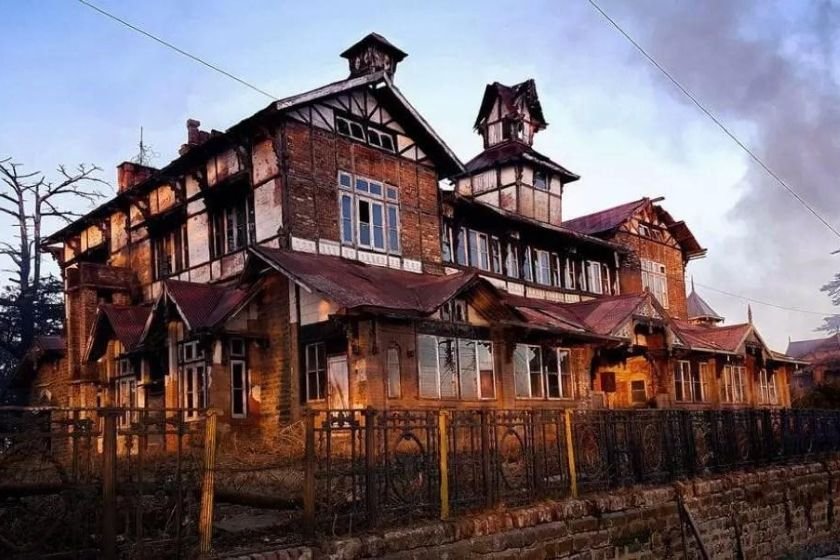
The bungalow once belonged to another Shimla.
A quieter town of forest roads, horse-drawn carriages, evening gatherings and British officers escaping the summer heat of the plains.
During the day, Dukhani was remembered as an elegant colonial residence surrounded by mountain air and tall trees. Guests arrived for weekend parties, conversations continued late into the evening, and warm light shone through the windows.
But one room carried a darker memory.
According to the legend, an elderly Englishman had died there after shooting himself while dressed in a white sleeping gown.
Years later, a guest staying in the same room reportedly woke during the night and saw an old man standing near the bed.
The figure wore white.
He did not speak.
He walked towards the window and disappeared.
The experience became the foundation of one of Shimla’s best-known colonial ghost stories.
No reliable evidence proves that the House of Dukhani is haunted, and many details of its history remain uncertain. Yet unlike legends built around dozens of dramatic apparitions, the story of Dukhani survives through one quiet encounter.
An old room.
A silent figure.
And a man who appeared to repeat the final moments of a life that ended inside the house.
House of Dukhani at a Glance
| Detail | Information |
|---|---|
| Location | Traditionally associated with the Chharabra side of Shimla |
| Type of place | Former colonial-era private residence |
| Haunted character | An elderly man in a white gown |
| Central legend | A guest reportedly saw the figure of a man who had died in the same room |
| Present status | Private or restricted property; public access should not be assumed |
| Best way to experience the story | Through Shimla’s colonial folklore, not unauthorised exploration |
| Important rule | Do not trespass or disturb residents |
The Night at Dukhani
The best-known version of the story begins when Dukhani was owned or occupied by a British man remembered in later accounts as Buck or Bucky.
The bungalow was known for occasional weekend gatherings. Guests travelled to the house to escape official routines and spend time in Shimla’s cooler hills.
Among the visitors was a man later identified in popular retellings as Sir John Smith.
On one occasion, he and his wife stayed overnight at Dukhani.
The room assigned to them appeared ordinary. It contained the expected furniture, a bed and a window looking towards the dark hillside beyond the house.
Nothing happened while the household remained awake.
The disturbance began after midnight.
Sir John woke suddenly.
The room was cold and quiet. His wife remained asleep beside him.
An elderly man stood inside the room.
The figure wore a loose white gown.
At first, Sir John may have assumed that another guest had entered by mistake. But the stranger did not acknowledge him or explain why he was there.
He moved slowly across the room.
There was no hurry in his steps.
No anger.
No sound.
The old man approached the window and disappeared.
He did not open it.
He did not pass through a door.
One moment, the white figure was present.
The next, there was only darkness beyond the glass.
The Secret of the Room
The following morning, Sir John reportedly described what he had seen.
Only then was he told the story connected with the room.
An elderly Englishman was said to have died there years earlier after shooting himself while wearing a white gown similar to the clothing seen on the apparition.
Whether this death was supported by an official record is unclear. The identity of the man, the date of the incident and the exact circumstances are rarely provided in modern accounts.
The story survives mainly through repetition.
Yet this missing information makes the legend more unsettling.
There is no grave that visitors are directed towards.
No portrait identifying the figure.
No complete biography explaining his despair.
Only the claim that a man died in the room—and later returned to it.
The Figure Did Not Attack
The Dukhani apparition is usually described as quiet rather than violent.
The old man does not chase visitors.
He does not scream.
He does not throw objects or leave visible marks.
He simply appears.
He walks towards the window.
Then he vanishes.
This restraint gives the story much of its power.
A violent ghost can be dismissed as dramatic folklore. A silent figure repeating one short movement feels closer to memory.
Perhaps the apparition was unaware of the guest watching from the bed.
Perhaps it was not trying to frighten anyone.
Perhaps the figure was only repeating something that had already happened many years earlier.
The room may not have been a place the old man chose to haunt.
It may have been the last place he remembered.
A House of Weekend Gatherings
Before its haunted reputation took hold, Dukhani was remembered as a beautiful residence and a social gathering place.
Shimla during the British period contained many such bungalows. Officials and their families moved into the hills during the warmer months, bringing formal routines, private clubs and weekend entertainment with them.
A house like Dukhani would have experienced two very different identities.
During gatherings, it would have been filled with conversation, music, food and movement.
After the guests left, the same rooms would have returned to silence.
This contrast is central to the haunted story.
A staircase used by laughing guests becomes unsettling after midnight.
A window that offers a mountain view during the day becomes a black surface reflecting the room at night.
A white gown moving through a crowded house would attract little attention.
The same gown crossing an empty bedroom becomes impossible to forget.
Where Was the House of Dukhani?
Modern haunted-place articles often describe Dukhani simply as a house located on one of Shimla’s hills.
More specific historical references associate a property called Dukani or Dukhani with the Chharabra area, around 13 kilometres from central Shimla.
Chharabra developed around several important colonial properties, forest roads and residences. The area remains known for deodar and oak forests, cool weather and wide Himalayan views.
Historical descriptions also refer to a two-storey residence named Dukani that once stood near what later became the Kalyani Helipad area. It was remembered for its picnic grounds and terraced flower garden.
It is difficult to establish whether every haunted account refers to precisely the same structure.
Names, spellings and property boundaries changed over time. Later retellings may also have combined separate buildings or locations.
For this reason, visitors should not rely on vague online directions or enter private compounds searching for the haunted bungalow.
Dukhani is best understood as part of Shimla’s colonial folklore rather than a publicly accessible ghost-hunting destination.
The Window in the Story
The window is the most important object in the Dukhani legend.
The old man does not disappear into a wall or fade in the centre of the room.
He moves towards the window.
This detail creates several questions.
Did the original death occur near it?
Was the window once used as an exit towards a balcony or veranda?
Did moonlight, curtains or reflections help create the apparition?
Or did the witness see an ordinary person standing between the bed and the glass?
A dark window acts like a mirror at night. It can reflect furniture, curtains, clothing and someone moving elsewhere in the room.
A guest waking suddenly may see a pale reflection and interpret it as a figure.
But the legend insists that the old man walked.
He crossed the room.
And when he reached the window, he was gone.
Was Sir John Smith a Real Witness?
The name Sir John Smith appears repeatedly in popular versions of the Dukhani story.
However, the title and name are generic enough to raise questions. Modern retellings rarely provide an official position, date, diary, letter or original publication connecting him with the incident.
It is possible that the story began with a real guest whose name changed during retelling.
It is also possible that “Sir John Smith” was added later to give the account a respected colonial witness.
This uncertainty does not destroy the legend, but it changes how it should be presented.
The encounter should be treated as folklore rather than a documented paranormal testimony.
The strongest honest version of the story is not that a famous official proved the house was haunted.
It is that generations of storytellers remembered a guest who claimed to see an old man in white.
Why White-Gowned Ghosts Appear in Old Houses
White clothing appears frequently in ghost folklore.
Before modern sleepwear became common, long pale nightshirts and gowns were widely worn indoors. A person walking through a dimly lit room in such clothing could appear almost luminous.
In an old house, curtains, sheets and reflected light can create similar shapes.
Moonlight entering through a window may briefly illuminate one object while leaving everything around it dark.
A person who wakes suddenly may also experience a sleep-related hallucination. During the transition between sleep and wakefulness, the mind can project a human figure into the room with remarkable clarity.
Such an experience can feel completely real.
The figure may stand silently, move or disappear within seconds.
These explanations are possible.
They cannot confirm what the guest at Dukhani saw, especially when the original account is not available for examination.
The House That Became Its Own Story
Over time, Dukhani stopped being remembered primarily for its parties and gardens.
The ghost became its identity.
This is common with old private houses.
A single tragic story begins to overshadow decades of ordinary life. Every later creak, shadow or unexplained sound becomes connected with the original death.
A door moving in the wind suggests someone entering.
A pale curtain near the window resembles the gown.
A noise in the bedroom becomes the old man returning.
Eventually, the house is no longer simply where a death occurred.
It becomes the House of Dukhani—the place where the dead man is still seen.
Other Stories Associated with Dukhani
Later accounts have expanded the haunting beyond the original bedroom encounter.
Some people claim to have heard footsteps inside the bungalow when no one appeared to be moving.
Others mention strange noises coming from walls or closed rooms.
A few modern versions describe shadowy figures near windows or the feeling of being watched from inside the house.
These additions are less consistent than the central legend of the old man.
They may have developed naturally after Dukhani gained a haunted reputation.
Once visitors expect something supernatural, every unexplained sound becomes part of the same story.
For that reason, the white-gowned figure remains the most important and recognisable element of the legend.
What People Reportedly Experience
Accounts associated with the House of Dukhani commonly mention:
- an elderly man wearing a white gown;
- footsteps in an empty room or corridor;
- a figure moving towards a window;
- unexplained noises inside the bungalow;
- shadows appearing near glass or curtains;
- sudden coldness in a bedroom;
- the feeling that someone is standing nearby;
- disturbed sleep and the sense of being watched.
None of these experiences has been independently verified.
The house’s reputation rests on folklore, later travel writing and repeated versions of the original encounter.
Why Dukhani Feels Haunted
Colonial hill houses naturally create the atmosphere needed for ghost stories.
Timber floors expand and contract as temperatures change. Old windows shake in mountain wind, while roof sheets and beams respond to rain, cold and moisture.
Fireplaces, chimneys and wall cavities can carry sounds from one room to another.
Curtains move with air currents that may not be immediately visible.
At night, windows reflect the interior of a room. Someone waking in darkness may mistake a reflection or hanging garment for a person.
Isolation also affects perception.
A house surrounded by forest feels very different after the lights are switched off. Sounds from animals, branches and distant roads become difficult to identify.
History adds the final layer.
Once a guest hears that someone died in a particular room, the room is no longer neutral.
Every shadow has a possible identity.
Every sound belongs to someone who may not have left.
The Meaning Behind the Name
The word “Dukhani” is sometimes interpreted in modern storytelling as a name associated with sorrow.
This interpretation suits the legend, but the actual origin of the property’s name is not clearly established in dependable historical material.
It may have had a local, personal or geographical origin unrelated to the later tragedy.
Still, names influence how stories survive.
A beautiful house with a name that sounds mournful becomes easier to imagine as haunted.
The house appears to carry sadness even before the story is told.
Can the House Be Visited?
The House of Dukhani should not be treated as an open tourist attraction.
Its precise identification and present ownership are not consistently established in public accounts. Properties associated with the name may be private, restricted or no longer standing in their original form.
Visitors should not enter private compounds, question residents aggressively or photograph homes without permission.
Do not use uncertain online map pins as justification for trespassing.
The safest and most respectful way to experience the Dukhani legend is through Shimla’s colonial history and storytelling.
A haunted reputation does not cancel property rights.
Exploring Colonial Shimla Instead
Readers interested in the atmosphere behind the Dukhani story can explore publicly accessible parts of Shimla’s colonial heritage.
These include areas around:
- The Ridge;
- Christ Church;
- Gaiety Theatre;
- Viceregal Lodge;
- Chaura Maidan;
- Annandale;
- Mashobra;
- Chharabra;
- old forest roads and heritage neighbourhoods where access is permitted.
These locations help visitors understand the landscape in which stories like Dukhani developed.
Old houses stand among forests.
Mist hides buildings within minutes.
Roads curve away from the city lights.
The setting explains why Shimla produced so many ghost legends during and after the colonial period.
How to Reach the Chharabra Area
By Road
Chharabra lies on the Shimla–Kufri side, roughly 13 kilometres from central Shimla.
It can be reached by taxi, local bus or private vehicle, depending on current traffic and road conditions.
Because individual properties may be private or restricted, travellers should visit only recognised public locations.
By Bus
Local and regional buses operate between Shimla, Dhalli, Kufri, Mashobra and nearby areas.
Service frequency and stopping points can vary, so confirm the latest route locally.
By Train
Shimla railway station is the nearest railhead.
It is connected with Kalka by the historic narrow-gauge railway. The onward journey towards Chharabra is by road.
By Air
Shimla Airport at Jubbarhatti is the nearest airport, although flights may be limited and weather-dependent.
Chandigarh Airport provides broader connectivity, followed by a road journey to Shimla.
Best Time to Explore the Area
March to June and September to November generally offer comfortable conditions for exploring Shimla and Chharabra.
The monsoon brings thick mist and green forests, but it can also cause poor visibility, slippery roads and landslide disruption.
Winter may bring snow, ice and freezing temperatures.
Public heritage areas should be visited during daylight, especially when travelling on unfamiliar roads.
Do not attempt to locate private houses after dark.
Responsible Visiting
The House of Dukhani story is connected with a private residence and a reported death.
Visitors should:
- never enter private property without permission;
- avoid disturbing residents;
- not photograph through windows;
- never attempt night-time entry;
- avoid publishing unverified addresses;
- not conduct séances or paranormal investigations;
- avoid damaging old buildings or gardens;
- respect local road and security restrictions;
- treat the story as folklore rather than proof of a haunting.
The people living near a legendary location should not become unwilling participants in someone else’s ghost hunt.
Is the House of Dukhani Really Haunted?
There is no verified evidence proving that the House of Dukhani is haunted.
The most famous story describes a guest seeing an elderly man in a white gown disappear near a window in the same room where a man had allegedly died.
The witness, death and location are not supported by sufficient publicly available historical documentation to treat the account as proven fact.
Natural explanations involving reflections, sleep-related hallucinations, curtains, moonlight and the movement of an old house are possible.
Yet Dukhani remains one of Shimla’s most effective ghost stories because it asks for very little.
There is no violent pursuit.
No screaming apparition.
No dramatic curse.
Only an old man silently crossing a room where he may once have died.
Frequently Asked Questions
Where is the House of Dukhani located?
The property is traditionally associated with the Chharabra side of Shimla, although its precise identification is not consistently established in modern accounts.
What is the main ghost story?
A guest reportedly saw an elderly man wearing a white gown walk across a bedroom and disappear near a window.
Who was the ghost believed to be?
The figure was said to be an Englishman who had died after shooting himself in the same room.
Was Sir John Smith the witness?
Popular retellings use that name, but dependable original documentation identifying the witness has not been established.
Can tourists enter the House of Dukhani?
No public access should be assumed. The property may be private, restricted or changed from its historical form.
Is the suicide historically confirmed?
The death is central to the legend, but accessible accounts do not provide enough reliable evidence to confirm the person, date and circumstances.
Is Dukhani close to central Shimla?
The location is generally associated with the Chharabra side, around 13 kilometres from central Shimla.
Is it safe to search for the house at night?
No. Visitors should not travel onto private roads or enter restricted properties while searching for a haunted location.
The Man at the Window
The room is dark except for moonlight falling across the floor.
Someone wakes and sees an old man standing beside the bed.
White gown.
Pale hands.
Head lowered.
The figure does not speak.
It turns and walks towards the window.
One slow step.
Then another.
The guest waits for the glass to open.
It never does.
The old man reaches the window and disappears into it, leaving only the reflection of the room behind.
By morning, the house appears ordinary again.
Sunlight enters through the same glass.
Guests speak in the corridor.
Nothing suggests that anyone stood there during the night.
Except the person who watched him cross the room—and never forgot the sound of footsteps that made no sound at all.