Most people who climb this hill know her as the goddess who takes away worry — far fewer know that the pindi they’re bowing to represents a goddess who once severed her own head to feed the hunger of those who served her.
Himachal has no shortage of goddess temples built around comfort — deities who soothe, who protect, who grant. This one wears that reputation too, and wears it proudly; “Chintpurni” literally means “she who removes worry,” and pilgrims by the thousands come here for exactly that. But underneath the comfort is one of Tantric Hinduism’s strangest and most unsettling images: a goddess so committed to nourishing her companions that she took a blade to her own throat rather than let them go hungry. Chintpurni Devi is Chhinnamastika — the Severed-Headed One — and that single fact reframes almost everything else about this hilltop shrine.
🌄 Location & How to Reach It
Chintpurni is a small town in Una district, roughly 40 km north of Una town, close to the border with Punjab, sitting at an elevation of about 977 meters, within the Shivalik range rather than the higher Himalaya proper. The temple itself sits atop a modest hill within the town, giving it a commanding, breezy view over the surrounding countryside rather than a dramatic mountain backdrop.
Google Maps: Get Directions
Elevation: ~977 m / 3,200 ft (per Wikipedia).
- By road: Well connected — state buses run in from Delhi, Chandigarh, Jalandhar, Amritsar, and Pathankot; the local route from Una goes via Mubarkpur and Bharwain. The temple is about 3 km west of Bharwain town, and the bus stand sits close enough that the walk in is short.
- By rail: Nearest station is roughly 20 km away (Amb Andaura / the Chintpurni Marg line, depending on source).
- By air: Gaggal Airport near Kangra, 60–68 km away.
Compared to Himachal’s harder pilgrimages — the ridge climbs and forest treks further into the hills — this one is an easy, well-paved approach. The only real climb is the short walk up from the bus stand to the temple itself.
🌸 Best Time to Visit
Timings vary a little by source, but the temple generally opens around 5:00–5:30 AM and closes between 9:30 and 10:00 PM, with longer winter hours in some accounts. Morning aarti falls around 6 AM, evening aarti around 8 PM. There’s no entry fee. The three big Navratri fairs — Chaitra (March–April), Sawan/Shukla Paksh (July–August), and Ashwin (September–October) — are when the town transforms completely: queues wind up the hillside, vendors call out over each other, and accommodation gets genuinely tight. If you want the temple at something closer to its everyday rhythm, avoid these windows; if you want to see why people call this one of the subcontinent’s great living pilgrimages, that’s exactly when to come.
🕉️ The Goddess Who Fed Herself to Her Own
The story at the center of Chhinnamasta worship isn’t gentle, and it isn’t meant to be. As it’s told, the goddess was bathing with her two attendants, Jaya and Vijaya, when they grew faint with hunger. There was no food at hand, and rather than let them starve, she drew a blade and severed her own head with it. Three streams of blood sprang from her neck: two arced out to feed Jaya and Vijaya, and the third she directed into her own severed mouth, feeding herself even as she stood, headless, still holding her head in one hand. It’s an image built entirely around self-sacrifice pushed to its most literal extreme — nourishment given even at the cost of the self doing the giving.
This is the same goddess later folded into the story of Sati. When Sati immolated herself after her father Daksha’s insult to Shiva, and Vishnu’s discus cut her body into the fifty-one pieces that became the Shakti Peethas, tradition holds that Sati’s head fell here — which is precisely why a goddess already associated with beheading became the presiding deity of this particular spot. Two separate myths, both centered on the same unsettling image, converging on one hillside.
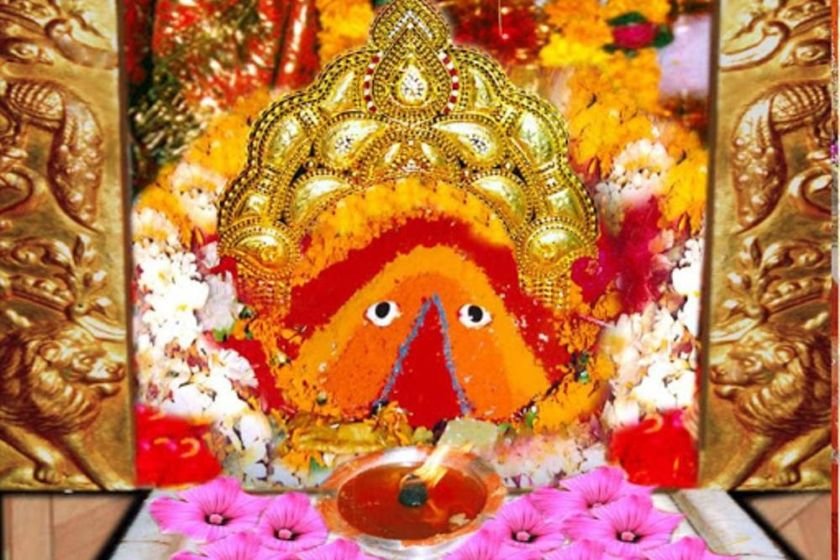
None of this shows up in the temple’s actual sanctum, worth saying plainly: the pindi — the round, faceless stone that represents her here — gives no visual hint of any of it. Which is itself worth sitting with for a moment: the goddess most known publicly for gently removing worry is, underneath, one of the fiercest and strangest figures in the entire pantheon.
🙏 What the Goddess Is Known For
In practice, almost nobody arrives at Chintpurni thinking about Tantric self-sacrifice — they arrive with a specific problem. Devotees tie a thread on the temple’s old banyan tree as a physical stand-in for a wish, and untie one, tradition says, once it’s granted. Offerings tend to be modest and specific: coconuts, red flags, sweets, chunri, and bangles, alongside chanting of the Durga Saptashati. She’s sought especially by those facing childlessness or seeking justice — practical, weighty concerns rather than abstract devotion. It’s a striking contrast to sit with: a goddess whose founding myth is one of the most extreme images of self-sacrifice in Hindu iconography has become, in daily practice, the goddess people turn to for very ordinary human hopes.
🏛️ The Temple Itself
The shrine is deliberately modest rather than monumental — a gold-coated main sanctum, marble flooring, and a scattering of smaller shrines to Hanuman, Ganesh, and Durga within the same complex. The pindi sits in the garbha griha, draped in flowers, with pilgrims queuing for a brief darshan rather than a long ritual. Nearby, the Amrit Kund, a holy pond, is believed to carry healing properties and draws its own quieter stream of visitors. It’s not an architecturally showy temple — nothing here competes for attention with the hill views or the crowds themselves — but the old banyan tree, thick with knotted threads, gives the complex a texture that’s genuinely its own.
📜 The Goddess Under Watch
One detail that rarely makes it into the wish-fulfilling framing: Puranic tradition holds that Shiva himself guards Chhinnamastika Devi from all four directions, through four separate temples nearly equidistant from Chintpurni — Kaleshwar Mahadev to the east, Narayana Mahadev to the west, Muchkund Mahadev to the north, and Shiv Bari to the south. It’s a striking piece of sacred geography: a goddess powerful enough to require an entire compass of protection, rather than a single consort standing beside her. There’s also a quieter historical footnote worth knowing — Chintpurni is one of a handful of Hindu pilgrimage sites, alongside Haridwar, where genealogical and pilgrimage records have been kept for generations by resident pandits, meticulous enough that the Genealogical Society of Utah microfilmed them for archival research. Fittingly for a shrine built on paradox, it’s simultaneously a site of fierce myth and one of quiet bureaucratic memory.
🎉 Festivals and Devotion
- Chaitra Navratri (March–April) — one of the year’s three major fairs
- Sawan/Shukla Paksh Mela (July–August) — a ten-day fair, especially intense
- Ashwin Navratri (September–October) — the third annual peak
- Daily worship — morning and evening aarti, offerings of halwa-puri, thread-tying at the banyan tree year-round
🏞️ While You’re in the Area
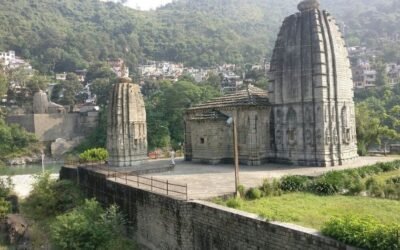
- Kaleshwar Mahadev Temple — the goddess’s eastern guardian shrine, on the Beas near Amb
- Baba Balak Nath Temple — a well-known cave shrine elsewhere in the region, often combined with a Chintpurni visit
- Jwalamukhi Temple — another of Himachal’s Shakti Peethas, worth pairing for a multi-shrine pilgrimage route
- Bharwain town — the nearest transport hub, 3 km away, useful for a meal stop or bus connection
❓ Quick Questions Travellers Ask
Why is Chintpurni Devi shown as a plain round stone rather than an image? The pindi form is traditional for many Shakti Peethas — the goddess is represented aniconically rather than through a sculpted likeness.
Is there an entry fee? No, entry is free, though a parchi (token) system controls the darshan queue.
What’s the best time to avoid crowds? Outside the three Navratri/Shukla Paksh fair windows — weekday mornings are noticeably quieter.
How does the “wish-fulfilling” reputation relate to the Chhinnamasta myth? They’re not contradictory so much as two layers of the same figure — the fierce, self-sacrificing Tantric goddess underneath, and the accessible, worry-removing deity devotees actually pray to.
Can I combine this with other temples in one trip? Yes — Kaleshwar Mahadev, Jwalamukhi, and Baba Balak Nath are all reasonably reachable from Chintpurni and commonly combined into a single pilgrimage circuit.
A Last Word
There’s a particular kind of vertigo in learning what a familiar deity actually represents underneath the version you grew up hearing. Chintpurni Devi is, to most who visit, simply the goddess who lifts a weight off your shoulders. But somewhere beneath that comfort is a goddess who once cut off her own head so no one near her would go hungry — and maybe that’s not a contradiction at all. Maybe the willingness to give until it costs everything is exactly what makes a goddess worth trusting with your worries in the first place.
Fact-check note: Sources conflict on how many generations separate Pandit Mai Das from the present day (12 vs. 26, depending on source) — this piece doesn’t pick one arbitrarily and omits the specific number from the body. Temple opening/closing times vary slightly across sources (5:00–5:30 AM open, 9:30 PM–10:00 PM close) and are given as a range rather than a false-precise figure. Precise GPS coordinates aren’t independently verified via an authoritative source, so only the Wikipedia-confirmed elevation (~977m) is stated, with a Maps search suggested instead of a pin. This is the second article the site has run on Chintpurni; the existing piece (“The Wish-Fulfilling Flame of the Shakti Peeth”) centers the worry-removing reputation and the Mai Das banyan-tree origin story as its main hook — this piece instead leads with the Chhinnamasta self-decapitation myth, which the earlier article only touches on in passing, and folds the four-Shiva-guardians tradition (also covered in the recent Kaleshwar Mahadev piece) in as connective regional context rather than a repeat.