Every year, by the width of a barley grain, the stone at the heart of this temple sinks a little deeper into the earth — and the day it disappears, the story goes, is the day this age of the world ends.
Most Himachal temples measure themselves against a legend fixed in the past — a god who once arrived, a battle once fought, a boon once granted. This one is different. It carries a legend that’s still running, quietly, in the present tense, every single year. Along a bend of the Beas River near Amb in Una district, the Kaleshwar Mahadev Temple houses a self-manifested Shivling that local belief holds is slowly descending into the ground, grain by grain, toward some final vanishing point nobody can quite predict. It’s a strange thing to build a pilgrimage around — not a miracle that already happened, but one that’s supposedly happening right now, too slowly for any single visit to notice. And underneath that prophecy sits an older, sadder story: of a goddess whose rage nearly consumed the universe, and a god who lay down in her path to stop her.
🌄 Location & How to Reach It
The temple sits in Kaleshwar village on the banks of the Beas, close enough to Amb town in Una district that most locals simply give directions from there, though the river here also brushes the edge of Kangra district — which is why you’ll find the temple claimed, gently, by both. It’s a quiet stretch of riverbank rather than a market-town shrine: agricultural land, a cremation ghat a short walk from the temple steps, and the sound of water rather than traffic.
Google Maps: Get Directions
- By road: Best reached via Amb or Pragpur; local taxis and buses run from Sadba, roughly 7 km from the temple itself. Well-connected by road to Una, Hoshiarpur, and Kangra.
- By rail: Amb Andaura railway station is the closest, around 20 km away.
- By air: Gaggal Airport near Kangra, roughly 60 km from the general area.
This one’s an easy stop rather than a trek — no climb, no forest trail, just a short drive off the highway and a walk down to the water. Anyone who’s done the harder pilgrimages in the hills — the ridge walks to Shikari Devi or the stepped ascents to some of the fort-temples further north — will find this one almost restful by comparison.
🌸 Best Time to Visit
The temple is generally open from 5:00 AM to 8:30 PM, with morning aarti around 6 AM and evening aarti around 7 PM, though it’s worth confirming locally since these can shift. Maha Shivratri transforms the place completely — night-long bhajans, havans, and community feasts draw crowds that a quiet Tuesday afternoon would never suggest. The month of Shravan brings a steadier, monsoon-season stream of devotees for special Monday abhishekams, and there’s a Baisakhi mela as well. One practical note that isn’t seasonal charm so much as safety: during monsoon, the Beas rises noticeably close to the temple, and caution near the riverbank matters more here than at most shrines.
🕉️ When the Goddess Stepped on God
The older of the temple’s two great stories goes back to the Satyug, the first and most innocent of the four cosmic ages. Demons — some tellings name Raktabeej, others leave it vaguer — had overrun creation, and the gods, desperate, turned to Shiva. He didn’t fight the war himself. Instead he called on Yogmaya, instructing her to take form as Mahakali and do what needed doing. She did. She won. And then she couldn’t stop.
Victory had unleashed something in her that victory alone couldn’t calm — a rage vast enough that the same gods who’d asked for her help now feared what she might do next. So Shiva went to her directly. He lay down in her path, letting her fury run its course over him rather than the world. When Kali’s foot came down and she recognized, in that instant, exactly whom she’d stepped on, the rage broke like a fever. She sat by the Beas and performed penance — grief and shame turning into stillness. Pleased by that turning, Shiva rose from the same ground as a Jyotirlinga, a self-manifested form of light, and the place took its name from that moment: Kalinath, meaning “Lord of Kali,” softened over centuries into Kaleshwar.
It’s a legend that asks something uncomfortable of the goddess it honors — that her power, unchecked, was itself the danger — and to its credit, the story doesn’t flinch from that. It’s less a tale of triumph than one of a god quietly absorbing a blow so someone else wouldn’t have to.
🕉️ The Sinking Stone
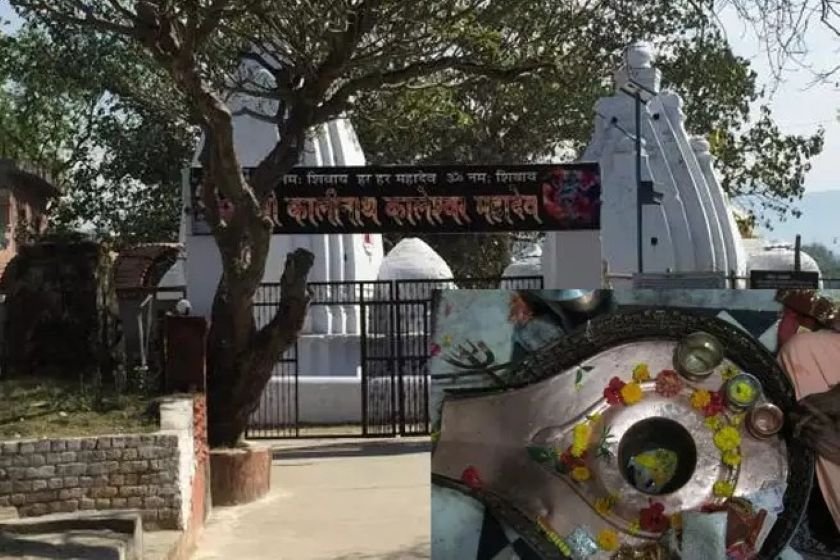
The second story is newer in flavor, even if nobody can say exactly when it started. The Shivling in the temple’s sanctum — subterranean, reached down a small step, so narrow that only one devotee fits before it at a time — is said to sink a little further into the earth each year, by roughly the width of a barley grain. Locals and pilgrims alike speak of it as a kind of divine hourglass: when the linga finally disappears entirely, the current age, Kalyug, will end, and the world will turn over into something new. It’s earned the temple an affectionate nickname among devotees — the “Mini Haridwar of Himachal” — for the same sense of a place where ordinary time feels thinner than usual.
Is it literally true, in the sense of measurable stone erosion? There’s no survey confirming it, and it would be dishonest to pretend otherwise. But it’s also the kind of belief that doesn’t need forensic proof to do its work — it gives an ancient, static object a live countdown, and that alone seems to be why pilgrims keep returning to check on it, one barley grain at a time.
🙏 What the Deity Is Known For
Here Shiva is worshipped specifically as Kalinath Kaleshwar, a fierce, protective form of Maha Rudra rather than the meditative ascetic more common at other Himachal shrines. Devotees come less for quiet contemplation than for a sense of shielded strength — this is a Shiva invoked as guardian first, philosopher second. Alongside him, most accounts describe three pindis representing Maha Kali, Maha Lakshmi, and Maha Saraswati, which — given that the temple’s founding legend is literally about Kali herself — actually fits the story here more naturally than it would elsewhere. Daily worship follows a simple rhythm of morning and evening aarti; there’s no elaborate ticketed darshan system, just incense, chanting, and the river close enough to hear throughout.
🏛️ The Temple Itself
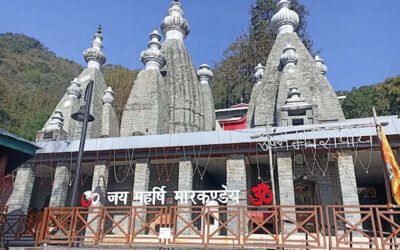
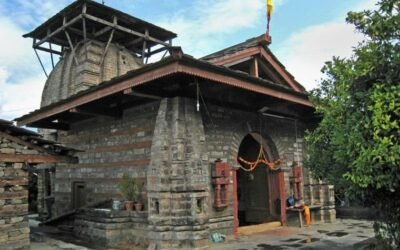
The structure itself doesn’t try to overwhelm. Sources put its current form at roughly 400 years old, though its mythic roots are described as reaching back millennia — a gap between structural age and legendary age that’s worth holding lightly rather than resolving. What stone-and-carving detail exists shows Vedic and Puranic figures worked into the surfaces, understated rather than ornate, with a nearby Panchtirthi Kund — a sacred pond said to hold water gathered from five major pilgrimage sites, mixed here by the Pandavas — offering a second, quieter ritual stop beyond the main sanctum. A cremation ghat sits just beside the temple, a reminder that this stretch of riverbank serves both the living and the dead.
📜 Shiva’s Eastern Watch
There’s a piece of regional geography that gives this temple a role most visitors miss entirely. According to local Puranic tradition, the great Shakti Peeth of Mata Chintpurni — not far away, and one of the most visited goddess shrines in this part of Himachal — is said to be guarded on all four sides by Shiva temples: Kaleshwar Mahadev to the east, Narayana Mahadev to the west, Muchkund Mahadev to the north, and Shiv Bari to the south. Whether or not the geometry is exact, the idea itself is striking — that this riverside temple isn’t just a standalone shrine but one post in a symbolic perimeter around a goddess considered too powerful to leave unwatched. Later, the Katoch dynasty, the historic rulers of the Kangra region, took on patronage of the site and expanded it. In 1913, the British archaeologist Henry Shuttleworth documented the temple, and it has since been referenced in discussions of monuments of regional archaeological importance — a rare case of an old riverside shrine getting a formal historical footnote at all.
🎉 Festivals and Devotion
- Maha Shivratri — the temple’s biggest gathering, with night-long bhajans, havans, and community feasting
- Shravan Mondays — special abhishekams through the monsoon month, drawing a steady stream rather than one huge crowd
- Baisakhi Mela — a local fair with folk music and cultural performances
- Daily worship — simple morning and evening aartis that continue quietly outside festival season
🏞️ While You’re in the Area
- Chintpurni Temple — one of Himachal’s major Shakti Peeths, roughly 40 km away, and the goddess this very temple is said to help guard
- Garli Village — a heritage hamlet near Pragpur with 19th-century architecture, including a old Rajah’s palace
- Dada Siba Temple — another Shiva shrine along the Beas, roughly 25 km off
- Kangra Fort — one of the largest forts in the Himalayas, a longer detour but worth it for history-minded travelers
- Dehra Gopipur — a small riverside town known for its natural scenery
❓ Quick Questions Travellers Ask
Is Kaleshwar Mahadev Temple in Una or Kangra district? Sources genuinely differ — the temple sits close to the district boundary along the Beas, referenced from Amb (Una) by some and Pragpur (Kangra) by others.
What are the temple timings? Generally 5:00 AM to 8:30 PM, with aarti around 6 AM and 7 PM, though it’s worth confirming locally as these can shift.
Is there an entry fee? No entrance fee is documented anywhere; entry appears to be free, as is typical for village-level Shiva shrines.
Can I stay overnight nearby? Simple accommodation is available through the local Mandir Committee, though it’s limited and can fill up during major festivals.
What’s the significance of the sinking Shivling? It’s a local belief, not a scientifically documented phenomenon — the linga is said to descend by a barley grain’s width each year, with its eventual disappearance marking the end of the current cosmic age.
A Last Word
There’s something almost humble about a temple that measures its own mythology in barley grains — not lightning bolts or floods, just the slowest possible unit of change, repeated patiently enough that no single visitor will ever see it move. Between the story of a god absorbing a goddess’s fury and the story of a stone quietly counting down, Kaleshwar Mahadev doesn’t ask you to witness a miracle so much as to sit, briefly, beside one already in progress — and trust that it’s still happening, even after you’ve gone.
Fact-check note: The temple’s district affiliation is genuinely disputed across sources — some place it in Una (near Amb), others in Kangra (near Pragpur); this piece presents both rather than picking one arbitrarily. No independently verified GPS coordinates exist for the site, so precise coordinates were omitted in favor of a search-based Maps direction. Distance figures to Pragpur (8–16 km) and the nearest rail station (~20 km) vary slightly between sources and are given as approximate ranges. The temple’s construction age (~400 years) versus its mythological origin (Satyug) reflects a real gap between structural and legendary dating found across sources, not an error to resolve. The “three pindis of Maha Kali, Maha Lakshmi, Maha Saraswati” detail — flagged in our style notes as a phrase that has wrongly carried over into unrelated articles before — was kept here because it appears consistently across independent sources and fits this temple’s own founding legend about Kali, unlike cases where it’s been mismatched to unrelated male deities. This is the third piece the site has run on this temple; the two existing articles (“The Rudra Flame Beside the Beas” and “The River’s Whisper and Shiva’s Flame”) both center the Kali-pacification legend as their primary hook — this piece instead leads with the sinking-Shivling prophecy and the Chintpurni “four guardians” tradition, neither of which the earlier two develop.