Six kilometres from Hamirpur, on the road to Nadaun, stands the shrine of a goddess who chose her own address — and made sure the king who came looking for her understood he didn’t get a vote in the matter.
Royal temple legends in Himachal tend to follow a familiar arc: a ruler is told, in a dream or an omen, that a deity wants to be found — and once found, the deity turns out to have very firm opinions about where she’s willing to stay. Jhanyari Devi Temple is one of the clearest examples of that arc in Hamirpur district, and one with real dynastic weight behind it, since the goddess at its centre isn’t a purely local figure but the kuldevi, the patron deity, of the Katoch kings of Kangra themselves. What follows is the story of a king who did everything royal protocol demanded to bring his goddess home in style — and still had to build her a temple exactly where he found her instead.
🌄 Location & How to Reach It
- Location: On the Hamirpur–Nadaun road, Hamirpur district, Himachal Pradesh
- Distance: Roughly 6 km from Hamirpur town
- Google Maps: Get Directions
- GPS Coordinates: Not independently verified for this piece — use the map link above, or search “Jhanyari Devi Temple, Hamirpur” directly on Google Maps for a precise pin before travelling
- Elevation/terrain: Hamirpur town itself sits at roughly 790 metres above sea level, in the gentler, lower-altitude belt of Himachal’s Shivalik foothills; the temple’s setting along this road is unremarkable in elevation but pleasant, rolling countryside
- By road: Buses and taxis run regularly from Hamirpur town, and the Hamirpur–Nadaun road is reported to be in good condition throughout
- By rail: Una is the nearest railhead, about 65 km away, with a road journey of roughly 1–2 hours onward to the temple
- By air: Gaggal Airport (Kangra) is the nearest, with a drive of several hours via Hamirpur
This is a straightforward, well-connected approach by regional standards — a paved road running directly to the site, no trekking or seasonal access issues to plan around.
🌸 Best Time to Visit
Summer (March to June) brings mild-to-moderately warm weather that makes for a comfortable visit, while winter (October to February) is quieter and cooler, better suited to travellers who prefer a peaceful temple visit over a crowded one. If atmosphere matters more to you than solitude, though, time your trip for Jeshth-Shukla Ashtami — usually falling in May or June — when the temple’s annual fair draws large crowds from Hamirpur and well beyond, and the site is at its most animated.
🕉️ The Legend: A Palanquin That Would Not Be Carried
The story begins with a king of the Katoch dynasty, the ruling house of Kangra, whose family had long worshipped a particular form of the goddess as their kuldevi — their protecting, ancestral deity. One night, she came to him in a dream and told him plainly: build me a temple. She didn’t stop there. She also told him where to find her.
Royal protocol of the time called for pomp, so the king assembled a grand procession — a beautifully appointed palanquin at its centre — and set out along the exact path his dream had described. He found precisely what he’d been told he would find. Satisfied, he had his men set the palanquin down on the ground so the idol could be placed inside it and carried back to the capital in appropriate style.
That’s when things stopped going according to plan. The moment his men tried to lift the palanquin again, it had become far too heavy to move — not slightly heavier, but decisively, immovably so. Dejected and confused, the king had no real choice but to make camp there for the night rather than press on.
He didn’t have to wait long for an explanation. In a second dream that same night, the goddess corrected him directly: it had been wrong, she said, to place her idol into the palanquin once the palanquin was already resting on the ground — as if the earth itself had already claimed the spot as hers. The king woke, consulted his ministers, and reached the only conclusion the dream allowed: the temple would be built right there, on the very ground where the palanquin had refused to rise again. What went up on that spot is the temple that still stands today.
It’s worth noting how closely this story rhymes with other temple legends across the same district — Gasota Mahadev’s lingam that a king’s men couldn’t lift, Awah Devi’s idol that struck its would-be movers blind and immovable in equal measure. Whether that repetition reflects a shared regional storytelling tradition or independent events told in similar language is impossible to settle from written sources alone — but it’s a pattern worth noticing rather than ignoring.
🙏 What the Deity Is Known For
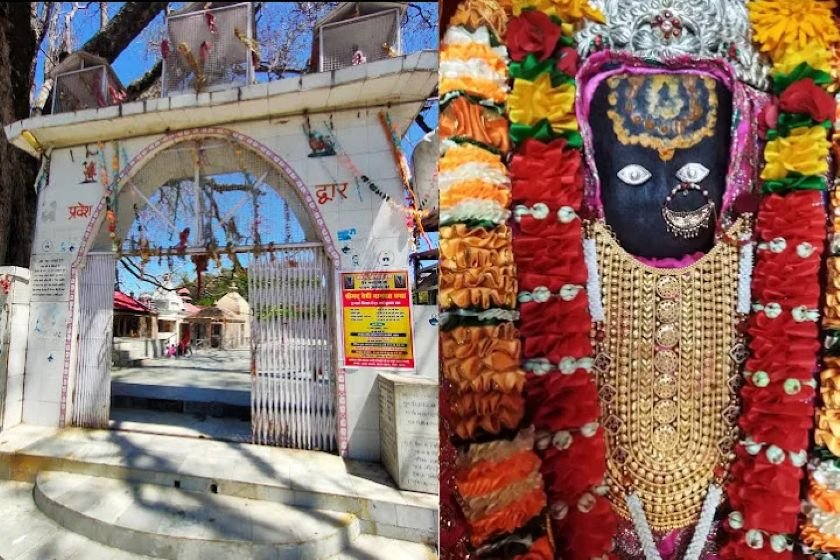
Jhanyari Devi’s significance runs on two tracks that reinforce each other. Religiously, she’s approached the way any protective form of Durga is approached in this region — for blessings, for the resolution of family troubles, for the kind of steady, ongoing devotion that doesn’t need a miracle to justify a visit. Historically, though, her standing is considerably larger than a typical village shrine, because she is the kuldevi of the Katoch kings of Kangra — one of the most consequential ruling dynasties in the western Himalayan hills. That dual identity, ancestral protector to a royal house and everyday goddess to ordinary devotees, gives the temple a weight that a purely local shrine wouldn’t carry, even though its physical scale remains modest.
It’s also worth being direct about what’s changed: with the erosion of princely privileges after Indian independence, the Katoch royal family no longer maintains the temple directly. That responsibility has passed to a locally elected committee — a shift that mirrors what’s happened to plenty of once-royal shrines across Himachal, where devotion has outlasted the political structures that originally built the walls.
🏛️ The Temple Itself
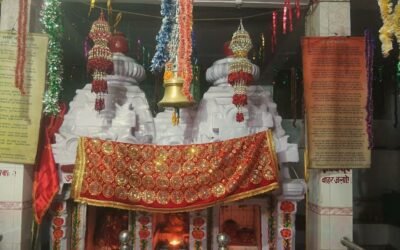
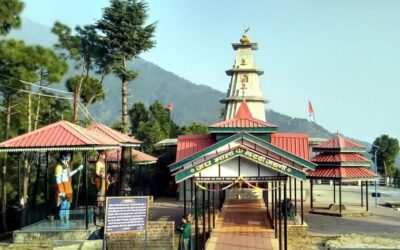
Jhanyari Devi Temple doesn’t attempt architectural grandeur, and that’s consistent with its origin story — a shrine built hastily on a campsite, not commissioned as a showpiece. What written accounts describe is a modest structure typical of the region’s older temples: simple stonework, a sanctum housing the goddess’s idol, and a temple complex that expands considerably in scale and noise only once a year, when the Ashtami fair fills its grounds with pilgrims, vendors, and the general commotion of a well-attended regional gathering. For most of the year, expect quiet — a working local shrine rather than a tourist site built for daily footfall.
📜 Regional Context: A Kuldevi Among Kuldevis
Hamirpur district’s temple landscape has an unusual density of kuldevi shrines — patron-goddess temples tied to specific Rajput clans rather than open, universal pilgrimage sites. Jhanyari Devi sits alongside Tauni Devi, patron goddess of the Chauhan clan roughly 13 km away, and Awah Devi (also known as Jalpa Devi), kuldevi to another set of local families on the district’s highest hill — each with its own version of the “the goddess refused to be moved” story, and each still carrying real weight for specific family lines who trace their devotion back generations.
The Katoch connection places Jhanyari Devi within a much larger historical frame, too. The Katoch dynasty ruled Kangra for centuries and later extended influence into what’s now Hamirpur district — the town of Hamirpur itself takes its name from Raja Hamir Chand, who governed the area in the early 18th century, and nearby Sujanpur Tira flourished under Raja Sansar Chand’s patronage later that same century, producing the murals and royal temples the town is known for today. Jhanyari Devi’s temple, tied to the same royal house but built on a goddess’s terms rather than a king’s original plan, offers a quieter counterpoint to that more visibly royal architecture just a short drive away.
🎉 Festivals and Devotion
- Jeshth-Shukla Ashtami: The temple’s major annual fair, typically falling in May or June, drawing large crowds from Hamirpur and surrounding areas for both religious observance and the wider social occasion of the mela.
- Daily worship: Ongoing, low-key devotional activity maintained by the local committee and regular visitors outside of festival season.
- Family and clan visits: As a kuldevi shrine, the temple also sees visits tied to family occasions and rites specific to households who trace their lineage or devotion to the Katoch tradition.
🏞️ While You’re in the Area
- Gasota Mahadev Temple: A 400-year-old Shiva shrine within easy reach, with its own “refused to be moved” legend involving a farmer’s plough and a king’s failed attempt at relocation.
- Kalanjari Devi Temple: Another well-known goddess shrine in the same general area, popularly grouped with Jhanyari Devi and Gasota Mahadev as one of Hamirpur’s most-visited temple trio.
- Sujanpur Tira: A heritage town roughly 22 km away, home to Katoch-era murals, royal temples, and fort ruins connected to the same dynasty Jhanyari Devi served as kuldevi.
- Narvadeshwar (Narbadeshwar) Temple: A Shiva shrine around 22–23 km away, worth combining with a wider day of temple visits in the district.
- Guler Haveli: An offbeat historical stop known for its old frescoes, appealing to travellers interested in the region’s artistic heritage beyond its temples.
❓ Quick Questions Travellers Ask
Is Jhanyari Devi actually connected to the Katoch royal family, or is that just local legend? It’s well-documented rather than purely local lore — she’s specifically identified across multiple sources as the kuldevi (patron goddess) of the Katoch kings of Kangra, giving the temple genuine dynastic significance beyond its physical size.
How old is the temple? Consistently reported as more than 200 years old, though, as with most temples of this kind, there’s no single inscribed founding date — the age comes down through sustained local and historical tradition.
Who manages the temple today, since it was built by royalty? A locally elected committee, not the Katoch family directly — a change that followed the end of princely privileges and privy purses after Indian independence.
Is the annual fair worth planning a trip around? Yes, if you want to see the temple at its liveliest — Jeshth-Shukla Ashtami draws large crowds and a genuinely festive atmosphere, though if you’d rather avoid crowds, the quieter winter months (October to February) suit a more contemplative visit instead.
Are there other similar “goddess who refused to move” temples nearby worth visiting together? Yes — Gasota Mahadev and Awah Devi both carry closely related legends within a short driving distance, making a themed day of temple visits around this recurring story an easy option if you’re already in the area.
A Last Word
What stays with you about Jhanyari Devi isn’t the size of the shrine — it’s the shape of the story behind it. A king did everything tradition asked of him: the dream, the procession, the palanquin, the pomp. And still, at the last possible moment, the goddess made clear that her wishes outranked his plans, down to the precise patch of ground she’d chosen to occupy. Six kilometres outside Hamirpur, that quiet insistence is still standing, looked after now by the same kind of ordinary local devotion that any village temple depends on — proof that a goddess’s authority doesn’t need a palace to be felt.
Fact-check note: The core legend — a king instructed in a dream to find and house the goddess, followed by the palanquin becoming immovable once set down — is consistent across multiple independent sources and represents the temple’s well-established primary tradition. The temple’s age (200+ years), its location on the Hamirpur–Nadaun road (about 6 km from Hamirpur), its status as the Katoch dynasty’s kuldevi shrine, and the Jeshth-Shukla Ashtami festival date are similarly well-corroborated across sources. No exact GPS coordinates, an official founding date, or specific priest/contact details could be verified, and none are stated or invented here. The observation about this legend’s similarity to other regional temple stories is offered as a pattern worth noting, not a claim about which version, if any, came first.