Every time she cut off his head, another one grew back laughing — the goddess worshipped here didn’t win her valley through strength alone, but through knowing exactly where a monster’s life actually lived.
Kinnaur doesn’t do its goddesses the easy way. Where other parts of Himachal tell you a deity simply arrived, or was found, or descended fully formed, this valley tends to give its protector goddesses actual battles to win — messy, clever, nearly-lost ones. The temple at the center of this story belongs to Chandika Devi, a fierce form of Durga worshipped here not as a distant cosmic force but as a kuldevi — a clan goddess, bound by blood-tie to specific Kinnauri families who still trace their protection back to her. And the story of how she earned that role involves a demon who simply would not stay dead, and a trick clever enough to finally end him.
🌄 Location & How to Reach It
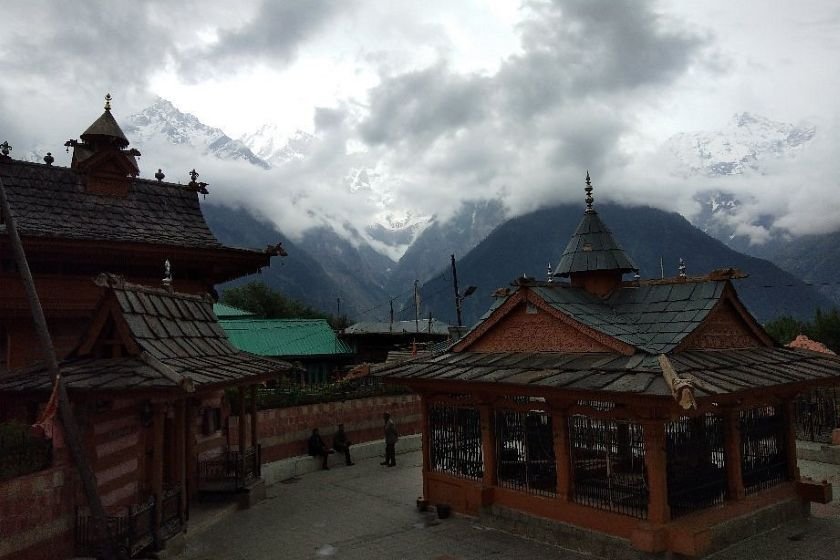
The temple sits above Reckong Peo, Kinnaur’s district headquarters, in the village of Kothi — reached by turning uphill opposite the HDFC bank in Reckong Peo’s main bazaar and following the road up for roughly 2 km. It’s a proper hillside approach: switchbacks through apple orchards and traditional Kinnauri stone-and-timber houses, with the high Kinnaur ranges filling the skyline behind you the whole way up.
Google Maps: Get Directions
- By road: Reckong Peo is well connected by HRTC buses and taxis from Shimla and Chandigarh (a long but scenic drive along the Sutlej); from the Reckong Peo bus stand, it’s a short taxi ride or a manageable uphill walk to Kothi.
- By rail: No direct rail access — the nearest practical railhead is Shimla, several hours away by road.
- By air: Shimla Airport is the closest, though most travelers fly into Chandigarh and drive in from there.
This is a gentle uphill walk rather than a trek — nothing like the multi-day approaches some of Kinnaur’s remoter shrines demand — and a reasonable stop even for travelers passing through Reckong Peo on the way to Kalpa or further into the valley.
🌸 Best Time to Visit
The temple is generally open from around 6:00 AM to 8:00 PM, though it’s worth confirming locally, as hours can shift with season and festival. Spring (March–May) and autumn (September–November) bring the most pleasant weather for the climb up from Reckong Peo. Navratri and Dussehra are the temple’s biggest devotional moments, when the goddess’s palanquin is carried out and danced through the crowd by four bearers — a sight worth planning a visit around if you can time it.
🕉️ The Demon Who Wouldn’t Die
According to local tradition, Chandika was the eldest of eighteen children born to the demon king Banasura, who once ruled over Kinnaur. When the siblings divided the region among themselves, Chandika took for herself the tract around Sairag, the historic heart of the valley — but ruling it was no formality. A local Thakur held power there with the backing of a demon whose strength seemed absolute: no blade could finish him, because every time his head was cut off, another simply grew in its place, laughing at whoever had struck the blow.
Chandika turned to a clever relative, Byche, for help. Byche tricked the demon into working at a water-mill and let his long hair get caught between the grinding stones — pinning him in place. With the demon trapped, Chandika struck, again and again, and again a new head rose from each cut, until she was standing in a rising sea of blood with no end to the fight in sight. Exhausted, she called for her brothers. Chagaon Maheshwar answered, and gave her the piece of information that changed everything: the demon’s real life didn’t reside in his head at all, but in a small beetle hovering above it. Kill the beetle, he told her, and the heads would stop returning. She did, and they did — and Chandika has ruled Sairag from her temple in Kothi ever since.
It’s a legend that rewards a second read: not a goddess overwhelming a monster through sheer force, but one who nearly loses, gets outside help, and wins only once she understands what she’s actually fighting. That’s a very different kind of heroism than the usual slaying-the-demon story, and it’s worth sitting with rather than skimming past.
🙏 What the Goddess Is Known For
For the Kinnauri families who claim her as kuldevi, Chandika isn’t an abstract cosmic protector but a specific, personal one — the goddess a family turns to in disputes, in illness, in anything that feels like it needs a fiercer intervention than ordinary prayer. She’s approached less for the gentle granting of wishes and more for protection and justice — the sense that wrongs will be set right and evil kept at bay. During major festivals, her presence is made physically active: the golden image is placed on a palanquin and carried by four bearers who let it sway and dip in response to the crowd’s questions, in the same devta-consultation tradition practiced across Kinnaur’s village deities.
🏛️ The Temple Itself
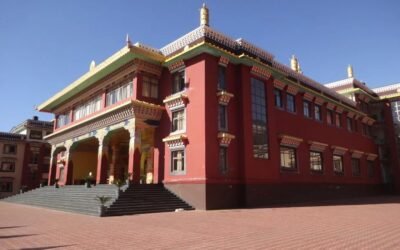
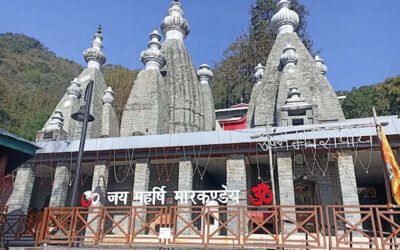
The complex at Kothi consists of two peaked wood-and-stone towers, built in classic Kinnauri style — the taller of the two is the older structure, its timber darkened with age, while the newer tower houses a number of images wearing distinctive rounded coverings that resemble old military busby caps, an unusual and specific local detail rather than a generic ornament. Inside the main shrine sits a golden image of the goddess seated on an arc, framed by the kind of detailed wood carving Kinnaur’s temples are known for throughout the valley. Just outside, a natural spring feeds a small pond stocked with fish — a swayambhu (self-manifested) water source, in keeping with several other Chandika shrines across the region that share the same feature.
📜 A Goddess Mapped Onto the Land Itself
What makes Chandika’s story unusual, even within Kinnaur’s rich devotional landscape, is how directly her mythology is tied to the region’s actual geography. The valley isn’t just home to her temple — according to tradition, it was literally divided up among Banasura’s children, with Chandika claiming this particular tract as her own portion. That’s a different relationship between deity and land than the more common pattern of a goddess simply appearing or being installed somewhere; here, the land itself is described as inheritance. It fits neatly into Kinnaur’s broader devta tradition, in which village deities are treated as active, opinionated members of the community — consulted through palanquin movements, invited to festivals, and credited with real jurisdiction over the affairs of the people who live under their watch. The autumn Fulaich festival, celebrated across Kinnaur in honor of ancestral spirits and local deities, sits within this same living tradition of gods who are neighbors as much as they are objects of worship.
🎉 Festivals and Devotion
- Navratri — the temple’s major devotional period, marked by heightened worship and ritual activity
- Dussehra — celebrated with particular significance given Chandika’s identity as a demon-slayer
- Palanquin processions — the goddess’s image is carried and consulted through movement, a practice tied to the broader Kinnauri devta tradition
- Daily worship — quieter devotion continues outside festival season, with locals visiting for personal and family matters
🙏 Getting in Touch
There’s no formal booking system, contact number, or dedicated tourism office for this temple — it functions as a living village shrine rather than a managed tourist site. The most reliable approach is simply asking locally in Reckong Peo bazaar for current directions and any festival-day timing changes, particularly around Navratri when access and crowds shift.
🏞️ While You’re in the Area
- Kalpa — a short drive further up the valley, with sweeping views of the Kinnaur Kailash range
- Narayan-Nagini Temple — another richly carved Kinnauri shrine near Kalpa, dedicated to Vishnu and the serpent goddess Nagini
- Suicide Point — a dramatic cliffside viewpoint near Reckong Peo
- Brelengi Gompa — a notable Buddhist monastery a short distance from Reckong Peo, reflecting Kinnaur’s dual Hindu-Buddhist character
- Roghi & Chini villages — traditional Kinnauri settlements worth a slower wander for their architecture and local life
❓ Quick Questions Travellers Ask
Is this the same as the “Durga Temple” listed in Rekong Peo itself? Sources vary — some list a Durga/Chandika shrine within Reckong Peo town (about 1.5 km from the bus stand), while others point specifically to the temple in Kothi village (about 2–3 km uphill); they may refer to the same complex or to a smaller in-town shrine associated with the same goddess.
Is there an entry fee? No entry fee is documented; it functions as a community temple rather than a ticketed attraction.
What should I wear or bring? Modest dress is appropriate, as at any Himachal temple; footwear is typically removed before entering the sanctum.
Can I combine this with a Kalpa trip? Yes — most travelers visit on the way to or from Kalpa, since both are close to Reckong Peo.
Is the temple open year-round? Yes, though winter weather in Kinnaur can make the uphill approach harder; spring and autumn are more comfortable for the visit.
A Last Word
There’s something quietly instructive in a goddess whose defining myth isn’t a clean victory but a near-defeat rescued by better information. Chandika didn’t beat her demon by being stronger — she beat him by finally understanding what he actually was. Climbing up through Kothi’s orchards to stand before her golden image, it’s worth remembering that the fiercest protection this valley offers wasn’t won by force alone, but by a goddess smart enough to ask for help and listen to the answer.
Fact-check note: Sources genuinely disagree on this temple’s exact location — some list a “Durga Temple” within Reckong Peo town itself (~1.5 km from the HRTC bus stand), while others describe the main Chandika Devi shrine as being in Kothi village, roughly 2–3 km uphill; this piece follows the Kothi location as the primary, more thoroughly documented site rather than resolving the discrepancy arbitrarily. No independently verified GPS coordinates were found, so a Maps search link is provided instead of a precise pin. Temple timings (6 AM–8 PM) come from a single tourism listing and should be confirmed locally, particularly during festivals. This is the second article the site has published on this goddess; the existing piece (“Chandika Devi Temple – The Warrior Goddess of the Kinnaur Clans”) centers her identity as kuldevi and general protector — this piece instead leads with the specific Banasura/beetle demon-slaying legend, which the earlier article does not develop in detail.