Once a year, two palanquins carrying the same god meet face to face in the same valley — a detail almost nobody writing about this temple online seems to mention
Most write-ups of village devta temples in Himachal Pradesh read almost interchangeably — cedar forests, a palanquin, an oracle, drums, and a vague sense of living tradition, all true, but rarely specific to the actual deity in question. Devta Banad, guardian of a cluster of villages in Jubbal’s Pabbar Valley, deserves better than that treatment, and there’s at least one genuinely distinctive fact about him that most casual accounts miss entirely: Banad Devta is worshipped at two separate shrines — one in Pujarli, one in the neighbouring village of Shari — and during festivals, the two palanquins are brought together to meet one another, a striking piece of living ritual that photographic field documentation from the region has captured but that rarely makes it into travel writing.
🌄 Location & How to Reach It
- Location: Pujarli village, Mandal area, Jubbal Tehsil, Shimla District, Himachal Pradesh – 171216
- GPS Coordinates: 31.1187° N, 77.7792° E
- Google Maps: Get Directions
- Distance: Roughly 125 km from Shimla, via Theog, Khara Pathar, and Hatkoti, into Jubbal Tehsil
This is a genuinely rural, off-the-main-tourist-track destination, and reaching it takes real commitment. From Shimla, the route runs through Theog and Khara Pathar before reaching Hatkoti, an important pilgrimage town in its own right, and on into Jubbal, from where local roads lead to Pujarli in the Mandal area. Regular buses connect Shimla to Jubbal and Rohru, with local transport or a hired taxi needed for the final stretch into the village itself.
Getting to the wider area: The nearest airport is Shimla’s Jubbarhatti Airport, and the nearest railhead is Shimla itself, connected to Kalka by the narrow-gauge Kalka-Shimla line. This is deep Pahari hill country — expect a genuine day’s journey from Shimla rather than a quick day trip.
🌸 Best Time to Visit
Jubbal’s elevation (Pujarli sits at a comparable altitude to the wider tehsil, around 1,900–2,200 metres) means seasons matter here. April to June brings the most comfortable travelling weather and coincides with much of the region’s spring festival calendar. September to November offers clear skies and the added bonus of Jubbal’s apple harvest season in full swing along the route. Winter brings heavy snowfall to this part of Shimla district, and while roads are generally kept open, travel becomes considerably harder, and remote village festivals may pause until spring.
Timings: No formal visiting hours exist for this village shrine — it functions as an active community temple rather than a managed tourist site, with access generally straightforward during daylight hours, though timing a visit around an actual festival will naturally depend on the local ritual calendar for a given year.
🕉️ A Living Deity, Not a Statue in a Box
Understanding Devta Banad means understanding how the entire Devi-Devta tradition works in this part of Himachal Pradesh, since it’s genuinely different from temple worship elsewhere in India. Banad isn’t approached as a fixed idol to be visited and left behind — he’s treated as a living, present entity, consulted directly through a gur (oracle), who enters trance to speak on the deity’s behalf, answering questions, settling disputes, and guiding decisions that affect the whole community. His presence is carried physically in a decorated palanquin, and it’s considered a mark of genuine divine presence that this palanquin is never set down on bare ground during processions — devotees and attendants take turns bearing it continuously rather than letting it rest.
Offerings here follow the pattern common across the wider Shimla hill region: red cloth, rice, ghee lamps, and, in certain traditional rites, animal sacrifice, though the specifics and frequency of any such practice vary by occasion and are best understood through direct, respectful inquiry locally rather than assumed. Devotees turn to Banad Devta specifically for matters of agriculture, livestock, and the resolution of disputes between villagers — a devta whose remit is thoroughly practical and communal, deeply woven into everyday village governance rather than confined to abstract spiritual matters.
📜 One God, Two Villages
Here’s the detail worth dwelling on properly, since it’s the single most distinctive thing about this deity and it’s largely absent from existing online coverage: Devta Banad maintains shrines in both Pujarli and the nearby village of Shari, and documented field photography from the region shows the two palanquins — Devta Banad-Pujarli and Devta Banad-Shari — being brought together to meet during festival occasions. This isn’t a case of two rival claims to the same deity, in the way some Himachal temples dispute origin stories; rather, it reflects how devta worship in this region often functions as a genuinely shared, cross-village institution, with a single deity’s presence and authority extending across more than one community, each maintaining its own shrine and its own palanquin, brought together periodically as an act of communal renewal and connection.
Jubbal as a whole is home to several such guardian deities, each tied to specific villages within the tehsil — Devta Deshmolya, Devta Mahasu, Devta Nageshwar, and Hateshwari Mata among them, the last of these housed in a significant two-storied pagoda temple in Jubbal town itself, believed locally to have been built by the Pandavas and dated by historians to somewhere around 800–1000 CE, later renovated by Jubbal’s own rulers. This dense local pantheon reflects the broader devi-devta system found across the upper Shimla hills, in which the region’s spiritual life is organised not around a handful of major pan-Indian deities but around a rich, interlocking network of local guardians, each with real, practically exercised authority over their own community.
Jubbal itself has real, if somewhat contested, dynastic history behind it: local tradition traces its ruling family’s origins to a branch of the Rathore lineage migrating from the princely state of Sirmaur, though historians studying the region treat this as likely a foundational myth explaining clan dispersal rather than strictly verifiable history — worth noting honestly rather than repeating as settled fact. What’s more solidly documented is that Jubbal functioned as one of eighteen Thakurais controlling territory across the Sutlej, Pabbar, and Giri valleys, gradually absorbing smaller feudatories like Rawin and Dhadi by the 18th century.
🏛️ Architecture Built for a Living God, Not a Static One
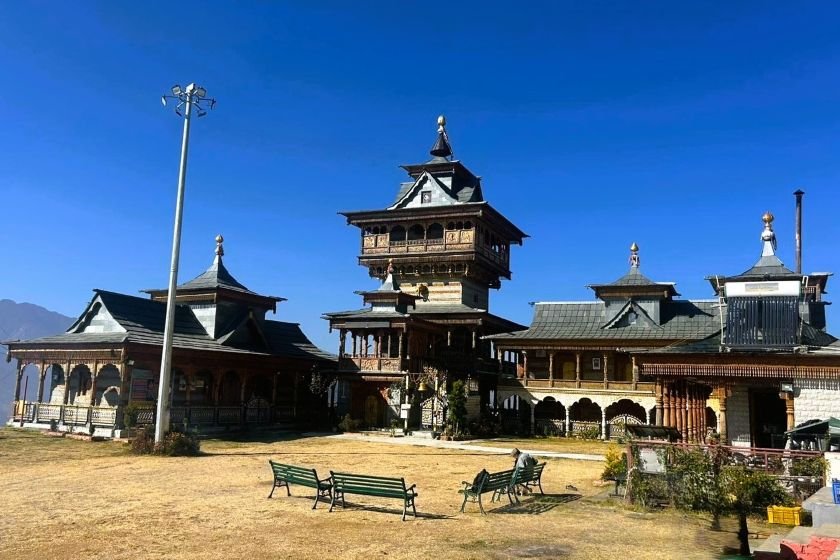
The temple follows the traditional Kath-Kuni style common across this part of the Himalaya — interlocking wood and stone construction, engineered specifically to withstand the region’s heavy snow load and occasional seismic activity, topped with slate roofing rather than the wooden shingles seen further west in Kullu. Structurally, the building is organised less around a fixed idol-housing sanctum in the conventional sense, and more around housing the deity’s rath (palanquin) itself — the physical vessel through which Banad Devta is understood to move and act in the world. The temple courtyard doubles, quite literally, as a village meeting space: festivals, community councils, and rituals of dispute resolution all take place here, blurring the line between religious and civic life in a way that’s genuinely distinctive to this style of Himachali worship.
🎉 Festivals and Community Life
- Annual Rath Yatra: Devta Banad’s palanquin is carried in procession accompanied by drums, trumpets, and traditional folk dance — the occasion when the Pujarli and Shari palanquins are documented meeting one another.
- Local fairs and Navratri: Marked with processions, offerings, and, on occasion, night-long bhajans drawing villagers from across the wider Mandal area.
- Community Bhoj: Shared feasts following major rituals, reinforcing the social bonds that this kind of devta worship is explicitly built to sustain.
🏞️ While You’re in the Area
- Hatkoti Temple: A significant Shaktipeeth dedicated to Mahishasuramardini, on the route between Shimla and Jubbal.
- Jubbal Palace: The heritage seat of Jubbal’s former ruling family, blending Kathkuni and Indo-European architectural styles.
- Hateshwari Mata Temple: Jubbal town’s own ancient pagoda-style shrine, traditionally linked to the Pandavas.
- Chanshal Pass: A scenic high-altitude route connecting Rohru to Dodra Kwar, popular with trekkers.
- Pabbar River Valley: Known regionally for trout fishing and its broader natural beauty.
🙏 Getting in Touch
There’s no formal contact number, booking arrangement, or managing organisation listed for this village shrine — it’s sustained entirely by local community structures rather than run as a tourist attraction. If you’re planning a visit, particularly around a festival, asking locally in Jubbal or Rohru for current information is a considerably more reliable approach than expecting any official point of contact.
❓ Quick Questions Travellers Ask
Is there just one Devta Banad temple? No — this is worth knowing before you go. Devta Banad has shrines in both Pujarli and the neighbouring village of Shari, with both palanquins recognised as manifestations of the same deity, occasionally brought together during festivals.
How difficult is it to reach Pujarli? It’s a genuinely remote village requiring a full day’s travel from Shimla via Theog, Khara Pathar, and Hatkoti into Jubbal Tehsil. This isn’t a casual day-trip destination, and local transport for the final stretch should be arranged in advance where possible.
Is there an entry fee? No, it functions as an active community shrine rather than a ticketed site.
Can outsiders witness the festivals here? Visitor accounts of similarly structured devta festivals across the Shimla hills suggest respectful outside observers are generally tolerated, though this is fundamentally a community ritual rather than a tourist event, and visiting with genuine respect and, ideally, local introduction is strongly advisable.
Is this connected to Mahasu Devta, mentioned in some regional accounts? They’re part of the same broader devi-devta cultural system found across the upper Shimla hills, and Jubbal’s own pantheon includes a separate Devta Mahasu shrine, but Banad and Mahasu are understood locally as distinct deities with their own separate followings, oracles, and shrines, rather than one being a form of the other.
A Last Word
There’s a reason generic descriptions of Himachal’s devta temples all start to sound the same — the underlying tradition really does share common threads across hundreds of villages. But Devta Banad’s story resists that flattening the moment you look closely: a god with two homes, two palanquins, and a documented tradition of bringing them face to face, in a valley where the line between religious devotion and everyday village governance barely exists at all. It’s a reminder that behind every one of these seemingly interchangeable “living deity” write-ups is usually something genuinely specific, if you’re willing to look past the first search result to find it.
Fact-check notes: The version of this article previously published on the site was almost entirely generic — describing rituals, architecture, and community role in terms that could apply to dozens of similar Himachal devta temples, without any detail specific to Banad Devta himself. This rewrite adds a genuinely distinctive, previously omitted fact: documented field photography (Wikimedia Commons, Shimla district category) shows Devta Banad maintaining two separate shrines, at Pujarli and Shari, with their palanquins brought together during festivals. Regional historical context on Jubbal’s dynastic origins is presented cautiously, noting that historians treat the Rathore-migration founding story as likely mythic rather than verified fact, per available scholarship (Grokipedia, Wikipedia). Verified GPS coordinates for Pujarli were pulled from live location data. No formal contact information exists for this village shrine, and none has been invented.