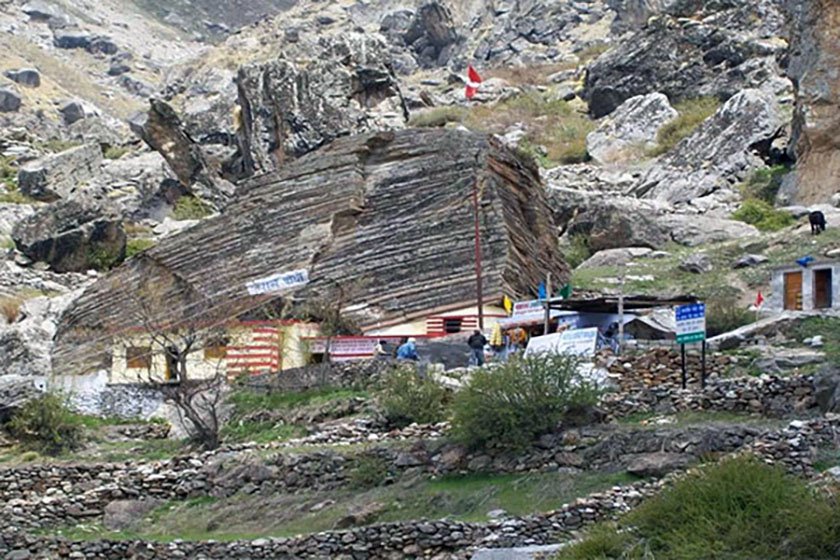
At the foot of Bilaspur, near the old memory of the Sutlej, a small cave keeps the name of the sage whose presence is believed to have shaped the town before it became Bilaspur.
Bilaspur is a town with two kinds of memory. One lies in the modern landscape of roads, markets, temples, and Gobind Sagar Lake. The other lies deeper, in stories of the old town, the Sutlej bank, submerged places, and names that survived even when geography changed. Vyas Gufa belongs to that older layer.
The cave is associated with Rishi Vyas, also known as Ved Vyasa, the sage traditionally credited with composing the Mahabharata, compiling the Vedas, and shaping some of the most important sacred literature of Hindu tradition. In Bilaspur, his memory is not only scriptural. It is local. The town itself is said to have once been known as Vyaspur, or linked with the name Beas Gufa, because of the sage’s association with this cave.
That is what makes Vyas Gufa more than a small cave shrine. It is part of Bilaspur’s naming memory — a place where sacred geography and town history meet.
🌄 Location & How to Reach It
Vyas Gufa is located in Bilaspur town, Himachal Pradesh, traditionally described as being at the foot of the city and near the Sutlej / Satluj river side. Several travel references place the cave on the left bank of the Sutlej, while Bilaspur’s official history page connects the old capital-site memory with a place traditionally called Beas Gufa after Rishi Vyas.
Google Maps: Get Directions
Elevation: Some travel references place Vyas Gufa at around 610 m above sea level, but a survey-certified cave-specific elevation is not consistently available across official sources.
- By road: Bilaspur is well connected by road with Shimla, Mandi, Hamirpur, Ghumarwin, Swarghat, Kiratpur Sahib, and Chandigarh. From Bilaspur town, visitors should ask locally for Vyas Gufa / Vyas Cave, as the exact approach may depend on the current town route and local access.
- By rail: The nearest practical broad-gauge railway access is generally through Kiratpur Sahib, Una, Chandigarh, or other Punjab-side stations, followed by road travel into Bilaspur.
- By air: The nearest commonly used airports are Chandigarh Airport and Kangra / Gaggal Airport, followed by road travel. For most visitors, road access remains the simplest option.
This is not a difficult trek. It is a local sacred site in the Bilaspur town area, best visited in daylight with directions confirmed locally.
🌸 Best Time to Visit
Vyas Gufa can generally be visited through most of the year. The most comfortable months are October to March, when the lower Bilaspur hills are cooler, and March to June if visiting in the morning or evening.
Bilaspur can become warm in summer, so early visits are better. Monsoon months may bring rain, humidity, and local road inconvenience, especially around lower slopes or old access paths. Winter is usually manageable, though mornings and evenings can be cool.
The cave is associated with Rishi Vyas, so days connected with guru worship, scriptural recitation, and local religious gatherings may be meaningful, but there is no consistently verified public festival calendar for this specific cave. Guru Purnima is spiritually relevant in the wider context of sage worship, though local observance at Vyas Gufa should be confirmed before planning around it.
Visit during daylight, move carefully inside or around the cave, and treat the space as a living sacred site rather than a casual tourist stop.
🕉️ Rishi Vyas, the Sage of Memory
Rishi Vyas is one of the most important sages in Hindu tradition. He is known as Ved Vyasa, the one who arranged or compiled the Vedas, and is traditionally credited with composing the Mahabharata, one of the world’s great epics. He is also associated with the Puranas and the transmission of sacred knowledge across generations.
In religious imagination, Vyas is not only an author. He is a compiler, teacher, seer, and organiser of memory. His role is to gather vast knowledge and give it form. That is why places associated with him often carry a feeling of stillness and depth. A Vyas site is not only about worship. It is about listening, learning, and remembering.
At Bilaspur, the sage’s memory becomes local through the cave. The tradition says that he meditated here for a long period, performing penance and spiritual discipline near the Sutlej. Whether one reads this as history or sacred tradition, it gives the cave its identity.
A cave is a fitting place for Vyas. It is inward, quiet, and removed from distraction. It suggests the kind of space where words can deepen before becoming scripture.
🏞️ The Cave at the Foot of Bilaspur
Vyas Gufa is often described as being situated at the foot of Bilaspur city. This detail matters because it places the cave not far away in a high remote forest, but near the base of the town’s own memory.
Many sacred caves in Himachal are hidden in cliffs or reached by long paths. Vyas Gufa is different. It belongs to the townscape. It sits close to the story of how Bilaspur itself came to be named, remembered, and settled.
Travel references describe the cave as being near the Sutlej and surrounded in older descriptions by pine, juniper, or hill vegetation. The wider landscape has changed over time, especially with the creation of Gobind Sagar Lake and the transformation of old Bilaspur. But the cave’s association with the riverbank and the sage remains central.
A visitor should not expect a huge cavern. The sacredness is not in size. It is in association. The cave holds a name, and that name is older than the modern town.
📜 From Vyaspur to Bilaspur
One of the most important traditions connected with Vyas Gufa is that Bilaspur’s earlier name was Vyaspur, linked to Rishi Vyas. Travel sources repeat this belief, and the official Bilaspur history page records that the new capital site was traditionally called Beas Gufa after Rishi Vyas, later becoming known as Bilaspur.
This makes the cave part of the town’s identity. Names are not small things. A place-name preserves memory long after buildings change, rulers pass, and landscapes are altered. If Bilaspur carries an older memory of Vyaspur or Beas Gufa, then Vyas Gufa is not merely one sacred point inside the town. It is part of the explanation of the town’s own name.
The official district history also preserves the story of a ruler choosing a new capital site on the left bank of the Sutlej, near a place traditionally called Beas Gufa. He built a palace called Dholar overlooking the river, and the town that developed there became Bilaspur.
In this way, Vyas Gufa stands at the meeting point of mythology, local tradition, and political geography. A sage’s cave becomes a landmark around which a town’s story is organised.
🙏 What Vyas Gufa Is Known For
Vyas Gufa is known first as a cave associated with Rishi Vyas / Ved Vyasa. Devotees and visitors connect the site with meditation, penance, scriptural wisdom, and the sacred memory of the Mahabharata.
It is also known for its link with Bilaspur’s old name. The belief that Bilaspur was earlier known as Vyaspur gives the cave a special importance in local heritage. It is not just a place where a sage is said to have meditated; it is a place through which the town understands its origin.
For devotees, the cave may be a place to seek wisdom, peace, blessings for education, clarity of mind, and spiritual grounding. Students, readers, teachers, and those connected with learning may find the Vyas association especially meaningful.
The cave is also part of Bilaspur’s broader sacred network, along with Markandeya Ji Temple, Laxmi Narayan Mandir, Baba Nahar Singh Temple, Naina Devi Temple, and other local shrines. Together, these places show that Bilaspur’s sacred geography is shaped by sages, deities, devtas, water, and hill-state memory.
🏛️ A Small Cave With a Large Literary Shadow
Vyas Gufa should not be judged by outward scale. The cave may be modest, but the figure associated with it is enormous in Indian sacred literature.
This contrast is important. A small cave can hold a large memory. In fact, many rishi sites work this way. They are not grand because the sage’s greatness was never architectural. It was inward. It came through tapasya, insight, and the power to turn divine knowledge into words.
The atmosphere of a cave naturally supports that memory. The light is reduced. Sound changes. The body slows. A person entering even a small cave becomes aware of silence differently. Such spaces invite inwardness.
At Vyas Gufa, that inwardness is connected with the sage who gave form to the Mahabharata — a text filled with war, duty, doubt, dharma, devotion, kingship, family, and the human struggle to act rightly. The cave’s quiet feels like the opposite of the battlefield, yet both are part of the same sacred imagination.
Before words become epic, they begin in silence.
🕉️ The Mahabharata, the Vedas, and the Guru Tradition
Ved Vyasa is traditionally honoured as the compiler of the Vedas and the composer or arranger of the Mahabharata. He is also revered on Guru Purnima, because the day is widely associated with Vyasa Puja and the honouring of the guru principle.
This gives Vyas Gufa a wider meaning beyond local tourism. It can be seen as a place connected with the guru tradition, sacred learning, and the transmission of knowledge. In Hindu thought, knowledge is not merely information. It is a path, a discipline, and a responsibility.
The Mahabharata itself is not only a story of war. It contains the Bhagavad Gita, moral dilemmas, royal histories, philosophical teachings, and complex reflections on dharma. To associate a cave with Vyas is therefore to associate it with the work of remembering and explaining human life.
For visitors, this means the cave should be approached differently from a viewpoint or picnic site. It asks for quiet. It asks for attention. Even if one cannot verify every detail of the legend, the symbolic value remains deep.
🌊 Sutlej, Old Bilaspur, and the Changed Landscape
The landscape around Bilaspur has changed dramatically because of the Bhakra Dam and Gobind Sagar Lake. Old Bilaspur was submerged, and the modern town developed in new form. This makes all old sacred references in Bilaspur especially important.
Sites like Vyas Gufa connect present-day Bilaspur with a remembered past near the Sutlej. The river was not only a geographical feature. It shaped settlement, movement, trade, sacred routes, and royal decisions. The official district history’s reference to a place traditionally called Beas Gufa near the old capital site helps preserve that connection.
When a landscape changes, memory becomes more valuable. A cave, a name, a temple, or a story can hold what water and time have altered.
Vyas Gufa therefore belongs not only to the story of Rishi Vyas, but also to the story of Bilaspur itself — a town that has had to remember across submergence, relocation, and rebuilding.
🎉 Festivals and Devotion
- Guru Purnima: Since Rishi Vyas is deeply associated with the guru tradition, Guru Purnima is spiritually meaningful in the wider context of Vyas worship. Local observance at the cave should be confirmed before planning around it.
- Vyas Puja: Devotees may honour Ved Vyasa as the great sage of sacred learning, scripture, and guru lineage.
- Quiet meditation: The cave setting naturally supports silence, reflection, and personal prayer.
- Student and knowledge prayers: Visitors may seek blessings for education, clarity, writing, study, and wisdom.
- Local darshan: The cave is part of Bilaspur’s local sacred circuit and may be visited along with nearby temples.
🏞️ While You’re in the Area
- Markandeya Ji Temple: A rishi shrine near the Jukhala / Markandeya side, associated with Rishi Markandeya, Lord Shiva’s blessing, and a sacred spring.
- Laxmi Narayan Mandir, Bilaspur: A town temple dedicated to Lord Vishnu and Goddess Lakshmi, located near the Bilaspur bus stand side.
- Baba Nahar Singh Temple, Dholra: A major local devta shrine associated with Baba Nahar Singh Ji and his sacred kharaun.
- Maa Santoshi Temple, Dholra: A local shrine dedicated to Maa Santoshi, especially meaningful for Friday vrat devotees.
- Gobind Sagar Lake: The reservoir that reshaped Bilaspur’s landscape and remains central to the district’s modern identity.
- Bhakra Dam: A major engineering landmark linked with the creation of Gobind Sagar Lake; access and permissions should be checked before planning.
- Naina Devi Temple: One of Himachal’s major Shakti shrines, often included in wider Bilaspur district pilgrimage routes.
🙏 Getting in Touch
There is no widely verified official visitor centre, booking system, or formal public contact number available for Vyas Gufa in accessible public sources. For current access, route condition, local worship arrangements, and photography rules, ask locally in Bilaspur town.
Because caves can have uneven surfaces, visitors should move carefully, especially during or after rain. If visiting with elderly people or children, confirm the exact access path beforehand.
As with all sacred cave sites, keep the area clean, avoid loud behaviour, do not write on cave walls or leave plastic waste, and ask before photographing inner sacred areas.
❓ Quick Questions Travellers Ask
Where is Vyas Gufa located?
Vyas Gufa is located in Bilaspur town, Himachal Pradesh, traditionally described near the foot of the city and the Sutlej-side sacred landscape.
Who is Vyas Gufa associated with?
The cave is associated with Rishi Vyas / Ved Vyasa, the sage traditionally credited with composing the Mahabharata and compiling the Vedas.
Was Bilaspur once called Vyaspur?
Local and travel references say Bilaspur’s earlier name was Vyaspur, linked to Rishi Vyas. The official district history also refers to a traditional site called Beas Gufa after Rishi Vyas.
Did Rishi Vyas write the Mahabharata here?
Local tradition connects the cave with Vyas’s meditation and penance. Claims about the exact composition of the Mahabharata at this site should be treated as sacred tradition rather than verified literary history.
Is the cave near the Sutlej?
Several travel references place it on or near the left bank of the Sutlej, though the wider Bilaspur landscape has changed significantly over time.
Is there a trek to reach Vyas Gufa?
No major trek is usually required, but the exact local access should be confirmed in Bilaspur town.
What is the best time to visit?
The cooler months from October to March are comfortable. Morning or evening visits are better during summer.
Is Guru Purnima important here?
Guru Purnima is spiritually relevant because it is associated with Ved Vyasa and the guru tradition, but local observance at the cave should be confirmed.
Can it be combined with other Bilaspur sacred sites?
Yes. It can be combined with Markandeya Ji Temple, Laxmi Narayan Mandir, Baba Nahar Singh Temple, and other Bilaspur sites.
Are photos allowed inside?
Photography rules may depend on local custom and cave conditions. Ask before photographing inner sacred areas.
A Last Word
Vyas Gufa is not a large place, but its name opens a large world. It carries the memory of Rishi Vyas, the sage of the Mahabharata, the arranger of sacred knowledge, and the figure through whom Bilaspur remembers an older name for itself.
In a district where water changed the map, names matter. Caves matter. Stories matter. They hold the parts of a place that cannot be measured only by roads or buildings.
At Vyas Gufa, the visitor meets a quieter Bilaspur — not the town of traffic and markets, not only the lake district shaped by Gobind Sagar, but the older Vyaspur of memory, where a sage sat in silence and a town learned to carry his name.
Fact-check note: Available public references consistently identify Vyas Gufa / Vyas Cave as a sacred cave in Bilaspur, Himachal Pradesh, associated with Rishi Vyas / Ved Vyasa. Travel sources describe it as situated at the foot of Bilaspur city and on or near the left bank of the Sutlej, with some giving an approximate elevation of 610 m. The official Bilaspur history page records that the new capital site was traditionally called Beas Gufa after Rishi Vyas and later became known as Bilaspur. Claims that Rishi Vyas meditated here and that Bilaspur was earlier called Vyaspur are treated as local sacred and naming traditions rather than archaeological proof of where the Mahabharata was composed. Exact cave access details, formal timings, management contacts, and a survey-certified cave elevation are not firmly verified in accessible public sources, so this article avoids forcing those claims.