Above the crowded rooftops of Sanjauli, a goddess who was once just a king’s dream still sits at the top of a hill the city has never quite managed to flatten.
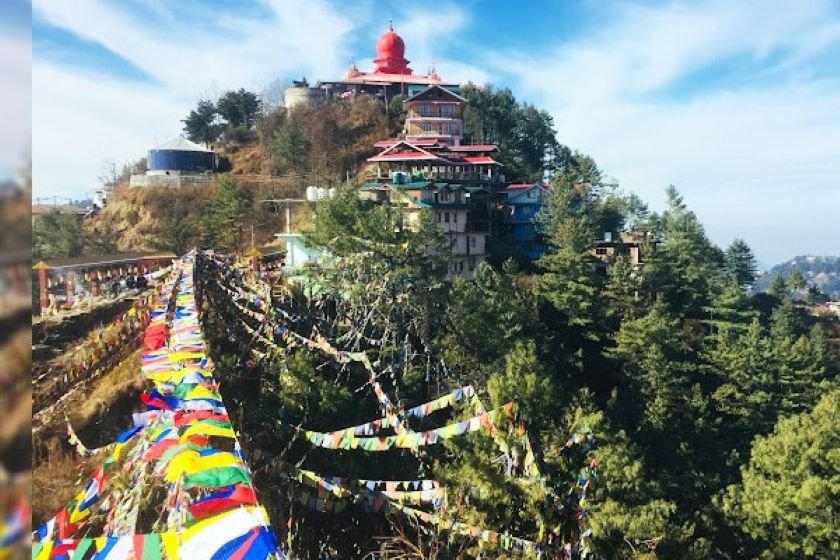
Some temples exist because a landscape demanded one — a spring, a cave, a peak too striking to leave unmarked. Others exist because a single person insisted, and everyone after them simply agreed to keep insisting too. Dhingu Mata’s temple belongs firmly to the second kind. There’s no ancient natural feature at its center, no river confluence or sacred rock — just a hilltop a local ruler once dreamed about, and a goddess who, as the story goes, asked to be given a home there. Centuries on, Shimla has grown up and around that hill on every side, tunnels and colonies pressing right up against its base, and yet the climb to the top still feels like stepping briefly out of the city rather than further into it.
🌄 Location & How to Reach It
The temple sits atop Dhingu Dhar, a hill rising above the Sanjauli neighbourhood on Shimla’s eastern side — a short local hop from the city’s famous Ridge and Mall Road rather than a separate journey out of town, with different sources putting that distance anywhere from about 2 to 10 kilometres depending on exactly which point in central Shimla you’re measuring from. A narrow link road climbs from Sanjauli market to a small municipal parking area near the top, though it’s tight enough that only small vehicles attempt it comfortably; most visitors either drive up cautiously or park below and walk.
Google Maps: Get Directions
No independently verified GPS pin exists for this piece, so treat Sanjauli market — a well-known, easily located landmark in its own right — as your reference point and follow the signed link road uphill from there.
Elevation is generally given as around 2,390 metres above sea level, based on figures from the temple’s own managing committee.
- By road: Local buses, autos, and taxis run from anywhere in Shimla to Sanjauli; from there it’s the link road or the stairway up
- By stairs: A winding flight of pink-painted steps — variously counted at around 300 to 400, depending on the source — climbs directly up the hillside for anyone who’d rather walk than drive
- By rail: Shimla’s own railway station is only a few kilometres away; the broad-gauge junction at Kalka, where the narrow-gauge heritage line begins, is about 90 km further down
- By air: Jubbarhatti Airport, roughly 20–25 km from Shimla, is the nearest airstrip
Compared to Himachal’s remote hill shrines, this is about as easy a “climb to a goddess” as it gets — a genuine urban hilltop, reachable well within an afternoon, with the city’s traffic noise fading out almost as soon as you start up the stairs.
🌸 Best Time to Visit
Shimla’s overall climate makes this an easy temple to visit across most of the year, but two stretches stand out: March through June, before the monsoon sets in, and again from roughly July to September, once the heaviest rains ease. Winter brings the cold that Shimla is famous for, and heavy snow can occasionally interrupt the temple’s regular weekly rhythms, including its Sunday community meal. If your visit coincides with Navratri, expect the temple considerably busier and more animated than on an ordinary weekday, with nine days of continuous recitation drawing steady crowds from across the city.
🕉️ The Legend: A King’s Dream, A Goddess Without Her Own Name
The story told most consistently here doesn’t begin with the goddess choosing her own identity — it begins with someone else’s sleep. A local ruler named Dhingu, the tradition goes, found the goddess Durga appearing to him in a dream, telling him plainly that she wished to be consecrated in a temple of his making. Rather than treat this as an idle dream, the raja took it as a direct command, and had a temple built on this hilltop in her honor. What’s quietly striking about the story, if you sit with it, is that the goddess enshrined here never really receives her own separate name in the retelling — she becomes known simply as Dhingu’s goddess, Dhingu Mata, the deity folded permanently into the identity of the king who obeyed her. The hill itself, Dhingu Dhar, carries the same borrowed name.
A second, less commonly repeated tradition — kept alive mainly by the temple’s own managing committee — offers a quieter, less royal origin: that the site was first recognized and established not by a king at all, but by an unnamed ancient sage who sensed the spiritual charge of the hilltop long before anyone built anything on it. Whether that sage’s recognition came before Raja Dhingu’s dream, fed into it, or represents a separate, older layer of memory that later got absorbed into the more dramatic royal story, isn’t something any single source resolves — and it’s honestly not clear that the two accounts were ever meant to be reconciled into one clean timeline.
What is worth saying plainly is that neither story comes with a date attached. Various sources describe the temple as roughly two centuries old, or more vaguely as “over a century” old, without agreeing on which, and no independently verifiable founding date for Raja Dhingu himself — or evidence he can be tied to a specific historical period — turned up in the course of researching this piece. The dream, the obedient king, and the goddess who took his name: it’s a good story, told with real conviction locally, and it’s fair to enjoy it as exactly that without needing it to double as settled history.
🙏 What the Deity Is Known For
Dhingu Mata is worshipped principally as a form of Durga, and devotees describe her, in the same broad terms used for the goddess across Himachal, as someone who fulfills the sincere wishes of those who climb up to ask. She isn’t tied to one narrow specialty the way some smaller village deities are — people come here with health worries, family concerns, and general appeals for protection and good fortune, much as they would at any well-regarded Durga shrine. What distinguishes this temple isn’t a unique ritual specialty but its place in the rhythm of a specific neighbourhood: it functions as much as a community anchor for Sanjauli as a pilgrimage destination in its own right, evident in the weekly Sunday langar that’s served here regardless of who shows up, without any distinction of background.
🏛️ The Temple Itself
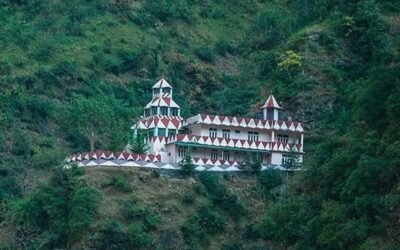
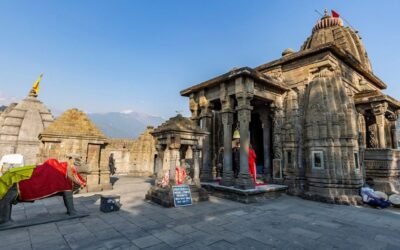
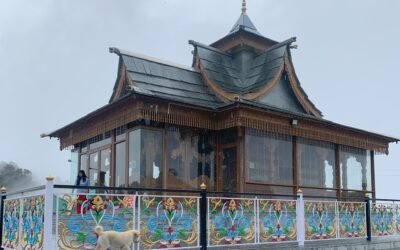
The temple is a compact, rectangular structure built in a blend of wood, stone, and glass rather than the heavier all-timber Kathkuni style found in some older Himachali shrines — bands of stone and glass run along its outer walls, and the roof itself continues that same wood-and-glass combination. Two bronze lion figures stand sentinel at the entrance, a detail visitors often mention first. Inside, Durga’s image sits at the center of the main hall, while a separate smaller shrine nearby houses a large Shiva lingam, and other subsidiary images — Rama, Ganesha, Hanuman, and additional forms of Shakti among them — are kept behind glass elsewhere in the complex. In front of the main shrine, a yagna kund holds an akhand jyoti, a flame the temple describes as having burned without interruption for many years, drawing its own share of curious visitors independent of the goddess herself. Step outside onto the hilltop proper, though, and the temple’s real second attraction becomes obvious: Shimla’s rooftops spread out below in one direction, the green stretch of the Naldehra valley visible in another, and on a clear day, a genuine sweep of the outer Himalayan ranges beyond both.
📜 Sanjauli, Shimla, and a City Built on Its Hills
Dhingu Dhar sits within a wider Shimla neighbourhood that has grown considerably since the British first turned this cluster of hills into their summer capital in the mid-1800s. Sanjauli itself lies just beneath the far more famous Jakhu Hill, home to the towering Hanuman statue that’s become one of Shimla’s best-known landmarks, and the temple’s setting reflects a pattern repeated across the city — a hilltop shrine tucked just above a busy residential quarter, close enough to reach on foot or by short taxi ride, distant enough in feel to offer a genuine pause from it. As Shimla has expanded, Sanjauli has become one of its denser, more built-up suburbs, and in 2021 the state government floated plans, under the Smart Cities Mission, to install an escalator connecting the Sanjauli road directly to the temple — a proposal that captures rather neatly how this particular shrine sits at the exact meeting point of old devotion and a fast-modernizing hill capital. Whether that escalator has since been built, delayed, or shelved isn’t something this piece can confirm with certainty, and is worth checking locally before you assume it’s there.
🎉 Festivals and Devotion
- Navratri (both spring and autumn observances) — the temple’s busiest period, with continuous Durga Saptashati recitation carried out across all nine days
- Weekly Sunday Bhandara — a free community meal served to all visitors regardless of background, paused only during the heaviest winter snowfall
- Daily worship — the temple opens as early as 5:00 a.m., with devotees visiting quietly through the rest of the day outside the major festival dates
🏞️ While You’re in the Area
- Jakhu Temple — Shimla’s best-known hilltop shrine, home to a towering Hanuman statue and equally sweeping views, a short distance away
- The Ridge and Mall Road — Shimla’s historic civic and commercial heart, easily combined with a Dhingu Mata visit given how close the two are
- Tara Devi Temple — another of Shimla’s hill goddesses, offering a natural point of comparison for anyone interested in the city’s several hilltop Devi shrines
- Naldehra — visible in the distance from Dhingu Dhar itself, and worth the fuller half-day trip separately for its golf course and open meadows
- Kali Bari Temple — a Bengali-founded Kali shrine on Jakhu Hill, offering a very different architectural and devotional flavor within the same short radius
❓ Quick Questions Travellers Ask
Is there an entrance fee? No. The temple is free to visit, with no tickets or advance booking required.
Can I drive all the way up, or do I need to walk? Small vehicles can manage the narrow link road to the parking area near the top, but the road is steep and tight enough that many visitors choose to park below in Sanjauli and either walk up the road or climb the pink stairway instead.
How difficult is the climb? It’s a genuine uphill walk rather than a stroll — manageable for most reasonably fit visitors, but worth knowing in advance if mobility is a concern, since there’s no vehicle alternative all the way to the door for larger cars.
Is photography allowed inside the temple? General photography around the hilltop and temple grounds is fine; it’s simply courteous to be more restrained during active worship or inside the main prayer hall.
Is the Sunday langar open to everyone? Yes — it’s served without regard to religion, caste, or background, in keeping with the temple’s own stated approach to the weekly meal.
A Last Word
There’s a particular kind of comfort in a temple that owes its existence to something as ordinary as someone’s dream, rather than a miracle no one can fully explain. Dhingu Mata’s hill hasn’t stayed untouched by the city growing up around it — the tunnels, the colonies, the escalator proposal all point to a shrine steadily being folded into Shimla’s daily infrastructure rather than kept apart from it. And yet the climb still does what climbs to hilltop goddesses have always done: it puts a small, deliberate distance between where you started and where you end up, just enough to notice the view, and the quiet, before heading back down into the city.
Fact-check note: The temple’s location atop Dhingu Dhar above Sanjauli, its dedication to Durga, the founding legend involving Raja Dhingu’s dream, the Sunday langar, and the presence of a continuously burning flame are corroborated across Wikipedia, the temple’s own managing committee’s website, and multiple independent travel sources. However, sources disagree meaningfully on several specifics that this piece hasn’t tried to force into false precision: the number of steps is given as both roughly 300 and 400; the temple’s age is described inconsistently as around 200 years old versus “more than a century”; and the distance from central Shimla ranges from about 2 to 10 km depending on the source and starting point used. One source’s stated elevation figure (2,438 m, apparently attached to an unrelated Kullu valley reference) appears to be an error and has been excluded in favor of the temple committee’s own figure of roughly 2,390 m. No independently verified GPS coordinates were available, so Sanjauli market has been used as a landmark reference instead. The 2021 escalator proposal is confirmed as having been announced, but this piece could not verify its current construction status, and that should be checked locally before a visit if it matters to your plans.