On a pine-covered hill above Solan, a wandering sage’s decades-long building project rises tier by tier toward a title that almost nobody can agree on the exact numbers for.
Most of Himachal’s great temples ask you to take their scale on faith, since nobody was measuring anything when they were first built centuries ago. Jatoli is the rare exception — a temple young enough that its own construction was witnessed, funded, and finished within living memory, and yet somehow it’s managed to attract just as much numerical disagreement as any ancient shrine. Ask how tall it actually is, or how far it sits from Solan, or even exactly when its founder first arrived here, and you’ll get a different answer depending on which sign, brochure, or blog you’re reading. What nobody disputes is the more important fact: four decades of donated labor and devotee money turned a sage’s meditation spot into one of the most striking pieces of temple architecture in the state.
🌄 Location & How to Reach It
Jatoli Shiv Temple stands on a hilltop in Jatoli village, just off the Solan–Rajgarh road, a short distance outside Solan town itself in Himachal Pradesh’s Solan district. Estimates of the exact distance from Solan’s city center vary noticeably by source — anywhere from 6 to 10 kilometres depending on which point in town you measure from — but in practical terms it’s a quick, uncomplicated side trip rather than a separate expedition.
Google Maps: Get Directions
Elevation is given by at least one source as roughly 1,300 metres, broadly consistent with Solan’s own mid-hill setting, though this figure could not be independently cross-confirmed and should be treated as approximate.
- By road: Regular taxis and local buses connect Solan town to Jatoli village; the approach road is well maintained, with a short uphill walk from the parking area through pine-lined paths covering the final stretch
- By rail: Solan’s own railway station, on the Kalka–Shimla heritage line, is only a few kilometres away; the broad-gauge junction at Kalka is roughly 45 km further down
- By air: Chandigarh International Airport, about 55–60 km away, is the nearest airport, with the drive to Solan typically taking two to three hours
This is a genuinely easy temple to reach compared to many of the state’s hill shrines — a short, well-paved approach with only a brief final climb, making it a comfortable stop for families and older visitors alike.
🌸 Best Time to Visit
Solan’s mid-elevation climate keeps this temple accessible for most of the year, with March through June and again September through November offering the clearest, most comfortable conditions for the walk up and the views from the courtyard. Winters are cool but rarely severe enough to close the site, and the monsoon months bring lush surroundings at the cost of occasional slippery paths. If your visit can line up with Mahashivratri, expect the courtyard at its fullest, with night-long worship and a noticeably different atmosphere than an ordinary weekday visit.
🕉️ The Name: A God’s Locks, or Just a Fitting Word for an Ascetic’s Hill
The temple’s name is the natural place to start, and depending on which telling you follow, it means one of two rather different things. The more dramatic version holds that Lord Shiva himself once passed through these hills during his wanderings, and that his jata — his long, matted ascetic locks — brushed against this particular hilltop, leaving it forever marked as his own ground. A second, quieter reading treats “Jatoli” less as a literal claim about Shiva’s hair touching this exact spot and more as a fitting name for any site associated with his ascetic form, the temple’s own rising, cascading tiers echoing the shape of those locks as they fall. Both versions are told locally with real conviction, and there’s no way to establish which came first, or whether the architectural echo inspired the name or the name inspired the architecture. It’s worth simply enjoying that ambiguity rather than forcing a single answer onto it.
🕉️ A Sage’s Penance and a Spring That Never Ran Dry
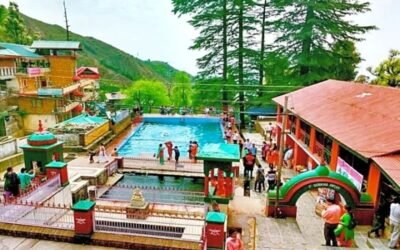
The temple’s more concrete, better-documented history begins with a wandering ascetic remembered as Swami Krishnananda Paramahansa, who is said to have arrived in this area sometime around 1950 — some accounts place his arrival more vaguely in the early twentieth century, without a firm date attached. Jatoli, by most tellings, was then a place struggling with a genuine water shortage, and the swami is said to have undertaken years of intense penance specifically to appeal to Shiva on the village’s behalf. According to the story, Shiva answered by striking the ground with his trident, and a spring rose up on the spot — water that has never run dry since, now channeled into the temple’s Jal Kund, a tank locals compare in sanctity to the Ganga itself and credit with the power to ease skin ailments in those who bathe in or drink it.
It was this same swami who, decades later, set the temple’s actual construction in motion, laying its first stones in 1974 after years of living and meditating in a small cave still preserved within the complex today. He did not live to see the project finished — he took samadhi in 1983 — but the temple trust that succeeded him kept building, entirely on devotee donations, for years afterward, with some accounts putting the total construction timeline at roughly thirty-nine years from first stone to completion. It’s this detail, more than the trident or the spring, that gives Jatoli its most genuinely distinctive quality among Himachal’s temples: an origin story rooted not in ancient, unverifiable antiquity, but in one identifiable person’s documented, multi-decade project, carried forward by a community after he was gone.
🙏 What the Deity Is Known For
Shiva is worshipped at Jatoli in the form of a swayambhu (self-manifested) Shivlinga, believed to have emerged from the earth rather than been carved and installed — a detail that matters to devotees precisely because it frames the temple’s location as chosen by the deity himself rather than by any human founder. Some accounts describe the linga itself as an unusually rare, glass-like translucent form, encased in silver alongside representations of Vishnu and Brahma. Devotees come here for the full range of concerns typically brought to Shiva — general prayers for wellbeing and protection, alongside specific hopes around family and fairness in disputes — offering red flags, coconuts, and sweets, and performing abhishek with the spring water drawn from the temple’s own Jal Kund.
🏛️ The Temple Itself
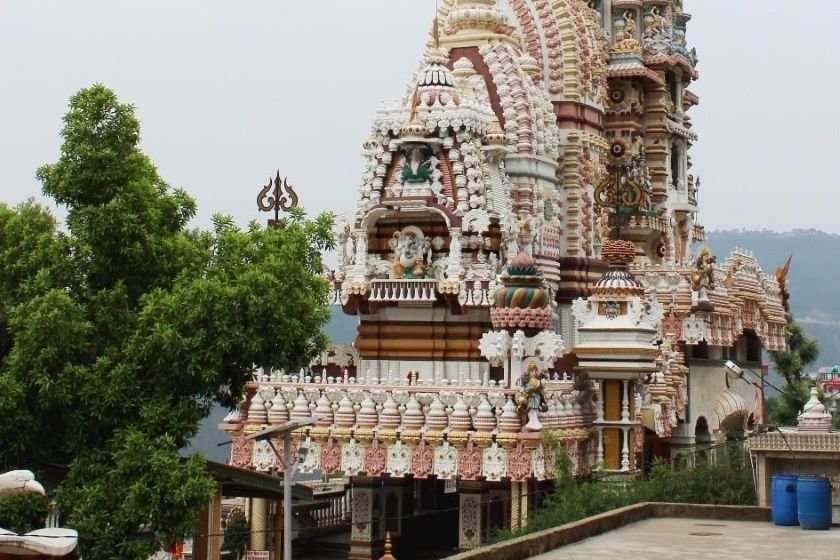
Jatoli’s defining feature is its height, built as a three-tiered pyramidal structure in a style that blends South Dravidian architectural conventions with North Indian influences, rising to a spire that most sources place at either 111 or 122 feet — a discrepancy substantial enough that it’s worth knowing about rather than repeating one figure as settled fact. Whichever the true number, it stands tall enough to be locally described as Asia’s tallest Shiva temple, a claim repeated so consistently across sources that it’s clearly part of the site’s own identity, even though no independent authority verifying “tallest in Asia” specifically turned up in research for this piece. The three ascending tiers each carry their own carved figure — Ganesha at the base, Sheshnag the serpent partway up, and a trident near the summit — with the whole structure topped by a golden kalash. Inside, a small preserved cave marks where Swami Krishnananda is said to have meditated, and a number of visitor accounts mention a curious acoustic detail: that certain stones within the complex, when struck, produce a sound resembling a damru drum. It’s a delightful claim, and one repeated widely enough locally that it’s clearly part of the temple’s living folklore — though it’s the kind of detail best experienced and judged for yourself rather than taken purely on faith.
📜 A Modern Temple in an Old Devotional Landscape
Solan’s identity as a district has always leaned more toward colonial-era commerce — the old brewery, the market town on the Kalka–Shimla road — than toward ancient pilgrimage, which makes Jatoli’s rise over the second half of the twentieth century a distinctive counter-thread in the district’s story. Rather than predating British Shimla the way some of the state’s older shrines do, Jatoli grew up alongside independent India itself, its four-decade construction timeline running roughly from the 1970s into the early 2010s — meaning much of what visitors see today was literally built within living memory, funded stone by stone through ordinary donations rather than royal patronage. It sits within a wider cluster of Solan-area devotional sites, including the well-known Shoolini Mata Temple closer to town, giving the district a small but genuine constellation of shrines worth exploring together.
🎉 Festivals and Devotion
- Mahashivratri — the temple’s largest gathering, marked by bhajans, havans, and community feasts drawing devotees from across the region
- Shravan Mondays — special abhishek and offerings observed through the monsoon month
- Daily worship — morning and evening aartis, incense offerings, and the chanting of Rudram and Shiva stotras, maintained year-round
🏞️ While You’re in the Area
- Shoolini Mata Temple — a well-known Shakti shrine closer to Solan town, roughly 3 km away, and a natural pairing with a Jatoli visit
- Mohan Shakti Heritage Park — a cultural and spiritual complex nearby, worth a stop for a very different kind of attraction
- Karol Tibba — a scenic trek with its own mythological associations, for anyone wanting to extend the visit into a longer outing
- Solan Brewery and Market — a slice of the town’s colonial-era commercial history, offering a good contrast to the temple’s devotional atmosphere
❓ Quick Questions Travellers Ask
Is there an entrance fee? No. Entry to Jatoli Shiv Temple is completely free.
Is Jatoli really the tallest Shiva temple in Asia? It’s consistently described that way locally and across most tourism sources, though the exact height quoted varies between 111 and 122 feet depending on the source, and no independent authority confirming the “tallest in Asia” title specifically was found in researching this piece. It’s safest to treat the claim as strongly held local pride rather than an independently certified record.
Can I actually go inside the meditation cave? Yes — the small cave associated with Swami Krishnananda Paramahansa is preserved within the temple complex and is generally open for visitors to enter and pray.
Is the climb to the temple difficult? No. It’s a short, well-maintained approach with only a brief uphill walk from the parking area, manageable for most visitors including families with children or older relatives.
Is the Jal Kund water safe to drink? Local tradition holds it has healing properties, particularly for skin conditions, but as with any natural water source, exercise the same ordinary caution you would anywhere else, and don’t treat it as a substitute for medical care.
A Last Word
There’s something quietly reassuring about a temple whose grandest claims — its height, its title, its exact age — remain genuinely, openly disputed, while the thing that actually built it is beyond argument: a sage’s decades of devotion, and a community’s willingness to keep laying stones long after he was gone. Whether Jatoli stands at 111 feet or 122, whether Shiva’s own locks brushed this exact hilltop or simply lent it a fitting name, the spire climbing above Solan’s pines is the same either way — a testament less to a single miraculous origin than to what four decades of ordinary people, giving what they could, are capable of building together.
Fact-check note: This piece deliberately omits a claim found in a previous article about this temple — that “the goddess is worshipped in the form of three pindis, representing Maha Kali, Maha Lakshmi, and Maha Saraswati.” No source consulted for this piece corroborates that claim, and it does not fit a temple whose central deity is Shiva; it appears to be a boilerplate paragraph carried over in error from an unrelated goddess-temple article, and has been removed rather than repeated. Separately, sources disagree meaningfully on several figures: the temple’s height is given as both 111 and 122 feet, the distance from Solan ranges from 6 to 10 km depending on source, and Swami Krishnananda Paramahansa’s arrival date is variously placed around 1950 or more vaguely in the “early twentieth century.” The temple’s construction dates (1974 start, 1983 samadhi, multi-decade completion) are corroborated consistently across multiple sources. The claim of stones producing a damru-like sound when struck, and the “tallest Shiva temple in Asia” title itself, are widely repeated local traditions rather than independently verified facts, and are presented here as such.