They say a god once came down to this valley disguised as a yak herder, took nothing more than a halter rope, measured out a square on the frozen ground — and by morning, the temple was standing.
Quick note before diving in: aguidetohimachal.com already touches on this temple within a broader piece, “Charang Village – Where Silence Guards the Holiest Temple of Kinnaur,” which treats it as one stop within a village profile. This piece takes the temple itself as the subject rather than the village, so the angle and depth differ meaningfully from that existing coverage.
Most Himachal temples are dated to a century, a king, or a dynasty. This one is dated to a single night. Deep in Kinnaur, past the last permanently inhabited village before the Indo-Tibet border, an 11th-century shrine sits below one of the district’s most demanding peaks — a temple so old and so remote that its own founding legend doesn’t bother with construction timelines at all. It simply says a god built it, alone, before dawn.
🌄 Location & How to Reach It
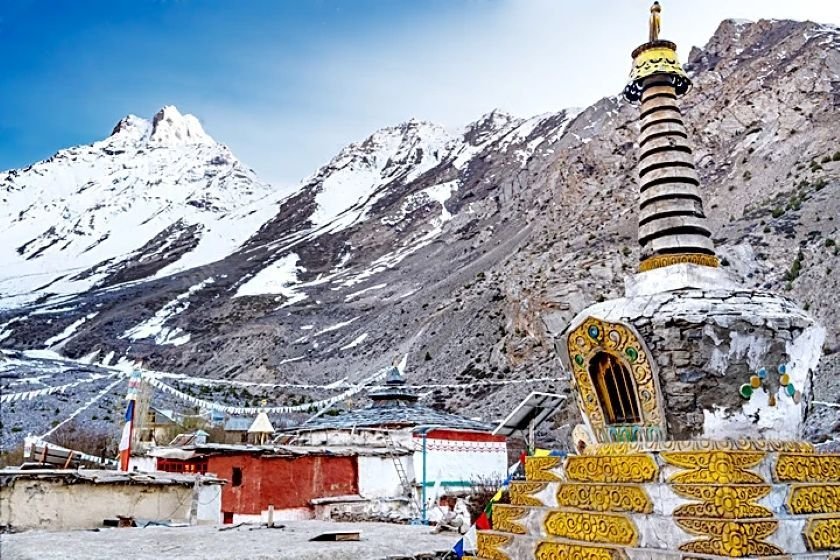
The temple sits roughly 1–2 km beyond Charang village, the last settlement along this stretch of the Indo-China border, at an elevation of about 3,400 meters. Charang itself is reached via a road that branches off NH5 at the Moorang bridge, deep in Kinnaur’s upper reaches — this is proper high-altitude, border-zone territory, not a casual day trip from Reckong Peo.
Google Maps: Get Directions
Elevation: ~3,400 m at Charang village; the temple sits a short distance above it.
- By road: Reach Charang via the NH5 turnoff at Moorang bridge; onward travel through Kinnaur to this area typically requires a private vehicle or shared taxi, as public transport thins out considerably this far up the valley.
- By rail: No practical rail access — Shimla is the nearest railhead, many hours away.
- By air: Shimla Airport is the closest option, though most travelers arrive via Chandigarh and drive the long route up through Kinnaur.
From Charang, it’s an easy 20-minute walk to the temple itself — gentle compared to what it took to get this far into the valley in the first place. This is not an easy stop tacked onto a longer trip; reaching Charang alone is a serious undertaking, and the temple should be thought of as a reward for having already committed to the journey, not a quick detour.
🌸 Best Time to Visit
Given the altitude and border location, this is very much a seasonal destination — accessible realistically only in the warmer months, roughly June through September, before snow and security considerations close the route. There’s no formal darshan timing here in the way a valley temple has visiting hours; access depends far more on road conditions, weather, and the temple’s resident nuns being present than on a printed schedule. Charang has no mobile network coverage — just two BSNL landlines, one in the village and one at the ITBP post — so this is also a place to visit with the expectation of being properly, temporarily unreachable.
🕉️ The God Who Built It in a Night
The temple’s name carries its own origin story. Rangrik Tungma is said to mean “God-made Temple,” and the legend behind it is refreshingly literal: a god descended into the valley, took the form of an ordinary yak herder, and using nothing more than a yak-halter rope to mark out the dimensions, built the entire structure in the span of a single night. It’s a modest kind of miracle — no thunderbolts, no cosmic battles, just a god quietly doing manual labor before anyone was awake to see it — and it fits the temple’s own character: unadorned, weathered, and entirely unconcerned with impressing anyone.
🕉️ The Goddess Who Rode In Before Buddhism Did
The second story here belongs to the deity the temple takes its name from. Rangrik Tungma herself is represented inside by a small metal image of a goddess astride a horse — the oldest object in the temple, predating everything else within its walls. Scholars examining the site believe she was very likely a pre-Buddhist deity, worshipped in this valley long before Buddhism arrived, and later folded into the newer religion’s pantheon rather than displaced by it — a pattern common across the Himalayan borderlands, where older mountain and horse-riding goddesses were absorbed rather than erased. It’s worth being honest about the limits here: nobody can say with certainty who she was before that absorption, only that she clearly mattered enough to survive it.
🙏 What the Temple Is Known For
Today Rangrik Tungma functions as a Tara temple — dedicated to Tara, the female embodiment of Buddhist enlightenment — and is cared for by resident nuns rather than monks, a detail that shapes its whole atmosphere. It’s also considered one of Kinnaur’s holiest sites and a recognized stop on the Kinner Kailash Parikrama, the circumambulation route around the sacred Kinner Kailash massif that draws pilgrims from both Hindu and Buddhist traditions — a reminder that in this part of Kinnaur, the two faiths have long worshipped side by side rather than separately.
🏛️ The Temple Itself
Inside, a single small window lights the main chamber, filling it with the kind of dim, concentrated atmosphere old Himalayan gompas are known for. Alongside the horse-mounted goddess, two other bronze images stand out for their age and craftsmanship: a Maitreya seated with legs pendant in bhadrasana, and a Buddha in bhumisparsha mudra — the earth-touching gesture. The walls of the main hall are set with clay idols arranged in a style echoing the famous mandala in the dukhang at Tabo Monastery, one of the great old Buddhist sites of the wider Himalayan region — a striking connection for a temple this isolated to share visual DNA with. The temple also holds an old collection of cream-colored, bone-handled knives and daggers, and local memory holds that centuries ago a raiding party crossed over from the Tibetan side and looted the site — a rare acknowledgment, in a place this sacred, that holiness hasn’t always meant safety.
📜 A Peak Named After Its Own Shrine
The mountain towering above this valley, Rangrik Rang, rising to 6,553 meters, takes its own name directly from the temple below it — a rare case of a peak being named for a shrine rather than the other way around. First summited in 1994 by a joint Indo-British mountaineering team, Rangrik Rang remains a serious, technical climb, and expeditions attempting it have historically stopped at the temple for blessings before heading up the glaciers beyond. It’s a small but telling detail about how deeply this shrine is woven into the identity of the landscape around it — even the mountain answers to its name.
🎉 Festivals and Devotion
Formal festival dates for this specific temple are not well documented in available sources — its devotional rhythm appears tied more to the Kinner Kailash Parikrama pilgrimage calendar and the resident nuns’ own religious observances than to a single annual mela. Visitors passing through as part of the parikrama, or mountaineering expeditions heading toward Rangrik Rang, have historically been offered a puja by the temple’s nuns before continuing onward.
🙏 Getting in Touch
There’s no phone number, booking system, or visitor office for this temple — it’s cared for by resident nuns in one of the most remote corners of Kinnaur. Given the location’s proximity to the Indo-China border, it’s worth checking current security and permit requirements locally in Reckong Peo or with Charang’s ITBP post before planning a visit, as access to border-adjacent areas in this region can shift. Beyond that, asking locally in Charang village is the only reliable way to confirm current conditions.
🏞️ While You’re in the Area
- Charang village — the last inhabited settlement before the border, worth time on its own for its Tibetan-style stone-and-mud architecture
- Kinner Kailash Parikrama route — the broader circumambulation trek this temple sits along
- Rangrik Rang base areas — for serious trekkers and climbers only, given the technical terrain beyond
- Sangla Valley — a more accessible, lower-altitude stop for travelers approaching from further down the valley
❓ Quick Questions Travellers Ask
Is this a Hindu or Buddhist temple? Buddhist — specifically a Tara temple cared for by nuns, though its central goddess is believed to predate Buddhism’s arrival in the valley.
How difficult is it to reach? Reaching Charang village itself is the hard part, given the altitude, distance, and remote roads; the walk from the village to the temple is an easy 20 minutes.
Do I need a permit to visit? Given the border-zone location, it’s worth checking current requirements locally before traveling — access rules in this area can change.
Is there mobile signal at Charang? No — only two BSNL landline connections serve the entire village and the nearby ITBP post.
What’s the best time of year to go? Roughly June through September, before winter snow and access conditions close the route.
A Last Word
There’s a particular quiet to a temple that a god supposedly built alone, overnight, with nobody watching — no audience to impress, no monument to prove a point. Standing before the small bronze goddess on her horse, older than everything else in the room, it’s hard not to feel that Rangrik Tungma has spent a thousand years exactly the way it was built: without fuss, without spectacle, just holding its ground quietly at the edge of the map.
Fact-check note: The distance from Charang to the temple is given as either 1 km or 2 km depending on source; this piece uses the range rather than picking one. The “God-made Temple” translation and yak-herder founding legend come from a single detailed source (American Alpine Club expedition report) and should be understood as local oral tradition rather than an independently corroborated historical account. No independently verified GPS pin exists for the temple itself, so the Maps link points to Charang village as the nearest reliable reference point. Formal festival dates specific to this temple were not found in available sources and are honestly described as undocumented rather than invented. This is the second piece the site has touched on this temple; the existing “Charang Village” article treats it as one feature within a village profile — this piece is built around the temple itself as the primary subject, with deeper detail on its two founding legends, its bronze images, and its connection to Rangrik Rang.