Eight kilometres from Hamirpur town, between two streams that never stop running, sits a Shiva lingam that a local king once tried and failed to carry away — and the temple built, quite literally, around the spot where it refused to move.
There’s a recurring shape to temple legends across Himachal’s smaller villages: a farmer, an ordinary day, a plough, and something buried in the earth that turns out not to be a stone at all. Gasota Mahadev Temple is one of the clearest, most stubbornly persistent versions of that story in Hamirpur district. What makes it worth telling in full isn’t just the discovery — it’s what happened afterward, when powerful men decided the discovery belonged somewhere grander, and the discovery itself disagreed.
🌄 Location & How to Reach It
- Location: Gasota village, on the Hamirpur–Jahu road (via a short diversion at Dosarka off NH-88), Hamirpur district, Himachal Pradesh
- Distance: Roughly 8–9 km from Hamirpur town
- Google Maps: Get Directions
- GPS Coordinates: Not independently verified for this piece — use the map link above, or search “Gasota Mahadev Temple, Hamirpur” directly on Google Maps for a precise pin before travelling
- Elevation/terrain: Hamirpur district sits at a comparatively low, gentle elevation for Himachal — mostly rolling hills rather than mountain passes — and the temple itself sits low, between two rivulets, rather than up on a ridge
- By road: Local buses and taxis run regularly from Hamirpur bus stand along the Hamirpur–Jahu road; if you’re unsure of the Dosarka diversion, it’s worth asking locally rather than relying on signage alone
- By rail: Una is the nearest railhead, roughly 60–65 km away, with onward road transport required
- By air: Gaggal Airport (Kangra) is the nearest, around 85–90 km away, with a drive via Hamirpur to follow
Compared to Himachal’s higher-altitude shrines, this is about as easy an approach as village temples get — a short, flat drive off a national highway, no trekking, no seasonal closures to plan around.
🌸 Best Time to Visit
Summer, from March through June, brings out the best of Gasota — full streams, green fields, and comfortable walking weather around the temple grounds. Monsoon changes the character of the water here: the pools nearby take on a deep green tinge from algae, which some find beautiful and most find better admired than swum in. For the fullest sense of what this temple means to its village, though, timing a visit for Mahashivratri or the Gasota Cattle Fair in mid-to-late May gives you the place at its most alive rather than at its quietest. No formal timings are published, but like most panchayat-run village shrines in the district, it’s open through daylight hours.
🕉️ The Legend: A Plough, A King, and a Stone That Would Not Leave
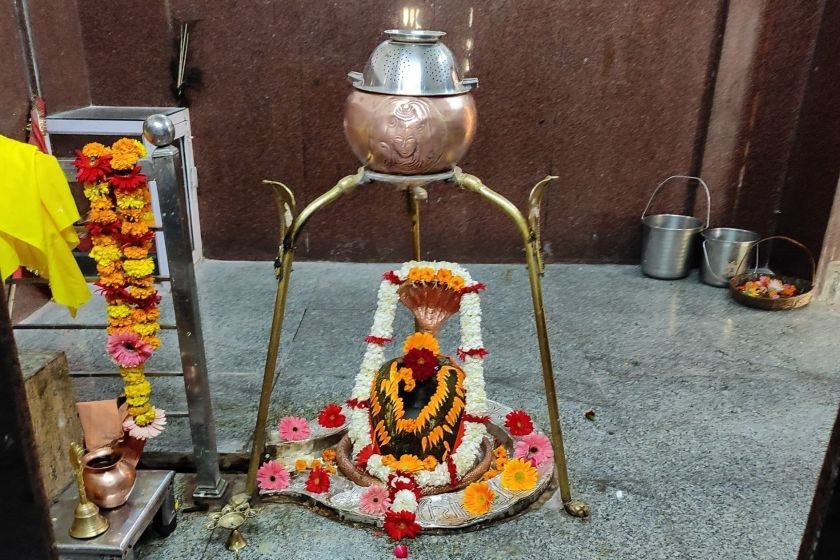
The story Gasota tells about itself starts in a field, not a sanctum. A farmer was out ploughing his land one ordinary day when the blade struck something buried and unmoving — not a root, not a rock, but a Shiva lingam, large enough that unearthing it took real effort, and marked, in some tellings, with a visible crack that’s still part of the idol today.
Word of the find travelled the way it does in small villages, and it eventually reached a local king, who decided a discovery like this deserved a home worthy of it — his own seat, not a farmer’s field. He sent men to lift the lingam and carry it back. They couldn’t move it. More hands were brought, more rope, more determined effort, and still the stone would not budge from the ground it had been found in. Eventually, with no other option, the king’s men gave up on relocation entirely, and the community did the only thing left to do: they built the temple where the lingam already was, rather than moving the lingam to where a temple already stood. That structure, expanded and maintained across generations since, is what stands in Gasota today.
There’s a second, older thread some in the region weave into this story — one that reaches back into the Mahabharata rather than village memory. It holds that the perennial stream running beside the temple traces its origin to Bhima, one of the five Pandava brothers, striking the ground with his mace during the Pandavas’ travels through these hills, opening a spring that has reportedly never run dry since. A separate, less widely corroborated tradition describes the lingam itself as bearing three distinct marks — associated with water, milk, and blood — each tied to a specific miraculous episode. This detail appears in far fewer sources than the core plough-and-king story, and is best treated as a secondary local tradition rather than the temple’s primary, most-attested legend.
What every version agrees on, though, is the basic shape of the story: something sacred was found here by accident, someone powerful tried to claim it elsewhere, and the attempt failed decisively enough that an entire temple got built around the refusal.
🙏 What the Deity Is Known For
Gasota Mahadev is, above all, a rain temple. When Hamirpur’s unpredictable hill weather tips into drought — a real and recurring concern in this agricultural belt — villagers gather here and offer water directly onto the lingam, treating the act as both plea and ritual. Local memory holds that the streams beside the temple respond to sincere prayer here, beginning to flow more strongly once the ritual concludes, and that renewed flow is read as confirmation that rain itself is on its way. Whether taken literally or as devotional metaphor, the practice is long-standing and genuinely observed, not staged for outside visitors.
Beyond the rain ritual, this isn’t a temple built around miracle tourism or grand pilgrimage claims. It doesn’t carry the pan-Himachal recognition of a Baba Balak Nath or a Jwala Ji, both a short drive away, and it doesn’t try to. People come for straightforward devotion — a stop before Mahashivratri, a prayer on the way to somewhere bigger, a half hour with a god that, as one local account of the temple put it, blesses through silence and shade rather than spectacle. Its modesty is very much part of its character, not a shortcoming.
🏛️ The Temple Itself
Don’t expect soaring shikharas or elaborate stone carving here. Gasota Mahadev is a modest, vernacular Himachali structure — stone-built, low-roofed, the kind of shrine raised and maintained by a farming community over generations rather than commissioned by royal patronage. The sanctum holds the lingam beneath the shade of an old peepal tree, and a reasonably large courtyard sits in front, filling with villagers and visiting traders during festival season and returning to near-total quiet the rest of the year.
Two water streams run along either side of the temple grounds, giving the whole site a constant, low background sound of moving water. A small natural pool nearby has served as an informal swimming spot for generations, though the algae that thickens through monsoon makes it more scenic than swimmable for much of the year. A cow shed and simple inn have been built within the temple complex to accommodate visitors and traders, particularly during the cattle fair. And at the rear of the temple, to one side of the entrance, is a samadhi sthal — a small burial ground where saints who once lived and served at Gasota were laid to rest, a quiet detail that marks this as a site of continuous religious life rather than a single-legend attraction.
📜 Regional Context: A Village Shrine in a District of Old Temples
Hamirpur district’s temple landscape is dense with shrines that predate Himachal’s more famous pilgrimage circuits — Jhanyari Devi, Kalanjari Devi, Narvadeshwar, and others scattered across a relatively small radius, most raised by local communities or minor princely patronage rather than as grand state projects. Gasota Mahadev, believed to be more than 400 years old, sits comfortably within that older, quieter layer. Unlike the Katoch-era royal temples of nearby Sujanpur Tira, built under Raja Sansar Chand’s direct patronage in the late 18th century, Gasota’s origins are agricultural and local rather than dynastic — a farmer’s field rather than a king’s commission, even if a king does appear in the legend as the one who failed to claim it. The temple remains managed today by the village panchayat, a continuity that reflects just how deeply local its identity and upkeep have always been.
🎉 Festivals and Devotion
- Mahashivratri: The temple’s principal devotional occasion, drawing worshippers from across the district for prayer and ritual observance.
- Gasota Cattle Fair: A week-long fair held every year on the first Monday of Jeshtha (mid-to-late May), blending religious devotion with cattle trading — a tradition significant enough that locals sometimes refer to the temple itself by the fair’s name.
- Rain rituals: Informal but recurring, held whenever drought conditions affect the district, drawing villagers to offer water at the lingam as both prayer and practice.
- Daily worship: Simple, low-key rituals maintained by the local community outside of festival season.
🏞️ While You’re in the Area
- Jhanyari Devi Temple: A Durga shrine roughly 6 km from Hamirpur on the Nadaun road, over 200 years old and easily combined with a Gasota visit given the short distance between them.
- Kalanjari Devi Temple: Another two-century-old shrine nearby, known for a legend of a goddess who resisted an attempted relocation of her own — a nice thematic pairing with Gasota’s own tale of a lingam that refused to move.
- Sujanpur Tira: A heritage town with Katoch-era royal temples, painted murals, and fort ruins, worth a half-day on its own and easily combined with a wider Hamirpur temple circuit.
- Baba Balak Nath Temple (Deotsidh): One of the region’s most-visited pilgrimage sites, a natural next stop for anyone building out a fuller day of temple-hopping around Hamirpur.
- Govind Sagar Lake: A change of pace from temple visits, offering boating and open-water views a little further afield.
❓ Quick Questions Travellers Ask
Is Gasota Mahadev Temple hard to find? Not especially, though it helps to ask locally once you’re near Gasota village — the diversion off NH-88 at Dosarka is easy to miss if you’re not specifically watching for it, and signage isn’t heavy.
How old is the temple, exactly? Most sources place it at over 400 years old, though there’s no documented founding date — the age comes down through sustained local tradition rather than an inscription or historical record.
Is the “three marks on the lingam” story something I should expect to hear at the temple? It may come up, but it’s a less widely attested tradition than the core plough-and-king legend, which is what most visitors and locals will tell you first if you ask about the temple’s origin.
Is there anywhere to stay nearby? There’s a basic cow shed and inn within the temple complex itself, built mainly for traders during the cattle fair, but for proper lodging, Hamirpur town — just 8-9 km away — is the nearest reliable option.
Can you swim in the streams near the temple? People do, particularly in summer, though the pool nearby tends to develop an algae tinge during monsoon that makes it more of a scenic feature than a dependable swimming spot at that time of year.
A Last Word
There’s something almost obstinate about Gasota Mahadev — a lingam that a king’s men couldn’t lift, a temple that never outgrew its village origins, a god who’s stayed put through four centuries while louder, larger pilgrimage sites rose up elsewhere in Himachal Pradesh. It isn’t trying to be anyone’s main destination, and it doesn’t need to be. But if you’re already tracing the older, quieter temples of Hamirpur district, the field where a plough struck something it shouldn’t have, and the shrine that was built exactly where that something chose to stay, are worth the short detour off the main road.
Fact-check note: The core legend — a farmer’s plough striking the lingam, and the temple being built where a king’s attempt to relocate it failed — is consistent across multiple independent sources and represents the temple’s well-established, primary local tradition. The temple’s approximate age (400+ years), its location on the Hamirpur–Jahu road, and the Gasota Cattle Fair timing (first Monday of Jeshtha) are similarly well-corroborated. The Mahabharata/Bhima spring-origin story and the specific “three divine marks” (water, milk, blood) detail on the lingam appear in only one source found during research and are presented here explicitly as secondary, less-verified traditions rather than the temple’s central legend. No exact GPS coordinates, priest contact details, entrance fees, or an official founding date could be verified, and none are stated or invented here.