Gayatri Temple, Jagatsukh – Two Stories, One Small Shrine
Ask five people how old this temple is and you might get five different answers — and stranger still, several of them are each partly right
Of all the temples clustered in the old village of Jagatsukh, the Gayatri Temple is the one most likely to leave you a little confused if you’ve done any reading beforehand — and that’s worth addressing honestly before anything else, rather than smoothing it over the way most write-ups do. You’ll find sources confidently calling this a 5,000-year-old temple, and in the very same breath, naming its founder as a specific modern devotee who built it in 1962. Those two claims can’t both be true, and untangling them actually makes for a better, more honest story than picking whichever sounds more impressive.
🌄 Location & How to Reach It
- Location: Jagatsukh village, on the Manali–Naggar road, Kullu District, Himachal Pradesh – 175143
- GPS Coordinates: 32.1983° N, 77.2024° E
- Google Maps: Get Directions
- Altitude: Roughly 1,900 metres
- Distance: About 6 km from Manali, roughly 15 km from Naggar
Jagatsukh sits directly on the Manali–Naggar road, and this temple is part of the same small cluster of shrines that includes the neighbouring Shiva-Parvati (Gauri Shankar) temple. Regular buses and taxis running between Manali and Naggar stop in the village, and the temple itself is only a short walk from the main road — no trek or climb required, making it one of the more easily combined stops on a longer Kullu Valley itinerary.
Getting to Manali first: The nearest airport is Bhuntar (Kullu-Manali Airport), around 50 km away. Most visitors reach Jagatsukh as a short detour on the way to or from Naggar rather than as a standalone destination.
🌸 Best Time to Visit
Sitting right on the road at a relatively gentle altitude, this temple is comfortably visitable year-round. March to June brings mild weather and the surrounding orchards in bloom. September to November offers the clearest views of the mountains, including glimpses toward Deo Tibba from parts of the village. Winter brings snow to the courtyard, which several visitors describe as genuinely beautiful against the old woodwork, though the road stays passable for longer here than at higher-altitude temples elsewhere in the valley.
Temple timings: No formal posted hours exist — it functions as an open village shrine, generally accessible during daylight hours.
🕉️ Untangling Two Temples in One Place
Here’s the honest version of the story. Jagatsukh’s temple cluster includes a genuinely ancient shrine, historically recorded as dedicated to Sandhya Devi — a goddess closely associated with Gayatri in Vedic tradition, since the Gayatri mantra itself is addressed to the goddess across the three sandhyas, the sacred junctures of dawn, noon, and dusk. This is almost certainly the temple locals and older records refer to when they describe an ancient Gayatri shrine at Jagatsukh. Its significance to historians is considerable: an inscription found on stone slabs at this temple, documented by the scholar Hiranand Sastri in the early twentieth century, references a date corresponding to 1428 CE — making it, by several scholarly accounts, the earliest precisely dated temple anywhere in the Kullu Valley.
Separately, and considerably more recently, a new Gayatri shrine was built in 1962 by a devotee named Sri Chidambara Dixit, inspired, according to his own account, by a personal spiritual experience of the goddess’s blessing. This newer temple houses a marble image of Gayatri, and over the following decades, additional deities were installed in stages: an idol of Hanuman in 1977, Ganesha alongside Siddhi, Buddhi, and Shanmukha in 1986, Shiva and Parvati together with the Navagraha deities in 1990, and more recently an image of Vishnu. This is a temple that has visibly grown through ongoing devotion rather than standing untouched since antiquity — which is precisely why the “5,000 years old” claim attached to it in so many places doesn’t hold up. What’s likely happened, across years of travel blogs copying each other, is that the genuine antiquity of the neighbouring Sandhya Devi/Gauri Shankar temple cluster has simply been transferred, inaccurately, onto this newer, separate shrine.
None of this makes the 1962 temple any less worth visiting. If anything, knowing its real, recent, and well-documented history — a devotee’s personal act of faith, expanded thoughtfully over three decades by his community — is a more interesting story than an unverifiable claim of impossible antiquity.
🏛️ What You’ll Actually See
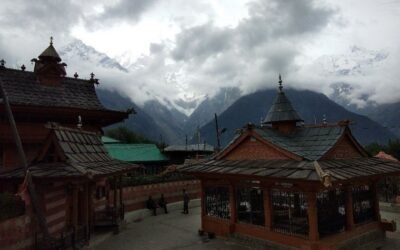
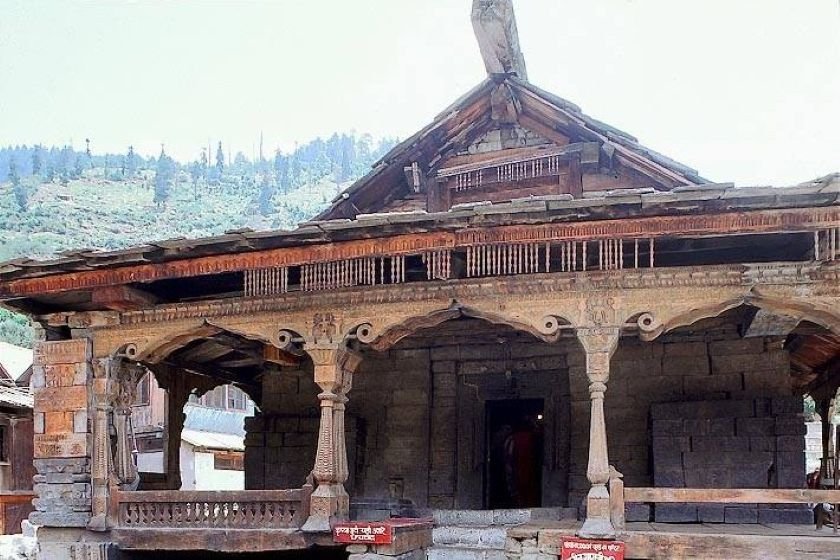
The temple most visitors photograph today is modest and intimate: a small shrine housing the marble Gayatri murti, with the additional deities added over the decades sharing space within the same complex. The woodwork throughout is genuinely fine, in keeping with the broader tradition of carved timber craftsmanship found across Jagatsukh’s older temples, even though this particular building is comparatively young. Visitors consistently describe the atmosphere as unusually peaceful, helped by how few outside tourists make the stop compared to more heavily promoted temples in Manali proper.
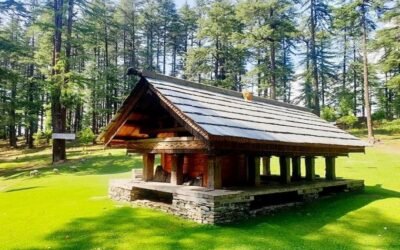
Step behind the temple and you’ll find the older, historically significant Shiva-Parvati shrine standing close by — the two sit almost back-to-back, which is likely another reason their histories have blurred together so often in casual accounts. A large, distinctively tall tree stands near the temple grounds, mentioned by several visitors as a notable feature of the site.
📜 Jagatsukh’s Deeper History
Understanding why any of this matters requires knowing a bit about Jagatsukh itself. Formerly called Nast, this unassuming village served as the original capital of the Kullu kingdom for more than ten generations of rulers, long before that seat of power shifted first to Naggar and later to Sultanpur, near modern Kullu town. That history is why such a small village holds such a disproportionately rich cluster of old temples — the Sandhya Devi/Gayatri shrine among them — each a small surviving fragment of a much larger political and spiritual centre that time has otherwise mostly erased.
🎉 Festivals and Devotion
- Navratri: A significant occasion at the temple, marked by prayer, decoration, and increased footfall from devotees of Goddess Gayatri.
- Chacholi Jatra: Jagatsukh’s wider annual festival, celebrated across the village and its temple cluster on the full moon day of Chaitra.
- Daily worship: Maintained quietly by local devotees, with prayer sessions, devotional singing, and community gatherings a regular part of temple life according to visitor accounts.
🏞️ While You’re in the Area
- Gauri Shankar (Shiva-Parvati) Temple: Standing immediately behind the Gayatri temple, the genuinely ancient stone shrine at the heart of this cluster’s history.
- Sandhya Devi Temple: Home to the valley’s earliest precisely dated inscription.
- Arjun Gufa (Arjuna’s Cave): A short distance away, associated with local legend of Arjuna’s penance.
- Naggar: 15 km further along the same road, with its castle, Murlidhar Temple, Tripura Sundari, and its own Gauri Shankar shrine.
🙏 Getting in Touch
There’s no formal contact number for the temple itself, though the Manali Tourism Office (+91-1902-252942) can help with general travel arrangements and information for the Jagatsukh area if needed. As with most of this village’s shrines, asking locally is the more natural way to get current information about festival timings or visiting customs.
❓ Quick Questions Travellers Ask
Is this temple really 5,000 years old? No — this is a common but inaccurate claim, likely transferred from the genuinely ancient, neighbouring Sandhya Devi/Shiva-Parvati temple cluster. The Gayatri shrine most visitors see today was built in 1962 by a named devotee, Sri Chidambara Dixit, with subsequent additions made through the 1970s to 1990s.
Is there an entry fee? No, it’s a working village temple without any admission charge.
How long does a visit take? Most visitors spend 15–20 minutes here, often combined with the neighbouring Shiva-Parvati temple in the same short stop.
What’s the difference between this and the Sandhya Devi temple mentioned in some older accounts? They’re closely linked, since Gayatri and Sandhya Devi are associated within Vedic tradition, and both sit within the same small temple cluster at Jagatsukh — but the historically significant, precisely dated ancient shrine and the newer, marble-idol Gayatri temple most visitors photograph today are, in practice, separate structures with quite different histories.
Can I combine this with other Jagatsukh sights easily? Very easily — the Shiva-Parvati temple sits right behind it, and the village’s other old shrines are all within a short, comfortable walk.
A Last Word
There’s a kind of honesty in a temple that doesn’t need an inflated origin story to be worth visiting. The Gayatri shrine at Jagatsukh has a real history — a devotee’s act of faith in 1962, steadily built upon by a community over three decades, standing quietly beside a genuinely ancient neighbour whose own age needs no exaggeration. Sometimes the more interesting temple is the one that’s honest about being young.
Fact-check notes: Multiple sources online describe this temple as “5,000 years old” while simultaneously naming its 1962 founder, Sri Chidambara Dixit — an internal contradiction that appears to stem from conflating this newer shrine with the genuinely ancient, neighbouring Sandhya Devi/Shiva-Parvati temple cluster, whose 1428 CE inscription is well documented by historians (Hutchison and Vogel, citing Hiranand Sastri’s epigraphic survey). This article separates the two histories honestly rather than repeating the inflated claim. Verified GPS coordinates were pulled from live location data. No formal contact number exists for the temple itself; the Manali Tourism Office number is provided as a general regional contact instead.