Every winter, a waterfall freezes into the shape of Shiva himself. Local memory says a mother once knelt at this exact spot for seven thousand years, waiting for a son
There’s a particular kind of hush that settles over Solang Valley once the tourist buzz of the ski slopes gets left behind on the trek up to Anjani Mahadev. The path narrows, the crowds thin, and somewhere past the pine forest and the last of the snack stalls, you round a bend and the waterfall comes into view — and for a few months of the year, that waterfall isn’t simply falling water anymore. It’s frozen, mid-cascade, into a towering pillar of ice that devotees have been calling Shiva himself for as long as anyone here can remember.
🌄 Location & How to Reach It
- Location: Burwa village, near Solang Valley, Manali, Himachal Pradesh – 175103
- GPS Coordinates: 32.3083° N, 77.1442° E
- Google Maps: Get Directions
- Altitude: Roughly 2,800 metres
- Distance: About 14–16 km from central Manali
The trek: From the Solang Valley parking area, a scenic path of roughly 2 km leads to the temple, crossing streams, weaving between snow-dusted boulders, and climbing through pine forest along the way. Most reasonably fit visitors cover it in around an hour round trip, and several report that claims of the walk being “impossible” without a horse are exaggerated — a normal, unhurried pace gets most people there comfortably on foot. That said, horses and ATVs are both available for hire near the parking area for anyone who’d rather not walk, particularly useful for older visitors or those unused to trekking at this altitude.
Getting to Solang Valley first: Regular taxis and buses run from Manali town, roughly 30–45 minutes away by road. The nearest airport is Bhuntar (~65 km), and the nearest railheads are Joginder Nagar (~165 km) or Pathankot (~300 km) — firmly hill-country territory reached almost entirely by road.
🌸 Best Time to Visit
This is a temple defined by its seasons more than almost any other in the valley. December through February is when the ice lingam actually forms, making winter the single most important window if witnessing that phenomenon is your reason for visiting — expect genuinely cold conditions and a snow-covered trail, so proper winter gear and care around ice underfoot both matter. By April, much of the ice has melted, though some visitors still catch remnants of it. March to June and September to November offer the most comfortable trekking weather if your priority is the walk and the scenery rather than the ice formation specifically, with wildflower meadows in spring and clear mountain views in autumn.
Temple timings: Generally open 6:00 AM to 6:00 PM, accessible throughout the day, with no entry fee — horse rides, ATVs, and other activities are charged separately by local operators rather than the temple itself.
🕉️ The Ice Lingam, and What It Actually Represents
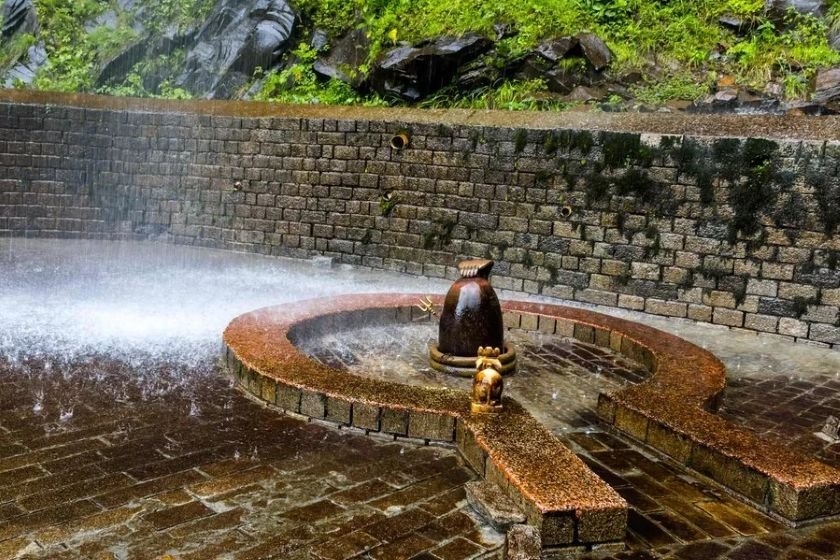
At the heart of this temple is a naturally forming ice Shivalinga, created each winter as a waterfall above the shrine freezes into a towering column, its height varying year to year — accounts range from roughly 20 to 40 feet depending on the season and who’s measuring. The waterfall continues flowing even as it freezes, meaning the ice lingam receives what devotees describe as a continuous, natural abhisheka — the ritual bathing traditionally performed on a Shivalinga by hand, here carried out uninterrupted by the mountain itself around the clock. It’s this detail, more than any other, that’s earned the temple its popular nickname: the “Mini Amarnath” of Himachal Pradesh, drawing a direct comparison to the far more famous ice lingam shrine in the Amarnath cave of Jammu and Kashmir.
Some devotees maintain a tradition of walking the final stretch to the temple barefoot, even in the snow, treating the discomfort as an act of devotion believed to leave them unharmed by the cold through the strength of their faith. It’s a striking thing to witness, whatever one makes of the belief behind it.
📜 Two Timelines Worth Keeping Separate
Here’s a distinction worth being honest about, since a lot of casual write-ups blur it together. The mythological association of this site with Anjani, mother of Hanuman, is ancient — local tradition holds that during the Treta Yuga, she performed an extraordinarily long penance here, seeking a powerful son, and that Shiva, moved by her devotion, appeared before her and granted the boon that led to Hanuman’s birth. Some tellings specify this penance lasted seven thousand years, which is less a literal historical claim than a way of conveying the sheer, almost incomprehensible depth of her devotion — the kind of number ancient Indian storytelling uses precisely because ordinary units of time can’t capture what it’s trying to express.
Separately, and much more recently, the physical ice lingam phenomenon itself is described by several sources as having been discovered only in the late 20th century, credited to a wandering ascetic known as Baba Prakash Puri, said to have found the site through spiritual vision. A small cave at the base of the steps leading up to the temple, known as Anjani Gufa, is associated both with Anjani’s own ancient penance and, in some accounts, with the meditation of Baba Prakash Puri himself — a small hut near the temple continues to honour him. These are two different timescales telling two different, complementary stories: an ancient mythological claim to the land, and a comparatively modern human account of how the site’s present-day pilgrimage tradition actually began. Treating them as two layers rather than one seamless history is simply more honest than most tellings manage.
🏛️ A Temple Built Around What Nature Provides
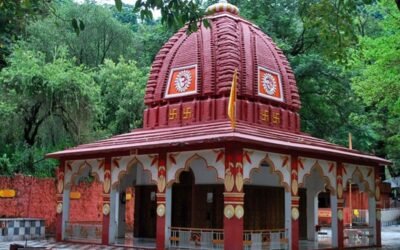
Architecturally, there’s deliberately little to describe here in the conventional sense — the temple is modest and largely open-air, built around the sacred rock and waterfall rather than housing them within an elaborate structure. This is a shrine defined by its setting far more than by carved woodwork or stonemasonry: snow-covered boulders lining the trail, pine forest opening onto alpine meadow, prayer flags moving in mountain wind, and at the centre of it all, the ice formation itself, changing shape and height through the winter months as fresh water continues to freeze and build upon what’s already there.
🎉 Festivals and Seasonal Devotion
- Maha Shivratri: The temple’s most significant occasion, marked by night-long bhajans, havans, and community feasting among devotees who make the journey specifically for this festival.
- Winter Pilgrimage (December–March): Less a single festival than an entire season of devotion, as pilgrims trek through snow specifically to witness the ice lingam at its fullest and offer prayers before it melts.
- Daily worship: Offerings of water, flowers, and incense continue year-round, though naturally concentrated most heavily during the winter months when the temple’s signature phenomenon is visible.
🏞️ While You’re in the Area
- Solang Valley: The adventure-sports hub at the base of the trek, known for skiing, paragliding, and zorbing depending on the season.
- Rohtang Pass: A seasonal high-altitude pass further along the same general route, gateway to Lahaul and Spiti.
- Old Manali and Manu Temple: Comfortably combined with a visit here as part of a broader Manali-area itinerary.
- Jogini Falls: Another scenic waterfall with its own local devotional associations, near Vashisht.
🙏 Getting in Touch
Unlike several of the more remote hill temples in this valley, Anjani Mahadev does have a publicly listed contact number: +91 1902 226 221 — worth calling ahead if you want to check trail and snow conditions before setting out, particularly outside the main winter pilgrimage season when access and the state of the ice lingam can vary considerably.
❓ Quick Questions Travellers Ask
Do I need a horse or ATV to reach the temple? Not necessarily. Multiple recent visitor accounts specifically push back on claims that the trek requires one — most reasonably active people complete the roughly 2 km walk on foot within about an hour. Horses and ATVs remain a genuinely useful option for older visitors, those with mobility concerns, or anyone simply preferring not to walk, and are readily available near the parking area for a fee.
When exactly will I see the ice lingam? Primarily December through February, with the formation typically at its most impressive during the coldest weeks. By April, most of the ice has usually melted, though this varies year to year depending on the season’s weather.
Is there an entry fee? No, entry to the temple itself is free. Horse rides, ATV hire, and other activities near the trailhead are separately priced by local operators.
Is the trek difficult in winter? It requires real care — icy patches underfoot are a genuine hazard, and several visitor accounts specifically warn about “black ice” on the trail. Proper footwear and a cautious pace matter more here than at almost any other temple on this list.
Is this the same kind of ice lingam as the one at Amarnath? The comparison is a popular one, hence the “Mini Amarnath” nickname, and the phenomenon is genuinely similar — a natural ice formation venerated as a manifestation of Shiva. That said, they’re entirely separate, independent natural occurrences at very different locations, not connected beyond the shared symbolism.
A Last Word
There’s something quietly moving about a temple whose central miracle isn’t permanent — no ancient stone carved once and left to weather slowly across centuries, but ice that builds itself fresh each winter and disappears again by spring, only to return the following year exactly when it’s needed. It mirrors, in its own way, the story it’s built around: a devotion so total it outlasted every reasonable measure of time, rewarded not with something fixed and unchanging, but with a blessing that simply keeps returning, winter after winter, for anyone willing to make the climb.
Fact-check notes: The earlier draft of this article, published on the site, included the “three pindis — Maha Kali, Maha Lakshmi, Maha Saraswati” paragraph found in numerous other temple articles on the site — a ninth confirmed instance of this recurring error, particularly inapplicable here since this is a Shiva shrine with no Devi-focused iconography. It has been removed. This rewrite also draws a clearer, more honest distinction between the ancient mythological association of the site with Anjani’s penance and the considerably more recent (late 20th century) discovery of the physical ice lingam phenomenon by Baba Prakash Puri, rather than presenting both as a single seamless timeline. Verified GPS coordinates and a publicly listed contact number were pulled from live location data.