Long before the sword and the Khalsa, there was a sixteen-year-old on a riverbank who would later write that these were among the happiest years of his life — and the town that grew up around that memory still carries his footprint in its name.
Most places tied to Guru Gobind Singh are remembered for what he endured — exile, battle, the loss of his sons, the founding of the Khalsa under threat of persecution. Paonta Sahib remembers something gentler: a brief, deliberately chosen interlude of peace, poetry, and family life, tucked between one confrontation and the next. It’s a shrine built less around a single dramatic event than around an entire era — roughly four unhurried years on the banks of the Yamuna, before history called the Guru back toward the harder chapters everyone remembers him for.
🌄 Location & How to Reach It
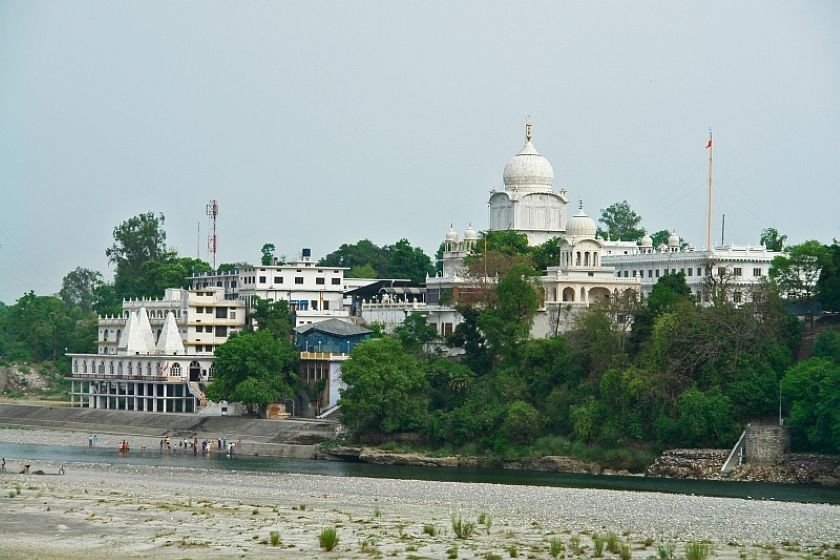
Gurudwara Paonta Sahib stands on the right bank of the Yamuna River in the town of Paonta Sahib, Sirmaur district, close to Himachal Pradesh’s border with Uttarakhand.
Google Maps: Get Directions
- By road: Paonta Sahib is roughly 42–45 km from Nahan, about 44–50 km from Dehradun, and around 120–125 km from both Chandigarh and Ambala — all well-connected by regular buses and taxis.
- By rail: The nearest major railheads are at Dehradun and Ambala; Paonta Sahib does have its own small station, though it mainly handles local and regional trains.
- By air: Dehradun’s Jolly Grant Airport, roughly 45–60 km away, is the closest airport with meaningful connectivity.
As Sikh pilgrimage sites go, Paonta Sahib is an easy one to reach — a riverside town rather than a hilltop climb, well within reach of a day trip from Dehradun and a comfortable stop for anyone travelling the Sirmaur–Dehradun corridor.
🌸 Best Time to Visit
Paonta Sahib sits at a lower, warmer elevation than much of Himachal, so its climate runs closer to the plains — hot summers, a proper monsoon, and a cold snap in deep winter, with October through March being the most comfortable stretch for a visit. The Gurudwara itself is a living, daily place of worship rather than a seasonal pilgrimage site, so there’s no single “best” month the way there might be for a Navratri-linked temple — though the Hola Mahalla fair and celebrations around Guru Gobind Singh’s birth anniversary and Baisakhi bring the town to life with an energy well worth planning around if your dates allow it.
🗡️ The Guru’s Years at Paonta
In 1685, at the invitation of Raja Medini Prakash of Nahan, a sixteen-year-old Guru Gobind Singh left Anandpur Sahib and travelled into the hill kingdom of Sirmaur with his family and several hundred Sikhs. The Raja, keen to secure a powerful ally and mindful of the region’s shifting rivalries, came out from his capital personally to receive him. Guru Gobind Singh laid the foundation of a new settlement on the riverbank himself — the name “Paonta” is said to mean “a foothold,” marking, quite literally, the spot where he first set foot in Sirmaur territory. One striking local tradition holds that the Yamuna’s waters, usually turbulent here, fell quiet just below this spot at the Guru’s own behest — offered less as a verified historical fact than as the kind of reverent detail that attaches itself to a place remembered so fondly.
What followed was, by the Guru’s own account, an unusually settled and contented chapter of his life. He would later write of this period: “I enjoyed myself on the banks of Yamuna and saw amusements of different kinds.” It was here, over roughly three to four years, that he composed major portions of the Dasam Granth — including works like the Jaap Sahib and Chandi di Var — supported by a court of scholars and poets, sometimes numbering as many as fifty-two, whom he’d gathered to translate classical texts and produce new literature. It was here, too, that his eldest son, Sahibzada Ajit Singh, was born, and where the Guru is remembered to have brought the hermit-sage Rishi Kalpi down from a Himalayan retreat to stay a while as his guest.
The peace didn’t last indefinitely. Tensions with neighbouring hill rajas — chiefly Raja Fateh Shah of Garhwal — escalated, and in 1688 the Guru’s forces met and defeated an allied army at the Battle of Bhangani, fought a short distance from Paonta. Shortly afterward, the Guru left for Anandpur Sahib, entrusting the site to a caretaker, and the quiet years at Paonta came to their natural end. What’s worth sitting with, though, is that this wasn’t primarily a martial chapter while it lasted — it was, by the Guru’s own words, one of the more contented periods of an otherwise embattled life, and that’s the memory the Gurudwara was ultimately built to hold.
🙏 What This Place Is Known For
Gurudwara Paonta Sahib is revered above all as a site of literary and spiritual creation rather than conflict — a place where devotees come to connect with the Guru’s writings, his teaching, and the community he built here, as much as with any single miraculous event. Sikhs and visitors alike come to pay respects at the Darbar Sahib, to view relics associated with the Guru’s stay, and to take part in the daily Guru ka Langar, which by some accounts feeds several thousand visitors a day, regardless of faith or background — a living continuation of the same principle of open hospitality the town was founded on. It’s also, notably, a site visited by both Sikh and Hindu pilgrims, with the adjoining Yamuna temple reflecting the layered, shared religious life of the region rather than a single tradition’s exclusive claim to the place.
🏛️ The Gurdwara Itself
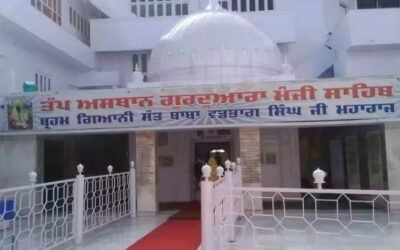
The present-day complex, spread across roughly three acres, centres on the Darbar Sahib, the main sanctum housing the Guru Granth Sahib, along with relics including Guru Gobind Singh’s sword and a rare quill pen he is said to have used. A magnificent gold-plated palanquin, the Palki, donated by devotees over the years, is one of the complex’s most striking features. Several named sites within the grounds carry specific memories from the Guru’s stay: the Sri Talab Asthan, where he once disbursed salaries to his warriors and court poets; the Sri Dastar Asthan, associated with turban-tying ceremonies and competitions; and the Kavi Darbar Asthan, where literary works were composed, recited, and debated in his presence. A small memorial to Rishi Kalpi and a museum displaying weapons and manuscripts from the period round out the complex, and Gobind Ghat, at the rear of the grounds, leads down to the Yamuna itself.
The structure seen today isn’t the Guru’s original building — the shrine was reconstructed in 1823 by Baba Kapur Singh with funding from Sahib Singh Sandhawalia, and it has been maintained and expanded in various ways since. Its management passed through a complicated 20th-century chapter, with hereditary caretakers eventually giving way, after a 1964 dispute involving a group of Nihang Sikhs who forced entry to begin a continuous recitation of the Guru Granth Sahib, to an eleven-member committee established in 1970 under the Shiromani Gurdwara Parbandhak Committee — a piece of institutional history that’s less commonly told than the Guru’s own era, but very much part of how the site came to be what it is today.
📜 Regional Context — Sirmaur’s Sikh Chapter
Paonta Sahib’s founding sits at an interesting crossing point in Sirmaur’s history: a hill kingdom, wary of its neighbours and eager for a powerful ally, opening its territory to a young Sikh Guru who would go on to found the Khalsa little more than a decade later. The district carries several other sites tied to this same period — Gurudwara Bhangani Sahib, marking the 1688 battle fought nearby, and Gurudwara Tirgarh Sahib, associated with the same conflict — making Sirmaur one of the more concentrated clusters of early Sikh historical geography outside Punjab itself, layered directly on top of the region’s older Hindu shrines and princely-state history.
🎉 Festivals and Devotion
- Guru Gobind Singh’s birth anniversary: One of the Gurdwara’s largest annual celebrations, drawing large numbers of pilgrims from across India and abroad.
- Baisakhi: Marked with particular significance here, given its close association with the founding of the Khalsa not long after the Guru’s time at Paonta.
- Hola Mahalla: An annual fair held at the Gurdwara, blending devotional and martial-tradition elements typical of Sikh Hola Mahalla observances.
- Daily Guru ka Langar and kirtan: The steady, everyday rhythm of the Gurdwara — recitation, hymn-singing, and free community meals served without interruption year-round.
🏞️ While You’re in the Area
- Yamuna Temple – Immediately adjacent to the Gurdwara, this shrine to the river goddess reflects the shared devotional landscape of the town.
- Gurudwara Bhangani Sahib – A short distance away, marking the site of the 1688 battle that ended the Guru’s peaceful years at Paonta.
- Gurudwara Tirgarh Sahib – Built on the hillock associated with the same conflict, worth combining with Bhangani Sahib for those interested in the fuller story.
- Katasan Devi Temple – A Devi shrine on the Nahan road, built to commemorate an unrelated but similarly historic local military victory.
- Renuka Lake – Himachal’s largest natural lake, tied to the legend of the sage Parshuram, a comfortable half-day trip from Paonta Sahib.
❓ Quick Questions Travellers Ask
Is there an entry fee at Gurudwara Paonta Sahib? No, entry is free, as at all Sikh gurdwaras, and the Guru ka Langar serves free meals daily to all visitors regardless of faith.
Can non-Sikh visitors enter and receive langar? Yes — gurdwaras are open to people of all backgrounds, and the langar tradition specifically emphasizes serving everyone without distinction.
How long does a typical visit take? Most visitors spend a couple of hours taking in the Darbar Sahib, the museum of relics, and the riverside grounds, though pilgrims often stay longer for kirtan or langar.
Is photography allowed inside? As with most gurdwaras, visitors should expect restrictions inside the Darbar Sahib itself; it’s best to check on-site signage and ask staff before photographing the sanctum.
What should I wear or bring? A head covering is required inside the Gurdwara — scarves are typically available at the entrance if you don’t have one — and shoes must be removed before entering.
A Last Word
It’s easy, looking back from everything that came after — the Khalsa, the wars, the losses — to read Guru Gobind Singh’s whole life as one continuous trial. Paonta Sahib pushes back gently against that reading. For a few years, on this particular riverbank, there was poetry, family, scholarship, and by his own account, genuine contentment before the harder chapters resumed. That’s not a small thing to build a shrine around, and it’s not a bad thing to sit with, quietly, on the banks of the Yamuna today.
Fact-check note: The Guru’s arrival in 1685 at Raja Medini Prakash’s invitation, his roughly three-to-four-year stay, the composition of major portions of the Dasam Granth here, the birth of Sahibzada Ajit Singh, the 1688 Battle of Bhangani, and the 1823 reconstruction by Baba Kapur Singh are corroborated across multiple independent sources, including the Sikh Encyclopedia and SikhiWiki. The quote regarding the Guru’s contentment at Paonta is documented in at least one historical account. The tradition of the Yamuna falling silent at the Guru’s behest is a devotional detail repeated in tourism sources rather than an independently verifiable historical claim, and is presented here as local tradition rather than fact. The 1964 Nihang dispute and 1970 committee resolution are corroborated in the Sikh Encyclopedia’s account. No verified GPS coordinates or specific visiting-hours details beyond general daily practice could be confirmed, so none are stated as fixed facts above.