Deep in the forests near Gagret, a Shivlinga that a Mughal army once tried to dig up is said to still be standing quiet watch over Himachal’s most powerful goddess shrine.
Most temples carry one good story. This one carries several, stacked on top of each other like sediment — a father and daughter from the Mahabharata, a swarm of insects that stopped an empire’s soldiers in their tracks, and a quieter, older belief that this exact patch of forest forms part of a protective ring around one of the region’s great Shakti Peethas. Any one of these would be enough to anchor a temple’s reputation. Here, they all sit together, layered into the same shaded grove beside the Swan River, and nobody seems especially bothered about reconciling them into a single tidy account.
🌄 Location & How to Reach It
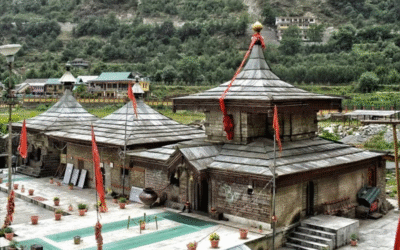
Drona Shiv Bari Temple stands in a forested setting near Ambota village, close to Gagret in Himachal Pradesh’s Una district, on the route many pilgrims travel between the plains and the well-known Chintpurni Temple. The temple sits beside the Swan River (also called the Sombhadra), amid dense forest once locally remembered as “Drone Nagri” — Drona’s own settlement.
Google Maps: Get Directions
No independently confirmed GPS pin was available for this piece, so use Gagret — a well-known town on the Jalandhar–Mandi highway (NH-70) — as your reference point.
- By road: Gagret sits directly on NH-70; the temple is a short distance from the town, roughly 26 km from Hoshiarpur and about 32 km from Una, the district headquarters
- By rail: Amb Andaura railway station, on the Delhi–Una line, is only about 5 km away
- By air: Chandigarh and Gaggal (Dharamshala) airports are the nearest options, both requiring a longer road journey onward
Unlike many of the state’s hilltop shrines, this is a plains-and-lowland-forest temple rather than a mountain climb — flat, shaded, and easy to reach by road, making it a natural stop for anyone already traveling this stretch toward Chintpurni.
🌸 Best Time to Visit
Una district’s lower elevation means noticeably hotter summers than the high hills further north, so October through March is the most comfortable stretch for a visit, with cooler air and pleasant forest shade. The temple is busiest around Mahashivratri, when devotees gather for night-long worship, and again during the Baisakhi fair, held on the second Saturday of the Baisakh month, which local tradition holds as an especially auspicious day for wishes to be granted here. Many visitors combine a stop here with a pilgrimage to Chintpurni, so expect a natural overlap in crowds around that temple’s own major festival dates as well.
🕉️ The Legend Everyone Tells: A Daughter’s Devotion
The temple’s best-known story goes back to the Mahabharata era, when Guru Dronacharya — the martial teacher of both the Pandavas and the Kauravas — is said to have lived in this very forest. Each day, tradition holds, he bathed in the Swan River before heading toward the Himalayas to offer his private prayers to Shiva, a routine he kept entirely to himself. His daughter, remembered here as Yayati, grew curious about where he disappeared to every day, and when she pressed him for an answer, he told her simply to chant “Om Namah Shivaya” at home with real devotion, and the truth would reveal itself in time. She did exactly that, and after some days of steady, focused chanting, Shiva appeared before her — not in his fearsome form, but as a small child, playing with her the way any child might. When Dronacharya discovered what had happened, he didn’t treat it as strange or alarming; he understood immediately what it meant, and at Yayati’s request, Shiva agreed to remain in the village permanently, manifesting as a Pindi Shivlinga — a naturally rounded stone form rather than a carved image — right on this spot.
🕉️ Two Quieter Legends: An Empire’s Soldiers, and a Goddess’s Guard
Two other traditions attach themselves to this same temple, each doing very different work than the Dronacharya story. The first is set centuries later, during the reign of the Mughal emperor Aurangzeb, when soldiers are said to have arrived at the temple and begun trying to dig up the sacred Pindi itself. As they dug, according to the story, a swarm of red-colored insects rose out of the ground in overwhelming numbers, attacking the soldiers until they collapsed, senseless. Only after villagers sprinkled sacred water from the temple’s Jalhari over them did the soldiers recover — and having witnessed what they took to be a direct supernatural rebuke, they are said to have fled, leaving the site untouched ever since.
The second, quieter tradition ties this temple into a much larger devotional geography: the belief that Shiv Bari sits to the south of the great Chintpurni Temple, one of the recognized Shakti Peethas, functioning as one of a set of protective Maharudra sites — Shiva in his fierce, guardian aspect — positioned in different directions around the goddess to form a kind of spiritual perimeter. It’s a striking idea, tying a modest forest shrine directly into the protection of one of the region’s most significant pilgrimage destinations, though it’s worth being honest that this framing rests entirely on local devotional tradition rather than anything that can be independently traced or dated. As for the temple’s own claimed age — commonly cited at roughly 5,000 years, placing its origins squarely in the Mahabharata period — that figure, like most claims of this kind attached to Mahabharata-era sites across North India, isn’t something that can be verified against any independent historical record, and is best appreciated as a marker of how old local memory holds this place to be, rather than a settled archaeological fact.
🙏 What the Deity Is Known For
Shiva is worshipped here in his self-manifested Pindi form, and devotees bring the usual range of concerns — protection, resolution of family difficulties, general wellbeing — to a deity whose story here is unusually gentle, remembered as much for playful, childlike appearance as for fierce power. The temple’s secondary identity as a guardian of Chintpurni adds a further layer some devotees specifically seek out: pilgrims already traveling to the Shakti Peetha will sometimes stop here deliberately, treating a visit to this Shiva shrine as a way of paying respect to the protective forces believed to surround the goddess herself.
🏛️ The Temple Itself
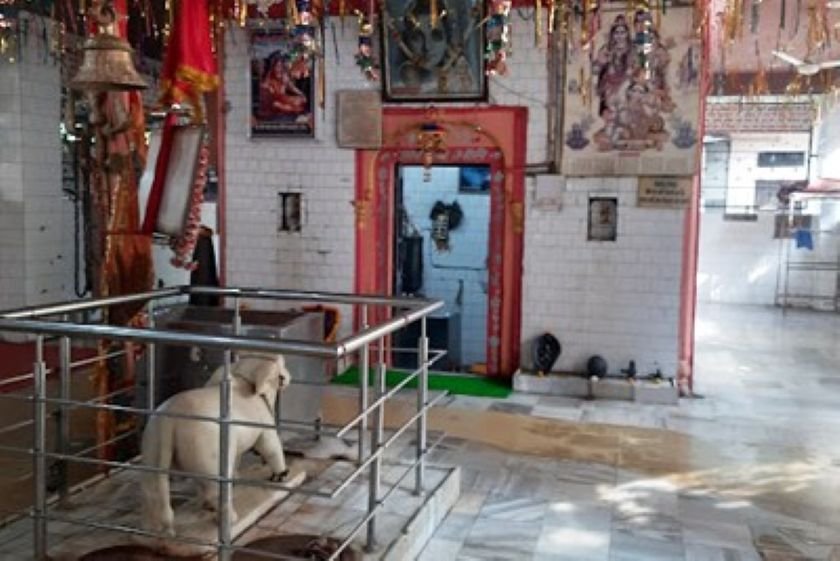
The complex sits within genuinely dense forest, reportedly under a longstanding local practice that timber from these woods is used only for temple-related work rather than general logging — a detail that, whether formally enforced today or not, speaks to how closely the grove itself is bound up with the site’s sanctity. Inside, alongside the central Pindi Shivlinga, the temple houses older idols of Virbhadra, Kartikeya, Kubera, and Ganesha. Scattered through the grounds are the samadhis of various saints who are said to have meditated here over the years, and, more unusually, four cremation grounds positioned in the four cardinal directions around the temple itself — an arrangement that adds a starker, more austere note to what is otherwise a gentle, forested setting. Four wells within the complex are attributed to the historical rulers of Jammu and Amb, said to have had them built after their own wishes were granted here — a rare instance of named royal patronage attached to a temple whose founding story otherwise belongs entirely to myth.
📜 A Forest Shrine Along the Road to Chintpurni
Gagret and the surrounding Una district sit along one of Himachal’s busier pilgrim corridors, the road that carries a steady stream of devotees toward Chintpurni, one of the fifty-one Shakti Peethas and among the most visited temples in the state. Shiv Bari’s own position within that landscape — geographically close to the route, and devotionally framed as a protector standing guard over the goddess herself — reflects a common pattern across North Indian pilgrimage geography, where a major Shakti shrine accumulates a ring of smaller, associated Shiva temples around it. It’s worth noting, too, that this temple has reportedly faced real challenges with preservation and oversight over the years, with local village committees taking up the cause of protecting and maintaining the site — a reminder that even temples wrapped in five-thousand-year legends still depend on very present-day, very human upkeep.
🎉 Festivals and Devotion
- Mahashivratri — night-long bhajans, havans, and community feasts, drawing devotees from across the district
- Baisakhi (second Saturday of Baisakh) — considered an especially auspicious day here, marked by a large fair and the belief that Shiva is particularly responsive to devotees’ wishes
- Shravan Mondays — special abhishek and offerings through the monsoon month
- Daily worship — morning and evening aartis and incense offerings maintained year-round
🏞️ While You’re in the Area
- Chintpurni Temple — one of the fifty-one Shakti Peethas and a major pilgrimage destination in its own right, closely tied to this temple’s own protective legend
- A nearby Shiva temple — a second, smaller Shiva shrine reported to be only about 2 km away, worth a look for anyone with time to spare
- Swan River — flowing directly beside the temple, offering a quiet spot for reflection beyond the main shrine itself
- Amb Andaura — the nearest railway town, useful as a base if arriving by train
❓ Quick Questions Travellers Ask
Is there an entrance fee? No. The temple is free to visit, in keeping with most Himachal Pradesh temples of this kind.
Is the temple really 5,000 years old? That figure is widely repeated locally and tied to the temple’s Mahabharata-era legend, but it isn’t something that can be independently verified — it’s best understood as a marker of the site’s deep traditional standing rather than a confirmed historical date.
Can this be combined with a Chintpurni pilgrimage? Yes — many devotees do exactly that, given the temple’s position along the same general route and its traditional role as one of Chintpurni’s protective sites.
Is the temple easy to reach without a private vehicle? Gagret is well connected by road along NH-70, and Amb Andaura railway station is close by, so it’s reachable by public transport with a short final leg by local taxi or auto.
Is there anywhere to eat or stay nearby? The temple itself doesn’t function as a full pilgrim rest-stop in the way some larger shrines do; most visitors treat it as a stop along the way to or from Chintpurni or Una, where fuller amenities are available.
A Last Word
There’s a certain honesty in a temple that doesn’t insist on just one story about itself. Drona Shiv Bari holds a playful father-daughter myth, a defiant stand against an empire’s soldiers, and a quiet claim to guarding a goddess, all in the same shaded grove beside the same slow river — and it doesn’t seem especially interested in choosing between them. Maybe that’s the most fitting thing about a temple devoted to a god who is, in Hindu tradition, at once an ascetic, a destroyer, and a child at play: it can hold more than one truth at a time, and let each visitor find whichever one speaks to them.
Fact-check note: This piece covers the same temple as two existing articles already published on this site (“Shiv Bari Temple – The Lingam of Light and the Legacy of Drona” and “Drona Shiv Bari – The Lingam of Light and the Daughter’s Devotion”), both of which center on the Dronacharya/Yayati legend as their primary framing. This piece has deliberately anchored instead on the temple’s protective Maharudra tradition and the Aurangzeb-era legend, to avoid producing a third near-identical piece — worth confirming internally whether having two prior versions was intentional. Separately, note that a different, unrelated temple also called “Shiv Bari” exists in Una town itself, reportedly built by a King Sahil Varman in the 16th century; that is not the temple covered here, and the two should not be conflated. The temple’s traditional age (~5,000 years) and its identity as a Mahabharata-era site are widely repeated local beliefs rather than independently verifiable facts. No independently confirmed GPS coordinates were available, so Gagret has been used as a landmark reference instead. The detail regarding wells built by the “King of Jammu and Amb” comes from a single source and could not be cross-verified elsewhere, so it is presented as reported tradition rather than settled fact.