Twice, centuries apart, the waters at the meeting point of the Beas and Suketi rivers have risen high enough to threaten everything around them. Both times, this five-faced Shiva temple has still been standing when the water finally went down.
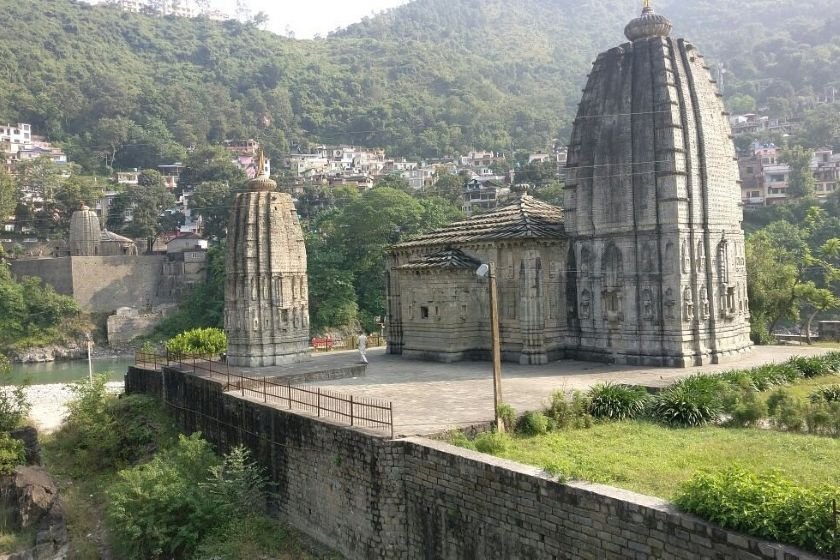
A temple built at a river confluence makes a quiet, ongoing bet against the water it lives beside. Panchvaktra has been making that bet for centuries, and so far, it keeps winning. In 1678, floodwaters damaged the temple badly enough that Mandi’s ruler at the time undertook a substantial reconstruction. Then, in recent flash flooding that swept away modern structures across the town and submerged the temple in swirling brown water on live television, Panchvaktra came through essentially intact — its stone platform and foundation holding firm while newer buildings around it didn’t. Locals and pilgrims have started drawing the obvious comparison to Kedarnath’s own much-discussed survival during Uttarakhand’s catastrophic 2013 floods. Whatever you make of that comparison, there’s something genuinely striking about a temple whose five-faced deity has now watched the same river rise against it at least twice, roughly three and a half centuries apart, and lost both times.
🌄 Location & How to Reach It
Panchvaktra Temple sits at the confluence of the Beas and Suketi rivers in the heart of Mandi town, Himachal Pradesh, roughly 750 metres from the Mandi bus stand.
Google Maps: Get Directions
- By road: An easy, short walk from Mandi’s main bazaar and bus stand; cross Bhootnath Bazaar toward the Beas riverbank, and the temple is visible from a considerable distance along the water.
- By rail: Joginder Nagar’s narrow-gauge terminus is the closest practical option, roughly 56 km away, with a substantial onward road journey either way since Mandi itself has no railway station.
- By air: The nearest airport is generally cited at around 59 km away near Kullu, with Chandigarh as a longer-distance alternative.
Given its central riverside position, this is one of the most straightforward stops on any walking tour of Mandi’s old town, easily combined with Triloknath and Bhootnath temples on the same visit.
🌸 Best Time to Visit
October through March offers the most comfortable conditions and, importantly, the lowest river levels for viewing the temple’s confluence setting safely and clearly. Mahashivratri is overwhelmingly the temple’s most significant occasion, marked by night-long bhajans, havans, and devta processions as part of Mandi’s wider town-spanning Shivratri fair. Shravan Mondays bring special abhishekam rituals and offerings through the monsoon month — though monsoon season is also, unavoidably, when this particular temple’s relationship with the rivers beside it becomes most dramatically visible.
🕉️ The Legend: Five Faces, and a Foundation Nobody Can Fully Date
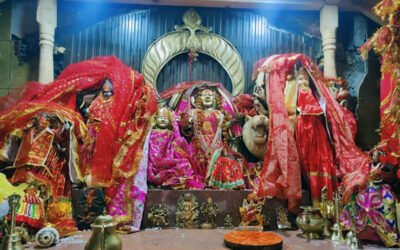
Panchvaktra takes its name directly from its presiding deity: a five-faced (panchvaktra) stone image of Shiva, with each face representing a different cosmic aspect — Aghora (destruction), Ishana (omnipresence and omnipotence), Tatpurusha (ego or cosmic self), Vamadeva (the feminine aspect), and Rudra (the creative-destructive force). Only three of these faces are visible when the idol is viewed from the front; according to a detailed architectural survey, the fourth face sits on the reverse of the image and the fifth on top, a layout that rewards a slow, deliberate circumambulation of the sanctum rather than a single glance from the entrance. Two supporting legends circulate locally alongside this core iconography: one crediting the Pandavas with an early construction here during their exile, another describing this as the site where Parvati completed her penance and finally won Shiva’s hand in marriage — neither independently verifiable, both fairly typical of the kind of epic-scale founding stories attached to old Shaivite sites across this region.
The temple’s actual construction history is where the sources genuinely, and quite significantly, disagree. Several detailed accounts credit Raja Ajbar Sen with building the temple in the 16th century — the same king credited with commissioning Mandi’s Triloknath Temple around 1520 — with a later 17th-century reconstruction under Raja Sidh Sen (reigning roughly 1684–1727) following serious flood damage recorded in 1678. Other sources are more cautious, stating plainly that the temple’s true foundation date is unknown and that the 17th-century work should be understood as a restoration rather than an original construction. At least one source pushes the temple’s origin back much further still, crediting an 8th-century founding to Raja Sahil Varman as “the founder of Mandi” — a claim worth treating with real skepticism, since Sahil Varman is more securely documented elsewhere as a historical ruler associated with the founding of Chamba, a separate princely state, rather than Mandi; this looks like a conflation between two different dynasties rather than a genuine alternate dating for this specific temple. Given how consistently the Ajbar Sen/Sidh Sen sequence appears across the more detailed and mutually corroborating sources, that combination — 16th-century construction, 17th-century flood restoration — is the more credible account, even if the temple’s very earliest history before Ajbar Sen remains genuinely unclear.
🙏 What Panchvaktra Is Known For
Panchvaktra is worshipped as Shiva in his fivefold cosmic form, a rarer and more elaborate iconographic choice than the single-faced Shiva images found at most temples, symbolizing his simultaneous presence across every direction and dimension. Devotees come seeking the same broad blessings associated with Shiva generally — protection, spiritual clarity, relief from suffering — but the temple’s specific five-faced form gives it a reputation as an unusually comprehensive or “complete” site of Shaivite worship, drawing pilgrims, historians, and casual visitors in fairly equal measure.
The temple’s resilience through repeated flooding has itself become part of its devotional identity. Local tradition increasingly frames the structure’s solid stone construction and survival through repeated deluges as a form of divine protection rather than simply sound medieval engineering — a belief reinforced, rather than undercut, by the fact that it has now happened more than once, separated by centuries, and involving the same basic threat each time.
🏛️ The Temple Itself
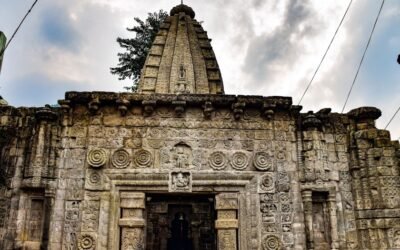
Built in the Shikhara style, Panchvaktra sits on a substantial stone platform, its main porch and mandapa supported by four intricately carved pillars. According to a detailed architectural survey, the temple faces northeast, its antarala guarded by dvarapalas (gate guardians), with a square-plan sanctum housing the presiding five-faced Shiva image alongside a subsidiary shrine to Batuk Bhairava — a triratha-plan structure of its own, with Bhairava depicted seated cross-legged on a square plinth. The complex’s main entrance faces the Beas River directly, flanked by carved guardian statues, with a large Nandi positioned in the courtyard facing the sanctum in the customary arrangement. Wall and pillar carvings throughout the complex depict Shiva in multiple additional forms, including Nataraja and Ardhanarishvara, alongside other mythological and decorative motifs.
At least one source describes the temple’s presiding idol as made of brass; this conflicts directly with more detailed architectural descriptions identifying it as a carved stone image, and the stone attribution — consistent with the temple’s broader reputation for solid stone construction being precisely what allowed it to survive repeated flooding — is the more credible of the two. One visitor account also describes a duplicated version of the five-faced idol displayed outside the sanctum in addition to the one inside the garbhagriha; this detail appears in only a single source and should be treated as an interesting but unconfirmed observation rather than settled fact. Architecturally, the temple is frequently compared to Mandi’s own Triloknath Temple, sharing a broadly similar Shikhara style while differing in its superstructure and decorative detailing — a useful comparison for anyone visiting both temples on the same day, as many pilgrims do.
📜 A Temple Twice Tested by the Same River
Panchvaktra’s two documented flood events — the 1678 damage that prompted Sidh Sen’s reconstruction, and its far more recent survival through severe flash flooding that submerged the temple while destroying newer structures nearby — give it an unusually concrete, recurring relationship with disaster compared to most temples in this series, whose resilience is more often described in purely mythic terms. This pattern places Panchvaktra within a small set of Himalayan temples, Kedarnath among the most famous, whose ongoing survival through serious natural disasters has become part of how devotees understand their sanctity — not instead of solid stone engineering, but alongside it.
🎉 Festivals and Devotion
- Mahashivratri: The temple’s most significant annual occasion, part of Mandi’s wider town-spanning Shivratri fair, with night-long bhajans, havans, and devta processions.
- Shravan Mondays: Special abhishekam rituals and offerings observed through the monsoon month.
- Daily Worship: Morning and evening aarti, chanting of the Rudram, and incense offerings.
🏞️ While You’re in the Area
- Triloknath Temple: A three-faced Shiva shrine sharing a broadly similar architectural style, elsewhere in Mandi’s old town.
- Bhootnath Temple: Central to Mandi’s Mahashivratri celebrations, a short walk away.
- Tarna Devi Temple: A hilltop Kali shrine overlooking Mandi town, reached by a climb of over 300 steps.
- Ardhnarishwar Temple: A composite Shiva-Parvati shrine notable for its roofless mandapa.
- Victoria Bridge: A historic British-era bridge spanning the Beas near the temple.
❓ Quick Questions Travellers Ask
Is it true this temple has survived multiple major floods? Yes — a documented flood in 1678 damaged the temple badly enough to prompt reconstruction under Raja Sidh Sen, and more recent severe flash flooding in Mandi left the temple largely intact while damaging or destroying newer structures nearby.
How old is the temple, really? Most detailed sources credit its construction to Raja Ajbar Sen in the 16th century, with a 17th-century restoration after flood damage; a claim attributing an 8th-century founding to a ruler more securely associated with Chamba’s history appears to be a factual error rather than a credible alternate date.
Why can I only see three of the five faces on the Shiva idol? The fourth face is carved on the reverse of the image and the fifth on top, meaning a full view of all five requires walking around and looking up at the sanctum image rather than viewing it only from the front.
Is there an entry fee? No entry fee could be confirmed for this article; as an actively worshipped ASI-protected temple, general darshan is very likely free.
Is it safe to visit during monsoon season? Given the temple’s location directly at a river confluence and its documented history of serious flooding, it’s worth checking local conditions before visiting during peak monsoon months, even though the temple structure itself has repeatedly proven resilient.
A Last Word
There’s a particular kind of trust that builds up in a structure that keeps surviving the thing everyone assumes will eventually take it down. Panchvaktra doesn’t need its five faces or its epic-scale founding legends to make the case for its own significance — the river has tried to end it at least twice, three and a half centuries apart, and both times the water has receded to find the temple still standing, faces intact, right where the Beas and Suketi have always met.
Fact-check note: The temple’s five-faced Panchvaktra Shiva iconography, its location at the Beas–Suketi confluence, its 17th-century restoration under Raja Sidh Sen following 1678 flood damage, and its recent survival through severe flash flooding are well corroborated across independent sources. Genuinely unsettled and flagged above rather than resolved with false precision: the temple’s original construction date (16th-century Ajbar Sen vs. an unverified 8th-century Sahil Varman attribution, which appears to conflate this temple with Chamba’s founding history), and whether the presiding idol is made of stone (per detailed architectural surveys) or brass (per a single source, likely inaccurate). A claim that a duplicate idol stands outside the sanctum appears in only one source. No entry fee could be confirmed.