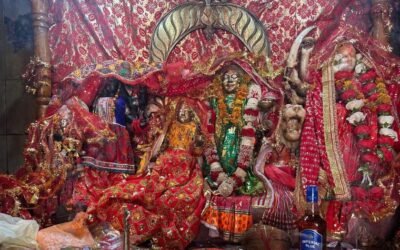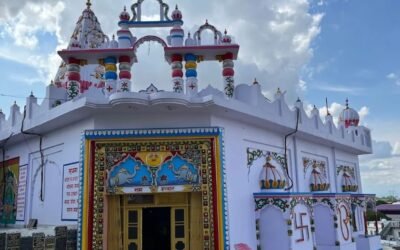
In a quiet village above Karsog, a temple has spent millennia guarding three things a fire, a drum, and one grain of wheat nobody is allowed to plant.
Most old temples ask you to take their age on faith — a worn inscription here, a half-legible date there, the rest filled in by tradition. Mamleshwar Mahadev does something stranger: it hands you physical objects and asks you to reconcile them with the calendar yourself. A flame that supposedly hasn’t gone out since before recorded history. A single grain of ancient wheat, kept rather than eaten. A drum nobody remembers building. Whether or not every claim survives close scrutiny, the temple in Mamel village, just outside Karsog town, is unmistakably one of Mandi district’s oldest living shrines — a place where the Mahabharata isn’t just referenced, it’s supposedly sitting right there in the courtyard.
🌄 Location & How to Reach It
Mamleshwar Mahadev Temple sits in Mamel village, a short distance from Karsog town in Mandi district, tucked into the wide, stream-fed Karsog valley that’s better known regionally for its orchards than its pilgrim traffic. It’s about 2 kilometres from the Karsog bus stand — close enough that most visitors treat it as a stop within Karsog rather than a separate excursion — and roughly 100 to 110 kilometres from both Shimla and Mandi town, the two cities most people arrive from.
Google Maps: Get Directions
No independently confirmed GPS pin exists for this piece, so use Karsog’s main bus stand as your anchor point and follow local signage the remaining stretch into Mamel — it’s a short, easy walk or drive from there, not a trek.
- By road: Karsog is well connected to both Shimla and Mandi by regular bus and taxi routes; Mamel village is a few minutes further by local road
- By rail: No broad-gauge line reaches the valley; the Shimla side connects (distantly) to the narrow-gauge heritage line, but almost everyone arrives by road regardless
- By air: The nearest airports are near Shimla and Kullu, both well over 100 km away, so this is very much a road trip rather than a fly-in stop
Unlike hill shrines that demand a climb, Mamleshwar Mahadev is refreshingly low-effort to reach — flat approach, no steps to speak of, and a temple you can visit comfortably even with young kids or elderly family in tow.
🌸 Best Time to Visit
Karsog valley’s mid-elevation setting means this temple, unlike many of Mandi’s high-altitude shrines, stays accessible more or less all year round. That said, spring through early autumn (roughly March to October) brings the valley’s orchards into bloom and fruit, and is generally the most pleasant stretch for travel. Winters are cold but rarely impassable at this elevation, so a visit outside the busiest festival dates can mean having the courtyard largely to yourself. If your interest is specifically in seeing the temple at its most animated, plan around Mahashivratri or one of the Shravan month Mondays, when the crowd and the ritual activity both pick up noticeably.
🕉️ The Legend: A Sage, a Kinnar Bride, and a God Called In to Settle It
The name itself is the place to start, because it isn’t a generic epithet for Shiva — it’s a compound built from a woman’s name. Long ago, tradition holds, the sage Bhrigu came to meditate in these hills, and a devoted young Kinnar woman named Mamlesha took it upon herself to serve him through his years of penance — bringing water, keeping his fire, tending to the quiet discipline of his practice. Over that long stretch of proximity, devotion turned into affection, and affection eventually into marriage. When Mamlesha became pregnant, Bhrigu found himself facing an uncomfortable social reckoning: a sage’s union with someone outside his own community carried real weight in that world, and rather than let the question sit unresolved, he turned to worship, invoking Shiva in his fierce Mahakal form to settle the matter through divine sanction. Shiva answered by manifesting here as a linga, and in doing so lent his own name to hers — Mamleshwar, the lord of Mamlesha. The village that grew up around the shrine took the same name in its own form, and the local telling of the temple’s history proudly notes that it has stood, in one form or another, since — as the phrase goes locally — Satya Yuga first gave way to Treta, Dvapara, and now Kali.
Layered onto that founding story is a second, later legend, set squarely in the Mahabharata era. During their long exile, the Pandava brothers are said to have passed through this valley, and in some versions of the story they’re credited with raising the outer structure of the temple itself. It was here, tradition says, that they lit a fire pit during the month of Shravan — a flame that, according to the temple’s own account, has never gone out since. It’s also here, according to this same layer of story, that Bhima is said to have kept a great drum for his own amusement during the quieter stretches of exile, leaving it behind when the brothers moved on. A separate, more dramatic version of the drum’s origin holds that its wood came from a felled tree once inhabited by a demon defeated by the gods — two different explanations for the same object, both still told side by side rather than one having won out over the other. A further story, tied to the same period, describes a demon in a nearby cave that had to be fed a village resident once a day, until Bhima intervened and killed it — one telling links this act directly to the lighting of the eternal fire, though how tightly the two events connect depends on who’s narrating.
Whatever their exact relationship to one another, these two founding traditions — the Bhrigu-Mamlesha story explaining the name, and the Pandava-era story explaining the relics — sit together here without much friction, each addressed to a different part of what the temple actually holds. It’s worth saying plainly, though, that a continuously burning fire and a preserved grain of wheat surviving five millennia are extraordinary claims by any measure, repeated with total sincerity locally but not something that can be independently verified against a timeline that old — they’re best appreciated as living tradition rather than settled archaeological fact.
🙏 What the Deity Is Known For
Mamleshwar is worshipped here as Shiva in a fairly classical devotional register — not tied to a single narrow request the way some village deities are, but approached broadly for wellbeing, resolution of family troubles, and the kind of steady blessing associated with Shiva worship generally across the hills. What sets this shrine apart locally isn’t a specialized reputation so much as its standing: it’s described as the presiding deity of the wider Karsog area and of the old Suket territory that once governed this part of Mandi district, which gives it a stature closer to a regional anchor point than a small wayside shrine. Devotees bring the usual quiet offerings — bilva leaves, ghee lamps, water for abhishek — and the temple’s rhythm follows Shiva’s calendar closely, with the Shravan month and Mahashivratri drawing the most sustained attention.
🏛️ The Temple Itself
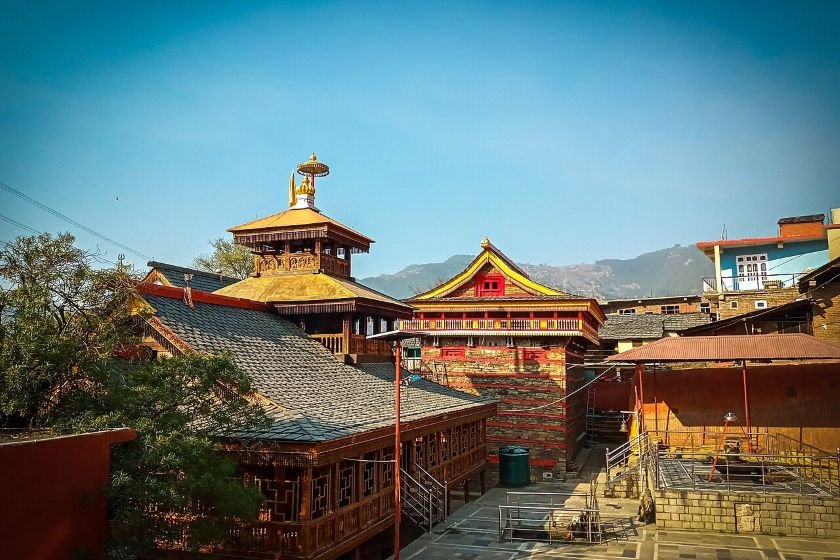
Architecturally, this is a good example of the timber-and-stone Kathkuni building tradition found across this belt of Himachal — alternating courses of dressed stone and deodar wood that give hill temples both their sturdiness against snow load and their distinctive layered look. The temple stands on a raised plinth, topped with an arched roof of stacked slate, and the woodwork around its doors carries the kind of unhurried, hand-cut floral carving that this region’s temple carpenters were once known for. Inside, rather than a single sanctum with a single deity, the temple holds five separate Shivalingas together — an unusual concentration that locals point to as one more sign of the site’s accumulated, layered sanctity rather than a single clean origin story. Just outside, a natural spring feeds the temple’s ritual bathing and abhishek needs, its cold mountain water threading a quiet, practical note through all the surrounding legend. Stand in the courtyard on an ordinary afternoon and what you notice first isn’t grandeur — it’s the shade of old trees overhead, the smell of cedar and incense mixing, and the sense of a place that has been tended, gently and without interruption, for a very long time.
📜 Karsog Valley and the Old Suket Connection
Karsog sits somewhat apart from Mandi district’s more heavily touristed corridors, and that relative quiet has as much to do with its political history as its geography. This valley once fell within the old princely state of Suket, a separate hill kingdom that existed alongside Mandi for centuries before India’s post-independence reorganization folded both into the modern district. Mamleshwar Mahadev’s description as presiding deity of “Karsog and Suket” together is a clue to that older political geography — this was a temple that carried weight not just for one village but for the wider territory a local ruling house once governed. The valley today carries several other old shrines from roughly the same devotional world, most notably the Kamakhya Devi Temple in Karsog town itself, known for its own detailed woodcarving, giving the area a small but genuine cluster of heritage sites rather than a single standalone attraction.
🎉 Festivals and Devotion
- Mahashivratri — the temple’s largest gathering, marked with night-long bhajans and communal offerings
- Shravan Mondays — a steady rhythm of special abhishek and offerings through the monsoon month
- Budhi Diwali — a distinctive local tradition observing Diwali roughly a month after the rest of the country, rooted in the belief that news of Rama’s victory over Ravana simply took longer to travel to these hills; the delayed festival has been kept alive here for generations
- Daily worship — morning and evening aartis continue quietly outside the major festival calendar, without much fanfare
🏞️ While You’re in the Area
- Kamakhya Devi Temple, Karsog — a short distance away in Karsog town, notable for its own intricate wood carving and worth combining with a Mamleshwar visit on the same day
- Karsog town — orchards, a small market, and a genuinely unhurried valley-town atmosphere for anyone wanting to linger rather than rush through
- Mahunag Temple — dedicated to a locally revered deity connected to the Mahabharata’s Karna, and a reasonable add-on for anyone interested in the valley’s wider epic-era temple network
- Shikari Devi Temple — considerably further and a proper trek in its own right, but for travelers already exploring Mandi district’s Mahabharata-linked shrines, it makes sense as a separate, more demanding leg of the same trip
❓ Quick Questions Travellers Ask
Can I actually see the ancient grain of wheat and Bhima’s drum? Visitors describe being shown both by the temple’s priest on request, though access understandably depends on who’s present and how busy the day is — it’s not treated as a standing museum display.
Is this a difficult temple to reach compared to other Mandi shrines? No — it’s one of the easier ones. There’s no serious climb involved, unlike hill-top shrines such as Shikari Devi; a short walk from Karsog’s bus stand covers most of the distance.
Is the temple open year-round? Yes. Karsog’s mid-elevation setting means it doesn’t face the seasonal closures that affect Mandi district’s higher peak temples.
What is Budhi Diwali, and can outsiders attend? It’s a local, delayed version of Diwali tied to a story about news of Rama’s victory arriving late in these hills; visitors are generally welcome to observe, though it’s a community occasion rather than a staged tourist event.
Is there a fee to enter or to see the relics? No verified information on an entrance fee or fixed viewing charge was found for this piece — treat any request for payment with the same caution you would at any small local shrine, and ask locally before your visit if this matters to you.
A Last Word
There’s something quietly moving about a temple that measures its own age not in inscriptions or dynasties but in a single grain of wheat someone, at some point, decided not to eat. Whether that grain — or the fire beside it, or the drum resting nearby — truly reaches back to the Mahabharata is a question the temple itself doesn’t seem terribly anxious to settle. What it offers instead is continuity: a sage’s devotion, a god’s intervention, a pair of exiled brothers passing through, and a village that has simply kept the story going, object by object, for as long as anyone can remember.
Fact-check note: The temple’s location in Mamel village near Karsog, its dedication to Shiva as Mamleshwar, the Bhrigu-Mamlesha origin legend, and the presence of the eternal flame, ancient grain, and Bhima’s drum are corroborated across Wikipedia and multiple independent regional sources. However, sources disagree on several specifics that this piece has not tried to force into false precision: the preserved grain’s weight is variously reported as 200, 250, and 400 grams, and its identity as wheat versus barley also varies by source. No independently verified GPS coordinates, altitude figure, or entrance-fee/contact information could be confirmed, so exact coordinates and a specific altitude have been left out rather than guessed, and readers are directed to Karsog’s bus stand as a reliable, well-mapped reference point instead. Claims of the flame and grain dating back roughly 5,000 years to the Dwapara Yuga are widely repeated local tradition rather than independently verifiable fact, and are presented here as such.