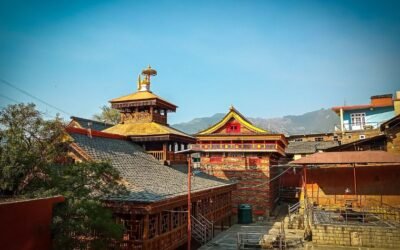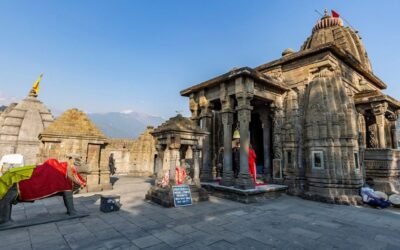
Locals will tell you, without a hint of doubt, that a spider built this temple. They mean it rather more literally than you’d expect
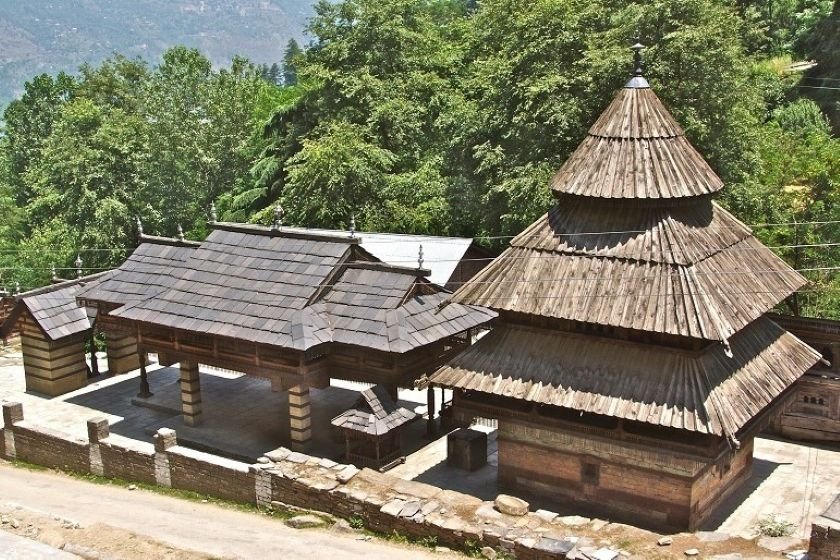
Naggar has no shortage of old temples clustered within walking distance of each other, but ask anyone in the village which one is truly theirs — the deity they’d turn to first, before any other — and most will point you toward Tripura Sundari. She’s the valley’s Ishta Devi, its chosen protector, and the wooden pagoda built in her honour carries a legend distinctive enough that it’s worth sitting with for a moment before you even reach the entrance: that the goddess herself, taking the form of a spider, spun this structure into being, and that’s why, if you look closely at its layered wooden tiers, the whole building still faintly resembles a web.
🌄 Location & How to Reach It
- Location: Near Naggar Bus Stand, Naggar, Kullu District, Himachal Pradesh – 175130
- GPS Coordinates: 32.1119° N, 77.1670° E
- Google Maps: Get Directions
- Altitude: Roughly 1,850 metres
- Distance: About 21–23 km from Manali, 23–28 km from Kullu town
This is one of the more conveniently placed temples in Naggar — sitting close to the bus stand and an easy walk from Naggar Castle, along the same short stretch most visitors already cover on foot when exploring the village. Regular buses and taxis connect Naggar to both Kullu and Manali, and once you’re in the village, the temple, castle, Murlidhar shrine, and Roerich Gallery are all comfortably within a single walking loop.
Getting to Naggar first: The nearest airport is Bhuntar (~37 km), and the nearest railheads are Joginder Nagar (~131 km) or the more distant Chandigarh and Pathankot connections — this remains firmly road-trip territory rather than rail-accessible.
🌸 Best Time to Visit
March to June brings mild weather to Naggar and the surrounding hillsides in bloom, good conditions for a longer walking tour of the village’s temple cluster. September to November offers the clearest skies for photographing the temple’s distinctive tiered silhouette against the mountains. Winter dusts the wooden roofs with snow, a sight several visitors specifically describe as beautiful, though a few of Naggar’s smaller lanes can ice over, so some caution is warranted in January and February.
Temple timings: Currently listed as open daily from 9:00 AM to 5:00 PM — worth checking locally if you’re visiting around the temple’s May fair, since hours can shift during major festivals.
🕉️ Inside the Sanctum
The goddess herself is carved in black stone, her expression famously gentle rather than fierce, draped in a gold-and-red scarf and seated on a lotus. In her hands she holds a set of symbolic weapons — a noose, a goad, a sugarcane bow, and flower-tipped arrows — each representing not violence but mastery: control over the mind, over desire, over the restless pull of the senses rather than external enemies. It’s a striking iconographic choice for a goddess otherwise associated with formidable Shakti, and it says something about how she’s understood locally — less a destroyer to be feared than a protector whose power is precisely her self-command.
The idol is enshrined with what’s often described as 21 ceremonial masks, and the temple complex around her houses an unusually full pantheon: stone images of Brahma, Vishnu, Ganesha, Lakshmi, and Shiva-Parvati together, alongside a small, separate 30-centimetre idol of Tripura Rakshasa, the demon associated with her mythology, cast in an eight-metal alloy. A wood-carved Ganesha greets visitors at the entrance, and several visitors specifically mention a natural formation resembling Ganesha’s form found within a sacred tree on the temple grounds — the kind of detail that turns a five-minute stop into something people linger over.
One particular local custom stands out for how unusual it is: on the first day of Baisakhi, the goddess is traditionally offered the burial shrouds of the recently deceased as an offering of cloth — an association that connects to a striking verse from the Lalita Sahasranama, describing this form of the goddess as the supreme Shakti seated upon the bodies of Brahma, Vishnu, Shiva, and Rudra themselves. It’s a genuinely unusual piece of theology to encounter in such a modest hill temple, and it points to how seriously this goddess’s deeper Shakta symbolism is taken here, even in a shrine most tourists walk past without a second glance.
📜 Correcting the Record on the Temple’s Age
Here’s a detail worth being precise about, since it’s easy to get wrong: this temple was built by Raja Yashodhapal in the 11th century CE, not the 16th, as a handful of less careful write-ups claim. Multiple independent sources — travel documentation, heritage blogs cataloguing Himachal’s temple architecture, and long-standing visitor accounts — consistently agree on the 11th-century dating, making Tripura Sundari one of the older wooden shrines in a village that already holds some of the Kullu Valley’s most significant historic temples.
The building itself offers a visible clue to its own layered history: several visitors and heritage writers note that the carvings on one side of the main shrine appear noticeably older and more refined than the rest of the temple, suggesting the courtyard may incorporate elements of an even earlier structure predating the main pagoda — a pattern that turns up more than once among Kullu’s older temples, where a “new” building often quietly absorbs fragments of what stood there before it.
🏛️ Architecture Modelled on a Legend
Structurally, Tripura Sundari is a three-tiered pagoda, built almost entirely of deodar wood and stone, and its design draws direct inspiration from the more famous Hidimba Devi Temple in Manali — the resemblance is close enough that first-time visitors often mistake photographs of one for the other. Differences do exist: where Hidimba stands as a single, freestanding tower with four tiers, Tripura Sundari’s three-tiered structure sits within a small complex of buildings rather than in isolation, and its top storey is capped with a distinctive circular pinnacle, or chhatra, rather than Hidimba’s conical brass finial.
The lower two storeys are divided by squat, sturdy wooden pillars, and every visible surface — pillars, doorframes, the gabled roofline itself — carries dense, confident carving. Wind chimes hang from the roof edges, and more than one visitor has wondered aloud what this courtyard must sound like on a genuinely windy day, cedar-scented air moving through hanging wood and metal. The temple has occasionally caught the attention of Indian cinema too — visitors have mentioned film shoots taking place here, drawn by the same striking silhouette that makes the temple such a distinctive sight from the road below.
🎉 Festivals and the Goddess’s Own Journey
- Sharhi Jatra (May): The temple’s principal annual fair, honouring Tripura Sundari with music, procession, and widespread local participation.
- Seasonal palanquin journeys: Local tradition holds that the goddess periodically travels from Naggar across the wider valley, carried in a decorated palanquin accompanied by golden ceremonial masks (mohras) and traditional Himachali drums and horns — reportedly spending time in Rupi before reaching Manikaran on the third day of her journey, a genuinely evocative piece of living devotional practice.
- Daily worship: Steady and devoted, reflecting her standing as the valley’s tutelary goddess rather than a shrine visited only on special occasions.
🏞️ While You’re in the Area
- Naggar Castle: A short walk away, the 16th-century Kathkuni fort of the Kullu rajas.
- Gauri Shankar Temple: The 11th–12th century Shikhara-style shrine near the castle, one of the last Gurjara-Pratihara monuments in the Himalaya.
- Murlidhar Krishna Temple: On a ridge above Naggar, standing on ground older than the village itself.
- Jagatipatt Temple: The small shrine inside Naggar Castle associated with the valley’s council of deities.
- Nicholas Roerich Art Gallery: The former home and studio of the Russian painter, close by.
🙏 Getting in Touch
There’s no independent phone number or booking contact listed for this temple specifically — it operates as an active community shrine with regular, currently posted hours (9 AM–5 PM daily) rather than as a managed tourist attraction. For questions about festival timings, particularly around the May Sharhi Jatra, asking locally in Naggar or checking with the Himachal Pradesh Tourism office is the most reliable option.
❓ Quick Questions Travellers Ask
How old is the temple, exactly? It was built by Raja Yashodhapal in the 11th century CE. A few less careful sources online cite the 16th century instead — that figure isn’t supported by the wider body of independent research on the temple and should be treated as an error rather than an alternative dating.
Is there an entry fee? No, entry is free, in keeping with its status as an active community temple rather than a ticketed monument.
How does it compare to Hidimba Devi Temple in Manali? The two share a clear architectural family resemblance — both are wooden pagoda-style temples with tiered, gabled roofs — but Tripura Sundari is a three-tiered structure set within a small complex, while Hidimba stands as a single four-tiered tower. Visiting both on the same trip makes for a genuinely interesting architectural comparison.
How long does a visit take? Most visitors spend 20–40 minutes here, easily combined with Naggar Castle and the other nearby temples in a single walking loop through the village.
Is photography allowed? Generally yes around the temple grounds; as always, it’s respectful to be mindful near the sanctum itself during active worship.
A Last Word
There’s something quietly wonderful about a temple whose own foundational myth is architectural rather than martial — no demon slain, no cosmic battle, just a goddess choosing to become something small and patient enough to spin her own dwelling into existence, thread by thread. Stand in that courtyard, cedar-scented wind moving through hanging chimes, carved pillars catching the afternoon light, and the comparison stops feeling whimsical. It starts to feel like the most natural way anyone could describe how something this intricate came to exist on a quiet hillside above the Beas.
Fact-check notes: The earlier draft of this article, published on the site, included the same “three pindis — Maha Kali, Maha Lakshmi, Maha Saraswati” paragraph found in several other temple articles on the site — a fifth confirmed instance of this recurring error, removed here. It also stated the temple was built in the 16th century; the large majority of independent sources (Tripadvisor field visits, Hindu Temples of India documentation, Trawell, and The OK Travel) consistently date the temple to the 11th century CE under Raja Yashodhapal, and this has been corrected accordingly. Verified GPS coordinates and current opening hours (9 AM–5 PM daily) were pulled from live location data. No independent phone number or contact exists for this temple, and none has been invented.