On a quiet hillock behind Chintpurni, a goddess is worshipped not with grand fire rituals but, on her most important day of the year, with a household fire kept deliberately cold.
Most of the goddesses covered on this site are approached with flame — ghee lamps, havans, the blaze of a Shakti Peetha’s eternal devotion. Sheetla Devi asks for something almost the opposite. She’s a goddess of coolness, invoked specifically against the kind of feverish, burning illness that once terrified every household with small children, and one of her most distinctive traditions is a day when devotees deliberately don’t light their cooking fire at all. It’s a small, domestic, almost quiet form of worship, tucked into a modest hilltop temple that most pilgrims encounter only as a short detour on their way to somewhere more famous.
🌄 Location & How to Reach It
Sheetla Devi Temple sits on a hillock close to Chintpurni, one of Himachal’s most visited Shakti shrines, near Bharwain in Una district. Its exact distance from Chintpurni is reported inconsistently across sources — visitor accounts place it anywhere from about 1 km to 7 km away — but in practical terms it functions as a short, easy add-on to a Chintpurni visit rather than a separate journey.
Google Maps: Get Directions
No independently confirmed GPS pin was available for this piece, so use Chintpurni Temple itself as your reference point and follow local signage from there.
- By road: Well connected via the Hoshiarpur–Dharamshala state highway that also serves Chintpurni; local taxis commonly combine both temples in a single trip
- By rail: Una Himachal railway station is a few kilometres away
- By air: Chandigarh is the nearest major airport, roughly 100–120 km away depending on the route taken
Given how closely it sits to Chintpurni’s own pilgrim infrastructure, this is one of the easiest temple detours in the district — a short climb up a hillock rather than a demanding trek.
🌸 Best Time to Visit
The temple is busiest during the Sheetla Mata Mela, a nine-day fair held in the Chaitra month (roughly March–April), and again during Navratri, when it often shares in the wider crowds drawn by Chintpurni’s own festival calendar. Outside these periods, expect a much quieter, more contemplative visit — many pilgrims treat it as a peaceful pause before or after the more crowded darshan at Chintpurni itself. Una district’s lower elevation means hot summers, so the cooler months from October through March are generally the more comfortable stretch for travel.
🕉️ The Legend: A Goddess of Coolness Against a Demon of Fever
Sheetla Devi’s core story isn’t unique to this particular hilltop — it’s a widely shared piece of North Indian tradition that this temple, like many others dedicated to her, inherits and localizes. The most common telling holds that a demon named Jwarasur once spread a fever-borne, incurable disease across the world, terrorizing families with no defense against it. Durga, worshipped in this context as Katyayani, responded on two fronts: she sent her fierce attendant Batuk, in the form of Bhairav, to confront and defeat the demon directly, while she herself took on a gentler, healing form — Sheetla, “the cool one” — to bring relief and cure to those already afflicted. A closely related version of the story frames it instead as Shiva and Parvati’s shared concern for the world’s children, with Parvati specifically channeling her own coolness into the form of Sheetla to protect the young from Jwarasur’s fever.
Layered onto this widely shared myth is a more local, specifically Una tradition: that sometime in the 16th century, a local saint remembered as Baba Gopal Das experienced a vision of the goddess herself, who instructed him to establish a temple in her honor on this hillock. A second, less specific local tradition credits the site’s founding more vaguely to the Pandavas during their forest exile — a claim repeated at a great many old North Indian temples and one that’s difficult to treat as anything more than a common devotional motif rather than a verifiable historical detail specific to this hill. Between Baba Gopal Das’s dated vision and the vaguer Pandava tradition, the former at least offers something concrete to hold onto, even if it, too, rests entirely on local memory rather than independent documentation.
🙏 What the Deity Is Known For
Sheetla Devi is approached above all as a protector of children’s health, historically invoked most specifically against smallpox and other fever-related illnesses, and more broadly today as a guardian against disease and misfortune in general. Parents bring young children here for blessings, and the goddess’s identity as a healing rather than a fearsome force gives the temple a notably gentler devotional atmosphere than some of the district’s more austere Shakti shrines. One of the most distinctive expressions of her worship is observed on Sheetla Ashtami (also widely known elsewhere in North India as Basoda), a day tied to the Krishna Paksha of Chaitra, when many devotee households deliberately eat food prepared the previous day and avoid lighting a cooking fire — a small, homebound ritual of coolness that mirrors the goddess’s own gentler nature, offered in households as much as at the temple itself.
🏛️ The Temple Itself
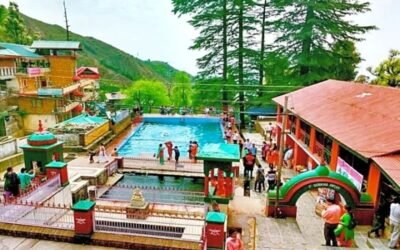
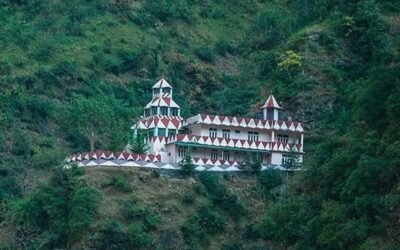
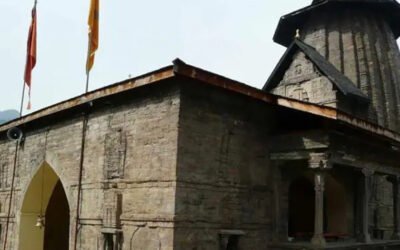
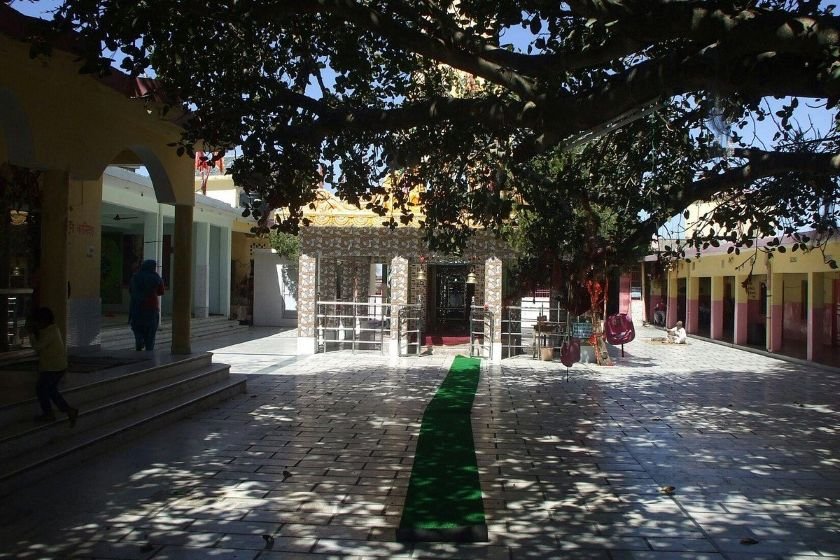
The temple is built in a traditional Himachali style, combining wood and stone with the kind of hand-carved panel work seen at many of the district’s older hill shrines, its sanctum housing the main image of the goddess surrounded by several smaller subsidiary shrines. A spacious courtyard, used for festival gatherings and community events, is typically decorated with colorful flags during major observances. Perched on its hillock, the temple offers sweeping views over the surrounding Una countryside — visitors describe clear sightlines toward the Dhauladhar range on good days, a reminder of just how much elevation this modest hill still commands over the plains below.
📜 One Shrine Among Nine: Una’s Place in the Himachal Devi Circuit
Sheetla Devi Temple is generally counted among the “nine Devi temples” of Himachal Pradesh, a loosely grouped set of Shakti shrines across the state that together form an informal pilgrimage circuit distinct from, though overlapping with, the more formally defined 51 Shakti Peethas. Its proximity to Chintpurni — one of those Peethas, and among the most visited pilgrimage sites in the region — places Sheetla Devi’s temple within a wider devotional landscape where a major shrine draws smaller, complementary temples into its orbit. It’s worth being precise here: Sheetla Devi’s Una temple is not itself one of the 51 Shakti Peethas, whatever its shared name with more famous shrines elsewhere in India might suggest; its significance rests on its own local tradition and its role within this regional Devi circuit, not on any claim to that specific status.
🎉 Festivals and Devotion
- Sheetla Mata Mela (Chaitra, March–April) — a nine-day fair marked by religious rituals and cultural events, the temple’s largest annual gathering
- Sheetla Ashtami / Basoda — observed with the distinctive no-cook-fire household tradition described above
- Navratri — celebrated with large crowds, often overlapping with pilgrim traffic bound for nearby Chintpurni
- Daily worship — regular aartis and offerings maintained throughout the year outside the major festival dates
🏞️ While You’re in the Area
- Chintpurni Temple — one of the 51 Shakti Peethas and the main pilgrimage anchor of the area, an easy combination with a Sheetla Devi visit
- Drona Shiv Bari Temple — a forested Shiva shrine near Ambota/Gagret with its own Mahabharata-era legend, elsewhere in the same district
- Bharwain market — the small town at the foot of the Chintpurni approach road, useful for food and basic supplies before or after temple visits
- Amb Andaura — a nearby railway town, useful as a base for onward travel
❓ Quick Questions Travellers Ask
Is there an entrance fee? No. The temple is free to visit.
Is this the same temple as the famous Sheetla Devi Shakti Peetha in Gurugram, Haryana? No — that’s a separate, unrelated temple with its own distinct legend and history. This Una district temple shares only the goddess’s name and general identity, not the specific site or founding story.
Can this be visited on the same day as Chintpurni? Yes — most pilgrims do exactly that, given how close the two sites are to one another.
Is the temple suitable for young children? Yes, and appropriately so — Sheetla Devi is specifically associated with children’s protection and health, and many parents bring young children here for that reason.
What is Sheetla Ashtami / Basoda, and is it specific to this temple? It’s a widely observed North Indian festival honoring Sheetla Devi generally, not unique to this particular temple, though it is marked here as it is at Sheetla shrines across the region.
A Last Word
There’s something quietly refreshing about a goddess whose defining ritual is restraint rather than spectacle — a day without fire, a hilltop without grand claims to ancient empire-scale sanctity, just a modest, well-loved shrine doing exactly what it was built to do: watching over children, cooling fevers, and giving pilgrims already bound for Chintpurni’s greater crowds a calmer place to pause first.
Fact-check note: The temple’s location near Chintpurni in Bharwain, its identity as one of Himachal’s “nine Devi temples,” its dedication to Sheetla Devi as a healing form of Durga/Parvati, and the Sheetla Ashtami/Basoda tradition are corroborated across multiple independent sources. However, at least one commonly circulated source about this temple conflates it with the separate, well-documented Sheetla Devi Temple in Gurugram, Haryana — including claims that it is one of the 51 Shakti Peethas, that it was built by the Pandavas/Yudhishthira on the banks of the Ganges, and that it hosts a Gardabh Mela donkey fair. None of these claims apply to the Una district temple, and they have been deliberately excluded here. A claim that the “present structure was built in the 19th century by Raja Sahil Varman, the Maharaja of Una” also appears in some sources, but the same figure and detail surfaces attached to an entirely different, unrelated Shiv Bari Temple in Una town — suggesting this detail has been cross-contaminated between temple listings and should not be treated as reliable for either site without further verification. This piece could not confirm the temple’s exact founding date beyond the 16th-century Baba Gopal Das tradition, and no GPS coordinates were independently verifiable, so Chintpurni has been used as a landmark reference instead. Distance from Chintpurni is reported inconsistently (1–7 km) across sources and has been presented as a range rather than a single figure.