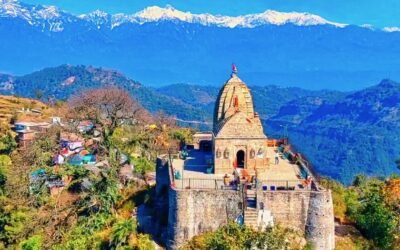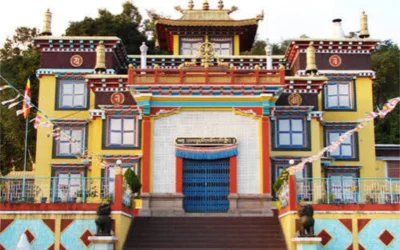
Before she ever reached the hillside where her temple now stands, the goddess of Chindi is said to have passed through half a dozen villages — blessing some, adopting one as her mother’s house, and leaving at least one permanently barren after its people disrespected her.
Most temple legends describe a goddess appearing at a single spot and staying there. Chindi Mata’s story is a journey — a specific, remembered itinerary through named villages in Karsog Valley, each stop leaving its own lasting mark on the local landscape and, in one case, apparently still visible in the soil today. And when she finally did settle, at the village that now bears her name, the story of how her temple’s actual layout came to be planned is, if anything, even stranger: not sketched by any architect, but traced on the ground first by a colony of ants, whose pattern a local priest reportedly saw revealed to him in a dream.
🌄 Location & How to Reach It
Chindi Mata Temple sits in Chindi village, roughly 13–14 km before Karsog town on the Shimla route, in Mandi district’s Karsog Valley, Himachal Pradesh, at an altitude reported around 1,400 metres.
Google Maps: Get Directions
- By road: Reachable by taxi or bus from either Shimla or Karsog, along a route often described as scenic but requiring patience given the winding mountain roads typical of this part of Himachal.
- By rail: Shimla is generally cited as the nearest railhead, connected onward to Kalka by a narrow-gauge line, though a considerable road journey remains from either direction.
- By air: No nearby airport serves this specific route directly; travellers typically connect via Shimla or the wider Kullu-Manali corridor.
Chindi itself functions as a quiet hill-station stopover before the descent into Karsog Valley proper, and many visitors combine the temple with a broader loop through Karsog’s dense cluster of old shrines.
🌸 Best Time to Visit
The temple’s garbhagriha (inner sanctum) is reportedly open for darshan only between 7 and 9 a.m., a genuinely narrow window worth planning around carefully rather than assuming the temple is accessible throughout the day. The main Chindi Mata fair, held during Shravan month, is the temple’s most significant annual event, when the goddess is taken in a chariot to visit nearby sacred sites — though tradition holds she never crosses a stream during this procession and never spends a night away from her temple, returning each time before nightfall.
🕉️ The Legend: A Journey Through the Hills, and a Map Drawn by Ants
Chindi Mata’s story unfolds in two connected parts — first, how she chose this particular village after a long journey through the surrounding hills, and second, how her temple came to be built once she arrived.
According to local tradition, the goddess first appeared in the form of a young girl, having left a place called Jufar before arriving at a village called Shiva. There, she was welcomed by Mahasu, a locally revered deity, who accepted her as his sister and is credited with directing her onward toward Chindi. From Shiva she travelled to Bajo, where she asked for water; the villagers there treated her with such warmth and respect that she declared Bajo her maternal home, promising to return every three to five years — a promise local tradition holds is still honoured today. Continuing on, she reached Bakhrot and declared the site sacred, a status still marked by an annual fair held there each Shravan month. Her journey took a darker turn at a place called Bahog, home at the time, according to the story, to demons who treated her with disrespect; she killed them in response and cursed the land to remain permanently barren — a curse local tradition insists holds true to this day, with the site said to support no vegetation. Finally, she arrived at Chindi itself, and was sufficiently moved by its beauty to decide to remain there permanently.
The temple’s actual construction is explained through a separate, equally distinctive tradition. According to multiple independent accounts, the goddess appeared in a local priest’s dream and informed him that a colony of ants had already traced out the blueprint for her temple on the ground nearby — a plan he was simply meant to follow rather than design himself. At least one version of the story goes further, describing the goddess personally overseeing the construction using a rope reportedly made by the ants themselves. This detail is what gives the temple its name: “Chindi” is understood locally to derive from this ant-drawn map, making the temple’s very name a permanent reference to its unusual origin story.
🙏 What Chindi Mata Is Known For
Chindi Mata is worshipped as a fierce, eight-armed (ashtabhuja) form of Durga, understood locally as Chandi — one of the goddess’s most formidable manifestations. Devotees travel from considerable distances to pray for good health, general wellbeing, and the fulfilment of sincere wishes, with a particular local belief that childless couples who pray here with genuine devotion may be blessed with children. The temple falls within the historical territory of the old Suket princely state, one of the two Sen-descended kingdoms — alongside Mandi — that were eventually merged into present-day Mandi district after Indian independence.
The annual Shravan fair remains the temple’s most vivid expression of ongoing devotion: when the goddess emerges from the main temple in her chariot, local tradition holds that fog descends over the surrounding hills and rain begins to fall, understood as a protective veil ensuring no other deity present at the fair is able to witness her dancing.
🏛️ The Temple Itself
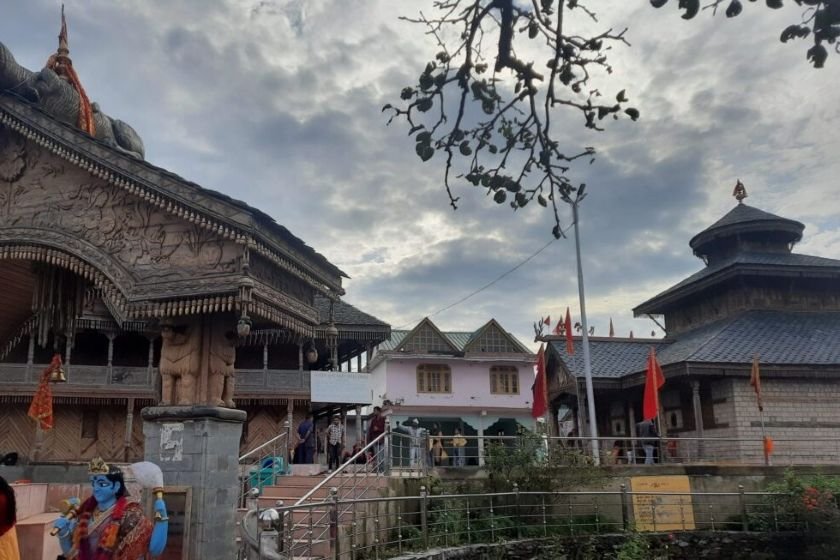
Chindi Mata’s temple is a striking, multi-storeyed wooden structure built in a distinctive pagoda style, its tiered, gabled roofs adorned with carved animal motifs — a wood-carved deer head, flying eagles perched across different roof levels, and carved tiger figures standing guard at the main gates. Inside and across the structure’s surfaces, totem-painted ceilings, floral carvings, and murals depicting Ganesh, serpents, lions, elephants, and birds create a dense visual record of local craftsmanship and devotional storytelling. The main sanctum houses the ashtabhuja stone idol of the goddess alongside a separate idol of Vishnu, an interesting pairing that broadens the temple’s devotional scope beyond Shakti worship alone.
Outside the main shrine, a circular stepwell provides the water used in abhishek rituals, and a second structure stands opposite the main temple — described by different sources either as a temple treasury (bandar) or as a two-storey hall combining langar (community kitchen) and storage functions, a minor discrepancy likely reflecting the building’s dual or evolved use over time rather than a genuine disagreement about its existence. The temple complex is looked after by a rotating clan of priests who take turns conducting worship, rather than a single resident pujari — a arrangement distinct from the more individually identified priestly lineages found at some other Himachal shrines.
📜 Karsog Valley’s Suket Heritage
Chindi Mata sits within a valley whose temple architecture and mythology are shaped heavily by the old Suket kingdom’s history, alongside neighbouring shrines like Kamaksha Devi at Kao and the ancient Mamleshwar Mahadev temple. Together, these Karsog Valley temples represent one of Himachal’s richest concentrations of indigenous hill-style wooden architecture, distinguished from the stone Nagara temples of the Kangra Valley by their heavy use of timber, gabled slate roofs, and dense, animal-and-nature-themed carving traditions specific to this part of the Himalayan foothills.
🎉 Festivals and Devotion
- Chindi Mata Fair (Shravan month): The temple’s principal annual event, in which the goddess is taken by chariot to visit nearby sacred sites, always returning before nightfall and never crossing a stream along the way.
- Bakhrot fair (Shravan month): A related annual observance at one of the villages tied to the goddess’s original journey.
- Bajo return visits (every 3–5 years): A distinctive, longer-cycle tradition honouring the goddess’s declared maternal home.
- Daily darshan: Limited to a narrow morning window, generally 7–9 a.m., outside of festival periods.
🏞️ While You’re in the Area
- Kamaksha Devi Temple, Kao: A wooden Durga shrine roughly 20 km away, with its own distinctive history and legal history around a now-banned sacrificial tradition.
- Mamleshwar Mahadev Temple, Mamel: An ancient Shiva temple in Karsog town, credited to Pandava-era construction.
- Shikari Devi Temple: A roofless Shakti shrine at the highest point in Mandi district, reachable via trekking routes from the wider Karsog/Chindi area.
- Karsog Valley: Known more broadly for its apple orchards, paddy fields, and dense concentration of ancient temples.
- Bajo, Bakhrot, and Bahog: The villages featured in the goddess’s own founding journey, of interest to anyone wanting to trace the full legend on the ground.
❓ Quick Questions Travellers Ask
What time should I plan to arrive for darshan? Early morning is essential — the inner sanctum is reportedly open for viewing only between 7 and 9 a.m., outside of which the goddess’s image isn’t accessible to visitors.
Is the story about the barren land at Bahog something visitors can actually see? Local tradition holds that the site remains without vegetation to this day as a direct result of the goddess’s curse, though this is a devotional claim rather than something independently documented for this article.
Is there an entry fee? No entry fee could be confirmed for this article; as an actively worshipped local shrine, general darshan is very likely free.
How does the priest rotation system work? The temple is maintained by a clan of priests who take turns performing worship, rather than a single dedicated resident priest — worth being aware of if you’re hoping to speak with a specific pujari about the temple’s history.
Can this temple be combined easily with other Karsog Valley temples in one trip? Yes — Chindi Mata is commonly visited alongside Kamaksha Devi, Mamleshwar Mahadev, and other Karsog Valley shrines as part of a broader exploration of the region’s dense temple heritage.
A Last Word
There’s something quietly remarkable about a temple whose entire origin story refuses to center on the temple itself — instead tracing a goddess’s footsteps across an entire valley, rewarding one village with a permanent bond, cursing another for its cruelty, before finally arriving somewhere beautiful enough to stay. And even then, once she’d chosen Chindi, the story insists she still didn’t build the place alone — she left that final, oddly literal task to a colony of ants, patient enough to map out, line by line, exactly where her home should stand.
Fact-check note: The temple’s dedication to Chandi/Durga in her eight-armed form, its ant-mapped construction legend, its narrow morning darshan hours, and its location in Chindi village within the historical Suket kingdom are corroborated across multiple independent sources. The detailed multi-village journey legend (Jufar–Shiva–Bajo–Bakhrot–Bahog–Chindi) appears consistently across at least two independent sources but is not as widely cross-referenced as some other temples’ core legends in this series, and should be understood as a well-established local tradition rather than something verifiable beyond that. The exact nature of the smaller building opposite the main temple (treasury vs. langar/storage hall) varies slightly across sources. No entry fee could be confirmed.