Twice she appeared in a king’s dream asking to be moved, and both times the Sen kings of Keonthal obeyed — which is how a goddess from Bengal ended up ruling a hilltop above the Shimla-Kalka highway.
Most Himachal temples exist to explain why a god chose one particular rock, spring, or peak and stayed there forever. Tara Devi’s story is the opposite kind — a temple built around a goddess who never quite settled. She arrived from far outside the hills, was housed once, then asked to be housed again somewhere higher, and a century and a half later her own shrine had to be dismantled and rebuilt from scratch because the wood itself gave out. Nothing about her presence here reads as ancient or inevitable. It reads as a series of decisions, made by kings across three generations, that a hill above Shoghi was where she wanted to be seen from — and every generation since has had to keep proving her right.
🌄 Location & How to Reach It
Tara Devi Temple sits on Tara Parvat, a forested hilltop between Shimla and Shoghi, just off the Kalka–Shimla highway (NH-22) near Kacchi Ghati. It’s commonly cited as roughly 11 km from central Shimla, though — like a lot of hill-station distances — you’ll see it quoted anywhere from 7 km to 18 km depending on which end of Shimla and which road the source is measuring from.
Google Maps: Get Directions
The temple stands at about 1,850 metres (roughly 7,200 feet), wrapped in oak, rhododendron, and deodar forest, with the Shivalik ranges and — on a clear day — the snow line of the higher Himalayas visible from the courtyard.
- By road: Taxis and local buses run from Shimla via NH-22; the final stretch up from the highway is walkable in well under an hour for most visitors, or drivable most of the way with parking a short walk from the temple gate.
- By rail: Tara Devi Railway Station, on the UNESCO-listed Kalka–Shimla toy train line, sits a few kilometres below the temple — a nostalgic way to arrive if you don’t mind a short uphill walk afterward.
- By air: Jubbarhatti Airport, Shimla’s own small airstrip, is the nearest, though with limited flight connectivity; Chandigarh’s airport is the more reliable option for most travellers, followed by a drive up to Shimla.
As hilltop temples in this region go, Tara Devi is one of the easier ones — no serious trek required, just a manageable climb from the road, which is part of why it draws such heavy weekend crowds.
🌸 Best Time to Visit
March to June and September to November bring the clearest skies and the most comfortable temperatures for the walk up. Monsoon months make the forest paths slick and the views hazy, and heavy snowfall in peak winter can make the approach genuinely difficult. The temple is open daily from 7 AM to 6:30 PM, and mornings — before the weekend crowds arrive — are the quietest time to be there. If you can time a visit around Ashtami during Shardiya Navratri, you’ll catch the temple at its most alive: this is the day the Sen family itself still comes to worship its ancestral goddess, and a fair with a long-standing wrestling tradition unfolds in the temple complex alongside it.
🕉️ The Legend — A Goddess Who Asked Twice
The story, as it’s told locally, runs across two kings and roughly sixty years.
Sometime in the mid-1700s, a Sen dynasty ruler of the old Keonthal state — most accounts name him Bhupendra Sen — kept a small family idol of the goddess Tara close to him, reportedly carried on his person. According to one strand of the story, he’d gone hunting in the dense forests near Junga and lost his way; exhausted, he fell asleep and dreamed that the goddess, along with her guardian figures Bhairav and Hanuman, asked to be unveiled properly for the people rather than kept hidden as a private family idol. The king donated land — accounts put it at fifty bighas — and built a temple where a wooden image of Tara was installed according to Vaishnav ritual.
That might have been the end of it, except the goddess apparently had further plans. A generation or two later, King Balbir Sen of the same line dreamed of her again — this time asking to be moved up, onto the hilltop of Tara Parvat itself, so she could look out over the whole valley. Balbir Sen commissioned a new idol cast in ashtadhatu, the traditional eight-metal alloy, reportedly made by an artisan in Junga and carried up to the hill on the back of an elephant. Most sources date this installation to 1825. It’s this hilltop shrine, not the original valley temple, that pilgrims climb to today.
A separate and more widely repeated tradition skips the dream sequence and simply says the idol was carried by a Sen king from West Bengal, a devotee of the goddess who brought her image into the hills himself — which would explain why Tara Devi’s iconography and her association with the Dus Mahavidyas feels distinctly Bengali-Shakta rather than purely local Pahari. A third, more generic version — a sage protecting the region from demons, rewarded with the goddess’s promise of protection — circulates too, but it reads like the kind of origin story attached to many regional shrines rather than something specific to this one, and it sits less easily alongside the detailed, name-and-date version involving the two kings.
Whichever version is closer to fact, all of them agree on one unusual thing: this is a goddess who is remembered as having asked for what she wanted, more than once, rather than simply being found.
🙏 What the Goddess Is Known For
Tara Devi — one of the ten Mahavidyas, and worshipped here as a form of Durga and Kali both — is approached as a protector as much as a granter of wishes: devotees speak of her watching over travellers, over the Shimla valley generally, and over the Sen family in particular, who still treat her as their kuldevi (family deity) and return each Ashtami to prove it. She isn’t positioned as a rival to bigger pilgrimage circuits like Naina Devi or Chintpurni; this is a quieter, more local devotion; people come for blessings, for the annual family-and-community feast tradition, and increasingly, for the walk and the view as much as the darshan itself. Sunday and Tuesday langars are organized by devotees fulfilling vows — and the waiting list to sponsor one reportedly runs to several years, which says something about how deeply this particular practice is embedded locally, even if the temple itself doesn’t draw crowds from across the state.
🏛️ The Temple Itself
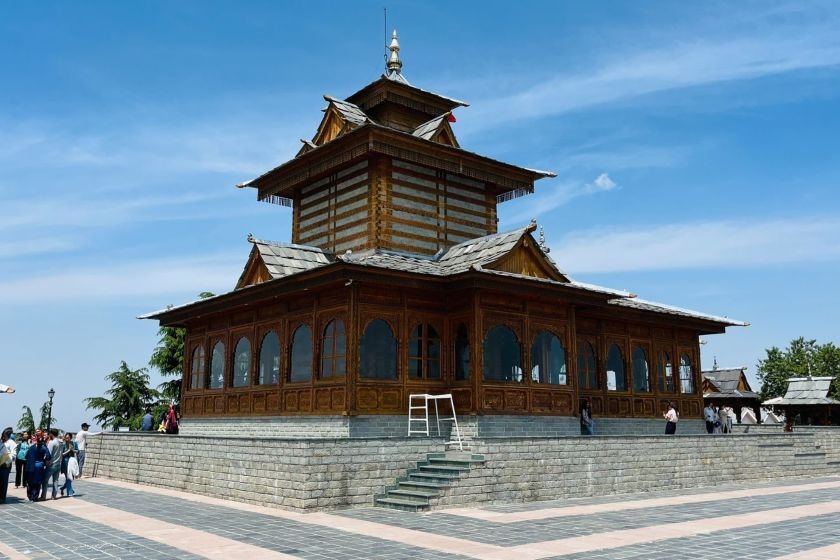
What stands on the hilltop today is, in a strict sense, not old. The original wooden structure suffered the fate most timber buildings in this climate eventually do — prolonged exposure warped and degraded it — and the temple was entirely rebuilt, a restoration reported to have taken around three and a half years and cost upward of ₹6 crore, with the new ashtadhatu idol reinstalled on 20 July 2018 in a ceremony attended by some ninety priests. The rebuilders kept the wood carving deliberately close to the original Pahari style: elaborate floral and mythological motifs worked into doors and door-frames, small carved representations of goddesses set into the main façade, and gold and silver used generously around the inner sanctum.
Stand in the courtyard and the sensory picture is fairly consistent across visitors’ accounts — bells, the low murmur of chanting, incense drifting on cold mountain air, and underneath it all the particular hush of a forest clearing rather than a busy town temple. Alongside the main Tara idol, the complex houses images of Saraswati and Kali, and a separate shrine to Batuk Bhairav stands nearby, along with a small Shiva temple known locally as Shiv Bavdi.
📜 Regional Context — The Keonthal Connection
Tara Devi belongs to a cluster of temples tied to the old princely states that once ringed Shimla before the British hill station absorbed the area administratively. Keonthal, the state the Sen dynasty ruled, had its seat partly at Junga — the same place where, in the legend, both the original idol-bearing forest and the artisan who cast the 1825 ashtadhatu image are located, and where the Sen fort reportedly still stands. That the Sen family continues the Ashtami worship today isn’t just a nice detail for a brochure; it’s one of the more intact living threads connecting modern Shimla back to its pre-colonial political geography, in a district where most surviving markers of that era are colonial rather than princely.
🎉 Festivals and Devotion
- Ashtami (Shardiya Navratri): The temple’s biggest day — the Sen family’s own worship of their kuldevi, paired with a public fair and a long-running wrestling tradition in the temple complex.
- Navratri (both cycles): General festive worship, folk music, and larger-than-usual crowds.
- Sunday and Tuesday langars: Community meals sponsored by devotees fulfilling personal vows, reportedly booked years in advance.
- Daily aarti: Morning and evening worship with bells, conch, and chanting — a smaller-scale but daily version of the same devotional energy.
🏞️ While You’re in the Area
- Jakhoo Temple, Shimla – The Hanuman shrine on Shimla’s highest point, easily paired with Tara Devi as a two-temple day if you have transport sorted.
- Kali Bari Temple, Shimla – A Bengali-style Kali shrine in town; given Tara Devi’s own Bengal connection in local legend, the two make an interesting thematic pairing.
- Sankat Mochan Hanuman Temple – A quieter Hanuman shrine on the outskirts, good for a low-key second stop.
- Kalka–Shimla Toy Train (Tara Devi Station) – The UNESCO-listed toy train line runs right past the base of the hill; riding a leg of it and walking up from the station is a scenic way to combine the two experiences.
- Shoghi – A small forested town nearby known for orchards and short walking trails, useful if you want to stretch the visit into a half-day in the hills rather than a quick temple stop.
❓ Quick Questions Travellers Ask
Is there an entry fee at Tara Devi Temple? No, entry is free, and the temple is open daily from 7 AM to 6:30 PM.
How long does the whole visit take? Most visitors budget around two hours including the walk up from the road or railway station and time at the temple itself.
Can I combine a toy train ride with the temple visit? Yes — Tara Devi Railway Station on the Kalka–Shimla line is a short distance below the temple, making it a popular way to arrive for those doing a leg of the toy train journey anyway.
Is the climb difficult? No — it’s a gentle, non-technical uphill walk suitable for most fitness levels and families, unlike some of the steeper temple treks elsewhere in the district.
What should I avoid carrying inside? Leather items — bags, belts, wallets, shoes — are commonly restricted inside the sanctum, as at many Devi temples in the hills.
A Last Word
There’s something quietly honest about a temple whose central story isn’t “the goddess chose this exact spot and nothing has changed since,” but rather “she kept adjusting her mind, and the people who loved her kept building to match.” The wooden shrine of Bhupendra Sen’s time is gone. Even the ashtadhatu-era structure of 1825 has since been dismantled and rebuilt in the 2010s. What hasn’t moved is the fact of the family still climbing up every Ashtami to sit with a goddess their ancestors first carried into these hills — proof, maybe, that a shrine doesn’t need to be physically old to be genuinely rooted.
Fact-check note: The 1766 construction date, the 1825 ashtadhatu installation, the Sen/Keonthal dynasty attribution, the 2018 rebuilding and reinstallation ceremony, and the Ashtami/Navratri fair tradition are corroborated across multiple independent sources. The exact distance from Shimla varies significantly by source (7–18 km) depending on the measuring point, so it’s presented here as an approximate range rather than a fixed figure. The “sage protecting the region from demons” legend appears in fewer, less detailed sources than the two-kings narrative and reads as a more generic temple-origin motif; it’s included here as a secondary, less-corroborated tradition. No independently verified GPS coordinates, priest contact details, or entrance-fee changes could be confirmed, so none are stated above.