A sage once waited on this hilltop for a god who said he’d come back — and the temple standing here today is, in a sense, still waiting with him.
Some temples exist because a god appeared and stayed. Jakhoo exists because a god appeared, made a promise, and then broke it — and what got built afterward was less a monument to divine glory than a monument to disappointment, quietly turned into devotion instead of resentment. It’s a very human kind of origin story to find at the top of Shimla’s highest hill: not a triumphant arrival, but an apology that came centuries too late, carved permanently into stone and memory instead. Everything else about Jakhoo — the giant statue, the ropeway, the mischievous monkeys — sits on top of that older, smaller, more wistful story, and it’s worth knowing before you climb up to see the rest.
🌄 Location & How to Reach It
Jakhoo Temple sits atop Jakhoo Hill, Shimla’s highest point, about 2.5 km east of the Ridge, at roughly 2,455 metres (8,054 feet) above sea level.
Google Maps: Get Directions
- On foot: A well-marked trail begins near Christ Church and the State Library at the Ridge and climbs steadily through deodar forest for about 2–2.5 km — roughly 30–45 minutes at a comfortable pace, longer if you stop to enjoy the views or dodge the resident monkeys.
- By pony: Horse rides are available from the base for those who’d rather not walk the whole way up.
- By ropeway: The Jakhu Ropeway, opened in 2017, covers the same ground in about 5–6 minutes, running roughly from 9:30 AM to sunset, with separate one-way fares for adults and children.
- By taxi: Vehicles can take you most of the way up via the road that loops around from the Ridge, though the final stretch to the temple itself is still on foot.
Compared to some of the district’s real hilltop treks, Jakhoo is about as accessible as a “highest peak” temple gets — genuinely walkable in trainers, with a cable car option for anyone who’d rather skip the climb entirely.
🌸 Best Time to Visit
Jakhoo is a year-round temple, and Shimla’s own climate does most of the work of deciding when to go: March to June for mild, clear days; the monsoon months bring fog and slippery trails; and the pleasant, crisp stretch from September through November is when the Shivalik views are at their sharpest. The temple is open daily from 7 AM to 8 PM, with mornings and just before sunset offering the best light for the panorama. If you can time it, Dussehra (Vijayadashami), usually in September or October, is the temple’s biggest day of the year — fitting, for a shrine dedicated to the god who fought on Rama’s side in that very war.
🕉️ The Legend — A Sage Left Waiting
The story goes back to the Ramayana, to the night Lakshmana lay dying on the battlefield at Lanka, struck down by a devastating arrow. Rama sent Hanuman north, toward the Himalayas, to fetch the Sanjeevani herb that alone could save him. Flying over this hill in search of it, Hanuman came upon a sage in deep meditation — most tellings name him Yaku or Yaaku, a Yaksha, one of the nature-spirit beings that stand between the human and the divine, and it’s from this name that “Jakhu” is said to derive.
Hanuman landed to ask the sage for guidance — and landed with such force, the story goes, that the hill itself sank partway into the earth, settling at roughly the height it stands today. Yaku told him what he needed to know about the herb. Grateful, Hanuman promised the sage he’d stop by again on his way back from the Himalayas, once Lakshmana was saved.
He never did. Delayed by a fight with the demon Kalanemi and pressed for time, Hanuman took a shortcut back to Lanka and flew straight past the hill without a second landing. Yaku waited. When it became clear Hanuman wasn’t coming, the sage — by most accounts more sorrowful than angry — built a temple on the spot in Hanuman’s honour anyway, and an idol of the god is said to have manifested there on its own, unasked. Hanuman’s footprints, the story adds, are preserved behind the temple to this day in a small marble shrine.
No one can date any of this precisely, and it shouldn’t be mistaken for verified history — there’s no archaeological record tying a specific structure here to the Ramayana era, and what stands on the hill now reflects centuries of local rebuilding rather than one continuous ancient building. But as an origin story, it’s an unusually tender one: most temple legends end with the god delivering on a promise. This one is built around a promise that quietly went unkept, and a devotee who built a shrine out of that disappointment rather than around a triumph.
🙏 What Hanuman Is Known For Here
Hanuman is worshipped everywhere in India as the embodiment of devotion, strength, and selfless service — the ideal disciple, not just a powerful deity in his own right. At Jakhoo specifically, devotees come seeking courage, protection from harm, and relief from fear and obstacles, much as they would at any major Hanuman shrine. There’s also a small local tradition that ringing the temple bell here brings good fortune for the following few days — a lighter, more folk-devotional layer sitting alongside the weightier Ramayana story. Unlike some temples where ritual practice can feel elaborate or opaque to outsiders, worship at Jakhoo is straightforward and accessible: darshan, an offering, a moment at the bell, and the climb itself functioning almost as a form of penance or devotion in its own right.
🏛️ The Temple Itself
The temple complex today is a mix of old devotional simplicity and one very modern, very large addition. The sanctum itself is modest — carved pillars and walls depicting deities and welcoming female figures, oil lamps, the low murmur of bells and chanting, murals inside portraying scenes from Hanuman’s exploits in the Ramayana. It’s the kind of interior that rewards slowing down rather than rushing through.
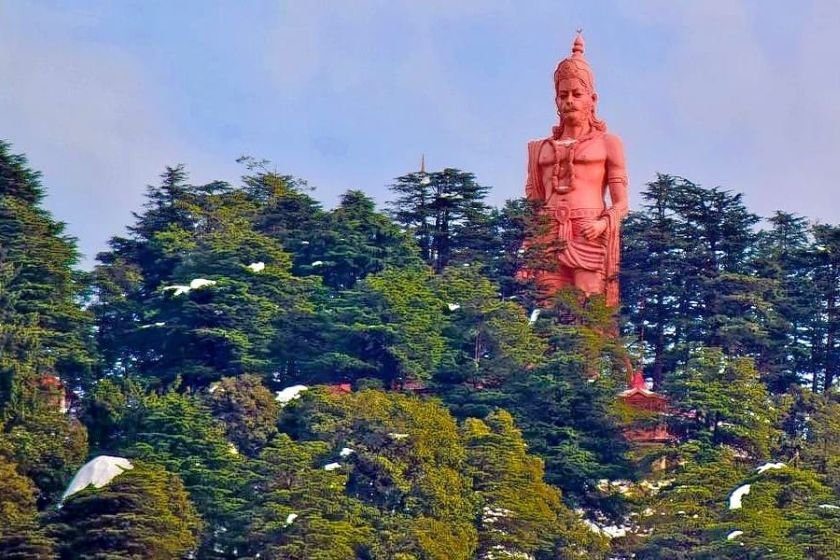
Then you step back outside, and the scale changes completely: a 108-foot statue of Hanuman, unveiled on 4 November 2010 at a reported cost of around ₹1.5 crore and formally revealed to the public by Bollywood actor Abhishek Bachchan, dominates the hilltop and is visible from large parts of Shimla town below, especially once it’s lit up after dark. It’s one of the tallest Hanuman statues anywhere, and it sits slightly oddly — deliberately or not — against the quiet, apologetic little legend the temple is actually built on.
And then there are the monkeys. Troops of rhesus macaques and langurs treat the hill as home turf, believed locally to be descendants of Hanuman’s own vanar sena. They’re a genuine part of the experience rather than incidental wildlife — visitors are routinely advised to leave food out of sight, avoid direct eye contact, keep bags zipped, and, if it makes you feel better, rent one of the sticks available near the base for a nominal fee, mostly as a visual deterrent rather than for actual use.
📜 Regional Context — A Skyline Marker Before It Was a Postcard
Long before Shimla became the British Raj’s summer capital in the mid-19th century, Jakhoo Hill’s prominence as the highest point for miles around had already made it a natural site for sacred association — the pattern repeats across the Himalayan foothills, where the tallest local hill tends to end up claimed by a temple sooner or later. Colonial-era Shimla grew up literally underneath it, and 19th-century gazetteers note the hill as a landmark feature without treating the temple itself as a major colonial-era construction — this was, and largely remains, a site shaped by local devotion and periodic rebuilding rather than any one ruling dynasty’s patronage, unlike some of the district’s temples with a clearer princely-state backstory.
🎉 Festivals and Devotion
- Dussehra (Vijayadashami): The temple’s principal festival, marking Rama’s victory over Ravana — celebrated here with particular devotion given Hanuman’s central role in that story. It was held at Annadale until 1972, after which the celebration moved to Jakhoo itself.
- Tuesdays and Saturdays: Traditionally considered auspicious days for Hanuman worship generally, and Jakhoo sees a steady flow of devotees on these days beyond the usual tourist footfall.
- Daily aarti and darshan: Ongoing, low-key devotional life continues through the year regardless of festival calendar.
🏞️ While You’re in the Area
- Christ Church, The Ridge – Roughly a kilometre away; Shimla’s landmark colonial-era church, notable for housing one of India’s largest pipe organs.
- Lakkar Bazaar – A short walk from the temple, this wooden-handicraft market is a good stop for local souvenirs on the way back down.
- Kali Bari Temple, Shimla – A Bengali-style Kali shrine dating to 1845, a short distance away, and a nice contrast in devotional style if you’re doing a temple-hopping day in Shimla.
- Himalayan Nature Park – Near the ropeway’s lower station, a good option if you want a quieter nature stop before or after the climb.
- The Ridge and Mall Road – Shimla’s central promenade and shopping street, both an easy walk from the temple’s base.
❓ Quick Questions Travellers Ask
Is there an entry fee at Jakhoo Temple? No, entry is free, though donations are welcomed; the temple is open daily from 7 AM to 8 PM.
What’s the easiest way to get to the top? The Jakhu Ropeway, which takes about 5–6 minutes from its lower station near the Ridge — the fastest option if you’d rather skip the walk.
Are the monkeys actually dangerous? Not typically aggressive, but they are opportunistic and quick — the standard advice is to keep food and dangling items out of sight and avoid direct eye contact rather than to fear them outright.
How long does the whole visit take? Most visitors spend around 1.5–2 hours total, including the walk or ropeway ride up, time at the temple and statue, and the way back down.
Is the trek difficult? No — it’s a well-maintained, moderately inclined forest path suitable for most fitness levels, not a technical or strenuous climb.
A Last Word
It’s easy to walk away from Jakhoo remembering only the statue — it’s the part visible from half of Shimla, after all, lit up at night like a beacon over the town. But the story underneath it is smaller and, honestly, more affecting: a sage who kept a hilltop vigil for a friend who never came back, and who chose, in the end, to build something beautiful out of that absence instead of letting it curdle into bitterness. Whatever you make of the legend’s historical truth, that’s not a bad thing to carry back down the hill with you.
Fact-check note: The temple’s location, altitude, the 2010 statue unveiling (with cost and Abhishek Bachchan’s involvement), the 2017 ropeway opening, and the Dussehra festival’s move from Annadale in 1972 are corroborated across multiple sources including Wikipedia. The Ramayana-era origin legend, the sage Yaku/Yaksha connection, and the footprint shrine are consistently repeated across local and tourism sources but have no independent archaeological or historical verification — they’re presented here as legend, not established history. The exact construction date of the original temple is unknown and not fabricated here. No verified GPS coordinates or priest contact details are included, as none could be independently confirmed.