Years before a wandering saint’s name would reach Steve Jobs and a generation of Silicon Valley seekers, he spent ten quiet days in these Shimla pines and asked for a temple to be built.
Most temples in these hills carry legends too old to date — a king’s dream, a sage’s penance, a battle nobody living remembers. This one is different: everyone involved has a name, a title, and a year attached to them, because it was built well within living memory, by people whose descendants can still be traced. And yet the man at its center, Neem Karoli Baba, would go on to become one of the most quietly influential spiritual figures of the twentieth century, revered by pilgrims across North India and, decades later, name-checked by tech founders half a world away who’d never set foot in these particular pines. This is the temple that came first — before the fame, before the foreign devotees, when it was still just a forest, a ten-day stay, and a wish.
🌄 Location & How to Reach It
Sankat Mochan Temple stands in the Taradevi area on the Kalka–Shimla highway (NH-5), a short distance outside central Shimla, surrounded by deodar and pine forest. Distance from the city center is given fairly consistently across sources at somewhere between 5 and 7 kilometres, depending on which point in Shimla you measure from.
Google Maps: Get Directions
GPS Coordinates: 31.0854°N, 77.1425°E
Elevation: approximately 1,975 metres above sea level, per Wikipedia’s cited figure — one other regional source gives a noticeably lower figure of 975 metres, which looks like it may be missing a digit rather than reflecting a genuinely different measurement, so treat that lower number with caution.
- By road: Regular buses and taxis run along the Kalka–Shimla highway; the temple sits directly on this route, making it an easy stop rather than a detour
- By rail: Shimla’s own railway station is only a few kilometres away
- By air: Jubbarhatti Airport, roughly 23 km from Shimla, is the nearest airstrip
Of all the hill shrines around Shimla, this is one of the simplest to reach — no real climb, no narrow forest track, just a straightforward stop directly off the highway.
🌸 Best Time to Visit
Shimla’s general seasonal pattern applies here: March through June offers clear, comfortable weather, and October through February brings crisp air and quieter surroundings, with genuinely cold mornings in the depths of winter. The monsoon months of July to September bring heavier rain and mist that can make the forest paths slick, though the temple itself remains open and accessible year-round. Tuesdays and Saturdays, associated with Hanuman worship, draw noticeably more visitors, and Sundays bring the temple’s well-known community meal, so plan around those days if you’re hoping for either a livelier atmosphere or a quieter one.
🕉️ The Story: A Ten-Day Stay That Became a Lifelong Wish
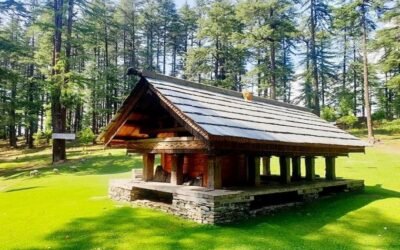
Sometime around 1950, a wandering ascetic known then by various names — Lakshman Das among them, long before the world would come to know him as Neem Karoli Baba — arrived in the forested hills around Shimla and settled into a simple hut for what accounts describe as somewhere between nine and twelve days, the exact count varying slightly depending on which telling you read. Some versions place this stay specifically at Taradevi itself; the temple’s own tradition holds that it was in the very patch of forest where the shrine now stands. Either way, it was here, deep in meditation, that he became convinced a Hanuman temple needed to rise on this spot — not through any dramatic vision or divine confrontation, simply a conviction that settled into him during those quiet days and never left.
He shared the wish with his growing circle of followers, and it sat for over a decade before anything was built. It was only in 1962 that the then Lieutenant Governor of Himachal Pradesh, Raja Bajrang Bahadur Singh — himself the ruler of the small former princely state of Bhadri — joined with a devotee named Bhagwan Sahai to begin construction in earnest. The temple was finally consecrated on 21 June 1966, a Tuesday, fittingly enough given Hanuman’s traditional association with that day of the week.
What makes this story worth telling honestly, rather than dressing up as something grander, is the sheer ordinariness of it: a wandering renunciate liked a particular hillside, said so, and over a decade later, people who respected him made it happen. There’s a real temptation to link this temple directly to Neem Karoli Baba’s later, far more famous ashram at Kainchi Dham near Nainital — the place Steve Jobs and, later, Mark Zuckerberg would travel to and credit with shaping their thinking — but it’s worth being precise about the timeline rather than blurring it for a better story. Kainchi Dham’s own Hanuman temple was consecrated in 1964, two years before this one in Shimla was formally completed, even though Neem Karoli Baba’s original stay and wish here in Shimla predates Kainchi’s founding by well over a decade. In other words: the idea for this temple came first, but the building at Kainchi was finished first. Both belong to the same saint’s life, but neither one is simply an earlier draft of the other, and it does the story more justice to leave that ambiguity intact than to flatten it into a tidy “first” or “original.”
🙏 What the Deity Is Known For
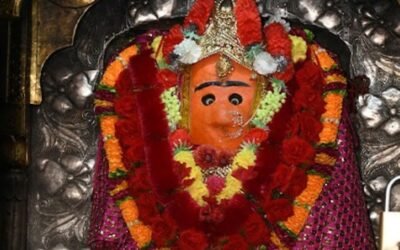
As his title suggests, Hanuman is worshipped here specifically in his aspect as Sankat Mochan — the remover of troubles, the deity devotees turn to precisely when a difficulty feels too large or too stubborn for ordinary remedies. This is a role Hanuman carries across Hindu devotional practice generally, closely tied to the Hanuman Chalisa and to the older Sankat Mochan Hanuman Ashtakam composed by the poet-saint Tulsidas, both widely recited here alongside regular aarti. The temple’s association with Neem Karoli Baba adds a further layer: many who visit come not only for Hanuman’s traditional protective role but out of devotion to the saint himself, whose own small shrine sits within the same complex.
🏛️ The Temple Itself
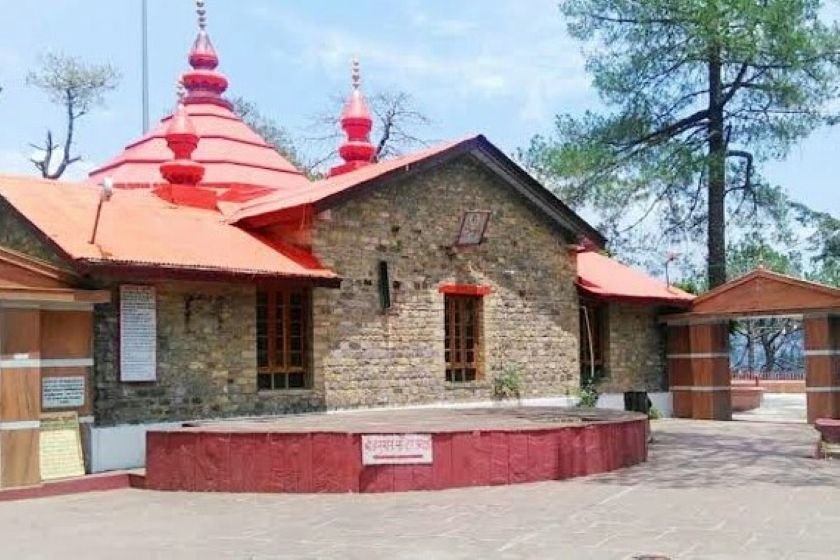
The complex spreads across a reported 18.8 bighas of forested land, considerably larger than a single shrine — alongside the main Hanuman sanctum sit separate spaces for Rama, Sita, and Lakshmana, for Shiva, and for Ganesha, the last of these built, according to one detailed account, in a distinct South Indian architectural style rather than matching the rest of the complex. A modest shrine dedicated to Neem Karoli Baba himself, added in 1998, sits nearby. Architecturally, the main structure keeps things simple and unornamented rather than reaching for grandeur — the emphasis throughout is on the setting rather than elaborate stonework, with deodar and pine pressing close on all sides and Shimla’s rooftops visible in the distance from the temple grounds. A three-storey building within the complex does double duty, housing the Sunday langar hall on one side and functioning as a rentable venue for local weddings on the other, alongside a children’s park and a small Ayurvedic dispensary that serves the surrounding community.
📜 A Temple Built in a City the British Once Ruled the Summer From
Sankat Mochan’s story sits inside a larger and slightly ironic historical frame: it rose in the very hill station the British had built as their summer seat of imperial power, less than two decades after Indian independence. Where Shimla’s colonial-era landmarks — the Ridge, Christ Church, the old Viceregal Lodge — speak to one chapter of the city’s history, this temple belongs to a distinctly different one: the quiet, largely unplanned way indigenous devotional life kept expanding through the same hills once dominated by colonial administration, without particular fanfare or official notice. It’s a useful reminder that not every meaningful site in Shimla dates back centuries — some of the city’s most visited spiritual landmarks are younger than living grandparents, and Sankat Mochan is a clear example of a shrine whose importance rests entirely on devotion accumulated within a few living generations, rather than any claim to ancient origin.
🎉 Festivals and Devotion
- Hanuman Jayanti — celebrated with bhajans, special aartis, and a large community gathering
- Ram Navami — marked with havans and the ceremonial dressing of Lord Rama’s idol in new clothes
- Dussehra — effigies of Ravana, Kumbhakarna, and Meghnad, reportedly crafted by artisans brought in from Meerut, are burned here in a local Ram-Lila performance
- Weekly Sunday Bhandara — a large free community meal drawing devotees from across the city
- Tuesdays and Saturdays — the temple’s busiest ordinary days, given Hanuman’s traditional association with both
🏞️ While You’re in the Area
- Tara Devi Temple — a Shakti shrine on a neighbouring hilltop, giving the area its name and offering a natural pairing with a Sankat Mochan visit
- Jakhu Temple — Shimla’s largest and best-known Hanuman shrine, home to a towering statue, useful for comparing the city’s two major Hanuman devotional sites
- Kali Bari Temple — an older Kali shrine associated with the goddess Shyamala, from whom some trace Shimla’s own name
- The Ridge and Mall Road — Shimla’s historic civic core, easily combined with a Sankat Mochan visit given the temple’s position directly on the highway into town
❓ Quick Questions Travellers Ask
Is there an entrance fee? No. The temple is free to visit, with no ticket required.
What are the temple’s timings? Broadly from around 6:30 a.m. to 8:00 p.m. in summer and slightly shorter hours in winter, with morning and evening aarti performed daily.
Is the Sunday langar open to all visitors, not just regular devotees? Yes — it’s a large, open community meal, and visitors are generally welcome alongside regular worshippers.
Is this the same place Steve Jobs or other well-known Neem Karoli Baba devotees visited? Not directly. The site most associated with Neem Karoli Baba’s Western following is Kainchi Dham near Nainital in Uttarakhand, a separate ashram founded a few years after this Shimla temple’s own construction began. This temple is connected to the same saint but is not the site of those specific, more widely told stories.
Can I stay overnight nearby? The temple itself isn’t set up as a pilgrim guesthouse in the way some ashrams are; most visitors treat it as a day stop and stay in Shimla proper if they need accommodation.
A Last Word
There’s a particular kind of quiet dignity in a temple that doesn’t need to borrow fame from elsewhere to matter. Sankat Mochan’s own story is a modest one — a tired traveler, a forest he liked, a wish that took over a decade to become a building — and it stands perfectly well on those terms, without needing to claim a closer connection to its founder’s later, more celebrated legacy than the facts actually support. Stand in that courtyard on an ordinary Tuesday, with the pines pressing in and Shimla’s rooftops just visible below, and it’s easy enough to understand why a tired ascetic once thought this particular patch of forest was worth stopping in for ten quiet days.
Fact-check note: The temple’s founding narrative — Neem Karoli Baba’s stay in the area around 1950, the involvement of Lieutenant Governor Raja Bajrang Bahadur Singh and devotee Bhagwan Sahai from 1962, and the 21 June 1966 consecration — is corroborated consistently across Wikipedia and multiple independent regional sources. GPS coordinates are drawn from Wikipedia’s cited infobox. Sources disagree on minor details that this piece has not tried to force into false precision: the length of Neem Karoli Baba’s stay is variously given as 9–10, 10, and 10–12 days, and one source places his hut specifically at Taradevi rather than at the exact site of the present temple. One regional source’s stated altitude of 975 m appears inconsistent with Wikipedia’s more detailed figure of 1,975 m and looks like a probable transcription error rather than a genuinely different measurement; this piece has used the higher, more consistently cited figure. The relationship between this temple and Neem Karoli Baba’s later, more internationally known ashram at Kainchi Dham has been presented carefully rather than simplified — the two sites were built on different, overlapping timelines, and this piece has avoided implying that Kainchi Dham’s well-known Western visitors, such as Steve Jobs, had any direct connection to this Shimla site.