Above Dharamshala, in the lanes of McLeod Ganj, Tsuglagkhang is not only a Buddhist temple; it is the spiritual centre of a people who carried their faith across the Himalayas.
Some temples are old because stone has survived. Tsuglagkhang is different. Its importance comes from a more recent wound: the exile of the 14th Dalai Lama and the Tibetan community after 1959. In McLeod Ganj, the temple complex became the public spiritual heart of Tibetan life in India — a place of prayer, teaching, memory, protest, meditation, and cultural continuity. Visitors often call it the Dalai Lama Temple Complex, but its Tibetan name, Tsuglagkhang, carries a deeper meaning. This is the main temple beside Thekchen Chöling, the residence and office area of His Holiness the Dalai Lama, and one of the most important Tibetan Buddhist sacred sites outside Tibet. The Office of His Holiness regularly refers to Tsuglagkhang as the Main Tibetan Temple in Dharamshala.
🌄 Location & How to Reach It
Tsuglagkhang / Dalai Lama Temple Complex is located in McLeod Ganj, above Dharamshala in Kangra district, Himachal Pradesh. The complex lies within the Tibetan settlement area of McLeod Ganj, close to the residence and office of His Holiness the Dalai Lama at Thekchen Chöling, P.O. McLeod Ganj, Dharamshala, Himachal Pradesh 176219.
Google Maps: Get Directions
Elevation: around 2,000 metres in the McLeod Ganj area, commonly cited for the town rather than the temple complex alone.
- By road: McLeod Ganj is road-connected with Dharamshala, Kangra, Pathankot, Chandigarh, Delhi, Palampur, and other Himachal towns. From Dharamshala, taxis, local buses, and shared vehicles run up to McLeod Ganj.
- By rail: The nearest broad-gauge railway station is Pathankot, followed by road travel to Dharamshala and McLeod Ganj. The Kangra Valley narrow-gauge line also serves the wider Kangra region, but most long-distance travellers use Pathankot.
- By air: The nearest airport is Gaggal Airport / Kangra Airport, followed by road travel to Dharamshala and McLeod Ganj.
This is an easy in-town sacred visit once you are in McLeod Ganj, but the area can become crowded during public teachings, Tibetan events, long weekends, and holiday seasons.
🌸 Best Time to Visit
The best months to visit Tsuglagkhang are usually March to June and September to November. Spring and early summer are pleasant for walking around McLeod Ganj, visiting the temple, and combining the trip with nearby monasteries, cafes, museums, and short walks. Autumn brings clearer mountain light and cooler air.
Monsoon can be beautiful, but McLeod Ganj and Dharamshala receive heavy rain. Landslides, mist, slippery paths, and traffic delays are possible during July and August. Winter is cold, especially in the morning and evening, but the temple can feel quieter outside peak tourist periods.
For general visitors, the temple complex is usually visited during daylight hours. For public teachings by His Holiness the Dalai Lama, the official Dalai Lama website states that teachings in India are generally free and open to the public, but registration is required for teachings in Dharamshala. Registration usually begins a few days before the teaching and ends the day before the first teaching day, with registration hours listed as 9:00 AM to 1:00 PM and 2:00 PM to 5:00 PM at the Main Tibetan Temple courtyard.
🕉️ The Temple That Became a Home in Exile
Tsuglagkhang cannot be understood like an ancient Himalayan gompa built by a king or lama many centuries ago. Its meaning is tied to modern Tibetan history. After the 14th Dalai Lama came into exile in India in 1959, Dharamshala and McLeod Ganj gradually became the centre of Tibetan life in exile. The complex today is closely associated with His Holiness’s residence, public teachings, long-life prayers, Tibetan Buddhist ceremonies, and the wider exile community. The official contact address of the Office of His Holiness is at Thekchen Chöling, P.O. McLeod Ganj, Dharamshala, showing how closely this sacred area is tied to the Dalai Lama’s institutional presence.
This gives the temple a different emotional character. It is not only a place of worship. It is a place where displacement was given a sacred centre. People who lost access to monasteries, landscapes, and temples in Tibet found in McLeod Ganj a new public heart for prayer and continuity.
That is why Tsuglagkhang feels both devotional and historical. Monks chant. Pilgrims turn prayer wheels. Visitors sit in silence. Public teachings bring thousands into the courtyard. But behind all of this is a larger story: a people keeping their religious life alive far from home.
🕉️ Main Tibetan Temple and the Presence of the Dalai Lama
The Office of His Holiness frequently refers to Tsuglagkhang as the Main Tibetan Temple. Public events, teachings, long-life prayers, and special ceremonies are often held here when His Holiness is in Dharamshala. In recent official reports, large gatherings at Tsuglagkhang have included teachings, long-life prayer ceremonies, and birthday celebrations, with thousands of devotees and visitors attending.
This does not mean visitors can casually meet the Dalai Lama. The Office of His Holiness clearly notes that private audiences in Dharamshala have been greatly reduced because of His Holiness’s advanced age. It also says that another opportunity to see him is during public teachings at Tsuglagkhang or other scheduled events.
For travellers, this distinction is important. Tsuglagkhang is open as a sacred complex, but the Dalai Lama’s residence and personal access are not tourist attractions. The right way to visit is with respect: come for the temple, the teachings if scheduled, the prayer atmosphere, and the Tibetan cultural setting — not with the expectation of a personal meeting.
🙏 What Tsuglagkhang Is Known For
Tsuglagkhang is known as the main Tibetan temple complex in McLeod Ganj and the spiritual centre associated with the 14th Dalai Lama in Dharamshala. It is known for public Buddhist teachings, prayer gatherings, the temple courtyard, monks, prayer wheels, stupas, statues, and its connection with the Tibetan community in exile. The official Dalai Lama website describes public teachings at the Main Tibetan Temple / Tsuglhakhang and gives practical instructions for attending them, which confirms its central role in Tibetan Buddhist public life in India.
The complex is also associated with nearby Tibetan institutions and cultural spaces, including the broader McLeod Ganj Tibetan settlement, monastery life, and the Tibet Museum area. For many visitors, this is the first place where the Tibetan exile story becomes visible: not as a paragraph in a book, but as a living community of prayer, language, food, art, politics, and memory.
People come here for different reasons. Buddhist devotees come for prayer and teachings. Tibetan families come for ceremonies and community gatherings. Travellers come to understand McLeod Ganj beyond cafes and mountain views. Some come only for silence.
The temple holds all of that, but it asks for seriousness. This is not only a tourist stop. It is a working sacred centre.
🏛️ Prayer Wheels, Courtyard, Temple Hall, and Mountain Air
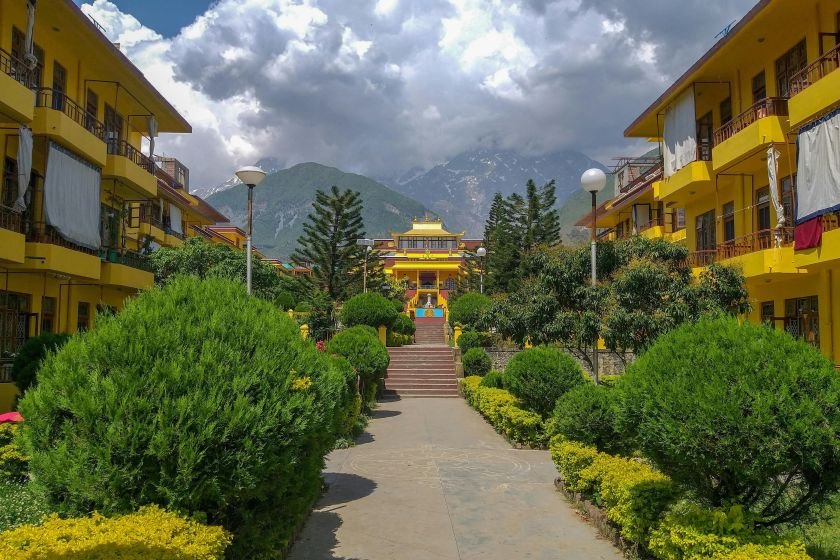
The experience of Tsuglagkhang begins before entering the main hall. The complex has a public walking rhythm: steps, courtyard, prayer wheels, circumambulation, monks moving quietly, visitors removing shoes, and the soft sound of mantras from people turning the wheels as they walk.
The architecture is not old in the way Tabo or Nako are old. Its importance is not based on medieval murals or ancient stone. Tsuglagkhang’s architecture is functional, Tibetan, public, and devotional. It has to hold large gatherings, teachings, ceremonies, and everyday prayer. The courtyard is especially important because public teachings and registration activity take place there during scheduled events.
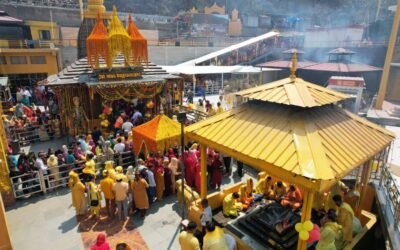
Inside, visitors may find images associated with Tibetan Buddhist worship, lamps, offerings, monks, and quiet sitting spaces. The mood changes depending on the day. On an ordinary morning, the complex can feel calm and spacious. During a major teaching, birthday celebration, or long-life prayer ceremony, it becomes a sea of people — monks in robes, Tibetan elders, international visitors, Indians from the Himalayan belt, volunteers, security, and the sound of collective recitation.
The Dhauladhar mountains rise beyond McLeod Ganj, and that setting matters. The temple does not stand in a remote monastery valley. It stands in a busy hill town, yet the mountains behind it still give the place a sense of refuge.
📜 Tibet in Exile, Not a Museum Piece
It is easy to describe McLeod Ganj as “Little Lhasa,” but Tsuglagkhang asks for a more careful phrase. This is not a decorative Tibetan-themed town. It is a living centre of exile culture. The temple complex, the Dalai Lama’s office presence, the monks, the teaching schedule, the Tibetan institutions, and the surrounding settlement all come from a painful historical movement.
The Office of His Holiness continues to publish reports from Thekchen Chöling, Dharamshala, often describing ceremonies, teachings, prayers, visiting groups, and gatherings at Tsuglagkhang. Recent reports mention thousands gathering for teachings and birthday celebrations, which shows that the complex remains active and central, not only symbolic.
For a traveller, the right approach is to avoid reducing the place to “peaceful vibes.” There is peace here, but it is not empty peace. It is built through discipline, loss, memory, prayer, debate, study, exile, and the effort to preserve a tradition outside its homeland.
That is what makes Tsuglagkhang one of Himachal’s most important sacred sites. It is young compared to many temples, but its meaning is already historically deep.
🎉 Teachings, Prayer Ceremonies, and Devotion
- Public Teachings: Teachings in Dharamshala are generally free and open to the public, but registration is required. The official Dalai Lama website says registration is done at the Main Tibetan Temple / Tsuglhakhang courtyard before the teaching dates.
- Long-Life Prayer Ceremonies: Tsuglagkhang regularly hosts major Tibetan Buddhist prayer ceremonies. Official reports describe long-life prayer ceremonies for His Holiness at the Main Tibetan Temple in Dharamshala.
- Dalai Lama Birthday Celebrations: Large public celebrations are held when the occasion is marked in Dharamshala. Official reporting from 2025 described thousands gathered at the Main Tibetan Temple courtyard for His Holiness’s 90th birthday celebration.
- Daily Prayer and Circumambulation: Visitors can respectfully walk, turn prayer wheels, sit quietly, and observe the devotional rhythm of the complex.
- Visitor Conduct: Dress modestly, speak softly, remove shoes where required, avoid intrusive photography, and follow security instructions, especially during teachings or official events.
🏞️ While You’re in the Area
- Namgyal Monastery: Closely associated with the Dalai Lama’s monastic institution and Tibetan Buddhist practice in McLeod Ganj.
- Tibet Museum: A key place to understand Tibetan history, exile, and culture before or after visiting the temple complex.
- Kalachakra Temple: A nearby sacred space in McLeod Ganj, often connected with Tibetan Buddhist practice and public gathering areas.
- Bhagsunag Temple and Waterfall: A popular nearby Hindu sacred and natural site, best visited early to avoid heavy crowds.
- St. John in the Wilderness Church: A historic church in the cedar forest between McLeod Ganj and Dharamshala, useful for understanding the older colonial layer of the area.
- Dharamkot: A quieter village above McLeod Ganj, known for forest walks, stays, cafes, and access towards short hikes.
- Triund Trek: A famous day/overnight trek above McLeod Ganj, best attempted in the right weather with current local guidance.
🙏 Getting in Touch
For official information related to His Holiness the Dalai Lama, teachings, schedules, audiences, and office contact, use the official Dalai Lama website. The official contact page lists the Office of His Holiness at Thekchen Chöling, P.O. McLeod Ganj, Dharamshala, Himachal Pradesh 176219, with email ohhdl@dalailama.com and telephone numbers +91-1892-221343 and +91-1892-221879.
For teachings in Dharamshala, check the official schedule in advance. The official site notes that registration is required, there is no advance registration service for Dharamshala teachings, and foreigners need documents such as passport, Indian visa, and C-form copies for registration. People living in India need Aadhaar card copies.
For ordinary temple visits, no special booking is usually needed. Still, security rules can change during public events, teachings, VIP visits, or large gatherings, so follow local instructions on the day.
❓ Quick Questions Travellers Ask
Where is Tsuglagkhang / Dalai Lama Temple Complex located?
It is in McLeod Ganj, above Dharamshala in Kangra district, Himachal Pradesh, close to Thekchen Chöling, the residence and office area of His Holiness the Dalai Lama.
Is Tsuglagkhang the same as the Dalai Lama Temple?
Yes. Visitors commonly call it the Dalai Lama Temple Complex, while official Tibetan and Dalai Lama sources refer to it as Tsuglagkhang / Tsuglhakhang, the Main Tibetan Temple in Dharamshala.
Can visitors meet the Dalai Lama here?
Private audiences are greatly reduced, according to the Office of His Holiness. Visitors may be able to attend public teachings or events if they are scheduled and properly registered.
Is entry to public teachings free?
The official Dalai Lama website says teachings in India are generally free and open to the public, but registration is required for teachings in Dharamshala.
What is the best time to visit?
For ordinary travel, March to June and September to November are usually best. For teachings, follow the official schedule and registration instructions.
A Last Word
Tsuglagkhang is not powerful because it is ancient. It is powerful because it became necessary. After exile, a people needed a place where prayer, teaching, memory, and leadership could gather again. In McLeod Ganj, that place became the Main Tibetan Temple.
A visitor may come for silence, for Buddhist teachings, for the Dalai Lama’s presence, for Tibetan culture, or simply to understand why McLeod Ganj matters. But the temple gives the same lesson in many forms: faith can cross mountains, memory can survive displacement, and a courtyard can become the heart of a scattered people.
At Tsuglagkhang, Tibet is not preserved like an object behind glass. It is spoken, chanted, debated, prayed, and lived.
Fact-check note: Tsuglagkhang is identified by the official Dalai Lama website as the Main Tibetan Temple in Dharamshala, and the Office of His Holiness lists its address at Thekchen Chöling, P.O. McLeod Ganj, Dharamshala, H.P. 176219. Official Dalai Lama pages support the use of Tsuglagkhang / Tsuglhakhang for public teachings, registration at the temple courtyard, and the role of the complex in major ceremonies and gatherings. The statement that private audiences have been greatly reduced is also from the Office of His Holiness. Some tourist sources use approximate distances and timings for the temple, but this article avoids forcing a fixed daily visiting schedule because security, teaching events, and public ceremonies can change access rules. Travellers should check the official Dalai Lama schedule before planning around teachings or public appearances.