In Kangra’s Kalidhar valley, the goddess is not carved in stone or seated in a sanctum image; she appears as flame, rising through fissures in the old rock.
Some temples ask you to look at an idol. Jwalamukhi asks you to look at fire. That single difference changes the whole feeling of the shrine. Here, Maa Jwalamukhi / Jawala Ji is worshipped not through a face, a crown, or a sculpted body, but through living flames that burn inside the temple. The place is one of Himachal’s most important Shakti Peethas, and its story carries three strong layers at once: the myth of Sati’s fallen tongue, the natural mystery of the flame, and the long devotional history of a town built around the goddess’s fire.
🌄 Location & How to Reach It
Jwalamukhi Temple is located in Jwalamukhi sub-division of Kangra district, Himachal Pradesh, in the Kalidhar valley of the Shivalik range. The official Kangra Temples portal places the shrine at an altitude of about 600 metres, around 50 km from Dharamshala, 200 km from Chandigarh, 118 km from Jalandhar, 105 km from Pathankot, and 180 km from Shimla.
Google Maps: Get Directions
Elevation: about 600–610 metres
- By road: Jwalamukhi is well connected by road from Dharamshala, Kangra, Dehra, Nadaun, Pathankot, Chandigarh, and Jalandhar. Buses and taxis are commonly available because this is one of the major pilgrimage towns of Kangra.
- By rail: The nearest local rail access is Jwalamukhi Road / Ranital on the Kangra Valley Railway side, while Pathankot is the closest broad-gauge railhead listed by HPTDC at about 123 km.
- By air: The nearest airport is Gaggal Airport near Dharamshala, listed by official and tourism sources as the air access point for Jwalamukhi.
This is an easy road-accessible pilgrimage by Himachal standards. The challenge is usually not the terrain, but the crowd — especially during Navratri, weekends, and peak yatra days.
🌸 Best Time to Visit
Jwalamukhi can be visited throughout the year, but the most comfortable months are October to March, when the lower Kangra belt is cooler and easier for temple movement. Summer can be hot in the afternoon, so morning or evening darshan is more comfortable.
The busiest devotional periods are Chaitra Navratri and Ashwin Navratri, when large numbers of pilgrims come for darshan of the sacred flames. If you want the temple in its full public rhythm, Navratri is the right time. If you want a calmer experience, choose a weekday outside the festival season.
A local temple timing page lists summer opening around 5:00 AM and winter opening around 6:00 AM, with five daily aartis including Mangal Aarti, Bhog Aarti, Evening Aarti, and Shaiyan Aarti. Because temple schedules can change on festival days, confirm current timings before planning a special aarti visit.
🕉️ The Shakti Peeth of Sati’s Tongue
Jwalamukhi’s sacred identity begins with the wider Shakti Peeth tradition. According to the familiar Hindu story, Sati immolated herself after her father Daksha insulted Lord Shiva. Shiva, overcome with grief, carried her body through the universe until Lord Vishnu used his Sudarshan Chakra to cut the body into pieces. The places where those parts fell became Shakti Peethas.
At Jwalamukhi, tradition says Sati’s tongue fell. That is why the goddess here is not represented by a normal idol. The tongue becomes flame. Speech becomes fire. The power of the Mother appears as a burning mouth, which is also why the name Jwalamukhi is often understood as “flaming mouth.” The official Kangra Temples page describes Jawala Mukhi as one of the 51 Shakti Peethas and says the goddess is manifested here as flames leaping through fissured rocks.
This makes Jwalamukhi one of the most visually unusual Devi shrines in India. The devotee does not stand before a statue and imagine presence. The presence is already moving, flickering, and alive.
🔥 The Nine Flames Inside the Temple
Inside the temple, the goddess is worshipped through nine flames. The official Kangra Temples portal names these as Mahakali, Annapurna, Chandi, Hinglaj, Vidhya Basni, Mahalakshmi, Saraswati, Ambika, and Anji Devi.
This is the detail that gives the shrine its special force. Jwalamukhi is not only a place where one flame burns. It is a shrine where the flame itself becomes a many-sided form of the goddess. Each flame is worshipped as a different aspect of Shakti, turning the sanctum into a kind of fiery mandala.
There is no idol to dress in the usual way. No carved eyes look back at the devotee. The rock opens, the flame rises, and the worship happens before that small, living movement. It is easy to understand why this shrine has carried such a strong reputation for centuries. A flame is simple, but it never feels lifeless.
🕉️ The Cow, the Shepherd, and Raja Bhumi Chand
The temple’s origin legend adds a second layer to the Shakti Peeth story. According to the official Kangra Temples account, in ancient times a shepherd used to graze the cows of Raja Bhumi Chand near this place. One cow was found giving away her milk during the day and not yielding milk in the cowshed at night. When the matter was investigated, flames appeared at that spot. After learning of this, Raja Bhumi Chand had a temple built there and arranged for worship through Brahmins of the Bhojak caste.
This legend is important because it brings the cosmic story down to the ground. Sati’s tongue belongs to mythic time. The cow and shepherd belong to local discovery. Many Himalayan shrines carry this same pattern: a divine sign appears through an animal, a shepherd, a dream, a stone, a spring, or a flame; then a local ruler recognises it and gives it temple form.
These accounts should not be treated like modern archaeological records, but they should also not be dismissed. They tell us how the temple’s presence was remembered: not as a structure invented by rulers, but as a place where the goddess first revealed herself.
🙏 What Jwalamukhi Is Known For
Jwalamukhi is known for being a Shakti Peeth without an idol, where the goddess is worshipped as natural flames. HPTDC describes the goddess as manifesting as tiny blue flames burning through fissures in age-old rock, and also records the tradition that Sati’s tongue fell at Jwalaji.
Devotees come for darshan, fulfilment of vows, Navratri pilgrimage, family worship, and the blessings of Maa Jwala. The shrine is also part of the larger Himachal Shakti circuit, often combined with Chintpurni, Bajreshwari Devi, Chamunda Devi, Baglamukhi, and Naina Devi depending on route and available time.
The temple’s distinctiveness is not scale alone. It is the form of worship. The devotee does not ask where the idol is. The absence of an idol is the point. The flame is the murti. The fire is the sign. The goddess appears in a way that is both natural and sacred, both visible and impossible to fully explain.
🏛️ A Temple Built Around Fire
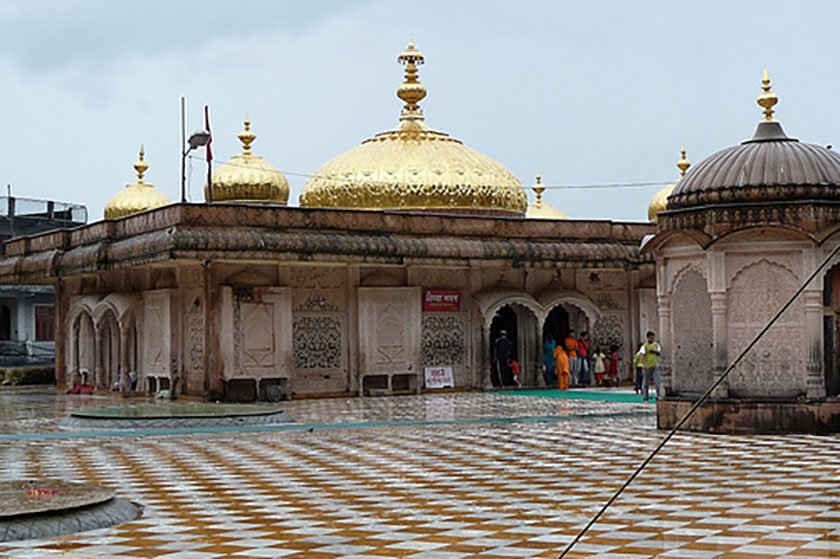
Architecturally, Jwalamukhi is not like the old stone temples of Chamba or the carved wooden shrines of Kullu. It is a pilgrimage complex built around a fire-sanctum. The official Kangra Temples page describes the temple as an example of Hindu, Sikh, and Mughal architectural influence, and also records later patronage connected with Maharaja Ranjit Singh.
The shrine’s experience is shaped by movement: queues, bells, priests, offerings, flame darshan, and the flow of devotees through the complex. On busy days, the temple can feel intense. The sanctum draws everyone forward because the darshan is small, focused, and brief. You do not linger before a large idol; you catch the flames, bow, and move with the line.
The most striking sensory detail is also the simplest. The flame does not behave like temple decoration. It emerges from stone. The devotee bends forward, and the eye searches for that small blue-orange movement in the rock. The entire temple exists to protect that moment.
👑 Akbar, Ranjit Singh, and the Shrine’s Wider Memory
Jwalamukhi also carries stories of powerful rulers bowing before the flame. One widely repeated legend says Emperor Akbar came to test or witness the power of the goddess and later offered a golden parasol. HPTDC mentions that Akbar installed a gold parasol at the shrine. In popular tradition, the parasol’s metal is said to have changed, showing that the goddess did not accept royal pride in the ordinary way.
This story should be handled as sacred tradition rather than firm court history. Its meaning is clear even if details vary: worldly power comes before the flame and is humbled.
The shrine’s later patronage is more clearly associated with Maharaja Ranjit Singh, whose name is connected in official temple material with gilding and contributions to the temple. This adds another layer to Jwalamukhi’s identity. The temple belongs to Himachal, but its devotional reach has always extended into Punjab, the plains, and the larger north Indian sacred network.
🎉 Festivals and Devotion
- Chaitra Navratri: One of the main annual pilgrimage periods, with heavy darshan crowds and a strong fair-like atmosphere around the temple town.
- Ashwin Navratri: Another major devotional season, especially important for Devi worship and family pilgrimage.
- Daily Aarti: A temple timing page lists five daily aartis, including Mangal Aarti, Bhog Aarti, Evening Aarti, and Shaiyan Aarti. Timings differ between summer and winter and should be confirmed before a special visit.
- Shaiyan Aarti: This night ritual is especially associated with the goddess’s resting arrangement, with part of the worship connected to Seja Bhawan, according to the local temple timing page.
- Year-round darshan: The official Kangra Temples page notes that devotees visit throughout the year to worship the holy flames.
🏞️ While You’re in the Area
- Bhairav Nath Temple: Located about 1 km from the main temple according to the Kangra Temples portal, this shrine is often linked with the protective sacred geography around Jwalamukhi.
- Teda Mandir: A nearby temple about 2 km from the main shrine, dedicated to Lord Ram in local temple listings.
- Ashtabhuja Devi / Ashtadashbhuji Devi area: A nearby Devi shrine associated in local temple material with the wider Jwalamukhi sacred zone.
- Kangra Fort: A major historical site in Kangra district, useful for travellers who want to combine pilgrimage with old hill-state history.
- Bajreshwari Devi Temple, Kangra: Another important Shakti shrine in Kangra, often combined with Jwalamukhi in a Devi circuit.
- Chintpurni Temple: A major Shakti Peeth in Una district, commonly paired with Jwalamukhi by pilgrims travelling from Punjab, Chandigarh, or Delhi.
- Chamunda Devi Temple: A major Kangra Devi shrine near Dharamshala and Palampur, best combined if you are making a longer Kangra Shakti route.
🙏 Getting in Touch
The official Kangra Temples portal lists Shri Jwalamukhi Mandir under the district temple information system and describes facilities such as free langar, medical facility, security, cleanliness arrangements, water and toilet facilities, and Yatri Niwas / Matri Sadan for pilgrims.
For current darshan rules, festival crowd arrangements, accommodation, and special aarti timing, use official district or temple-linked information where available and confirm locally during Navratri. Crowd arrangements can change quickly during major fairs.
❓ Quick Questions Travellers Ask
Where is Jwalamukhi Temple located?
It is in Jwalamukhi town, in Kangra district, Himachal Pradesh, around 50 km from Dharamshala.
Why is Jwalamukhi famous?
It is famous because the goddess is worshipped as natural flames emerging from fissures in rock, without a conventional idol.
Which part of Sati is believed to have fallen here?
Tradition says Sati’s tongue fell at Jwalamukhi, making it one of the important Shakti Peethas.
How many flames are worshipped inside the temple?
The official Kangra Temples page lists nine flames, representing different forms of the goddess.
What is the best time to visit Jwalamukhi?
For comfortable weather, visit from October to March. For peak devotion, visit during Chaitra or Ashwin Navratri, but expect heavy crowds.
A Last Word
Jwalamukhi stays with people because it refuses the usual shape of a temple. There is no face to remember, no idol posture to describe, no grand image that can be photographed and understood from outside. There is only flame.
That is enough. In fact, that is the point. The goddess here does not need a body because the fire speaks for her. It rises through old rock, small but impossible to ignore, and turns the whole shrine into an act of watching. Many temples hold light before the deity. At Jwalamukhi, the light is the deity.
Fact-check note: Jwalamukhi Temple’s location in Jwalamukhi sub-division of Kangra district, its altitude of about 600 metres, its distance of about 50 km from Dharamshala, and access via Jwalamukhi Road / Ranital and Gaggal Airport are supported by the official Kangra Temples portal. Its identity as one of the 51 Shakti Peethas, the belief that Sati’s tongue fell here, the absence of a conventional idol, and the worship of nine flames are also supported by official Kangra temple material. HPTDC supports the tradition of Sati’s tongue falling at Jwalaji, the flame emerging through rock fissures, and the temple’s associations with Akbar and Maharaja Ranjit Singh. Akbar-related details are treated as temple tradition because versions vary across sources. Aarti timings are drawn from a local temple timing page and should be confirmed before planning around a specific ritual, especially during Navratri.