A missionary lama climbed out of Ladakh with a vision and a foreign king’s backing, and left behind a monastery that Bhutan, four centuries later, still quietly claims a share of.
Lahaul’s gompas are mostly local stories — a village lama, a regional patron, a lineage traced back to Ladakh or Tibet. Shashur Monastery, on its pine-covered hillside just outside Keylong, carries a longer thread than most: its founding lama is remembered as a missionary of the very king who unified Bhutan as a nation, and the monastery is said to have kept up that connection ever since, down to who’s allowed to serve as a monk here. It’s an odd thing to find on a quiet slope above the Bhaga river — a small Himachal gompa with a genuine claim on the founding history of another country entirely.
🌄 Location & How to Reach It
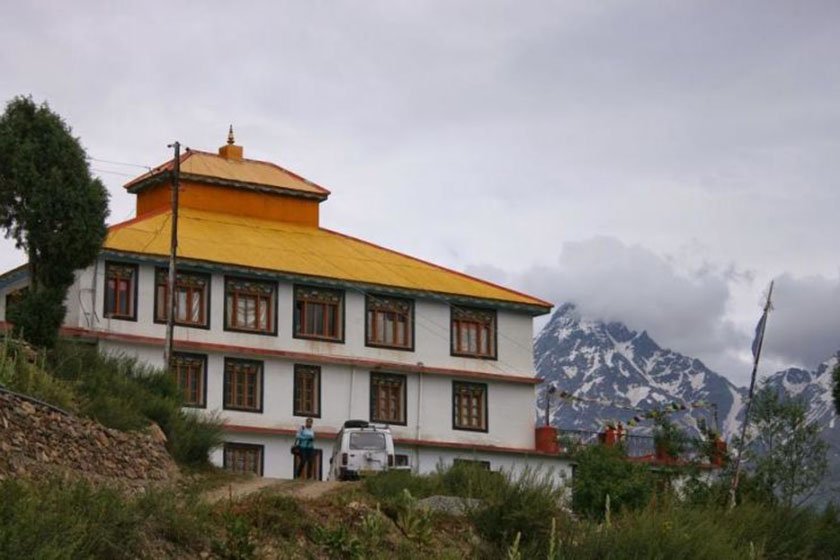
Shashur Monastery sits on a pine-forested hillside a short distance above Keylong, the district headquarters of Lahaul & Spiti, overlooking the Bhaga River valley below. The name itself comes from the local dialect — “Shashur” means “amidst the blue pines,” describing the patch of tall blue pine trees that surrounds the monastery, a striking and unusual sight in an otherwise largely treeless, arid stretch of the valley.
Google Maps: Get Directions
Elevation: approximately 3,700 metres (roughly 12,000 ft).
- By road: A short, motorable road of roughly 3 to 5 km (accounts vary slightly) climbs from Keylong to the monastery — an easy taxi or drive.
- By foot: A walking trail of similar distance also connects Keylong to Shashur, making for a manageable half-day hike with valley views the whole way up.
- By air: The nearest airport is Bhuntar (Kullu); Keylong itself is roughly 115 km from Manali by road, via Rohtang/the Atal Tunnel.
Of Lahaul’s better-known monasteries, Shashur is among the easiest to reach — a straightforward day trip from Keylong rather than an expedition, which is part of why it’s often paired with Kardang or Tayul on the same outing.
🌸 Best Time to Visit
Late May through early October is the reliable window, when the Manali–Keylong road is open and the weather is at its most manageable — though even in summer, the altitude means cold winds and a real chill, so warm layers are worth packing regardless of the season. The monastery keeps informal hours typical of a working gompa; arriving in daylight and asking after a resident lama is the practical approach rather than expecting fixed visiting times.
🕉️ A Vision, and a Missionary
The monastery’s founding is remembered, above all, as an act of religious expansion rather than a purely local initiative. It was established in the 17th century by a lama most commonly named Deva Gyatso (also recorded as Dawa Gyatsho or Dewa Tyatsho), who travelled from Ladakh or Zanskar — sources differ on precisely which — as a missionary aiming to plant a new tradition in a valley that had until then been shaped mainly by older Buddhist schools. One detailed account describes the founding as growing out of a personal vision that came to Gyatso, compelling him to build a centre for teaching and spirituality in this specific valley. Separately, and more strikingly, at least one source identifies him as a missionary sent under the patronage of Nawang Namgyal — better known to history as Zhabdrung Ngawang Namgyal, the Tibetan lama who fled to Bhutan in the 17th century and there unified the country as its first great religious and political ruler. If that connection holds, Shashur’s founding ties this one Lahaul hillside directly to the founding of a neighbouring nation — though it’s a claim repeated by only some sources and not confirmed everywhere, so it’s worth holding a little more loosely than the monastery’s basic founding date.
🏛️ The Gompa That Paused Mid-Build
A second, more practical legend concerns the building itself rather than the vision behind it. According to one detailed local account, an earlier attempt to build a monastery on this site was made in the 16th century by a lama remembered under a very similar name, but the construction was abandoned partway through. It was only later, in the 17th century, that Deva Gyatso restarted and completed the project — and tradition holds that he remained at Shashur for the rest of his life, staying on until his death rather than moving on to found other sites. Whether this represents two different lamas with near-identical names, or a single confused retelling of one lama’s own project, isn’t something the available sources resolve — but the detail of a stalled, then restarted, construction is a distinctive thread worth keeping separate from the founding-vision story above.
🙏 What the Monastery Is Known For
Shashur functions today as a working monastic community with a long-standing, specific custom attached to it: according to at least one lama who spoke with a visiting traveller, it has historically been customary for serving lamas at Shashur to come from Bhutan — a living echo, if true, of the monastery’s own founding connection to that country. It isn’t a claim independently documented elsewhere, so it’s best treated as an insider’s account of local practice rather than settled fact, but it fits neatly with everything else the site claims about its origins. Devotees and visiting monks come here for the same core reasons as at any working Himalayan gompa — study, ritual, and the particular quiet that a pine-covered hillside above a glacial river provides.
🏛️ Giant Thangkas and Eighty-Four Faces
Architecturally, Shashur is built in traditional Tibetan style from locally sourced stone and timber, set on a gently sloping hill chosen, evidently, as much for its views and seclusion as for practicality. Inside, the prayer halls hold some of Lahaul’s most striking devotional art: thangka paintings reportedly as large as fifteen feet (around five metres) tall, along with wall paintings depicting all eighty-four mahasiddhas of tantric Buddhism — a far more complete rendering of that lineage of saints than most smaller gompas attempt. The monastery also houses a large statue of Guru Rinpoche (Padmasambhava) and, fittingly given its founding story, an image associated with Namgyal — very likely a reference to the same Bhutanese ruler credited with sponsoring the monastery’s original missionary lama. Carved woodwork and brightly painted doorways round out an interior that, by most visitor accounts, rewards a slow look rather than a quick pass-through.
📜 Which Lineage It Actually Belongs To
Here Shashur’s own record gets genuinely tangled. The most carefully sourced references — Wikipedia, the Treasury of Lives biographical encyclopedia, and the Tibetan Buddhist Encyclopedia — all describe Shashur as a Drukpa Kagyu monastery, part of the same lineage network as Kardang, Gemur, and Guru Ghantal elsewhere in Lahaul. A number of tourism-oriented sources instead describe it as Gelugpa, the school to which the Dalai Lama himself belongs, and one such source even (incorrectly) calls Gelugpa the “red hat sect” — a label that properly belongs to older schools like Nyingma and Kagyu, not to the Gelugpa, who are conventionally known as the “yellow hat” tradition. This looks like a genuine, repeated error that has spread across several tourist-facing pages rather than a real ambiguity in the historical record, and it’s worth knowing before repeating it yourself: Shashur’s better-attested affiliation is Drukpa Kagyu.
🎉 Festivals and Devotion
- Tsheshu (also spelled Tsesha or Tshechu) — Shashur’s main annual festival, held in June or July, featuring the masked Chham dance performed by resident lamas in vivid, elaborate costume, dramatising the triumph of good over evil
- Unlike some of Lahaul’s smaller gompas, Shashur’s festival appears consistently and reliably described across sources as an active, ongoing annual event, drawing visitors and devotees from across the valley
- Daily monastic life — chanting, ritual, and study continue year-round independent of the festival calendar
🏞️ While You’re in the Area
- Kardang Monastery — Lahaul’s largest and most prominent Drukpa gompa, a short distance away, and often paired with Shashur on the same day
- Tayul Monastery — another significant nearby gompa, roughly 6 km from Keylong, known for a large Padmasambhava statue and its own Kangyur library
- Keylong — the district headquarters itself, with a small market, basic facilities, and views over the Bhaga River
- Gemur & Guru Ghantal Monasteries — further afield along the valley, both part of the same wider Drukpa Kagyu network Shashur belongs to
- Bhaga River — visible from the monastery’s hillside, and a pleasant walk in its own right for those staying in Keylong
🙏 Getting in Touch
There’s no formal visitor centre or booking system attached to Shashur Monastery — it functions as a working religious community rather than a tourist facility. Visiting during daylight hours and asking for a resident lama is the normal way in, and most visitors report a warm, unhurried welcome once someone is found.
❓ Quick Questions Travellers Ask
What does “Shashur” mean? It means “amidst the blue pines” in the local dialect, referring to the stand of blue pine trees surrounding the monastery.
Is Shashur Monastery Drukpa Kagyu or Gelugpa? The better-sourced references identify it as Drukpa Kagyu; a number of tourism sites incorrectly label it Gelugpa, which appears to be a repeated error rather than a genuine dispute.
How far is Shashur Monastery from Keylong? About 3–5 km, reachable by a short motorable road or a walking trail of similar distance.
Is there a real connection between Shashur and Bhutan? Some sources describe its founding lama as a missionary sent under the patronage of the Bhutanese unifier Zhabdrung Ngawang Namgyal, and one account describes a custom of Shashur’s monks traditionally coming from Bhutan — though neither claim is universally confirmed across sources.
When is the best time to see the Chham dance festival? June or July, during the annual Tsheshu festival, when masked lama dances are performed in the monastery courtyard.
A Last Word
Most small Himalayan monasteries measure their importance in local terms — a valley served, a lineage preserved, a festival kept alive. Shashur’s story, if even part of it holds up, reaches further than that: a vision, a missionary from Ladakh or Zanskar, and a founding tied to the same man who built a nation next door. Whether or not every strand of that connection survives close scrutiny, it’s a reminder that these quiet pine-covered hillsides were never as isolated as they look from the road — they were nodes in a much larger Himalayan Buddhist world, and Shashur, in its own understated way, still shows the seams.
Fact-check note: The founding lama’s name appears across sources as Deva Gyatso, Dawa Gyatsho, and Dewa Tyatsho, and his origin is given as either Ladakh or Zanskar — these are treated here as the same figure with inconsistent transliteration/attribution rather than resolved into one version. The claim that he was a missionary sponsored by Zhabdrung Ngawang Namgyal, the founder of Bhutan, comes from a single source and is not corroborated elsewhere, so it is presented as an unconfirmed but notable claim. The account of an abandoned 16th-century construction attempt preceding Deva Gyatso’s 17th-century completion likewise comes from a single detailed source and isn’t found elsewhere; it’s included as a distinct legend rather than merged into the main founding date. The monastery’s sectarian affiliation is inconsistently reported: the more rigorously sourced references (Wikipedia, Treasury of Lives, Tibetan Buddhist Encyclopedia) identify it as Drukpa Kagyu, while several tourism sites incorrectly label it Gelugpa (one mislabels Gelugpa itself as the “red hat” sect, which is factually incorrect) — this looks like a genuine recurring error across secondary sources rather than real ambiguity, and is flagged as such rather than silently repeated. Reported elevation and distance-from-Keylong figures vary slightly across sources (elevation given as either ~3,700m/12,000ft or, in one clearly inconsistent source, 6,000ft; distance from Keylong given as 3, 4, or 5 km) — the more consistent figures are used here. No independently verified GPS coordinates were found, so none are given; the Get Directions link above should be replaced with your own verified link if you have one. This is a distinct article from the version of Shashur Monastery already published on aguidetohimachal.com (subtitled “The Blue Pines and the Red Robes”); this piece takes the Bhutan-connection and founding-legend angle as its hook rather than repeating that one’s framing.