In McLeod Ganj, Namgyal Monastery is not only a place where monks study and pray; it is the living monastic seat of the Dalai Lama, rebuilt in exile after Tibet was left behind.
Some monasteries are old because their buildings have stood for centuries. Namgyal Monastery carries a different kind of age. Its roots go back to 16th-century Tibet, but its present life in McLeod Ganj, Dharamshala belongs to the Tibetan exile story after 1959. It is the personal monastery of His Holiness the 14th Dalai Lama, a centre for tantric ritual, Buddhist learning, public prayer, and the preservation of Tibetan religious life outside Tibet. Many visitors see it as part of the larger Dalai Lama Temple area, but Namgyal is not just an attraction beside Tsuglagkhang. It is the monastic institution that has served the Dalai Lamas for centuries and continues that role in India today.
🌄 Location & How to Reach It
Namgyal Monastery is located in McLeod Ganj, above Dharamshala in Kangra district, Himachal Pradesh. It is closely associated with the Tsuglagkhang / Dalai Lama Temple Complex and the residence area of His Holiness the Dalai Lama at Thekchen Chöling. The monastery sits within the Tibetan settlement of McLeod Ganj, where prayer flags, monastic buildings, Tibetan shops, cafes, museums, and the Dhauladhar mountains all form part of the same lived landscape.
Google Maps: Get Directions
Elevation: around 2,000 metres in the McLeod Ganj area, commonly cited for the town rather than the monastery alone.
- By road: McLeod Ganj is well connected by road with Dharamshala, Kangra, Pathankot, Palampur, Chandigarh, and Delhi. From Dharamshala, taxis, shared cabs, and local buses run up to McLeod Ganj.
- By rail: The nearest broad-gauge railway station is Pathankot, followed by road travel to Dharamshala and McLeod Ganj. The Kangra Valley narrow-gauge line serves the wider Kangra region, but most long-distance travellers use Pathankot.
- By air: The nearest airport is Gaggal Airport / Kangra Airport, followed by road travel to Dharamshala and McLeod Ganj.
This is an easy in-town visit once you are in McLeod Ganj, but the area becomes crowded during teachings, Tibetan events, long weekends, and peak tourist seasons.
🌸 Best Time to Visit
The best months to visit Namgyal Monastery are usually March to June and September to November. Spring and early summer are pleasant for walking around McLeod Ganj, visiting the monastery, and combining the trip with Tsuglagkhang, the Tibet Museum, Bhagsu, Dharamkot, and nearby forest walks. Autumn brings clearer skies and stronger mountain views.
Monsoon can be beautiful but heavy. Dharamshala and McLeod Ganj receive intense rain, and July–August can bring mist, slippery paths, traffic disruption, and landslide risk on approach roads. Winter is cold, especially in the morning and evening, but it can be quieter outside the holiday rush.
For ordinary visitors, daytime is best. If you wish to attend a teaching of His Holiness the Dalai Lama at the nearby Main Tibetan Temple, check the official Dalai Lama schedule and registration rules in advance. Teachings in Dharamshala are generally free and open to the public, but registration is required for Dharamshala teachings.
🕉️ The Monastery Founded for the Dalai Lamas
Namgyal Monastery was founded in 16th-century Tibet by the Second Dalai Lama, Gendun Gyatso. Its purpose was not ordinary. From the beginning, Namgyal monks assisted the Dalai Lamas in public religious affairs and performed ritual prayer ceremonies for the welfare of Tibet. The monastery also became an important centre of learning, contemplation, and meditation on Buddhist treatises.
This history gives Namgyal its special status. It was not simply one monastery among many. It belonged directly to the institution of the Dalai Lama. Its monks were trained not only for personal practice, but for ritual service, ceremonies, teachings, and the spiritual responsibilities connected with Tibet’s highest religious leadership.
When the 14th Dalai Lama came into exile in India in 1959, this old monastic role did not end. It had to be carried across the Himalayas and rebuilt in a new place. That is what makes Namgyal Monastery in McLeod Ganj so important. The building is in Himachal, but the institution carries Tibet’s religious memory.
🕉️ A Monastery Rebuilt in Exile
After exile, Dharamshala and McLeod Ganj became the main centre of Tibetan life in India. Namgyal Monastery became part of this new sacred geography, close to the Dalai Lama’s residence and the Main Tibetan Temple. Today, it is widely known as the personal monastery of His Holiness the 14th Dalai Lama and is closely linked with public rituals, teachings, and the Tibetan community in exile.
This is why Namgyal feels different from ancient monasteries in Spiti or Kinnaur. It is not important because its walls are medieval. It is important because a displaced tradition found a working centre here. Monks study. Rituals continue. Prayers are offered. The Dalai Lama’s public religious life is supported by a monastic institution that has served his lineage for centuries.
A visitor should understand this before entering. Namgyal is not a decorative Tibetan building in a hill station. It is part of a living exile institution.
🙏 What Namgyal Monastery Is Known For
Namgyal Monastery is known as the personal monastery of the Dalai Lama and as a centre of Tibetan Buddhist learning and tantric practice. Public references also identify it as Namgyal Tantric College, reflecting its role in ritual and advanced Buddhist practice.
The monastery’s key role has been to assist with rituals involving the Dalai Lama and perform prayers for the welfare of Tibet. Its monks are associated with major ritual systems and Buddhist practices, including tantric traditions such as Kalachakra, Yamantaka, Chakrasamvara, Guhyasamaja, and Vajrakilaya, which are commonly linked with Namgyal’s ritual identity.
For visitors, the monastery is known for monks in maroon robes, prayer wheels, Buddhist chants, temple halls, courtyard movement, and its closeness to Tsuglagkhang. But its deeper importance lies in continuity. Namgyal carries the ritual responsibilities of the Dalai Lama’s monastery from Tibet into India.
🏛️ Courtyard, Monks, Prayer Wheels, and Tibetan Form
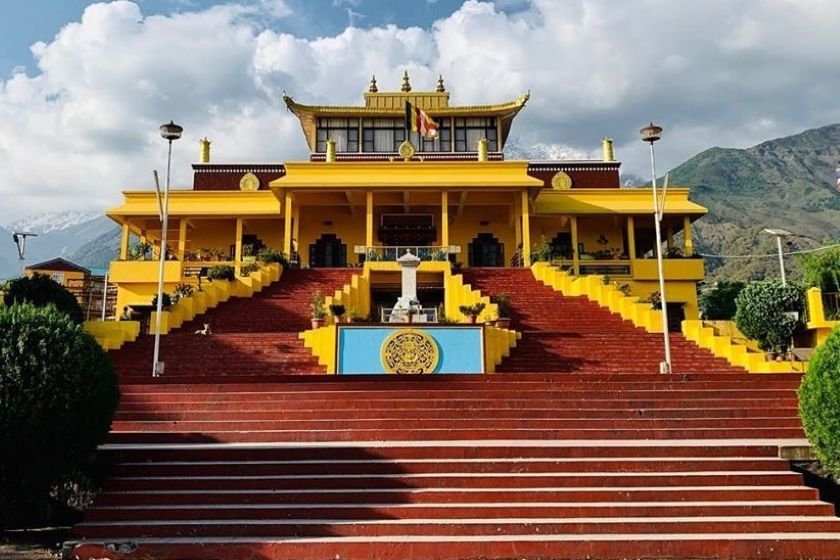
Namgyal’s architecture is not ancient in the same way as Tabo or Nako. Its significance lies in function, presence, and community. The monastery buildings reflect Tibetan Buddhist design: broad stairways, temple halls, painted details, prayer flags, prayer wheels, open courtyards, and spaces large enough for monastic and public activity.
A visitor walking through the area may notice monks moving between halls, people turning prayer wheels, the murmur of mantras, and the steady rhythm of a working monastery. On ordinary days, the complex can feel calm. During ceremonies or teachings nearby, it becomes part of a much larger flow of devotees, monks, Tibetans, Indians, and international visitors.
The Dhauladhar range gives the monastery its natural background. McLeod Ganj can be busy, crowded, and commercial in parts, but the monastery area still holds a serious atmosphere when approached respectfully. The sound of prayer wheels and chanting changes the pace.
This is not a place to rush through for one photo. It is better to walk slowly, sit quietly if allowed, and watch how the monastery is used by the people for whom it is not a tourist site, but a daily spiritual home.
📜 Namgyal, Tsuglagkhang, and the Exile Heart of McLeod Ganj
Namgyal Monastery is often mentioned together with Tsuglagkhang, the Dalai Lama Temple Complex. The two are close in both geography and meaning. Tsuglagkhang is the main public temple space where teachings and ceremonies are held, while Namgyal is the monastic institution linked with the Dalai Lama’s ritual and spiritual functions.
This relationship matters because visitors often blur all of McLeod Ganj’s Tibetan sacred area into one name: “Dalai Lama Temple.” That is understandable, but not precise. Tsuglagkhang is the temple complex. Namgyal is the monastery. Together, they form the spiritual centre of Tibetan exile life in Dharamshala.
The official Dalai Lama website regularly refers to the Main Tibetan Temple in Dharamshala as a place where teachings, long-life prayers, and major public events are held. Recent reporting also notes large gatherings at the Tsuglagkhang temple complex in McLeod Ganj for Dalai Lama-related celebrations. Namgyal monks are part of this wider ceremonial world.
For travellers, this means Namgyal should not be treated as a separate isolated sightseeing stop. It belongs to a living network: Dalai Lama residence, Main Tibetan Temple, monastery, Tibet Museum, Tibetan settlement, and the exile community.
🎉 Rituals, Teachings, and Devotion
- Dalai Lama’s Ritual Monastery: Namgyal monks have historically assisted the Dalai Lamas in public religious affairs and performed ritual prayers for the welfare of Tibet.
- Tantric Buddhist Practice: The monastery is also known as Namgyal Tantric College, with ritual traditions connected to major tantric systems.
- Public Teachings Nearby: Public teachings of His Holiness the Dalai Lama are usually held at the nearby Main Tibetan Temple / Tsuglagkhang. Registration is required for Dharamshala teachings.
- Daily Prayer and Monastic Life: Visitors may see monks studying, chanting, walking, or moving through the temple area. Observe quietly and avoid interrupting.
- Respectful Visit: Remove shoes where required, dress modestly, keep your voice low, avoid intrusive photography, and follow posted instructions around prayer halls and sacred objects.
🏞️ While You’re in the Area
- Tsuglagkhang / Dalai Lama Temple Complex: The main public Tibetan temple complex in McLeod Ganj, closely associated with the Dalai Lama’s teachings and ceremonies.
- Tibet Museum: An important place to understand Tibetan history, exile, and cultural memory before or after visiting the monastery.
- Kalachakra Temple: A nearby Buddhist temple space associated with Tibetan ritual art and practice.
- Bhagsunag Temple and Waterfall: A popular Hindu sacred site and waterfall near McLeod Ganj, best visited early to avoid heavy crowds.
- St. John in the Wilderness Church: A historic church in the deodar forest between McLeod Ganj and Dharamshala.
- Dharamkot: A quieter village above McLeod Ganj, useful for forest walks, stays, and access towards short hikes.
- Triund Trek: A famous trek above McLeod Ganj with Dhauladhar views, best attempted in suitable weather with current local guidance.
🙏 Getting in Touch
For official information about His Holiness the Dalai Lama, teachings, and schedules, use the official Dalai Lama website. For the monastery’s broader institutional history and international branch information, Namgyal Monastery Institute of Buddhist Studies also provides a useful account of Namgyal’s origin in Tibet and its role as the Dalai Lama’s monastery in Dharamshala.
For ordinary visits, no special booking is usually needed, but access to specific halls may depend on ceremonies, teachings, security arrangements, or monastery rules. Always follow local instructions on the day.
Do not expect a private meeting with the Dalai Lama. Public teachings and official events follow schedules and registration procedures, and access rules can change.
❓ Quick Questions Travellers Ask
Where is Namgyal Monastery located?
Namgyal Monastery is in McLeod Ganj, above Dharamshala in Kangra district, Himachal Pradesh.
Is Namgyal Monastery the same as the Dalai Lama Temple?
They are closely connected but not exactly the same. Tsuglagkhang is the main Dalai Lama Temple Complex, while Namgyal Monastery is the Dalai Lama’s personal monastery and monastic institution.
Who founded Namgyal Monastery?
Namgyal Monastery was founded in 16th-century Tibet by the Second Dalai Lama, Gendun Gyatso.
Why is Namgyal Monastery important?
It assists with rituals connected to the Dalai Lama, preserves Tibetan Buddhist learning and tantric practice, and serves as the Dalai Lama’s monastery in exile.
Can visitors attend teachings here?
Teachings by His Holiness the Dalai Lama are generally held at the nearby Main Tibetan Temple / Tsuglagkhang. Registration is required for Dharamshala teachings.
A Last Word
Namgyal Monastery is not powerful because it tries to impress visitors. Its strength is quieter and heavier. It carries the memory of Tibet into the hills of Himachal and keeps alive a monastic role that began centuries before exile.
In McLeod Ganj, the monastery stands close to the Dalai Lama’s temple, close to the Tibetan community, and close to the daily movement of people who pray, study, serve, and remember. That closeness is its meaning. Namgyal is not only a monastery that moved from Tibet to India. It is a monastery that continued.
At Namgyal, exile did not end the ritual life of Tibet. It gave it another mountain home.
Fact-check note: Namgyal Monastery’s founding in 16th-century Tibet by the Second Dalai Lama, Gendun Gyatso, and its historic role in assisting the Dalai Lamas with public religious affairs and prayers for Tibet are supported by Namgyal Monastery Institute of Buddhist Studies. Its identity as the personal monastery of the 14th Dalai Lama in Dharamshala and its alternate name Namgyal Tantric College are supported by multiple Buddhist and reference sources. The relationship between Namgyal Monastery and the nearby Tsuglagkhang / Main Tibetan Temple is handled carefully here: visitors often group them together as the Dalai Lama Temple area, but Namgyal is the monastic institution while Tsuglagkhang is the main public temple complex. Public teachings, registration rules, and schedules should be checked through the official Dalai Lama website before visiting for a specific event.