In the pine and oak forests near Bir, Palpung Sherabling does not stand like a roadside monastery; it opens slowly as a complete monastic world of study, retreat, art, chanting, and Karma Kagyu transmission.
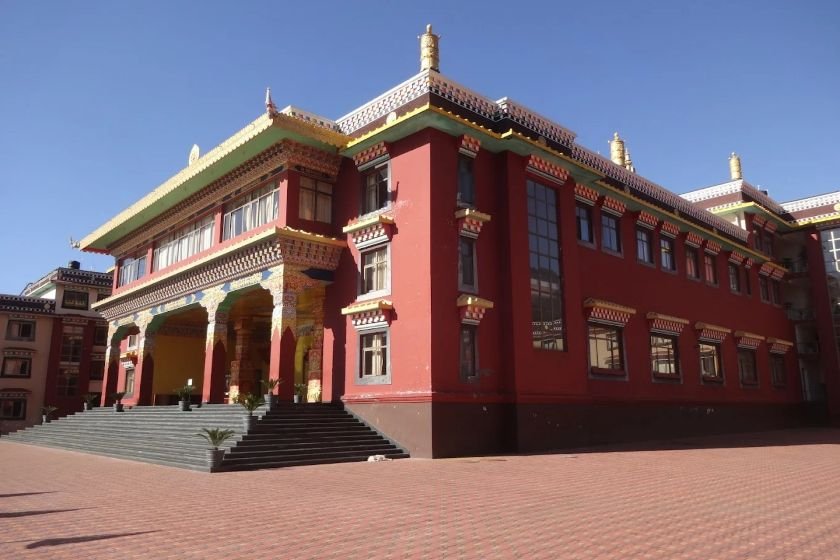
Some monasteries are easy to reduce to a photograph. Palpung Sherabling is not one of them. The golden roofs, red-and-yellow walls, broad courtyard, and forested approach are beautiful, but the real importance of the place lies deeper. This is the Palpung Sherabling Monastic Seat at Bhattu / Upper Bhattu near Bir, the Indian monastic seat of Guru Vajradhara H.H. Chamgon Kenting Tai Situpa, one of the great masters of the Karma Kagyu lineage. Established in exile in Himachal Pradesh, Sherabling carries the older Palpung tradition forward through monastic education, retreats, ritual practice, Buddhist art, and the transmission of Mahamudra teachings. It is close to Bir’s famous paragliding world, but it belongs to a much quieter geography — the forest path, the prayer hall, the retreat centre, and the discipline of monks who have come here to study and practise.
🌄 Location & How to Reach It
Palpung Sherabling Monastic Seat is located at Bhattu / Upper Bhattu, near Bir in Kangra district, Himachal Pradesh. It lies a few kilometres from Bir town and is commonly visited from the Bir–Billing / Baijnath side. The monastery is set amid pine and oak forest, away from the busier market and landing-site atmosphere of Bir, which gives the complex a quieter and more secluded feeling. The official Palpung introduction says the monastery is only a few miles from the nearest town but “retains its calmness and isolation.”
Google Maps: Get Directions
- By road: The usual approach is through Baijnath – Bir – Bhattu / Upper Bhattu. Local taxis are available from Bir, Baijnath, and nearby villages. Many travellers also cycle or ride two-wheelers from Bir towards the monastery, as the forest road is one of the pleasant routes in the area.
- By rail: The nearest narrow-gauge rail access is Ahju / Baijnath Paprola on the Kangra Valley Railway. For broad-gauge rail travel, Pathankot is the practical railhead, followed by road travel towards Baijnath and Bir.
- By air: The nearest airport is Gaggal Airport / Kangra Airport, followed by road travel through Kangra, Palampur, Baijnath, and Bir.
This is an easy monastery visit once you are in Bir or Baijnath. The route is road-accessible, but the monastery’s atmosphere is quieter than Bir’s paragliding zone, so it should be visited as an active sacred institution rather than a casual sightseeing stop.
🌸 Best Time to Visit
The best months to visit Palpung Sherabling are usually March to June and September to November. Spring and early summer are comfortable for walking around the monastery complex, cycling from Bir, and enjoying the forested setting. Autumn gives clearer skies, cooler air, and better light for seeing the monastery buildings against the surrounding hills.
Monsoon can make the forest road slippery and misty, though the area becomes very green. Winter is peaceful and can be a good time for travellers who want fewer crowds, but mornings and evenings can be cold.
For ordinary visitors, daytime is best. The monastery is a working monastic seat with prayer halls, monk residences, retreat spaces, and ritual activity. Access to certain halls may depend on current prayers, ceremonies, retreats, teachings, or monastery rules. Do not assume all inner spaces are open. Ask respectfully before entering, photographing, or sitting inside prayer halls.
🕉️ The Palpung Lineage Replanted in Himachal
The word Palpung belongs to a much older Tibetan Buddhist world. The historic Palpung Monastery in Kham, eastern Tibet, became one of the great centres of the Karma Kagyu tradition. The Palpung tradition is especially associated with the Tai Situpa lineage, art, scholarship, meditation, and the transmission of profound teachings such as Mahamudra.
After the upheavals of Tibetan exile, the tradition needed a new living centre. The official biography of the 12th Kenting Tai Situpa records that in 1976, at the age of 23, he established Palpung Sherabling Monastic Seat in Himachal Pradesh, India, where he trains, educates, ordains, and transmits teachings to future Buddhist masters.
This is what gives Sherabling its importance. The buildings may be modern compared with old Himalayan monasteries, but the lineage inside them is not new. The monastery is a continuation of a major Tibetan Buddhist current, rebuilt in the foothills of the Dhauladhar range.
🕉️ The Seat of the 12th Kenting Tai Situpa
Palpung Sherabling is closely associated with Guru Vajradhara H.H. Chamgon Kenting Tai Situpa, the 12th Tai Situpa. Palpung sources describe him as the current holder of the main Kagyu lineage and a major spiritual master trained by the 16th Gyalwa Karmapa.
This matters because Sherabling is not only a monastery with monks. It is a seat of transmission. In Tibetan Buddhism, such a place carries teachings, empowerments, retreats, texts, ritual practice, art, and the training of future teachers. The monastery’s purpose is not only to preserve a memory of Tibet, but to continue producing living practitioners and masters.
The word “seat” should therefore be taken seriously. Palpung Sherabling is not just a branch centre. It is the Indian monastic seat of a major Karma Kagyu lineage holder.
🙏 What Palpung Sherabling Is Known For
Palpung Sherabling is known for Karma Kagyu Buddhist study and practice, the presence and lineage of the 12th Kenting Tai Situpa, its large traditional Tibetan-style monastery complex, retreat programmes, ritual life, and the preservation of the artistic lineage of Palpung. The official Palpung introduction says the design follows the ancient science of geomancy and that Palpung Sherabling cultivates and preserves the artistic lineage of the Palpung tradition.
The complex is also substantial in scale. The official Palpung page states that Sherabling has 250 monks’ quarters, accommodating over 500 monks, along with three shrine halls, six shrine rooms, and traditional and modern monastic features.
For visitors, the monastery is known for its large courtyard, colourful Tibetan architecture, prayer halls, golden roofs, chortens, forested approach, and calm surroundings. But the deeper identity of Sherabling is monastic training. The visible beauty is only the surface of a much larger religious institution.
🏛️ A Forest Monastery Built With Geomancy and Scale
Palpung Sherabling does not feel like a small village gompa. It is a planned monastic seat. The approach through Bhattu’s forested roads already changes the mood before one reaches the complex. Pine and oak trees frame the way. Prayer flags appear. The town noise drops behind.
The monastery buildings are bright but disciplined: red walls, yellow panels, painted beams, golden roof details, broad stairways, shrine halls, and a spacious courtyard that can hold monastic gatherings. The official Palpung description notes that the design follows geomancy, which is important in Tibetan architecture and sacred planning.
Inside, the visual language becomes more intense: thangkas, images of Buddhas and lineage masters, ritual objects, lamps, painted surfaces, and the quiet order of a functioning Buddhist institution. A visitor should not rush here. The complex is large enough to walk slowly, but the prayer spaces ask for even slower attention.
The monastery’s strength is balance. It is grand, but not noisy. It is close to Bir, but not absorbed by tourism. It is modern in construction, but old in lineage.
📿 Retreat, Practice, and the Three-Year Discipline
One of the most important parts of Sherabling’s life is retreat practice. The official Palpung page describes the monks’ retreat centre, Tenzing Gephel Ling, located on the eastern rim of the Sherabling campus. It notes that since 1987, groups of monks have completed the traditional three-year three-month retreat, with participants from Tibet, Bhutan, Nepal, and other regions. The page also describes retreat days beginning at 5:00 AM and ending at 9:00 PM, with approximately nine to eleven hours of practice daily.
This detail is central to understanding the monastery. Sherabling is not just a place where visitors see statues and courtyards. Behind the public-facing beauty is a rigorous practice system. Retreat is where teachings become lived discipline: mantra, meditation, visualisation, ritual, and repetition over years.
For travellers, this should change the way the monastery is viewed. The calm atmosphere is not accidental. It is produced by a place where people actually practise.
📜 Bir, Bhattu, and the Tibetan Buddhist Belt of Kangra
The Bir–Bhattu area is one of the important Tibetan Buddhist landscapes of Himachal. Bir is often marketed for paragliding, cafes, and homestays, but the region also contains monasteries, Tibetan settlements, Buddhist institutes, and monastic traditions that give it a much deeper identity.
Palpung Sherabling stands slightly apart from the busier travel circuit. That separation matters. It keeps the monastery from becoming only another tourist attraction. Visitors who make the short journey from Bir to Bhattu enter a different version of the region — quieter, more monastic, more disciplined.
This is one of the reasons Sherabling should be included in any serious Bir article, not as an “extra place to see,” but as one of the main reasons Bir’s cultural landscape is so rich. Paragliders rise from Billing. Monks study and practise at Sherabling. Both belong to the same region, but they show very different faces of it.
🎉 Teachings, Monastic Life, and Devotion
- Karma Kagyu Practice: Palpung Sherabling is a major Karma Kagyu monastic seat associated with the Tai Situpa lineage and the transmission of Buddhist teachings.
- Monastic Education: The monastery trains, educates, ordains, and transmits teachings to future Buddhist practitioners and teachers.
- Three-Year Retreat: The retreat centre has hosted traditional three-year three-month retreats since 1987, with monks practising for long daily hours.
- Artistic Lineage: The monastery preserves the artistic lineage of the Palpung tradition, including Tibetan Buddhist visual and ritual culture.
- Visitor Conduct: Speak softly, dress modestly, avoid intrusive photography, do not interrupt monks, and follow any signs or instructions around shrine halls, retreat areas, and residences.
🏞️ While You’re in the Area
- Bir Tibetan Colony: The main Tibetan settlement area near Bir, with monasteries, cafes, guesthouses, and cultural spaces.
- Chokling Monastery, Bir: A beautiful Tibetan Buddhist monastery in Bir, often combined with Sherabling for a monastery circuit.
- Billing Paragliding Site: One of the world-famous paragliding take-off points above Bir, best visited separately from monastery time.
- Baijnath Temple: An important ancient Shiva temple near Bir, useful for travellers interested in the older Hindu sacred landscape of Kangra.
- Deer Park Institute: A Buddhist learning and cultural centre in Bir, known for teachings, courses, and contemplative programmes.
- Ahju / Baijnath Paprola Railway Area: Useful for travellers interested in the Kangra Valley Railway and local access routes.
- Palampur: A nearby tea-garden town with views of the Dhauladhar range, often combined with Bir and Baijnath travel.
🙏 Getting in Touch
For official information, use the Palpung website and current monastery channels. The Palpung contact page advises people who want to visit Palpung Sherabling to contact the monastery office in advance to avoid inconvenience, especially for special needs, interviews, or formal requests.
For ordinary visitors, a respectful daytime visit is usually straightforward, but access to specific halls, teachings, retreat areas, or ceremonies may change. If a hall is closed, do not insist. Ask politely or return another time.
For serious retreats, teachings, interviews, or organised visits, contact the monastery in advance rather than relying on travel blogs.
❓ Quick Questions Travellers Ask
Where is Palpung Sherabling Monastic Seat located?
It is at Bhattu / Upper Bhattu near Bir in Kangra district, Himachal Pradesh.
Which Buddhist tradition does Palpung Sherabling belong to?
It belongs to the Karma Kagyu tradition of Tibetan Buddhism and is the Indian seat of the 12th Kenting Tai Situpa.
When was Palpung Sherabling established in India?
The official biography of the 12th Kenting Tai Situpa records that he established Palpung Sherabling in Himachal Pradesh in 1976.
Is Palpung Sherabling near Bir?
Yes. It is only a few kilometres from Bir, in the forested Bhattu / Upper Bhattu area.
Can visitors enter the monastery?
Visitors can generally visit respectfully during the day, but access to halls, teachings, and retreat areas depends on monastery rules and current schedules.
A Last Word
Palpung Sherabling is close enough to Bir to be visited easily, but it should not be treated as a quick add-on to paragliding. The monastery belongs to another rhythm. It is built around study, retreat, chanting, teaching, art, and lineage.
The forest approach helps prepare the mind for that difference. The road leaves the busy world slowly. The buildings appear in colour and order. The courtyard opens. Somewhere inside, monks study, chant, practise, and continue a tradition that crossed the Himalayas in exile.
At Sherabling, the visible monastery is beautiful. The invisible discipline behind it is what makes the place sacred.
Fact-check note: Palpung Sherabling’s identity as the Indian monastic seat established in Himachal Pradesh by H.H. Chamgon Kenting Tai Situpa is supported by official Palpung sources, which state that he established it in 1976 at age 23. The official Palpung introduction supports the monastery’s scale, including 250 monks’ quarters, accommodation for over 500 monks, three shrine halls, and six shrine rooms, and notes its geomancy-based design and preservation of Palpung artistic lineage. The retreat-centre information, including Tenzing Gephel Ling, traditional three-year three-month retreats, and long daily practice hours, is also drawn from official Palpung material. Location references use the commonly accepted Bhattu / Upper Bhattu near Bir, Kangra identification; exact visitor access, teachings, and hall openings should be confirmed with the monastery before formal or special visits.