A few hundred steps down from Sangla’s market, a serpent-god’s temple and a Buddhist monastery stand wall to wall, and nobody there finds that unusual.
Most temple stories in Himachal are about a single deity and a single faith establishing itself on a single hillside. This one is a little different, because it isn’t really the story of one religion at all — it’s the story of two, sharing a courtyard, a drumbeat, and a village’s devotion without either one crowding the other out. Sangla’s Bering Nag Temple is a serpent-guardian shrine, old enough that its exact founding has been lost to memory, and it happens to sit beside a working Buddhist monastery in a way that tells you something true about Kinnaur before you’ve even read a single legend about the deity himself.
🌄 Location & How to Reach It
The temple stands in Sangla village, the largest settlement of the Sangla (Baspa) Valley in Kinnaur district, close to the banks of the Baspa River. It sits roughly 214 to 240 km from Shimla by road, depending on the route taken, and is reached not by climbing but by descending — a fifteen-to-twenty-minute walk down several hundred steps from Sangla’s main market, a small reversal that catches a lot of first-time visitors off guard.
Google Maps: Get Directions
Elevation: approximately 2,700 meters, consistent with Sangla village’s general altitude.
- By road: Regular taxis and buses connect Sangla to Shimla, Rampur, and Reckong Peo; the final stretch into the valley narrows and climbs, and travel times lengthen considerably in winter.
- By rail: No direct rail access — Shimla is the nearest practical railhead, several hours away by road.
- By air: Shimla Airport is the closest, though most travelers actually arrive via Chandigarh and drive up through the Kinnaur valley.
Compared to some of Kinnaur’s steeper pilgrim climbs, this one is a gentle, well-worn village walk — easy enough for almost anyone who can manage stairs, and over quickly enough that it’s often folded into a half-day stroll around Sangla rather than treated as a destination in its own right.
🌸 Best Time to Visit
There’s no formal entry fee, and the temple is generally open through daylight hours, though on ritual and festival days the inner sanctum may close to outside visitors without much notice. April to June and September to October bring the most comfortable weather for the walk down and back up. The one date genuinely worth planning around is the Fulaich Fair, held in September (some years stretching into early October) — arrive on the right day and you’ll find the deity’s idol freshly adorned with the rare high-altitude Brahmakamal flower, gathered from the surrounding peaks that same morning.
🕉️ The Nag Who Wears Two Names
Ask five different sources what the presiding deity here is actually called, and you’ll get at least three answers. Some call him Bering Nag (or Bairing Nag, or Beri Naag, spellings vary), a serpent-guardian in his own right. Others call him Lord Jagas, described as a local form of Shiva. A few simply call him Shri Bering Nag, a deity of the Sangla villagers, with no further identification offered — because none is needed for the people who actually worship him.
This isn’t a puzzle that needs solving so much as it is how Himachal’s local devta tradition tends to work. A village guardian can be quietly identified with a major Hindu god in some retellings while remaining, in everyday practice, very much his own being — with his own name, his own rituals, his own calendar, answerable to nobody’s theology but the village’s. Anyone hoping to walk away from Sangla with one tidy answer for who Bering Nag “really” is will leave a little unsatisfied, and that’s worth saying honestly rather than forcing a resolution the sources themselves don’t offer.
One small note on the name: at least one long-time visitor has pointed out that “Bering Nag” reads suspiciously close to Berinag, the well-known town and temple in Uttarakhand’s Pithoragarh district. The resemblance appears to be coincidental — nothing in the record ties Sangla’s deity to the Uttarakhand site.
🕉️ The God Who Sleeps for Half the Year
The second story here is about rhythm rather than origin. Bering Nag is regarded locally not just as a temple deity but as a guardian of forests, rivers, weather, and the land itself — and, according to at least one regional account, the temple observes an annual closing each year on the first day of the month of Magh (mid-January), with the deity’s ritual “return” celebrated in the last week of May. During that closed period, villagers are said to avoid disturbing the surrounding landscape — no major land-clearing, no heavy construction — an old, unwritten conservation ethic that predates the modern language of sustainability by a long way.
That same account, though, goes on to describe the May reopening as a rare event occurring only “once in 30 to 35 years” — a claim that sits awkwardly next to its own description of an annual closure. A strictly yearly ritual cannot also be a once-in-a-generation occurrence, and no other source consulted here corroborates the multi-decade framing. It reads as if a genuine yearly closing-and-reopening tradition has been blended with a separate, rarer ceremonial event somewhere in the retelling. The annual pattern appears to be the better-documented one; the “once in decades” detail should be treated as unconfirmed until a local resident or temple authority can speak to it directly.
🙏 What the Deity Is Known For
Devotees come to Bering Nag seeking the things a guardian deity is traditionally asked for in this part of the Himalaya: protection for crops and livestock, good rainfall, and general wellbeing for the village and its people rather than any single dramatic miracle attached to his name. He is not positioned, in the sources available, as a wish-granting deity in the way some Himachal shrines are marketed to outside pilgrims — his relationship with Sangla reads as older and more domestic than that, closer to a village’s ongoing working relationship with the land it depends on.
🏛️ A Courtyard Shared by Two Faiths
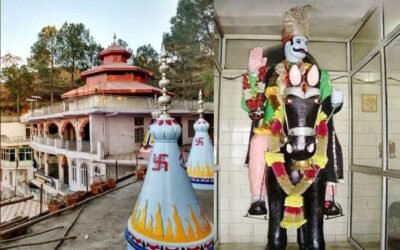
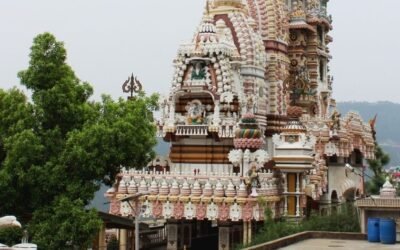
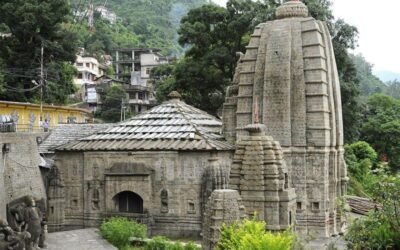
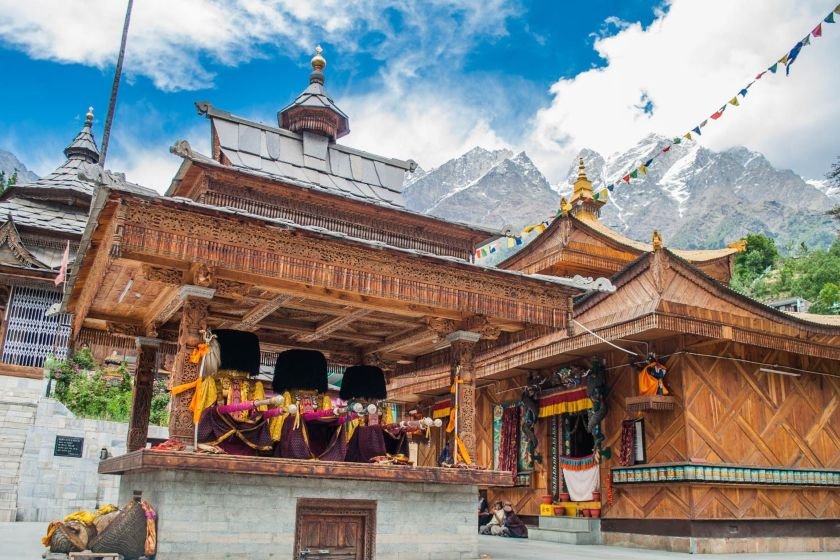
Kinnaur is frequently described as the meeting point between Buddhist Tibet and Hindu India, and the Bering Nag complex is one of the few places where that description stops being abstract. The temple’s own woodwork is genuinely exceptional — carved friezes and pillars depicting angels, nagas, deities, creepers, flowers, sun, and moon motifs, etched with a level of detail that draws comment from almost every visitor who’s climbed down to see it. But standing right beside it, sharing the same courtyard, is a Buddhist shrine decorated with dragon motifs on its gate and a large dharma chakra inside, complete with Nagara drums and Tibetan dongzing used in temple ritual.
One visitor who’s walked both structures noted that while the temple’s core relics appear genuinely old, the surrounding courtyard itself has been refurbished more recently — concrete flooring and stepped stone seating among the newer additions. So the woodwork that draws the most admiration is old; the ground beneath it is a working mix of old and new, which is fairly ordinary for an actively used village shrine rather than a preserved monument. What isn’t ordinary, at least by the standards of most of Himachal, is that a Hindu deity’s temple and a Buddhist monastery occupy the same small footprint without either tradition treating the other as an intrusion.
📜 A Valley on the Border of Two Himalayas
Lower Kinnaur sits at a genuine cultural hinge point — Hindu belief systems arriving from the plains and princely states to the south, Tibetan Buddhist practice filtering down from the high passes to the north and east. Villages like Sangla, positioned along old trade routes between the two worlds, absorbed both rather than choosing one, and the Bering Nag complex is a small, physical record of that absorption: not a syncretic invention dreamed up for tourists, but the ordinary residue of centuries of two faiths sharing a valley too narrow and too remote for either to dominate completely.
🎉 Festivals and Devotion
- Fulaich Fair (September, sometimes into October): The temple’s main public event — devotees offer seasonal flowers, including the rare Brahmakamal gathered from nearby peaks, to the accompaniment of folk music, cymbals, and drums
- Annual closing and reopening: A ritual pause beginning on the first day of Magh (mid-January) and ending with the deity’s “return” in late May, observed with community restraint toward the surrounding land
- Daily devotion: Ongoing worship at both the Hindu shrine and the adjoining Buddhist monastery, largely undocumented in written sources but visibly part of everyday life in the village
🏞️ While You’re in the Area
- Kamru Fort & Kamakhya Devi Temple: A short drive away, this thousand-year-old fort and its resident goddess make for a natural pairing with Bering Nag on a Sangla day trip
- Baspa River trails: Riverside walks with views of snow-capped peaks, right below the temple’s own descent
- Chitkul village: The last inhabited village before the Indo-Tibetan border, a scenic extension of any Sangla Valley visit
- Sangla market: Kinnauri shawls, handloom weaving, and local produce, a short climb back up from the temple
🙏 Getting in Touch
There’s no formal booking process, phone line, or listed priest contact for Bering Nag — this is a working village temple, not a managed tourist site. If you need current information on ritual timings or festival dates, the practical approach is to ask locally in Sangla itself once you arrive; villagers and guesthouse owners tend to know exactly what’s happening at the temple that week, even when nothing is written down anywhere.
❓ Quick Questions Travellers Ask
Is Bering Nag the same as Lord Jagas? Sources vary — some identify Bering Nag as a local form of Shiva called Jagas, others simply name him as his own serpent-guardian deity without that association. Both framings appear in circulation, and neither is definitively “correct” over the other.
How hard is the walk to the temple? Easy in terms of distance, but it’s downhill on the way there and uphill on the way back — roughly fifteen to twenty minutes each way at a relaxed pace.
Can I visit the Buddhist monastery in the same courtyard too? Yes — the two structures share the same complex, and visitors typically see both on the same short visit.
Is there an entry fee? No, entry is free, consistent with most village-level temples in the region.
When is the best time to see the temple at its liveliest? During the Fulaich Fair in September, when the deity is adorned with fresh Brahmakamal flowers and the courtyard fills with music and community celebration.
A Last Word
Sangla Valley draws most travelers for its scenery — the Baspa river, the orchards, the road onward to Chitkul — and it would be easy to treat Bering Nag as a five-minute stop along the way. But stand in that courtyard for a while, with the Nagara drums on one side and the dharma chakra on the other, and it starts to feel like the more honest introduction to Kinnaur than the mountain views ever were: two faiths, one small patch of ground, and centuries of villagers who never saw the need to choose between them.
Fact-check note: Sources disagree on the deity’s precise identity (Bering Nag as an independent serpent-guardian vs. “Lord Jagas,” a Shiva form) and on the exact dates of the Fulaich Fair (August–September in some accounts, September–October in others); both are presented as genuine disagreements rather than resolved arbitrarily. One source’s claim that the temple’s ritual reopening happens only “once in 30 to 35 years” directly contradicts its own description of an annual closing-and-reopening cycle, and is flagged here as likely conflated with a separate, rarer event rather than treated as fact. No independently verified GPS coordinates were found, so a search-based Maps link is provided instead. This piece takes a different central angle from the existing “Bering Nag Temple – The Serpent Lord of the Flowering Valley” already published on the site, which focuses on standard deity/architecture/festival coverage without addressing the shared Hindu-Buddhist courtyard or the annual closing ritual — both of which anchor this version instead. Worth flagging separately: that existing live article contains a “three pindis: Maha Kali, Maha Lakshmi, Maha Saraswati” paragraph that appears to be a copy-paste error from a goddess-temple template, since Bering Nag is worshipped as a male serpent deity — this is the same site-wide boilerplate error noted in the style guide and may be worth correcting on the live page.