Near Gambhar Pul, where the Solan hills fold towards Kunihar and Subathu, Brijeshwar Mahadev is worshipped in a quieter landscape of road, stream, village memory, and Mahadev’s stillness.
Not every Shiva temple in Himachal becomes famous through large fairs, ancient inscriptions, or grand stone architecture. Some remain close to the road, close to villages, and close to the daily faith of local people. Brijeshwar Mahadev Temple near Gambhar Pul belongs to that gentler category.
The temple is associated with Lord Shiva, worshipped locally as Brijeshwar Mahadev / Bijeshwar Mahadev and sometimes referred to in local devotional language as Brijeshwar Devta. It lies near Gambhar Pul on the Kunihar–Subathu side of Solan district, in a region where old village routes, small hill settlements, streams, and local shrines shape the sacred map more quietly than the big pilgrimage centres.
This is a temple that should be understood through local devotion rather than publicity. Its importance lies in the way Mahadev is present in the everyday hills — not far away on Kailash alone, but near a bridge, a village road, a bend in the valley, and the prayers of people who know the place by memory.
🌄 Location & How to Reach It
Brijeshwar Mahadev Temple is located near Gambhar Pul in Solan district, Himachal Pradesh, on the side of the region associated with Kunihar and Subathu. Public local references place the temple close to Gambhar Pul, with one local description giving it as about 1 km from Gambhar Pul and around 8 km from Kunihar. The shrine is part of the lesser-known sacred geography of the Solan hills rather than a major tourist-marked pilgrimage centre.
Google Maps: Get Directions
Elevation: A precise temple-specific elevation is not consistently published in reliable public sources. The temple should be understood as part of the mid-hill Solan region near the Kunihar–Subathu side.
- By road: The temple is best approached by road from Kunihar, Subathu, Solan, or nearby villages. Since the final route may depend on local road names and village turns, ask locally for Brijeshwar Mahadev Mandir, Bijeshwar Mahadev, or Gambhar Pul Mandir.
- From Kunihar: Local references place the shrine roughly 8 km from Kunihar, though travellers should confirm the exact road and condition before visiting.
- From Gambhar Pul: Local references place the temple close to Gambhar Pul, about 1 km away in some descriptions.
- By rail: The nearest practical rail access is through the Kalka–Shimla railway line, with Solan and nearby stations serving the broader region, followed by road travel.
- By air: The nearest major airport is Chandigarh Airport, followed by road travel through Solan-side routes.
This is not a high-altitude trek. It is a local road-accessible Shiva shrine, but the final approach should be confirmed with nearby residents or drivers familiar with Gambhar Pul.
🌸 Best Time to Visit
Brijeshwar Mahadev Temple can generally be visited through most of the year. The most comfortable months are March to June and September to November, when Solan’s mid-hill weather is pleasant and road travel is easier.
During the monsoon, the hills become greener, but local roads near streams, bridges, and slopes can become slippery or affected by rain. Winter is usually manageable in this region, though mornings and evenings can be cold.
For Shiva devotees, Mondays, Mahashivratri, and the Shravan month are spiritually meaningful times. Because no official festival calendar for this specific temple is widely available in public sources, visitors should confirm locally before planning around a special puja, bhandara, or mela.
Morning is the best time for a quieter visit. The temple is part of a local devotional landscape, so it should be approached respectfully and not treated as a picnic halt.
🕉️ Brijeshwar Mahadev: Shiva in a Local Name
The name Brijeshwar / Bijeshwar Mahadev places the temple firmly in the Shaiva tradition. Mahadev is one of Lord Shiva’s most beloved names, meaning the great god. Across Himachal, Shiva is worshipped through many local names: sometimes connected with a village, sometimes with a spring, sometimes with a cave, sometimes with a ridge, and sometimes with a devta tradition.
At Gambhar Pul, Brijeshwar Mahadev is remembered locally as a form of Shiva rooted in this specific landscape. This matters because Himachal’s sacred geography is rarely limited to pan-Indian names alone. A deity becomes intimate when attached to a place. Mahadev is universal, but Brijeshwar Mahadev is local.
The temple’s local references also use the phrase Brijeshwar Devta, which suggests the shrine is not only a Shiva temple in the broad sense but also a local devta seat in the surrounding community’s devotional understanding.
This is how faith often works in the hills. The great god becomes the village guardian. The cosmic ascetic becomes the one who listens near a bridge, a path, and a stream.
🌉 Gambhar Pul and the Sacred Geography of a Crossing
The name Gambhar Pul gives the temple’s setting an interesting character. A pul, or bridge, is more than a structure over water. In the hills, bridges often mark transitions: from one slope to another, one village road to another, one valley side to another. People remember temples near bridges because they stand at points of movement.
A Shiva shrine near such a crossing feels natural. Shiva is often worshipped in threshold spaces — caves, cremation grounds, riverbanks, mountain tops, forests, and lonely bends of the road. He belongs where ordinary and sacred worlds touch.
The Gambhar Pul setting gives Brijeshwar Mahadev Temple a sense of passage. Devotees may stop while travelling, villagers may visit for routine worship, and local people may treat the shrine as a guardian presence near the road.
In sacred geography, crossings matter. A bridge asks for safe passage. A Mahadev temple near it becomes a place to bow before continuing.
🙏 What Brijeshwar Mahadev Temple Is Known For
Brijeshwar Mahadev Temple is known as a local shrine of Lord Shiva near Gambhar Pul in Solan district. It is visited by devotees for darshan, peace, protection, family well-being, and blessings from Mahadev.
The temple is also known through local devotional references and videos as Brijeshwar Devta Mandir or Bijeshwar Mahadev Mandir, showing that the name may be spoken slightly differently by different people. This is common in Himachal, where local pronunciation, Hindi spelling, and English transliteration often vary.
The shrine’s importance lies not in grand tourist infrastructure but in its local devotional character. It serves people who know the road, the bridge, the surrounding villages, and the deity by habit and faith.
For travellers, it offers a chance to see a quieter Shiva site in Solan district — away from the crowded famous temples, but still deeply connected to Himachal’s living Shaiva tradition.
🏛️ A Local Shiva Shrine, Not a Monumental Temple
Public sources do not provide a detailed architectural history, founding date, royal patronage record, or archaeological description for Brijeshwar Mahadev Temple. That should not be treated as a weakness. Many meaningful village temples in Himachal are under-documented online but important locally.
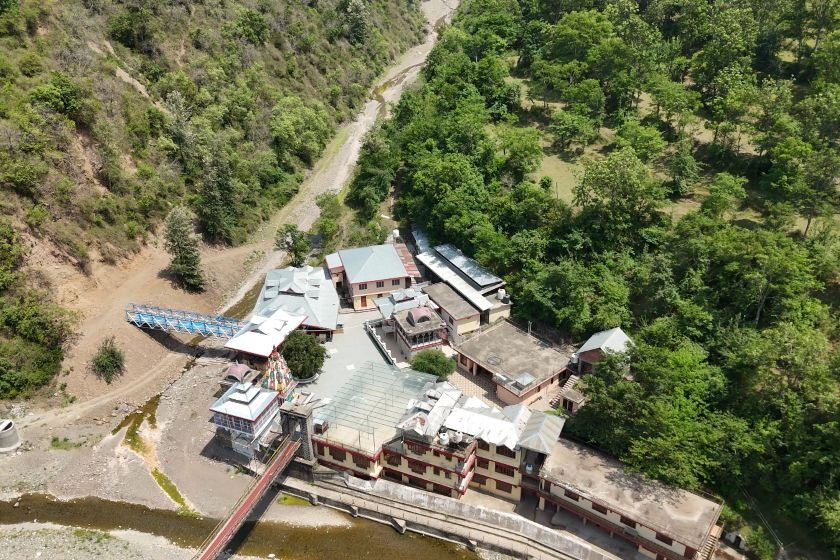
The temple should therefore be understood as a living shrine rather than a protected monument. Its form may have changed over time through local construction, renovation, repainting, and community care. This is normal for active hill temples.
A living temple is not frozen. People repair it. They add railings, roofs, paint, bells, tiles, and pathways as needed. The result may not look ancient, but the devotion can still be old.
The atmosphere of such a shrine comes from repeated visits: lamps lit on Mondays, bells rung before a journey, water offered to the Shiva lingam, and prayers whispered by people who do not need the temple to be famous.
🌿 The Solan Hills Around Kunihar and Subathu
The region around Kunihar, Subathu, and Gambhar Pul has its own quiet identity within Solan district. It is not as heavily promoted as Shimla, Kasauli, Chail, or the major temple routes, but it holds many small sacred places, old roads, cantonment-era memories, village settlements, and stream-side landscapes.
Kunihar is historically important as the centre of an old princely state, while Subathu carries its own cantonment and hill-road history. Between these better-known names are smaller villages, bridges, forests, fields, and shrines that give the region its lived character.
Brijeshwar Mahadev Temple belongs to this quieter Solan. It is not a destination built for large crowds. It is part of the route-based spirituality of the area — the kind of shrine people visit because it lies within the natural movement of their lives.
For a traveller interested in Himachal beyond famous lists, such temples are valuable. They show how sacred geography exists at the scale of villages and roads.
🕉️ Shiva, Water, and Hill Silence
Although public sources do not provide a detailed myth for Brijeshwar Mahadev Temple, the setting near Gambhar Pul naturally places it in the wider relationship between Shiva and water.
Across Himachal, Shiva shrines are often found near streams, springs, caves, and rivers. Water is offered to the Shiva lingam. The sound of flowing water suits the stillness of Mahadev. A bridge or stream-side temple can feel like a small form of Kailash brought into the local hills.
The mood of a Shiva shrine is usually simple: stone, water, bells, ash, flowers, leaves, and silence. Even when the temple building is modest, the ritual language is deep. A devotee pours water, folds hands, and lets the mind become quiet.
At Brijeshwar Mahadev, the landscape supports that mood. The hills around Gambhar Pul are not dramatic in a tourist-brochure way. They are lived hills — roads, turns, fields, villages, and the kind of silence that comes between passing vehicles.
That is enough for Mahadev.
🎉 Festivals and Devotion
- Mahashivratri: As a Shiva temple, Mahashivratri is the most important naturally relevant festival. Local arrangements should be confirmed before planning around the day.
- Shravan month: The month of Shravan / Sawan is especially meaningful for Shiva worship, with devotees offering water and prayers to Mahadev.
- Monday worship: Mondays are traditionally important for Lord Shiva and may be preferred by devotees for darshan.
- Local devta reverence: The use of names such as Brijeshwar Devta suggests a local devotional identity beyond general Shiva worship.
- Journey blessings: Because of its road-and-bridge setting, devotees may stop for blessings before or after travel.
- Respectful visit: Avoid littering, loud music, or treating the temple area as a casual roadside picnic point.
🏞️ While You’re in the Area
- Kunihar: A nearby historic settlement and useful local base for reaching Gambhar Pul and nearby villages.
- Subathu: A cantonment town with old hill-road character, located on the wider route network near the temple.
- Arki: A historically important town known for its palace, old state history, and nearby sacred sites.
- Jatoli Shiv Temple, Solan: One of Solan’s most famous Shiva temples, useful to combine for travellers exploring Shaiva sites in the district.
- Solan Town: A practical base for food, transport, accommodation, and onward routes towards Shimla, Kasauli, or Arki.
- Kasauli: A peaceful hill station known for colonial-era walks, churches, viewpoints, and forest roads.
- Local village shrines: The Kunihar–Subathu–Arki belt has many small temples and devta places that are best explored with local guidance.
🙏 Getting in Touch
There is no widely verified official website, booking system, formal public contact number, or management office information available for Brijeshwar Mahadev Temple, Gambhar Pul in accessible public sources. For current access, local road condition, festival arrangements, priest availability, and exact directions, ask locally in Gambhar Pul, Kunihar, Subathu, or nearby villages.
If you are visiting during Mahashivratri, Shravan, or a local bhandara, confirm the timing and crowd arrangements before travelling.
As with all living Shiva temples, remove shoes where required, keep the area clean, avoid touching sacred objects unless permitted, and ask before photographing the sanctum or local ritual spaces.
❓ Quick Questions Travellers Ask
Where is Brijeshwar Mahadev Temple located?
Brijeshwar Mahadev Temple is located near Gambhar Pul in Solan district, Himachal Pradesh, on the Kunihar–Subathu side.
Which deity is worshipped here?
The temple is dedicated to Lord Shiva, worshipped locally as Brijeshwar / Bijeshwar Mahadev.
Is it also called Brijeshwar Devta Mandir?
Yes. Local references use names such as Brijeshwar Devta, Brijeshwar Mahadev, and Bijeshwar Mahadev, with spelling variations.
How far is it from Kunihar?
One local reference places it around 8 km from Kunihar, but visitors should confirm the exact road locally before travelling.
How far is it from Gambhar Pul?
Local references describe it as close to Gambhar Pul, around 1 km in one available description.
Is there a trek to reach the temple?
No major trek is publicly documented. It is best understood as a local road-accessible shrine, though the final approach should be confirmed locally.
What is the best time to visit?
March to June and September to November are comfortable. For Shiva devotees, Mondays, Mahashivratri, and Shravan are especially meaningful.
Is there an official temple timing?
No verified official timing is available in accessible public sources. Visit during daylight and ask locally for darshan or puja details.
Can it be combined with other Solan temples?
Yes. It can be combined with Jatoli Shiv Temple, local Kunihar temples, Subathu-side shrines, and nearby Arki-region sacred places.
Are photos allowed inside?
Photography rules may depend on local custom. Ask before photographing the sanctum, Shiva lingam, or ritual spaces.
A Last Word
Brijeshwar Mahadev Temple near Gambhar Pul is not a temple of spectacle. It is a temple of nearness. Near a bridge, near villages, near the road between known towns, Mahadev sits in a form that belongs to local life.
Such shrines are easy to overlook because they do not always appear in official tourism lists. But Himachal’s sacred map is made of exactly these places — small temples, road shrines, devta seats, streams, bridges, and bells that local people know without needing signboards.
At Gambhar Pul, Brijeshwar Mahadev reminds travellers that Shiva does not need height, fame, or stone grandeur to be present. Sometimes a quiet shrine by the road is enough for the hills to become sacred.
Fact-check note: Public information on Brijeshwar / Bijeshwar Mahadev Temple, Gambhar Pul is limited. Available local and social references consistently identify it as a Shiva temple near Gambhar Pul on the Kunihar–Subathu side of Solan district, with one local reference placing it around 8 km from Kunihar and 1 km from Gambhar Pul. Local video references also use names such as Brijeshwar Devta, Brijeshwar Mahadev, and Gambarpul Subathu. Exact construction date, founder, architectural history, official timings, priest contact, festival calendar, and temple-specific elevation are not firmly verified in accessible public sources, so this article avoids forcing those claims and treats the shrine primarily as a living local Shiva temple.