In the heart of Chamba, an old stone temple remembers a princess, a king’s suspicion, and the moment a private loss became the sacred beginning of a town.
Chamba is not a town where temples stand apart from life. They rise beside markets, near police posts, along old lanes, above the Chaugan, and within walking distance of houses, shops, and public buildings. Among these shrines, Champavati Temple carries one of the town’s most intimate founding memories.
The temple is associated with Princess Champavati, daughter of Raja Sahil Varman, the ruler remembered for establishing Chamba as a capital in the early medieval period. The town itself is believed to have taken its name from her. That makes Champavati Temple more than a historic shrine. It is a place where Chamba looks back at its own beginning through the story of a daughter who disappeared, a father who repented, and a goddess who remained.
🌄 Location & How to Reach It
Champavati Temple is located in the heart of Chamba town, Himachal Pradesh, near the Treasury Building and Police Post area. Its central location makes it one of the easiest old temples to include in a walking route through Chamba’s historic core. Unlike remote hill shrines that require a long climb, this temple belongs to the everyday movement of the town.
Google Maps: Get Directions
Elevation: Chamba town is generally around 1,006 m / 3,300 ft above sea level.
- By road: Chamba is connected by road with Dalhousie, Banikhet, Pathankot, Khajjiar, Saho, and Bharmour. From within Chamba town, the temple can be reached easily by walking, local taxi, auto, or asking directions near the Treasury and Police Post area.
- By rail: The nearest major railway station is Pathankot, from where travellers continue by road to Chamba.
- By air: The nearest commonly used airports are Pathankot Airport and Kangra / Gaggal Airport, followed by road travel to Chamba.
This is an easy town temple to visit. The best way to experience it is not as a quick roadside stop, but as part of a slow walk through Chamba’s older sacred circuit.
🌸 Best Time to Visit
Champavati Temple can be visited through most of the year because it is located inside Chamba town. The most comfortable months are generally March to June and September to November, when walking through the old town is pleasant and the weather is suitable for temple visits.
During Navratri, the temple becomes especially meaningful because the presiding deity is associated with Goddess Mahishasuramardini, a fierce form of Durga. Some sources mention devotional activity during the spring and autumn Navratri periods, but exact festival arrangements should be confirmed locally before planning a visit around them.
Summer afternoons can be warm in town, so morning or late afternoon is better for a calmer visit. Monsoon months may bring rain and road delays in the wider district. Winter is manageable in Chamba, but mornings and evenings can be cold.
There is no need to expect a ticketed monument system. Champavati Temple is a living sacred site and a heritage monument. Visit respectfully, avoid loud behaviour, and ask before photographing inner areas.
🕉️ The Princess Who Became Chamba’s Memory
The legend of Champavati is one of the most important stories connected with the founding memory of Chamba. Raja Sahil Varman is remembered as the ruler who shifted the capital from the older region of Brahmapura / Bharmour to the present Chamba valley. His daughter, Princess Champavati, is said to have played a key role in this transition, and the town’s name is believed to have developed from her name.
But the temple’s legend is not simply a royal dedication. It carries a more painful story.
Princess Champavati was remembered as deeply religious. She would visit saints, shrines, and places of devotion. Her father, the king, became suspicious of her movements. One day, he followed her secretly to the place where she was believed to visit a sadhu. Some versions say he carried a dagger under his cloak, driven by doubt rather than trust.
When he reached the place, he found neither his daughter nor the saint. Both had vanished.
Then came a divine voice. The king was told that his suspicion had caused the loss of his daughter. To atone for his mistake and prevent further misfortune, he was instructed to build a temple in her memory.
The temple that rose from that grief became Champavati Temple.
🏛️ A Temple Built From Repentance
This legend should not be treated like a court record. It belongs to sacred tradition, and sacred tradition often speaks through emotion rather than documentation. But the story matters because it tells us how Chamba remembers trust, loss, and repentance.
The king in the story is not shown as triumphant. He is shown as a father who doubted too much and understood too late. The princess does not simply die in the usual sense; she is taken into the unseen. The temple becomes the visible answer to an invisible disappearance.
This gives Champavati Temple a different emotional weight from many other shrines. It is not only a place where a deity is worshipped. It is also a place where a royal mistake is remembered, where a daughter’s spiritual purity is honoured, and where Chamba’s own name becomes tied to feminine sanctity.
Many towns are named after rulers, battles, rivers, or forts. Chamba’s memory turns toward a princess.
That is the quiet power of this temple.
🙏 What Champavati Temple Is Known For
Champavati Temple is known first for its association with Princess Champavati, daughter of Raja Sahil Varman. It is one of the temples that helps explain the sacred and emotional origin of Chamba’s name.
The temple is also known for the worship of Goddess Mahishasuramardini, a fierce form of Durga who destroys the buffalo demon Mahishasura. In this form, the goddess represents divine power, courage, protection, and the victory of dharma over destructive force.
This creates an interesting layering. The temple is named after Champavati, but the deity worshipped within is Mahishasuramardini. The princess gives the temple its memory; the goddess gives it its living power.
The temple premises are also associated with shrines of Vasuki Naga and Wazir, according to several travel and heritage references. These details show how Chamba temples often hold more than one devotional layer. A goddess shrine may also preserve serpent worship, local guardians, and older regional traditions within the same sacred frame.
For devotees, the temple is a place of Shakti worship. For historians and travellers, it is a key to Chamba’s founding story. For the town itself, it remains one of the shrines through which Chamba remembers where it came from.
🏛️ The Shikhara Shrine With a Wheel Above
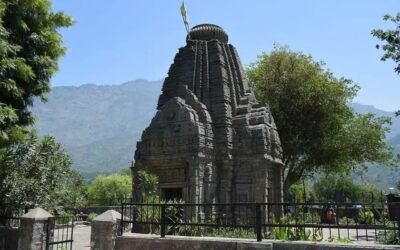
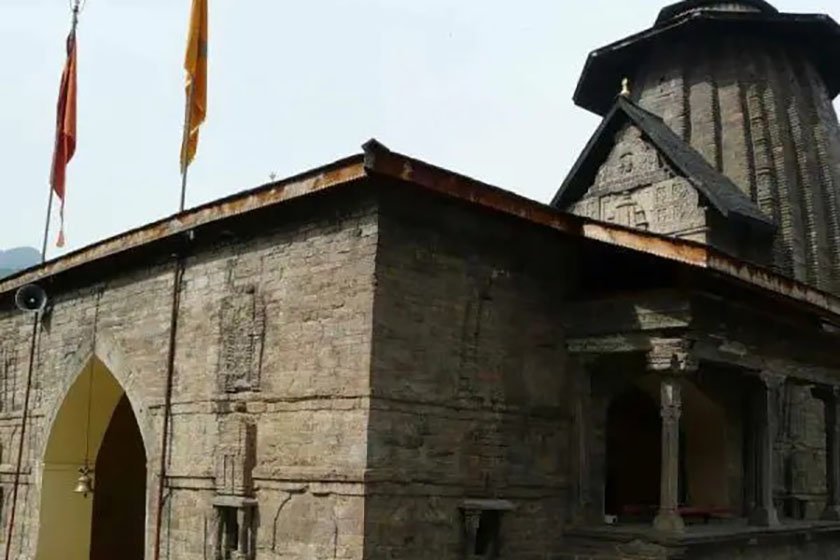
Champavati Temple is built in the Shikhara style, the North Indian temple form in which the sanctum rises into a tower-like superstructure. This style is seen in several important old temples of Chamba, including the famous Lakshmi Narayan Temple complex.
The temple is noted for its stone carvings, sculptural details, and a distinctive wheel-like feature on the roof. This wheel has often been mentioned as one of the features that distinguishes Champavati Temple from many other temples in the region.
The walls and surfaces carry carved detail rather than plain mass. A hurried visitor may notice only the outline of the shikhara, but the temple asks for closer looking. The stonework reveals the patience of old craftsmanship. Figures, forms, and architectural divisions turn the structure into a sacred text of its own.
Some sources compare the temple’s scale and presence with the Lakshmi Narayan Temple. That comparison should be made carefully. Lakshmi Narayan is the larger and more famous temple complex, but Champavati Temple has a special identity because of its founding legend and the way it connects architecture with the memory of the princess.
Stone holds the morning cool here. The town moves around it, but the temple remains still.
📜 Chamba, Sahil Varman, and the Founding of a Capital
To understand Champavati Temple, one must understand Chamba’s historical setting. The region’s older capital was associated with Brahmapura, now known as Bharmour. Raja Sahil Varman is remembered for shifting the capital to the present Chamba area around the early 10th century.
The story of Champavati is tied to this move. In one version, she influenced her father to establish the new town at the present location. In another, her disappearance and the divine instruction to build a temple led to the creation of the shrine that became central to the town’s identity.
These versions do not need to cancel each other. Himalayan sacred history often survives in layers. One layer remembers political relocation. Another remembers a daughter’s devotion. Another remembers the goddess. Another remembers the town taking its name from Champavati.
Together, they show that Chamba’s founding memory is not only royal or administrative. It is devotional. The town is not remembered as a capital alone. It is remembered as a place named through a princess and sanctified through a temple.
🏛️ Protected Memory and Archaeological Value
Champavati Temple is widely described as having strong historical and archaeological value. Several references state that it is maintained or protected by the Archaeological Survey of India, reflecting its importance as a heritage monument.
This matters because the temple is not only a place of worship but also a surviving example of Chamba’s old stone temple architecture. Its shikhara form, carved walls, roof feature, and sculptural detail make it part of the town’s built heritage.
But protection can only preserve stone. The living meaning of the temple comes from worship, memory, and local recognition. A temple like Champavati survives in two ways: through conservation and through devotion.
Both are necessary.
If the building is protected but the story is forgotten, the temple becomes only a monument. If the story is remembered but the structure is neglected, the physical memory weakens. Champavati Temple asks to be seen as both — heritage and shrine, architecture and legend, stone and prayer.
🎉 Festivals and Devotion
- Navratri: Because the temple enshrines Goddess Mahishasuramardini / Durga, Navratri is an important devotional period. Visitors should confirm current local arrangements before planning around exact rituals.
- Shakti worship: The temple is associated with the powerful feminine form of Mahishasuramardini, representing courage, protection, and victory over evil.
- Founding memory of Chamba: The temple is also revered because of its connection with Princess Champavati and the naming tradition of Chamba town.
- Local darshan: Since the temple is located in the town centre, devotees may visit as part of daily or occasional worship rather than only during major festivals.
- Heritage interest: Visitors interested in architecture often come to see the Shikhara-style structure, stone carvings, and distinctive roof wheel.
🏞️ While You’re in the Area
- Lakshmi Narayan Temple Complex: Chamba’s most important temple group, built in the Shikhara style and deeply connected with the town’s royal and religious history.
- Sui Mata Temple: A hill shrine associated with Queen Sunaina / Rani Sui and the legend of water being brought to Chamba through her sacrifice.
- Chaugan: The open public heart of Chamba, important for festivals, walking, public life, and understanding the town’s old layout.
- Bhuri Singh Museum: A valuable stop for Chamba paintings, inscriptions, royal history, arms, coins, Chamba rumals, and regional culture.
- Hari Rai Temple: A historic Vaishnavite temple known for its old stone architecture and connection with Chamba’s sacred townscape.
- Chamunda Devi Temple: A goddess shrine on the hill side, offering another expression of Chamba’s Shakti tradition and a wider view of the town.
- Akhand Chandi Palace: A former royal palace that helps visitors understand Chamba’s political and architectural past.
🙏 Getting in Touch
There is no widely verified official visitor centre, booking system, or public temple contact number available for Champavati Temple in common tourism references. For current darshan access, festival arrangements, photography rules, and priest availability, ask locally in Chamba town near the Treasury Building, Police Post, or old market area.
Because the temple is both a living shrine and a heritage structure, visitors should be careful. Remove shoes where required, avoid touching carvings, do not photograph inner sacred spaces without permission, and treat the stonework as protected heritage.
❓ Quick Questions Travellers Ask
Where is Champavati Temple located?
Champavati Temple is located in the heart of Chamba town, near the Treasury Building and Police Post area.
Who built Champavati Temple?
The temple is traditionally associated with Raja Sahil Varman, who built it in memory of his daughter Princess Champavati.
Which deity is worshipped at Champavati Temple?
The main deity worshipped is Goddess Mahishasuramardini, a fierce form of Durga.
Why is the temple named Champavati?
It is named after Princess Champavati, daughter of Raja Sahil Varman. Chamba town itself is believed to have derived its name from her.
What is the main legend of Champavati Temple?
The legend says the king became suspicious of his daughter’s visits to a sadhu. When he followed her, she disappeared, and a divine voice instructed him to build a temple in her memory.
What is special about the temple architecture?
The temple is known for Shikhara-style architecture, stone carvings, sculptural detail, and a distinctive wheel-like feature on the roof.
Is Champavati Temple protected by ASI?
Several references describe the temple as maintained or protected by the Archaeological Survey of India because of its historical and archaeological value.
Can it be visited with other Chamba temples?
Yes. It can be combined with Lakshmi Narayan Temple, Sui Mata Temple, Hari Rai Temple, Chamunda Devi Temple, and Bhuri Singh Museum.
Is there a trek to reach the temple?
No. It is located inside Chamba town and is easy to reach by walking or local transport.
What is the best time to visit?
The temple can be visited through most of the year. March to June and September to November are comfortable for exploring Chamba, while Navratri is especially meaningful for goddess worship.
A Last Word
Champavati Temple is not only an old shrine in Chamba. It is one of the town’s emotional foundations. Its story begins with doubt, loss, and repentance, but it ends in memory. A princess disappears, a king builds, a goddess is worshipped, and a town carries the name forward.
The temple’s stone does not speak loudly. It does not need to. Its shikhara rises in the middle of ordinary Chamba life, near offices, lanes, and footsteps. People pass by, devotees stop, travellers look up at the carvings, and the old story remains.
Chamba has many temples of gods and goddesses. Champavati Temple is also a temple of remembrance — of a daughter, a mistake, a voice, and a town that learned to keep her name.
Fact-check note: Champavati Temple’s location in central Chamba town near the Treasury Building / Police Post area, its association with Raja Sahil Varman and his daughter Princess Champavati, and its dedication to Goddess Mahishasuramardini / Durga are consistently supported by available tourism and heritage references. The temple is widely described as a Shikhara-style shrine with stone carvings and a distinctive wheel-like roof feature. Several sources also describe it as maintained or protected by the Archaeological Survey of India, though readers should consult current ASI listings for formal administrative status. The legend of Champavati’s disappearance is treated here as sacred and local tradition rather than a court-recorded historical event. Exact daily timings, priest contact details, and a temple-specific elevation are not firmly verified in accessible public sources and are therefore not forced.