Every river in the hills has a name and a story, but few carry the memory of a sage who tried to end his life in their waters and simply couldn’t.
Grief in Hindu myth rarely stays private — it reshapes rivers, renames villages, and occasionally builds temples in its wake. The story behind Vashisht, a small village just across the Beas from Manali, is one of the more unusual versions of that pattern. It doesn’t open with a miracle or a blessing. It opens with one of the most revered sages in the Vedic tradition, utterly broken by loss, walking into a river to die — and the river itself refusing to let him. What follows from there is less a single legend than two intertwined ones: an old rivalry between a sage and a king that spirals into real devastation, and a smaller, gentler story about a river’s mercy that gave this village its name.
🌄 Location & How to Reach It
Vashisht sits on the right bank of the Beas River, roughly 3 kilometres from Manali across the water, tucked at the edge of a deodar forest at an elevation of around 2,100 metres. A narrow link road off the Manali–Atal Tunnel highway leads up into the village, which climbs gently from the riverbank into apple orchards and forest above.
Google Maps: Get Directions
GPS Coordinates: not independently pinned in this note; Manali town itself, immediately across the river, serves as the reliable reference point for navigation.
Elevation: approximately 2,100 metres, slightly higher than central Manali across the valley.
- By road: A short taxi, auto-rickshaw, or even walkable trip from Manali Mall Road; the connecting link road is narrow and prone to jams in peak summer season, so an early start or a two-wheeler helps.
- By rail: No railhead nearby — the closest usable stations are Chandigarh or Shimla’s narrow-gauge line, both several hours away by road.
- By air: Bhuntar (Kullu-Manali) Airport is the nearest, about 50 km away, with Chandigarh as the better-connected alternative for most travellers.
This is about as easy as a Himachal temple visit gets — no trek, no permit, and a walkable distance from Manali’s Mall Road for anyone staying in town.
🌸 Best Time to Visit
May to July and September to October offer the most comfortable weather for wandering the village on foot. Curiously, winter has its own appeal here: the hot springs steam visibly against falling snow, and bathing outdoors in sulphur-warm water while the ground around you turns white is one of Vashisht’s most-repeated visitor experiences. The temple keeps consistent hours through the year — 7 am to 9 pm daily — and the adjoining baths run 7 am to 1 pm and 2 pm to 9 pm, with no formal seasonal closure.
🕉️ A Cow, a King, and a War That Shouldn’t Have Happened
Long before Vashisht settled into this particular valley, his story in Hindu tradition was already defined by one of its most consequential rivalries — with King Vishwamitra, a powerful monarch who, on a hunting expedition, stumbled onto Vashisht’s forest hermitage. The sage offered the king and his entire army a feast so lavish it embarrassed Vishwamitra’s own royal kitchens. The source, Vashisht explained, was Nandini, daughter of the wish-granting cow Kamadhenu, who could conjure anything asked of her. Vishwamitra wanted her for his kingdom, offered fortunes in exchange, and when Vashisht refused — a sage does not sell what isn’t his to sell — the king tried to seize her by force.
What happened next escalated far beyond a dispute over livestock. Nandini, resisting capture, summoned entire armies from her own body, and Vishwamitra’s forces, including by some tellings his hundred sons, were annihilated in the clash. Humiliated by the realisation that spiritual power had outmatched his military might, Vishwamitra renounced his throne entirely and began a punishing, years-long path of asceticism to close that gap — a transformation so complete that he eventually earned the rare title of Brahmarishi, a sage-king who had genuinely become a sage. But the wound between the two men didn’t heal quickly. In the versions of the story that follow their rivalry further, it was Vishwamitra’s lingering fury that led, through a curse worked on a king named Kalmashapada, to the deaths of all one hundred of Vashisht’s own sons — the single event that broke him.
📜 The River Vipasha
It’s from that grief that the more local, more intimate legend picks up — the one that actually explains the village’s name. Devastated and unable to bear the loss, Vashisht attempted to end his life, by some accounts trying to drown himself, in others attempting to leap from a height or walk into fire first. Each time, nature itself intervened: the stones he fell onto are said to have turned soft as cotton, and the river he finally chose to enter simply would not receive him — it fled from him in a hundred streams rather than close over his head. Broken but alive, the sage eventually settled and rebuilt his life on this very riverbank. In gratitude, or perhaps in irony, he named the river Vipasha — “freedom from bondage” — and it’s this name that, over centuries, softened into Beas, the river that still runs past the temple today. The village that grew up around his new home simply took his own name: Vashisht.
It’s worth being honest about this story’s shape: it’s devotional legend passed down through oral and popular retelling, not a documented historical event, and different sources vary on exactly how the suicide attempt unfolded. What stays constant across every version, though, is the core image — a river that refused to take a grieving man’s life, and a name that still carries that refusal.
🙏 What the Temple Is Known For
As guru to the Raghu dynasty and personal teacher to Rama and his brothers, Vashisht occupies a position of unusual authority in the tradition — not a warrior-god or a fierce protector, but a figure associated with wisdom, patience, and the long, difficult work of moral guidance. Pilgrims come here seeking clarity, resilience through hardship, and blessings tied to study and discernment rather than material fortune. It’s a notably quieter kind of devotion than the Shakti-worship common elsewhere in the hills — less about urgent protection, more about steadying the mind.
🏞️ The Hot Springs
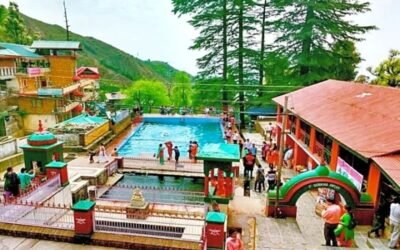
Right beside the temple, and arguably its bigger draw for most visitors today, are the Vashisht hot springs — naturally occurring, sulphur-rich waters said locally to have been created when Lakshman, unwilling to see his guru walk far for a daily bath, shot an arrow into the ground and opened the earth to hot water. Geologically, the springs draw from deep granite deposits running through the Himalaya, emerging at temperatures reported anywhere between roughly 40°C and 50°C, rich in sulphur and glacial minerals. Separate bathing enclosures serve men and women, and the water is widely believed locally to ease skin conditions and joint pain, though this is folk belief rather than a clinically established claim. There’s no entry fee for the baths, and unlike the temple itself, they draw an equal mix of pilgrims and travellers who couldn’t tell you the Vishwamitra story but know exactly how good the water feels after a day in the mountains.
🏛️ The Temple Itself
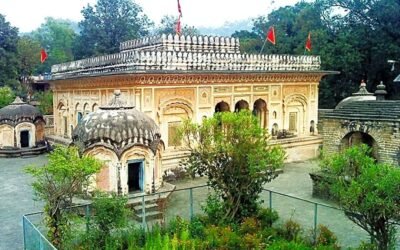
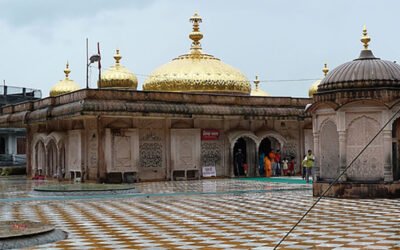
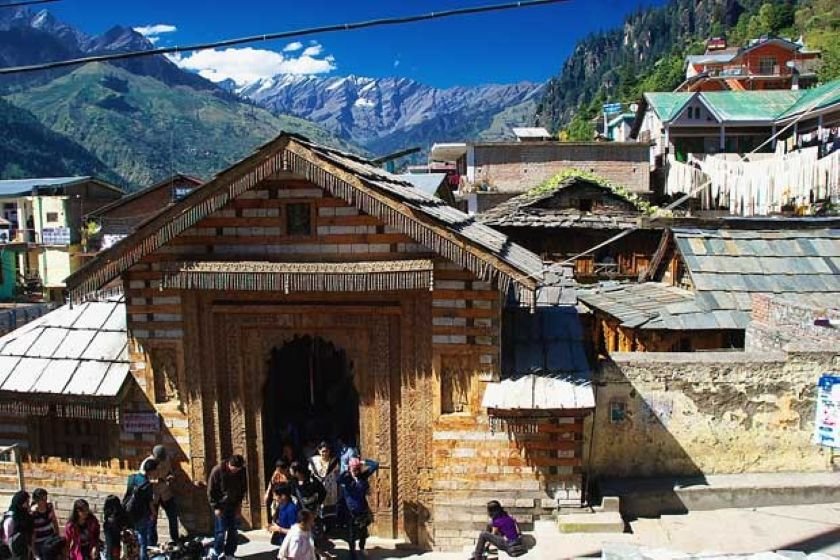
The temple is built in the Kath-Kuni style typical of the western Himalaya — alternating courses of timber and dry stone, locked together without mortar, a construction method that flexes rather than fractures under seismic stress. Inside sits a black stone image of Vashisht, draped in a dhoti, seated in meditation; the surrounding woodwork carries the ornate carving typical of Kullu-valley temples of real age, worn smooth in places by centuries of touch. Within the same complex, a small Rama temple stands adjacent, housing images of Rama, Sita, and Lakshman — a fitting companion shrine given the guru-disciple bond at the heart of the site’s mythology, and some local accounts describe a modest Shiva shrine here too, making it effectively three sanctums sharing one courtyard. The temple’s exact age is commonly quoted as 4,000 years, a figure repeated everywhere but impossible to independently verify; what’s more solidly documented is that the local Vashisht clan, claiming direct descent from the sage, is said to have ruled this village until as recently as 1534 — a far more concrete historical thread than the mythological dating usually offered.
🎉 Festivals and Devotion
- Vashisht Birsu Festival (April): a week-long local celebration with rituals, prayer sessions, and cultural performances — distinctly tied to this village rather than a generic hill-station festival
- Dussehra: observed here over seven days, reflecting the area’s long-standing Vaishnava character
- Guru Purnima: marked with bhajans and discourse honouring Vashisht specifically in his role as teacher
- Daily worship: morning and evening aartis continue year-round regardless of season
🏞️ While You’re in the Area
- Jogini Waterfall: a short, easy trek of under an hour through forest and orchard, ending at a 160-foot cascade with a small shrine at its base
- Hidimba Devi Temple: across the valley in Old Manali, dedicated to the forest goddess of Mahabharata fame
- Old Manali Market: cafés, woollens, and a distinctly bohemian, backpacker-heavy atmosphere that sits in genuine contrast to the temple’s quiet devotional pace
- Bhrigu Lake trek: Vashisht itself serves as a common starting point for this high-altitude glacial lake trail
- Solang Valley: for adventure sports, a short drive further up the valley
🙏 Getting in Touch
There’s no dedicated booking system or priest contact line for casual visitors; the temple runs on fixed daily timings (7 am–9 pm) rather than an appointment basis. If you’re planning around the Birsu festival specifically, it’s worth checking locally in Manali closer to the date, since exact scheduling can shift year to year.
❓ Quick Questions Travellers Ask
Is the Vashisht Temple the same as the hot springs? They’re part of the same complex but distinct — the temple houses the sage’s image and is a place of worship, while the adjoining baths are the public hot-spring pools, open to all with no entry fee.
Do I need to book the hot springs in advance? No — they’re open daily on a walk-in basis, with separate sections for men and women.
How old is the Vashisht Temple really? The commonly cited figure of 4,000 years isn’t independently verifiable; a more concrete historical detail is that a local ruling clan claiming descent from the sage held the village until 1534.
Is Vashisht village good for backpackers, not just pilgrims? Yes — it’s known as a quieter, smaller version of Old Manali, with cafés, guesthouses, and a strong long-stay traveller culture alongside its religious pilgrimage traffic.
What should I combine this visit with? Jogini Waterfall is the natural pairing — an easy trek starting right from the village, roughly 2.5 km from the temple.
A Last Word
There’s a strange comfort in a legend that doesn’t end in triumph but in survival — a sage who lost almost everything, tried three times by different accounts to end his own life, and was refused each time by the world around him rather than by some grand act of divine intervention. Stand by the Beas today, with steam rising off the hot springs and the old wooden temple quiet behind you, and it’s worth remembering that the river flowing past wasn’t always just scenery. Somewhere in its current is the memory of a man it once wouldn’t let go — and a name, freedom from bondage, that has outlasted every empire that’s risen and fallen in this valley since.
Fact-check note: Cross-checked across Wikipedia’s Vashisht village entry, multiple independent travel guides, and several retellings of the Vashisht-Vishwamitra Ramayana narrative (Bala Kanda), which offered a far more complete account of the sage’s backstory than the brief “his children were killed” summary common on tourism sites — that fuller version is used here, clearly marked as devotional legend rather than history. The existing site article on this same temple was not used as a source; it also carries the mismatched “three pindis — Maha Kali, Maha Lakshmi, Maha Saraswati” line found on several other articles on the site, which makes no sense for a temple dedicated to a male sage and was deliberately not repeated here. The temple’s “4,000 years old” age is widely repeated but unverifiable; the claim that the Vashisht clan ruled the village until 1534 is more specific and treated as the more credible historical anchor. Hot spring temperatures are reported inconsistently across sources (roughly 40–50°C depending on source and season) and are given as a range rather than a single figure. No independently verified GPS pin, priest contact, or booking system exists for the temple, so those gaps are stated plainly rather than invented.