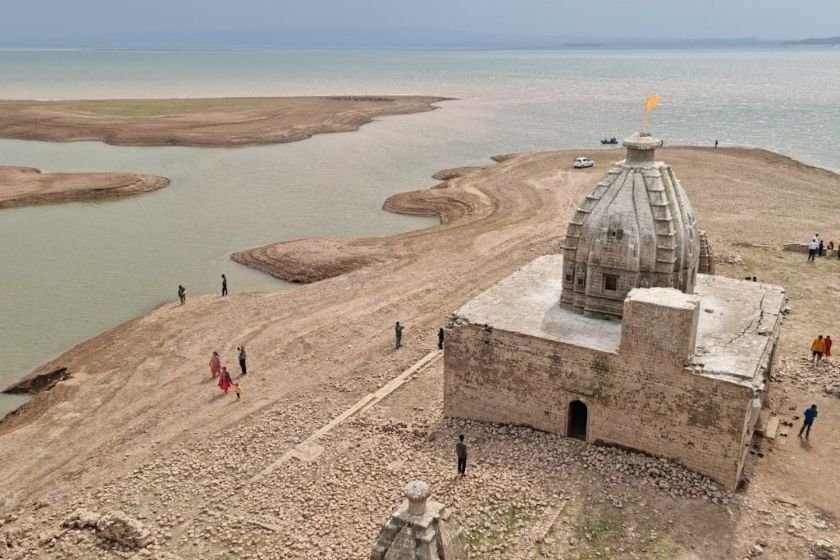
In the wide waterscape of Pong Dam reservoir, Bathu Ki Ladi spends much of the year hidden below Maharana Pratap Sagar, then rises again from the exposed lakebed like a stone memory the water could not erase.
Some temples stand on hilltops so they can be seen from far away. Bathu Ki Ladi does the opposite. For a large part of the year, it disappears. The temple cluster lies near Jawali in Kangra district, close to the Pong Dam reservoir, and remains submerged when the water level of Maharana Pratap Sagar rises. When summer lowers the reservoir, the old stone temples return to view — weathered, silent, and strangely intact after months under water. That seasonal vanishing is what makes Bathu Ki Ladi one of Himachal’s most unusual sacred sites: a temple group that is not only visited, but waited for.
🌄 Location & How to Reach It
Bathu Ki Ladi Temple is located near Jawali town in Kangra district, Himachal Pradesh, close to the Pong Dam reservoir / Maharana Pratap Sagar. The official Kangra district page places it about 3 km from Dhameta village, with distance references of roughly 60–67 km from Dharamshala / Kangra, around 80 km from Pathankot, and about 242 km from Chandigarh.
Google Maps: Get Directions
- By road: The practical approach is through Jawali, Dhameta, Nagrota Surian, or nearby Pong Dam-side villages, depending on current water level and access. When the reservoir bed is exposed, local vehicles may reach closer to the temple area, but this depends on the season and ground condition.
- By rail: The nearest useful rail access is the Kangra Valley Railway side, with stations such as Jawali and Nagrota Surian in the broader reservoir belt. For broad-gauge rail connectivity, Pathankot is the main practical railhead.
- By air: The nearest airport is Gaggal Airport near Dharamshala / Kangra, followed by road travel towards Jawali, Dhameta, and the Pong Dam side.
This is not a normal temple approach where the same route works all year. Bathu Ki Ladi depends heavily on the reservoir level. Before visiting, ask locally at Jawali, Dhameta, Nagrota Surian, or Pong Dam-side villages whether the temples are currently visible and reachable.
🌸 Best Time to Visit
The best time to visit Bathu Ki Ladi is usually March to June, when the water level of Pong Dam reservoir falls and the temple cluster becomes visible. The official Kangra district listing notes that these temples remain submerged for about 8 months and can be seen when the water level is low.
This is the single most important planning point. Do not plan Bathu Ki Ladi like a regular temple visit. During the monsoon and high-water months, the temples may be partly or fully underwater. Even when they are visible, the exposed reservoir bed may be muddy, uneven, hot, or difficult for small vehicles.
Morning is usually better than afternoon, especially in summer, because the exposed lakebed can become harsh and open under the sun. Carry water, wear proper shoes, and avoid walking too close to unstable mud, soft patches, or sudden water channels.
For photography, the best time is early morning or late afternoon, when the light gives the stone temples more depth and the reservoir landscape looks less flat.
🕉️ The Temple Cluster That the Water Hides
Bathu Ki Ladi is not one single temple. The name itself suggests a ladi, a row or chain. The site is a cluster of old stone temples, with the main shrine generally associated with Lord Shiva and Goddess Parvati, along with other carved forms and smaller shrines in the complex.
The most striking thing about the temples is not only their age, but their endurance. For months, they stand under the water of Maharana Pratap Sagar. Then, when the lake withdraws, they reappear with their stone walls, shikharas, carvings, and platforms still holding their form. In a place like Himachal, where many temples survive through wood, repair, and active village care, Bathu Ki Ladi survives differently — through stone and disappearance.
Local people know this rhythm well. The temple is not always “available.” It belongs to the reservoir calendar. When the water rises, it returns to silence. When the water falls, devotees, photographers, travellers, and curious visitors arrive across the exposed lakebed.
🕉️ The Pandava Story and the Stairway That Could Not Be Finished
Like many ancient and difficult-to-date temples in Himachal, Bathu Ki Ladi is linked in local tradition with the Pandavas. The common story says that the Pandavas built these temples during their exile. Some versions also speak of an attempt to build a stairway to heaven, or a construction that had to be completed in one night but remained unfinished.
This story should be understood as local sacred memory rather than proven history. There is no simple inscriptional record that settles the temple’s origin through the Pandavas. But the legend remains important because it tells us how people explain the site’s unusual character. A temple cluster appearing from water, standing in a wide empty reservoir bed, already feels outside ordinary time. The Pandava story gives that feeling a language.
In Himachal, the Pandavas often appear in stories attached to old temples, high routes, caves, and unfinished structures. Their name becomes a way to say: this place is ancient, difficult, and touched by a time beyond ordinary village memory. Bathu Ki Ladi fits that pattern perfectly.
🙏 What Bathu Ki Ladi Is Known For
Bathu Ki Ladi is known for its seasonal submergence, its ancient stone temple cluster, and its location inside the changing landscape of Pong Dam reservoir. It is one of the few sacred places in Himachal where the calendar of darshan depends so visibly on water level.
Devotees and visitors come here for different reasons. Some come because it is an old Shiva-Parvati temple cluster. Some come because the sight of temples emerging from a reservoir is rare. Some come for photography, especially when the temple stands against the dry lakebed or shallow water. Others come simply because the place has become part of Kangra’s unusual sacred geography.
The temple is also known for its stone material. Many local references connect the name Bathu with the strong bathu stone used in the construction, often said to have helped the temples withstand months of submergence with surprisingly little visible damage. Whether every detail of that explanation can be technically verified or not, the practical fact is clear: the stone temples have endured a condition that would have destroyed many weaker structures.
🏛️ Stone, Shikhara, and the Silence of the Reservoir Bed
Architecturally, Bathu Ki Ladi is usually described in relation to Nagara-style temple architecture, with stone towers and carved temple forms typical of old north Indian sacred design. The temples are not massive like the great temple complexes of central India, but in the open setting of Pong reservoir, they feel dramatic.
The open lakebed changes the way the architecture is experienced. There are no crowded market lanes, no old town walls, no dense village around the shrine when the water is low. Instead, the temples stand in exposed space. Their scale looks different depending on the water line. When the reservoir has partly receded, the temples can look like islands of stone. When the bed is dry, they feel like ruins released by the lake.
A visitor may notice carvings, small shrine forms, weathered stone surfaces, and the way the temple towers hold their shape despite repeated submergence. The place can feel beautiful, but also slightly lonely. Bathu Ki Ladi is not a polished pilgrimage complex. It is a surviving sacred structure in an altered landscape.
The silence here is not the silence of a forest temple. It is the silence of a lakebed. Open sky above, stone below, and the memory of water all around.
📜 Pong Dam, Maharana Pratap Sagar, and a Changed Landscape
To understand Bathu Ki Ladi, one has to understand Pong Dam. The official Kangra district page notes that Pong Dam was built in 1975 and that the reservoir, also known as Maharana Pratap Sagar, is a famous wildlife sanctuary and Ramsar wetland site. The reservoir covers a very large area and is one of the important water bodies in the Himalayan foothills.
Before the reservoir, the temple did not have the same seasonal underwater identity it has today. The creation of Pong Dam changed the landscape around it. Villages, routes, fields, and old places were affected by the rising waters. Bathu Ki Ladi became one of the most visible sacred reminders of that transformation.
This makes the temples emotionally complex. They are beautiful because they reappear, but they reappear because a whole landscape was drowned and remade. The reservoir gave the region a major wetland, fisheries, bird habitat, and water infrastructure. It also submerged old habitations and sacred sites. Bathu Ki Ladi stands at that difficult meeting point of heritage, water, development, and memory.
That is why the temples should not be described only as a “hidden gem.” They are more serious than that. They are a sacred survival from a changed valley.
🐦 A Temple Inside a Wetland World
Pong Dam is not only a reservoir. It is also a major wetland and bird habitat. The official Kangra page describes it as a famous wildlife sanctuary and Ramsar wetland. Around the reservoir, birdlife, fishing communities, seasonal water movement, and open wetland views form a landscape very different from Kangra’s hill temples and tea gardens.
Bathu Ki Ladi belongs to this wetland world now. During high water, the temples are part of the reservoir. During low water, they stand in the exposed bed. Around them, the land may look dry, cracked, muddy, or open depending on season. Birds may be seen in the wider Pong Dam area, and the reservoir’s scale can surprise first-time visitors.
This is another reason to visit responsibly. Do not drive recklessly across the exposed lakebed. Do not leave plastic. Do not disturb wetland areas, birds, or local fishing activity. A sacred site inside a reservoir needs more care than a paved temple complex.
🎉 Festivals and Devotion
- Seasonal Darshan: The main “festival” of Bathu Ki Ladi is its seasonal reappearance. The temples are generally visible and approachable when the reservoir level drops, especially around March to June.
- Shiva-Parvati Worship: The main temple is locally associated with Lord Shiva and Goddess Parvati, though regular priestly worship may not function like a normal roadside shrine because of seasonal submergence.
- Pandava Tradition: Local belief connects the temples with the Pandavas, especially with the idea of ancient construction during exile or an unfinished stairway-like sacred effort.
- Summer Visits: Devotees, photographers, and travellers usually visit during the low-water months. Summer afternoons can be hot and exposed, so morning visits are more practical.
- Water-Level Caution: During monsoon and high-reservoir months, the temples may be underwater or unsafe to approach. Always ask locally before visiting.
🏞️ While You’re in the Area
- Pong Dam / Maharana Pratap Sagar: The larger reservoir landscape around the temples, known for wetland views, birdlife, fisheries, and wide open water.
- Nagrota Surian: A practical Pong Dam-side settlement and rail-linked area useful for reaching different reservoir points.
- Jawali: The nearest important town reference for Bathu Ki Ladi, useful for road access, local directions, and basic supplies.
- Dhameta: A nearby village reference point, about 3 km from Bathu Ki Ladi according to the official Kangra listing.
- Masroor Rock-Cut Temples: One of Kangra’s most important ancient temple sites, often combined with Pong Dam-region travel if time allows.
- Kangra Fort: A major historical site in Kangra district, useful for travellers interested in old hill-state history.
- Jwalamukhi Temple: A major Shakti Peeth in Kangra district, often combined with a wider Kangra pilgrimage route.
🙏 Getting in Touch
There is no single widely verified temple-office contact for Bathu Ki Ladi that visitors should depend on for year-round access. The most useful contact is local: ask in Jawali, Dhameta, Nagrota Surian, or nearby Pong Dam villages about the current water level, route, vehicle access, and ground condition.
Do not rely only on old photos or social media posts. The temples may look accessible in one month and be submerged or unsafe in another. If you are visiting for photography, check recent local updates first.
For visitors interested in Pong Dam wildlife or reservoir areas, follow local forest/wetland rules and avoid entering restricted or ecologically sensitive zones.
❓ Quick Questions Travellers Ask
Where are Bathu Ki Ladi temples located?
They are near Jawali town in Kangra district, close to the Pong Dam reservoir / Maharana Pratap Sagar.
Why are Bathu Ki Ladi temples famous?
They are famous because they remain submerged in the reservoir for much of the year and become visible when the water level falls.
When is the best time to visit Bathu Ki Ladi?
The best time is usually March to June, when the reservoir level is low and the temples are more likely to be visible.
Which deities are worshipped at Bathu Ki Ladi?
The main temple is generally associated with Lord Shiva and Goddess Parvati, with other smaller shrines and carved forms in the cluster.
Can Bathu Ki Ladi be visited all year?
No. Access depends on the water level of Pong Dam reservoir. During high-water months, the temples may be submerged or unsafe to approach.
A Last Word
Bathu Ki Ladi is powerful because it does not stay available. It appears, disappears, and appears again. The lake covers it for months, but does not erase it. When the water falls, the temples return with the quiet patience of stone.
That is what makes the place unforgettable. It is not only an old temple cluster. It is a sacred structure living inside a modern reservoir. It reminds visitors that landscapes change, villages move, water rises, and yet some memories keep finding their way back to the surface.
At Bathu Ki Ladi, darshan begins before the temple. It begins with the question everyone asks first: has the water gone down enough?
Fact-check note: Bathu Ki Ladi’s location near Jawali in Kangra district, about 3 km from Dhameta village, and its position close to Pong Dam reservoir / Maharana Pratap Sagar are supported by the official Kangra district listing. The same official listing notes that the temples remain submerged for about 8 months and become visible when the water level falls. The official Kangra Pong Dam page supports the reservoir’s identity as Maharana Pratap Sagar, built in 1975, and its importance as a wildlife sanctuary and Ramsar wetland. The Pandava origin story, unfinished stairway tradition, deity details, and bathu-stone explanation are treated as local tradition or commonly repeated heritage accounts rather than inscription-verified history. Because access depends on reservoir level, travellers should confirm current visibility and route conditions locally before visiting.