Above Kugti, where the village path begins to rise towards the older routes of shepherds, pilgrims, and pass-crossers, Kartik Swami is remembered not as a distant god of temples, but as the guardian of the high road itself.
Kartik Swami Temple at Kugti is one of the most striking sacred sites in the Bharmour region of Chamba district. It is not a shrine that announces itself through a busy bazaar, a wide road, or a large temple town. Its presence is quieter and more demanding. To reach it, you first have to come to Kugti village, one of the remote settlements associated with the routes towards Kugti Pass, Jotnu Pass, and the old sacred geography around Manimahesh.
The temple is dedicated to Lord Kartikeya, the son of Lord Shiva and Goddess Parvati, who is worshipped across India by many names — Kartik Swami, Skanda, Kumara, Murugan, and in the Bharmour-Kugti region, most importantly, Kelang / Keylong Wazir. In this part of Himachal, he is not merely the youthful warrior of classical mythology. He is a mountain deity tied to movement, courage, protection, weather, grazing routes, and the difficult crossings that shaped life in the high Himalaya.
For travellers, Kartik Swami Temple is a beautiful trek above Kugti. For devotees, it is a place of faith before entering higher and harsher country. For the Gaddi world, it belongs to an older rhythm of seasonal movement, devta belief, and mountain respect.
🌄 Location & How to Reach It
Kartik Swami Temple is located above Kugti village in the Bharmour subdivision of Chamba district, Himachal Pradesh. The temple is generally described as lying around 6 km from Kugti village, at an approximate altitude of 3,100 metres. Some local and travel accounts describe the walk as closer to 4–7 km, which is common for mountain trails where the measured road distance, walking route, and local estimate can differ.
Google Maps: Get Directions
Approximate elevation: 3,100 metres
Nearest major base: Bharmour
Route: Chamba → Bharmour → Hadsar → Kugti → Kartik Swami Temple trek
- By road: Reach Bharmour from Chamba, then continue towards Hadsar and further to Kugti village, depending on road condition and season.
- By trek: From Kugti village, the temple is reached by a mountain walk usually described as around 6 km.
- By rail: The commonly used railhead for Chamba-Bharmour journeys is Pathankot.
- By air: The nearest practical airport is Gaggal Airport, Kangra, followed by a long road journey towards Chamba and Bharmour.
This is not a casual roadside temple visit. The final approach involves walking in mountain terrain, so visitors should keep proper shoes, water, warm clothing, and enough daylight for the return.
🌸 Best Time to Visit
The most practical time to visit Kartik Swami Temple is from late spring to autumn, when the route from Bharmour to Kugti is more accessible and the walking trail is generally open. The higher Bharmour region can receive snow, and the temple traditionally remains closed for a part of the winter season.
Recent local reporting noted that the temple reopened for devotees in April 2026 after remaining closed for more than four months during the winter period. This supports the local pattern that access and worship here are strongly seasonal, not fixed like a city temple.
For most visitors, May to October is the safer travel window. During monsoon, road conditions, landslides, and slippery trails should be checked locally before starting. In winter and early spring, snow and weather can make the route difficult or unsuitable without local guidance.
🕉️ The Local Name: Kelang Wazir
In Kugti and the surrounding Bharmour region, Kartik Swami is widely known as Kelang Wazir, also written as Keylong Wazir, Kelang Bajir, or Kaylong in different local and online references. These variations are not separate deities in the ordinary sense; they reflect how the name travels through local speech, transliteration, and regional tradition.
This local name matters because it shows that the temple is not simply a northern version of the better-known South Indian Kartikeya tradition. In Kugti, the deity belongs to a distinctly Himalayan world. He is remembered in relation to Gaddi pastoral life, high-altitude routes, difficult passes, and the older sacred links between Chamba, Bharmour, Lahaul, and Manimahesh.
The title Wazir gives the deity a courtly and protective identity in local imagination. He is treated as a powerful divine presence, one who stands close to the world of Shiva but also acts in his own authority.
🕉️ Lord Kartikeya: The Warrior Son of Shiva
In Hindu mythology, Lord Kartikeya is the warrior son of Lord Shiva and Goddess Parvati. He is often described as the commander of the divine army and the destroyer of the demon Tarakasura. Across India, his worship takes different forms. In South India, he is widely loved as Murugan or Subramanya. In parts of North India and the Himalaya, his temples are fewer, which makes the Kugti shrine especially important.
At Kugti, Kartikeya’s warrior identity fits the landscape. The temple stands not in a comfortable plain but on the way to mountain crossings. The people who prayed here were often those who understood risk directly — shepherds moving with flocks, pilgrims attempting sacred circuits, and travellers preparing for long climbs into unpredictable weather.
This is why Kartik Swami Temple feels less like a decorative shrine and more like a place of permission. Before going further, one stops, bows, and asks for strength.
🏔️ A Temple on the Route to Kugti Pass and Jotnu Pass
Kartik Swami Temple is closely associated with the routes leading towards Kugti Pass and Jotnu Pass. The Kugti Pass route is one of the old high Himalayan crossings connecting the Chamba side with the Lahaul side. It is also known as a traditional trail used by Gaddi shepherds during seasonal movement.
The official Bharmour reference describes the temple as a place devotees visit before attempting Jotnu Pass for Kailash Parikrama and Kugti Pass. That detail is important because it tells us how the temple functioned in real life. It was not only a destination; it was a threshold.
In mountain culture, thresholds matter. A village edge, a forest line, a pass, a bridge, a glacier crossing — each has its own fear and sanctity. Kartik Swami Temple belongs to that category. It is a shrine placed before the difficult part begins.
🙏 The Temple Complex and Marali Mata
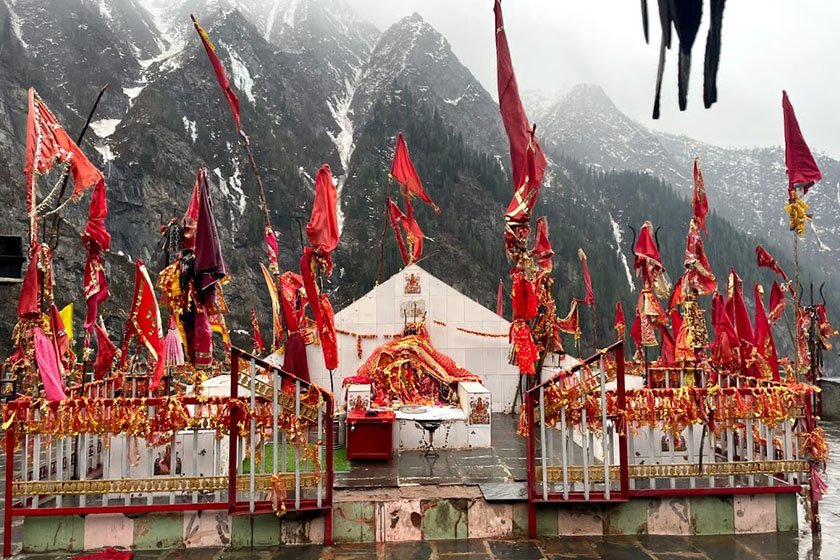
The temple complex is commonly described as having two sacred presences: one connected with Kartik Swami / Kelang Wazir and another with Marali Mata. Some local accounts describe Marali Mata as associated with the same divine family of Shiva and Parvati.
Because detailed written documentation on the temple complex is limited, it is better not to overstate the exact origin of every shrine within the complex. What can be said with confidence is that Kartik Swami and Marali are both part of the local sacred identity of this site, and devotees treat the place as more than a single isolated shrine.
This is common in Himachal’s devta landscape. A temple may have one principal deity, but the sacred space around it often includes related powers, attendants, local mother goddesses, nag deities, or older regional traditions that do not always fit neatly into textbook categories.
🪵 Architecture and Setting
Kartik Swami Temple is not famous because of monumental stone architecture. Its power comes from setting, placement, and devotion. The shrine stands in a high mountain environment where the surrounding ridges, meadows, forests, and snow views become part of the experience.
The temple’s form is simple and local rather than grand. This suits the Bharmour-Kugti region, where many sacred sites are deeply tied to landscape rather than scale. The climb, the silence, the changing weather, the last village behind you, and the route ahead all prepare the mind before darshan.
Visitors often remember the temple for its mountain views and the feeling of arrival after walking upward from Kugti. The journey gives the shrine its emotional weight. You do not just “reach” the temple; you earn the moment slowly, step by step.
🚶 The Trek from Kugti Village
The walk from Kugti village to Kartik Swami Temple is usually described as a moderate mountain trek. The distance varies in accounts, but 6 km from Kugti is the most commonly repeated figure in better local references.
The route rises through Himalayan terrain and offers views of the surrounding Kugti landscape. Depending on season, visitors may see green slopes, wildflowers, waterfalls, grazing areas, and snow on higher ridges. The trail is not extremely technical for regular mountain walkers, but it should not be treated casually.
Good walking shoes are important. Weather can change quickly. Mobile connectivity may be weak. It is better to start early, carry basic food and water, and avoid returning after dark. If travelling for the first time, a local guide or local advice from Kugti is highly recommended.
🐐 Kugti, Gaddi Life, and the Sacred Route
Kugti is more than a base village. It is part of the old Gaddi landscape of Chamba. The Gaddi community has long been associated with transhumance — seasonal movement with sheep and goats between lower and higher pastures. Routes such as Kugti Pass were not adventure trails in the modern sense; they were working mountain corridors.
Because of this, Kartik Swami Temple carries a different meaning from a shrine built mainly for tourists. It belongs to the lived geography of the people. The deity’s protection matters because the mountains are not symbolic here. They decide weather, food, movement, safety, and survival.
To understand the temple properly, one must see it through this mountain rhythm. The god is worshipped not only for blessings inside the temple but also for protection outside it — on trails, in storms, near passes, and during journeys that test the body and mind.
🌿 Nearby Places to Explore
Kugti Village
The last major settlement before the higher trails, Kugti is known for its traditional houses, mountain setting, and connection with Gaddi life.
Bharmour
Bharmour is the main cultural and spiritual base of the region, famous for the Chaurasi Temple Complex and its association with ancient Brahmapura traditions.
Hadsar
Hadsar lies on the route towards Bharmour’s pilgrimage and trekking circuits. Many travellers pass through it while moving towards Manimahesh or Kugti side routes.
Kugti Wildlife Sanctuary
The wider Kugti region falls within an ecologically rich mountain zone known for forests, wildlife, grazing routes, and high-altitude landscapes.
Kugti Pass
A demanding high-altitude route connecting Chamba with Lahaul, Kugti Pass is suitable for experienced trekkers with proper planning, local support, and weather awareness.
📌 Visitor Tips
Carry warm layers, even in the travel season. At around 3,100 metres, the weather can shift quickly. A sunny morning can become cold by afternoon.
Wear proper trekking shoes. Avoid walking in slippers or smooth-soled casual shoes, especially during or after rain.
Start early from Kugti. This gives enough time for darshan, rest, photography, and return before evening.
Do not litter. The Kugti region is both sacred and ecologically sensitive.
Confirm road conditions at Bharmour or Kugti before travelling, especially during monsoon, winter, and early spring.
Respect local customs. If a part of the shrine or ritual space is restricted, follow local instructions without argument.
Do not force exact festival or opening dates without checking locally. Seasonal temple access can depend on weather, snow, and local religious decisions.
🧭 Why Kartik Swami Temple Matters
Kartik Swami Temple matters because it preserves a rare Himalayan form of Kartikeya worship. It shows how a pan-Indian deity becomes local, intimate, and mountain-specific. Here, Kartikeya is not only the mythic commander of celestial armies; he is Kelang Wazir, the guardian of routes, the deity of courage, and a protector before difficult crossings.
The temple also matters because it keeps alive the sacred geography of Kugti. In one direction lies the village world. In another lies the pass world. Between the two stands the temple. That placement is the whole story.
Many temples are built where people gather. Kartik Swami Temple stands where people prepare to leave comfort behind.
✨ Final Thoughts
Kartik Swami Temple, Kugti, is not a shrine for hurried sightseeing. It asks for time, walking, weather awareness, and respect for local belief. Its beauty lies in the way devotion and geography meet. The god worshipped here is a warrior, and the path to him carries that same character — simple, steep, quiet, and honest.
For devotees, this is a place to seek courage. For trekkers, it is a sacred halt before the higher trails. For those who want to understand Himachal beyond famous towns and crowded temples, Kartik Swami Temple offers something deeper: a glimpse of faith as it has lived for generations in the mountains.
In Kugti, Kartik Swami does not feel far away. He feels like the one standing at the edge of the path, watching the pass, and waiting for every traveller to bow before moving ahead.
Fact-check note: Kartik Swami Temple’s location near Kugti village in Bharmour, Chamba district, its local identity as Kelang / Keylong Wazir, and its approximate altitude of 3,100 metres are supported by local Bharmour references. The most commonly cited distance is 6 km from Kugti, though some travel accounts describe the walk as 4–7 km, so the article treats the distance as approximate. The temple’s association with Marali Mata, Kugti Pass, and Jotnu Pass / Kailash Parikrama is also supported by local references. Seasonal closure and reopening are handled cautiously because access depends on weather and local temple practice; recent reporting confirms a reopening in April 2026 after winter closure. Broader details about Kugti Pass as a Chamba-Lahaul high-altitude route and a traditional Gaddi trail are supported by trekking references, but this article does not treat the pass route as suitable for casual visitors without planning and local guidance.