In the last inhabited village before Tibet, people don’t just say their goddess protects them — they say that once, when it mattered most, she got up and did something about it.
Every mountain valley in Himachal seems to have a goddess who arrived from somewhere else, chose a village to call home, and has watched over it ever since. It’s a familiar shape of story — but in Chitkul, the northernmost, farthest-flung village on the old Hindustan-Tibet trade route, the story doesn’t end with the goddess simply arriving and settling in. Local memory adds a second chapter, decades later, in which she is said to have stepped in again — not gently, but forcefully, at a moment of real danger. Long before that, though, she had to get here at all, crossing half of the Himalayas and dividing up an entire valley along the way.
🌄 Location & How to Reach It
Mathi Devi Temple stands in the heart of Chitkul, a Baspa Valley village in Kinnaur district that holds the distinction of being the last inhabited settlement on the old Hindustan-Tibet trade route — and, for ordinary travellers, the last point reachable before an Indo-Tibetan Border Police checkpost closes off the road toward the frontier. The village sits on the right bank of the Baspa River, roughly 26–28 kilometres from Sangla and around 45 kilometres from Karcham, where the Baspa Valley road branches off National Highway 5.
Google Maps: Get Directions
Elevation: approximately 3,450 metres — sources disagree on the exact figure, and one or two quote a much lower number that appears to be a units mix-up rather than a genuine second estimate.
- By road: From Shimla, the route runs via Narkanda, Rampur, and Karcham to Sangla and on to Chitkul — roughly 8–10 hours of mountain driving. The stretch between Sangla and Chitkul is the roughest leg of the journey, and a vehicle with decent ground clearance is worth having.
- By rail: The nearest railhead is Shimla (the narrow-gauge toy train from Kalka), around 240–250 kilometres away, with the rest of the journey by road.
- By air: Shimla Airport, about 250 kilometres away, is the closest airstrip; onward travel is by road regardless.
This isn’t a roadside shrine you stumble on — reaching it is a proper Himalayan journey, closer in spirit to visiting a remote monastery than a five-minute temple stop, and the last stretch of road demands the same respect as the rest of the trip.
🌸 Best Time to Visit
May–June and September–October are the two dependable windows. Early summer brings pleasant daytime temperatures and fully open roads, though it’s also peak season with crowded homestays. The post-monsoon stretch from late September into the first half of October is arguably the finer choice — clearer skies, a crisp valley, and the apple orchards along the way at their fullest. July and August bring monsoon rain and a real risk of landslides blocking the Karcham–Sangla stretch for hours or days, so this window is best avoided. From roughly mid-December to March, the road to Chitkul closes under snow entirely, and the village itself empties out as residents move to lower ground for the winter.
There’s no published set of formal darshan timings for the temple — this is a living village shrine, not a tourist-hours attraction, and its rhythms follow the priests’ daily rituals rather than a signboard.
🕉️ The Goddess Who Divided the Valley
The origin story told in Chitkul begins a long way from Kinnaur. Mathi Devi — locally also known as Shiromani Devi or Devi Chhitkul Mata, and honoured in local tradition as consort of Lord Badrinath — is said to have set out from Vrindavan, travelling through Mathura and Badrinath into Tibet, before turning back through Garhwal and Sirmaur to reach Sarahan, then the seat of the Bushahr kingdom. From there her path led toward Barua Khad, where she found the land ahead of her divided into seven distinct regions.
Rather than claim all of it for herself, she is said to have parcelled the valley out — appointing her nephew Narenas as guardian deity over Shuang and Chasu villages, entrusting the fort at Kamru to Lord Badrinath, and assigning protector deities to Rakchham, Dhumthan, and the Rupin valley. Only once every division had a guardian did she continue on to Chhitkul and settle there herself, in the temple that still bears her name. Local tradition credits her arrival with the village’s subsequent prosperity — better grazing, more reliable harvests, a settlement that took root and held.
It’s a legend built less around a single miracle than around an act of careful, almost administrative, generosity — a goddess distributing protection before claiming a home for herself.
🙏 The Goddess Who Rose Against the Border
A second story, told with far less ceremony but just as much conviction, belongs to living memory rather than deep myth. During the 1962 war with China, as Indian troops held the treacherous high terrain near the frontier, villagers in Chitkul say Mathi Devi herself intervened — that as Chinese forces attempted to press closer to the village, sudden and severe landslides blocked their advance, and locals were certain the goddess had caused them.
There’s no way to verify a claim like this, and it should be read as exactly what it is: an oral tradition born from a genuinely tense and frightening period on one of India’s most exposed frontiers, not a documented historical event. But it says something real about how Mathi Devi is understood here — not as a distant, purely mythological figure, but as a presence still expected to act, decades after her original arrival, whenever the village she chose is under threat.
🙏 What the Goddess Is Known For
Mathi Devi is worshipped here principally as a protector and a bringer of prosperity — invoked, according to local practice, during droughts, natural disasters, and periods of social strain, rather than approached mainly for personal boons the way some larger shrines are. Her presiding role over the valley’s seven divisions still shapes how she’s understood: less a single-village deity than a regional guardian who happens to reside in Chitkul.
Daily devotion follows a set rhythm — the deity’s form is ritually bathed by priests each morning, incense is lit in her honour, and temple musicians sing in her praise. It’s a modest, unhurried practice, closer to how a household deity might be tended than to the crowds and queues of a major pilgrimage site — appropriate to a temple that serves a village of a few hundred people rather than a national circuit of devotees.
🏛️ The Temple Itself
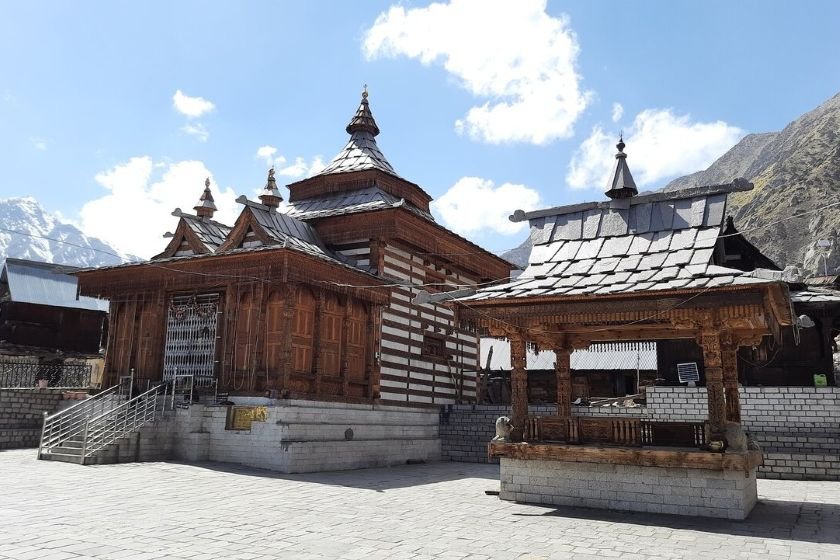
The temple is a striking example of Kath-Kuni architecture — alternating courses of stone and deodar wood, a building technique common across the higher valleys of Himachal and prized for the flexibility it gives structures against earthquakes and heavy snow load. Carved woodwork covers much of the visible timber, including dragon motifs that hint at the cultural overlap between Hindu and Tibetan Buddhist traditions this close to the border.
Inside the sanctum, the goddess isn’t represented by a conventional stone idol but by an ark carved from walnut wood, draped in cloth and adorned with a tuft of yak-tail hair. Two wooden poles are fitted to the ark so it can be carried, palanquin-style, during processions — a detail that speaks to how central movement and procession are to how this deity is honoured, rather than a fixed image simply sat in a shrine. Chitkul’s own three-temple complex — of which this is the most prominent and, by most accounts, the oldest — sits in the physical centre of the village, framed by traditional wooden houses on every side and the Baspa Valley’s peaks rising immediately behind.
📜 A Border Village Shaped by the Bushahr Kings
Chitkul’s history is bound up with the old Bushahr kingdom, whose rulers controlled this stretch of the Sutlej and Baspa valleys for centuries and whose seat at Sarahan and fort at Kamru both surface directly in Mathi Devi’s own migration legend. The temple’s construction is usually placed at around five hundred years old, credited in local tradition to a builder from Garhwal — a detail that lines up with the goddess’s own Garhwal origins in the story. A handful of tourism sites push the temple’s age back far further, to the fifth century BC or even the Mahabharata era; these claims aren’t corroborated by heritage or architectural sources and read more like generic temple lore borrowed from elsewhere than anything specific to Chitkul, so they’re worth treating with real scepticism.
What’s better documented is the region’s more recent history: Kinnaur remained closed to outside visitors for security reasons for decades, only opening to tourism in 1989, which is part of why Chitkul still feels so unusually intact compared to more heavily visited hill destinations.
🎉 Festivals and Devotion
- Phulaich (the Festival of Flowers) — Kinnaur’s best-known autumn celebration, generally falling in the second half of September on the Hindu calendar’s Bhadrapada month, marked by villagers climbing to alpine meadows to gather wildflowers, folk dances, and processions of local deities. It’s celebrated across several Kinnaur villages rather than being unique to Chitkul, but it colours the whole valley, including here.
- Palanquin processions — the walnut-wood ark is carried out on its poles during significant local occasions, accompanied by drums and horns, a practice distinct to how Mathi Devi and the region’s other devtas are honoured.
- Daily worship — the quieter, everyday layer beneath the fairs: morning ablutions, incense, and devotional singing that continue regardless of the tourist season.
🙏 Getting in Touch
There’s no formal booking process, listed phone number, or visitor office attached to the temple — this is a functioning village shrine, not a managed tourist site. If you’re planning a visit, particularly around a festival, your best bet is to ask locally once you reach Sangla or Chitkul itself; homestay owners and shopkeepers generally know the current state of the roads and whether anything is happening at the temple that week.
❓ Quick Questions Travellers Ask
Is Mathi Devi Temple open to non-Hindu visitors? Yes, visitors of any background are generally welcome to view the temple and its surroundings, though access to the innermost sanctum may be restricted, as is common at Kinnauri village shrines.
Do I need a permit to visit Chitkul or the temple? Indian citizens don’t need a special permit for Chitkul itself, though the area just beyond the village, toward the border checkpost, is off-limits to civilians.
Can I visit in winter? Not reliably. The road typically closes under snow from around mid-December to March, and most facilities in the village shut down for the season.
Is there an entry fee for the temple? No entrance fee has been reported for Mathi Devi Temple itself; nearby Kamru Fort, by contrast, does charge a small entry fee.
How much time should I set aside for Chitkul and the temple? Most travellers combine it with Sangla and Rakcham as part of a longer Kinnaur loop; a night in Chitkul is enough for the temple and village, but two nights leaves room for the surrounding walks without rushing.
A Last Word
There’s something quietly moving about a goddess whose defining legend isn’t a single dramatic miracle but an act of division — giving each corner of a valley its own guardian before finally choosing a home for herself at the farthest edge of it. And there’s something equally telling in the fact that, decades later, the people of Chitkul still reach for her name when they talk about the one time their remote, exposed village came under real threat. Whether or not you take that second story literally, it captures something true about what this small wooden temple means to the people who live beside it — not a monument to something finished long ago, but a presence they still expect, if it ever came to it, to show up.
Fact-check note: Core details here — the temple’s Kath-Kuni construction, the walnut-wood ark, the multi-stage arrival legend, and Chitkul’s status as the last village on the old Hindustan-Tibet route — are corroborated across multiple independent sources, including Wikipedia’s entry on Chitkul, heritage documentation from INTACH, and several regional travel guides. The temple’s age is genuinely disputed: most sources converge on roughly 500 years, but a couple of low-quality tourism pages claim a 5th-century-BC or Mahabharata-era origin (one even calling it a Shakti Peeth) without any supporting evidence — these read as generic, copy-pasted temple lore rather than anything specific to Mathi Devi, so they’ve been flagged as unreliable rather than repeated as fact. Precise GPS coordinates, elevation (sources range between roughly 3,450m and figures that appear to be a units error), and any formal temple timings could not be independently verified, so they’ve been left out or noted as approximate. One paragraph describing the deity as worshipped in the form of “three pindis — Maha Kali, Maha Lakshmi, and Maha Saraswati” appears in at least one other source on this subject but does not match Mathi Devi’s confirmed iconography (a single walnut-wood ark) anywhere else in the research — it looks like the same recurring copy-paste error flagged in past corrections on this site, and has been deliberately excluded here. The 1962 landslide story is reported as oral village legend only, with no independent historical corroboration, and is presented as such rather than as verified fact.