Step through the first gate and you’re standing, whether you know it or not, directly above the buried head of a demon king — defeated not by a god’s weapon, but by his own daughter’s dream.
Some temples mark where a god descended. This one marks where a war ended — a war that started, by most tellings, with a young woman falling in love with a face she’d only seen in her sleep. We’ve told pieces of this story before, in the temples of Chandika and Usha Devi further up in Kinnaur, both daughters of the same demon king. Sarahan is where their father’s story finally caught up with him — and where, centuries later, a goddess with three separate faces still watches over the ground where he fell.
🌄 Location & How to Reach It
The temple sits in Sarahan, sometimes called the “Gateway to Kinnaur,” in Shimla district, at an elevation of roughly 2,150 meters. Sarahan carries deep Puranic weight of its own — it’s identified as the ancient Shonitpur, once the capital of the Bushahr kingdom, before the dynasty later moved their seat further down to Rampur.
Google Maps: Get Directions
- By road: Roughly 180 km from Shimla, about a six-hour scenic drive via NH22 through Jeori (11 km before Jhakri, where the road splits toward Sarahan). Buses and taxis run regularly from Shimla and Rampur.
- By rail: No direct line — Shimla is the nearest railway station, itself connected onward to Kalka.
- By air: Jubbarhatti Airport near Shimla is the closest, roughly 180–198 km away depending on source.
This is a comfortable stop by Himachal pilgrimage standards — a proper road the whole way, right at the edge of Sarahan’s own market — though the drive itself, deep into the Sutlej valley, is a serious undertaking in its own right.
🌸 Best Time to Visit
Sources give slightly different daily hours — either a continuous 6:00 AM–7:00 PM, or a split 6:00 AM–12:00 PM and 3:00 PM–9:00 PM — so it’s worth confirming locally, especially since winter hours can shift with weather. April to June and September to November offer the clearest skies and most comfortable travel; winter turns Sarahan into genuine snow country, beautiful but harder to reach. Navratri (both Chaitra and Ashwin) and the three-day Dussehra fair are the temple’s major devotional peaks.
🕉️ The War Over a Dream
Sarahan’s Puranic legend picks up exactly where the stories of Chandika and Usha Devi leave off. Banasura, the demon king who by tradition divided Kinnaur among his many children, ruled this region himself — some accounts calling him great-grandson of Prahlad, others son of the demon king Bali, and a devoted follower of Shiva. When his daughter Usha fell in love, through a dream, with Aniruddha, grandson of Krishna, and had him secretly brought to her by her friend Chitralekha’s magic, Banasura discovered the young man and imprisoned him. That single act of a father’s fury brought Krishna himself to Shonitpur’s gates, backed by Balarama and Pradyumna, against Banasura and his patron Shiva.
The war that followed is remembered specifically at this spot: tradition holds that Banasura’s defeated head was buried directly in front of the temple’s entrance, the ground now marked by a raised platform in the very first courtyard visitors cross on their way in. After his fall, Krishna’s own son Pradyumna is said to have ruled the region, and it was the line that followed who first recognized Bhimakali as the area’s presiding goddess and built her a temple here. It’s a striking detail to sit with — every visitor to this temple walks, quite literally, over the ending of a story that began with someone else’s dream.
🕉️ The Goddess Who Is Three Women at Once
The second story here isn’t about war at all — it’s about how the goddess herself is worshipped, layered rather than singular. On the temple’s top floor, opened for worship only once a year, during Dussehra, sits the golden image of Bhimakali represented as a virgin girl. One floor below, worshipped daily, she’s surrounded by a crowd of attendant deities. Lower still, at the base, sits an image of Parvati, enshrined as Shiva’s consort — a floor kept closed most of the year, opened only when the Bushahr royal family themselves visit. Three ages of the same goddess, stacked vertically, each accessible on its own separate terms. There’s also a secondary, less common legend worth noting honestly: some local tradition holds that Bhimakali’s image emerged from the wooden staff of a sage named Bhimgiri — a quieter, gentler founding story that sits alongside the war legend rather than replacing it.
🙏 What the Goddess Is Known For
As kuldevi — clan goddess — of the Bushahr royal dynasty, Bhimakali has functioned for centuries as far more than a village deity: she’s the spiritual anchor of an entire former kingdom, protected and maintained by the royal family through generations, down to the present-day Bhimakali Temple Trust. Devotees come seeking her protection and blessing much as Kinnaur’s clan goddesses are approached — less for gentle comfort, more for a fierce, binding sense of belonging and guardianship.
🏛️ The Temple Itself
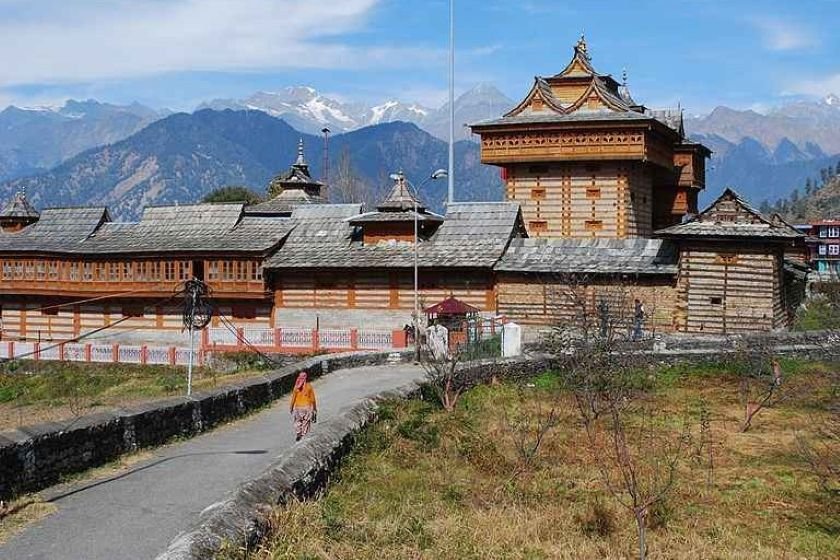
Built in the kath-kuni style — interlocking wood and stone, no mortar — the complex spans roughly an acre across three courtyards, with twin towers, a royal palace, guest quarters, and a scatter of smaller shrines. Four gateways lead progressively deeper in: a gold-plated main entrance, a silver-foiled second gate, a third opening onto the Raghunath temple, and a final stone gate known as Shri Dwar, sealed in slate. The original tower, damaged in the catastrophic 1905 earthquake, famously tilted rather than collapsed and is said to have straightened itself back during a later tremor — locals point to deep foundations and a disused escape tunnel, reportedly connecting to the village of Ranwin a kilometer away, once used by priests and royalty in emergencies. The current main tower was rebuilt in 1943 under Raja Padam Singh. Within the wider complex sit the Narsingha temple in the first courtyard, Raghunath temple in the second, and — more somberly — the Lankravir temple, dedicated to Bhimakali’s guardian deity, where, by most historical accounts, human sacrifice was practiced until the mid-19th century. It’s an uncomfortable piece of the temple’s history, but an honest one, and worth stating plainly rather than glossing over.
📜 A Kingdom Built Around Its Goddess
Sarahan’s whole identity grew up around this temple rather than the other way around — what began roughly 800 years ago as a royal shrine slowly drew a market, a village, and eventually a functioning capital around it, a rare case of sacred architecture generating an entire settlement in its own image. More recently, in 2022, a portion of the temple’s foundation collapsed, prompting the Bhimakali Temple Trust to bring in structural experts from IIT Mandi in 2023 to assess the damage and plan conservation — a reminder that even an 800-year-old fortress of faith needs active, ongoing care to survive the mountains it sits in.
🎉 Festivals and Devotion
- Navratri (Chaitra and Ashwin) — twice-yearly festivals with recitation of the Durga Saptashati
- Dussehra — a three-day fair, including animal sacrifice in Sarahan village and the only day the top-floor sanctum opens
- Rath Yatra — Lord Raghunath’s idol carried in procession to the nearby Padam Palace
- Janmashtami, Maha Shivratri, Budhi Diwali — celebrated with regular devotional fervor
- Udyapan Jag — an extraordinary festival held only once every hundred years or more, among the rarest religious observances in the region
🏞️ While You’re in the Area
- Padam Palace, Rampur — the royal seat connected to Sarahan’s Bushahr history
- Sarahan Pheasantry — home to the endangered Western Tragopan
- Bhaba Valley & Shrikhand Mahadev Trek — for those continuing into more serious high-altitude territory
- Kinner Kailash region — Sarahan’s role as gateway to Kinnaur makes it a natural jumping-off point deeper into the valley
❓ Quick Questions Travellers Ask
What are the temple’s opening hours? Sources vary — either continuous 6 AM–7 PM or a split 6 AM–12 PM and 3–9 PM; confirm locally, especially in winter.
Can visitors see the top-floor sanctum? It opens only once a year, during Dussehra; daily worship takes place one floor below.
Is the human sacrifice history still relevant today? No — it’s understood to have ended by the mid-19th century and has no bearing on the temple’s current, entirely conventional worship practices.
How is this temple connected to Kinnaur’s Chandika and Usha Devi temples? All three trace back to the same Puranic figure, Banasura — Chandika and Usha as his daughters in Kinnaur, and Sarahan as the site of his final defeat.
Is there accommodation near the temple? Yes — Sarahan has government-run guesthouses (including one styled after the temple’s own architecture) alongside private lodging options.
A Last Word
There’s a particular kind of gravity in a temple built on the exact spot where a father’s rage finally caught up with him, and a goddess who still, centuries later, insists on being worshipped as three different women rather than settling for one. Walking in over that quiet raised platform in the first courtyard, it’s worth remembering that every legend we’ve followed through Kinnaur — the sisters who inherited their portions of the valley, the goddess who fell in love in a dream — all of it ends, in some sense, right here.
Fact-check note: Temple opening hours are given inconsistently across sources (continuous 6 AM–7 PM vs. a split morning/evening schedule) and are presented as a discrepancy rather than resolved arbitrarily. Banasura’s genealogy also varies by source (great-grandson of Prahlad vs. son of King Bali) and both are noted rather than picked. No independently verified GPS coordinates were found for this piece, so a search-based Maps link is provided instead of a precise pin — though as a major, well-indexed pilgrimage site, the search link should resolve directly to the temple. The Lankravir human sacrifice history and the 2022 foundation collapse are both independently corroborated (Wikipedia, academic sources) and are reported factually rather than sensationalized. This is the second article the site has published on this temple; the existing piece (“The Shakti Peetha of the Snowbound Kingdom”) centers the Sati’s-ear origin legend and architectural overview — this piece instead leads with the Banasura war legend (connecting to the site’s existing Chandika and Usha Devi pieces) and the temple’s tiered goddess structure, neither developed in the earlier article.