Somewhere on this temple’s eastern wall, in wood carved over a thousand years ago, Vishnu’s ten avatars quietly share space with a shrine that belongs, by every other measure, entirely to Shiva.
Kinnaur’s temples rarely stay inside tidy religious lines, and this one is a particularly good example of why. Sungra Maheshwar is unmistakably a Shiva temple — the name says so outright, Maheshwar being one of Shiva’s own titles — and yet its most celebrated carvings depict someone else’s mythology entirely. It’s the kind of detail that tells you more about how faith actually worked in these valleys than any single legend could: less about strict devotion to one deity, more about honoring the whole current of divinity running through the mountains.
🌄 Location & How to Reach It
The temple sits in Sungra village, within Nichar tehsil of Kinnaur district — the same tehsil that’s home to the Usha Devi temple at Nichar itself, making this part of the valley a small cluster of interconnected shrines rather than isolated stops. Sungra sits along the Sutlej river valley, with the temple’s own legend directly tied to the mountains visible across the water.
Google Maps: Get Directions
- By road: Reached via the Nichar tehsil road network off NH5, in the same general stretch as Nichar and Bhabanagar villages; a hill drive rather than a trek.
- By rail: No direct access — Shimla remains the nearest practical railhead, several hours away.
- By air: Shimla Airport is closest, though most travelers arrive via Chandigarh and drive up through the Sutlej valley.
This is a moderate stop by Kinnaur standards — accessible by road, without the extreme remoteness of the valley’s border-adjacent shrines, but still firmly within genuine mountain-village territory.
🌸 Best Time to Visit
No formal published visiting hours exist for this temple — it functions as a village shrine on local rhythm rather than a managed tourist site. Mahashivratri is the standout date to plan around, when the temple comes alive with night-long bhajans and havans; the monsoon month of Sawan brings special Monday abhishekams as well. As with most of Kinnaur, late spring through autumn offers the most comfortable travel window, with winter snow complicating access.
🕉️ The Boulder That Never Landed
The temple’s most enduring legend is disarmingly physical, for a story about gods: long ago, Sungra Maheshwar was attacked by an assailant of extraordinary, superhuman strength — most local tellings name him as Bhima, the Pandava hero from the Mahabharata, said to have been passing through Kinnaur during the Pandavas’ long exile. From a mountaintop across the Sutlej, Bhima hurled a massive boulder at the temple, aiming to strike the deity directly. Maheshwar simply turned it aside. The boulder still rests near the road not far from the temple today, according to local tradition, its surface home to alpine flowers found nowhere else but the high mountains.
What none of the available sources explain is why Bhima would have attacked a Shiva shrine in the first place — the story is preserved as a pure test of strength and divine protection, without a clear grievance behind it. That’s worth stating honestly rather than inventing a motive: some local legends exist simply to prove a deity’s power survived a serious challenge, and this appears to be one of them.
🙏 What the Deity Is Known For
Sungra Maheshwar is worshipped here as Shiva in his role as cosmic protector, a guardian whose endurance against Bhima’s attack is treated less as ancient trivia and more as an ongoing assurance — a god who has already proven, physically, that this valley is under his protection. Daily worship follows the region’s familiar rhythm of morning and evening aarti, with chanting of Rudram hymns tied specifically to Shiva. As is common across Kinnaur’s devta network, the temple’s protective reputation extends beyond spiritual matters into a broader sense of guardianship over the surrounding villages.
🏛️ The Temple Itself
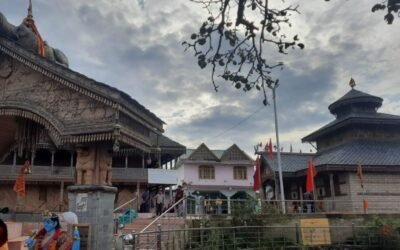
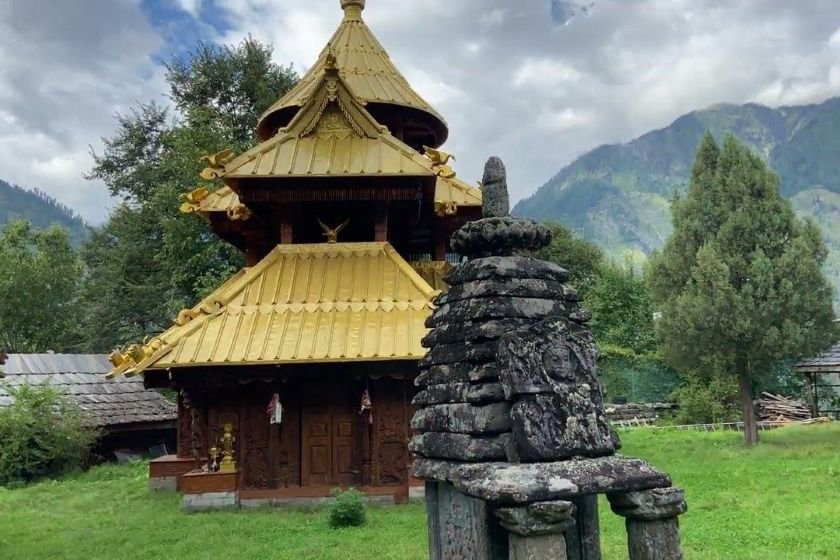
What draws most visitors here first is the woodwork. The temple’s gateway carries superb wood-panel carvings on either side, deeply cut in a style that rewards close, patient looking — the kind of detail easy to walk past and impossible to fully take in on a first pass. On the eastern wall, carvings depict the avatars of Vishnu alongside symbols of the Hindu zodiac, an unusual pairing for a temple otherwise devoted to Shiva, and one that speaks to how fluidly these traditions moved together in old Kinnauri craftsmanship rather than staying in separate lanes. The friezes along the eaves carry their own quiet beauty, and the buildings ringing the temple courtyard are decorated to match. A short distance from the main doorway stands a small stone shrine dating to the 8th century — older and plainer than the wooden temple beside it, and often cited as the clearest physical evidence of just how old this site actually is.
📜 A Family of Shiva Shrines Across the Valley
Sungra Maheshwar isn’t the only Maheshwar temple in this stretch of Kinnaur — a separate shrine to Chagaon Maheshwar, in nearby Chagaon village, appears in local tradition as the brother-god who advised the goddess Chandika on how to finally defeat the demon plaguing Sairag, by striking the life-sustaining beetle above his head rather than his endlessly regenerating skull. Whether Sungra and Chagaon Maheshwar represent the same figure under two village names, or two related but distinct forms of Shiva, isn’t something available sources resolve clearly — but either way, it reinforces the same pattern seen throughout this valley’s mythology: Kinnaur’s deities aren’t solitary figures, but relatives, watching over neighboring villages as an extended family.
🎉 Festivals and Devotion
- Mahashivratri — night-long bhajans, havans, and community feasting
- Sawan Mondays — special abhishekams through the monsoon month sacred to Shiva
- Fulaich (September) — the region’s broader flower festival honoring ancestral spirits, observed alongside neighboring village deities
- Daily worship — morning and evening aarti, incense, and chanting continue outside festival season
🏞️ While You’re in the Area
- Maa Usha Devi Temple, Nichar — a short distance away within the same tehsil, dedicated to a goddess tradition holds is part of the same extended family of Kinnauri deities
- Bhabanagar & Nichar villages — known for orchards and traditional Kinnauri architecture
- Sutlej riverbank viewpoints — for a look across at the mountaintop said to be Bhima’s throwing point
- Kinnaur Kailash region — further up the valley, for travelers continuing deeper into Kinnaur’s high country
❓ Quick Questions Travellers Ask
Why does a Shiva temple have carvings of Vishnu’s avatars? It’s not explained in available sources, but reflects a broader pattern in old Kinnauri temple art of honoring multiple traditions within a single sacred space rather than keeping them strictly separate.
Who attacked the temple in the legend? Most local tellings name Bhima, the Pandava hero, though the story doesn’t explain his motive — it functions mainly as proof of the deity’s protective strength.
Is there an entry fee? No entry fee is documented; it functions as a community village shrine.
Can this be combined with a visit to Usha Devi’s temple? Yes — both sit within Nichar tehsil and are commonly visited together.
What’s the best season to visit? Late spring through autumn, given Kinnaur’s winter snow and access challenges.
A Last Word
There’s something quietly reassuring about a god who didn’t need to strike back to win — Maheshwar simply turned the boulder aside and let it become, over centuries, a bed of mountain flowers instead of a ruin. Standing before carvings that blend Shiva’s own temple with Vishnu’s avatars on the very same wall, it’s hard not to read this place as a lesson in its own right: that protection, done well, doesn’t need to insist on being the only story in the room.
Fact-check note: No source explains why Bhima allegedly attacked this temple, and this piece states that gap honestly rather than inventing a motive. The relationship between Sungra Maheshwar and Chagaon Maheshwar (mentioned in this site’s Chandika Devi piece) is unclear from available sources — presented as an open question rather than resolved. No independently verified GPS coordinates were found, so a search-based Maps link is provided. This is the second article the site has run on this temple; the existing piece (“The Cedar Citadel of Shiva and the Boulder of Bhima”) also centers the Bhima-boulder legend but pairs it with a “three pindis: Maha Kali, Maha Lakshmi, Maha Saraswati” paragraph that appears to be the exact boilerplate error flagged in the site’s own style guide — mismatched here since this temple is dedicated to a male deity, Shiva. That paragraph was deliberately excluded from this piece, and it’s worth removing from the existing article as a correction. This piece instead leads with the Vishnu-avatar carvings on the eastern wall and the Sungra/Chagaon Maheshwar connection, neither developed in the earlier article.