Every year, before Mandi’s week-long International Shivratri Fair can properly start, the town’s presiding deity has to stop here first — a small ritual courtesy that has quietly continued since the temple, and the city around it, were founded together in the same year.
There’s a particular kind of authority that comes not from size or wealth, but from being first — the place everything else has to pass through before it’s allowed to proceed. Bhutnath Temple holds that position in Mandi almost literally: before the town’s famous International Shivratri Fair can begin, the palanquin of Raj Madho Rao — Mandi’s own presiding royal deity — is brought here first, to offer prayers at Bhutnath’s sanctum, before leading the procession of hundreds of hill gods that follows. It’s a small ceremonial detail, but it points to something larger about this temple’s place in Mandi’s identity: according to local tradition, the temple and the town itself were essentially born on the same day, in the same royal decision, at a spot supposedly revealed by a cow that simply wouldn’t stop giving away her milk to an empty patch of forest ground.
🌄 Location & How to Reach It
Bhutnath Temple stands in the heart of Mandi town, Himachal Pradesh, on Bhutnath Street, roughly 950 metres to 1 km from the Mandi bus stand.
Google Maps: Get Directions
- By road: An easy 15-minute walk or short auto-rickshaw ride from Mandi bus stand, right in the town’s main commercial area.
- By rail: Joginder Nagar’s narrow-gauge terminus is the nearest railhead, roughly 50–55 km away, with a substantial onward road journey required.
- By air: Bhuntar Airport near Kullu is the nearest, at approximately 60 km.
Given its central location, this is one of the easiest and most natural first stops on any walking tour of Mandi’s old town temples.
🌸 Best Time to Visit
March through May and October through November generally offer the most comfortable weather for exploring Mandi town. Mahashivratri (February–March) is, without question, the temple’s defining occasion — Bhutnath doesn’t just participate in Mandi’s International Shivratri Mahotsav, it opens it, with the week-long festival’s rituals beginning here before spreading across the rest of the town. The Shravan month also brings special pujas and rituals, and the period from Tararatri through to Shivratri itself sees the temple’s most distinctive ongoing ritual, described below.
🕉️ The Legend: A Cow, a Dream, and a City Born From Both
Bhutnath’s founding legend is also, according to local tradition, the founding legend of Mandi town itself. The story goes that in the early 16th century, the land where Mandi now stands was still dense forest on the far side of the Beas River, used mainly for grazing. A cow belonging to a Brahmin repeatedly wandered to one particular spot and released her milk directly onto the ground there, apparently of her own accord, day after day — a detail unusual enough that word of it eventually reached Raja Ajbar Sen, the ruler of Mandi state. That same night, according to most versions of the story, Shiva appeared to the king in a dream and revealed that a Shivalinga lay buried beneath that exact spot. Ajbar Sen ordered an excavation, and a self-manifested (swayambhu) Shivalinga was discovered exactly where the cow had been drawn. In gratitude, the king had a temple built on the site and shifted his capital there from Bhiuli — the same riverside area, described elsewhere in Mandi’s history, that had served as the old seat of power before this discovery. At least one source offers a variant explanation for the linga’s appearance, describing it as emerging in direct response to a grand yagna performed by the king rather than being a pre-existing, simply hidden object the cow happened to reveal — a subtle but real difference in how the miracle is understood to have unfolded, even though every version agrees on the basic outcome.
The temple’s name carries its own separate layer of legend. Most broadly, “Bhootnath” reflects one of Shiva’s classical epithets — “Lord of Spirits” — tied to his fearsome aspect as the deity who wanders cremation grounds covered in ash, commanding and restraining spirits so they cannot harm the living. A more specific, far less widely repeated local tradition instead credits the name to a sage called Mandav Rishi, said to have performed penance at this exact spot; according to this version, Shiva appeared to the sage accompanied by his ghostly attendants (ganas), and it was Mandav Rishi himself who, moved by that vision, first addressed Shiva as “Bhootnath.” This more specific naming story appears in only a single detailed source and is worth treating as a distinctive local variant rather than the primary explanation, which remains Shiva’s much more widely attested general epithet.
Most sources agree the temple was completed in 1527 CE, though at least one account gives 1526 instead — a minor, single-year discrepancy rather than a substantial dispute, and consistent either way with Ajbar Sen’s broader documented reign, given elsewhere as running from roughly 1499 to 1534.
🙏 What Baba Bhutnath Is Known For
Bhutnath is worshipped here as Shiva in his role as guardian of the spirit realm — fierce, protective, and closely associated with Mandi’s own civic identity rather than functioning as a purely devotional site set apart from the town’s daily life. Devotees visit seeking the general blessings associated with Shiva broadly: prosperity, the fulfilment of sincere wishes, and protection, alongside a strong sense of connection to Mandi’s own founding story.
The temple’s most distinctive ongoing ritual is the Ghritkambal Shringar — a tradition observed nightly from Tararatri through to Shivratri itself, in which butter is applied directly to the Shivalinga and shaped, each night, into a different form or representation of Shiva using butter paste alone. This practice, maintained since the princely era according to multiple independent sources, gives the temple’s most sacred object a visibly changing appearance across the lead-up to its biggest festival — a striking, hands-on devotional tradition distinct from the static idol-worship found at most Shiva temples.
🏛️ The Temple Itself
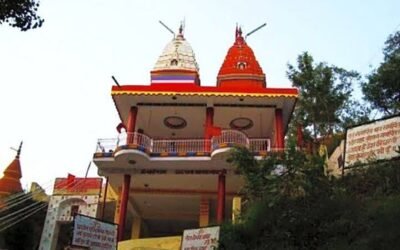
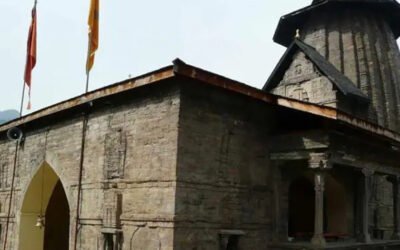
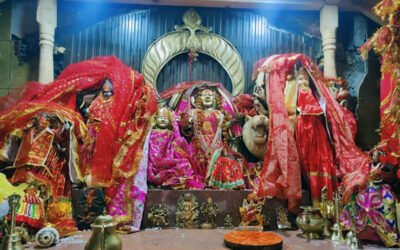
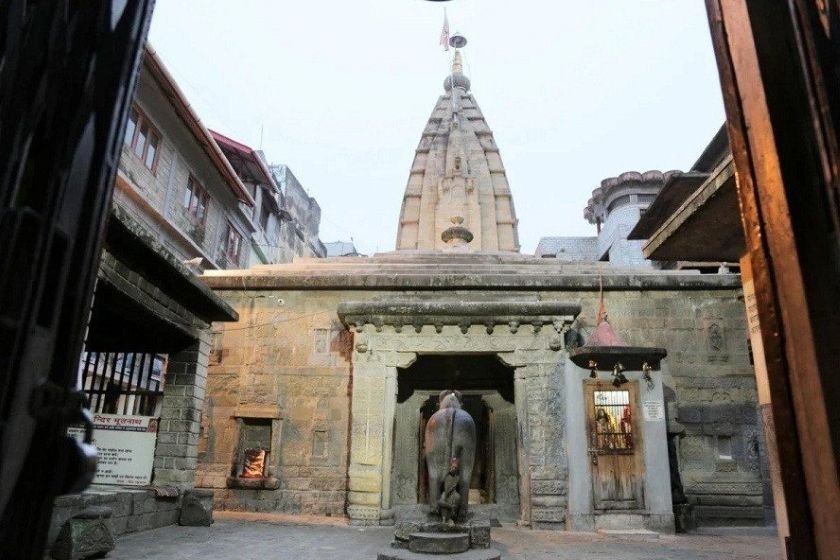
Built in the Shikhara style, Bhutnath’s temple centers on a sanctum housing the Shivalinga, with a brass image of Sheshnaga (the serpent associated with Vishnu, here positioned protectively over the linga) and a brass statue of Parvati installed behind it, alongside a brass Ganapati elsewhere in the temple. Nandi faces the deity from an ornamented, double-arched entrance, and a pinnacle rises above the sanctum in traditional Shikhara fashion. The temple’s assembly hall (mandapa) is raised on pillars, and inside, a havankund (fire pit) serves as the focal point for offerings of sacred ash (vibhuti) as part of regular worship. The complex also preserves a collection of ancient musical instruments and older statuary, offering visitors a small material record of the temple’s long devotional history beyond the architecture itself. In the courtyard, later additions include shrines to Narasimha, Vishnu, Radha-Krishna, and Vaishno Devi — a broadening of the temple’s devotional scope well beyond Shiva alone, layered on over the centuries following the original 16th-century construction.
📜 The Temple That Founded a Town
Bhutnath’s story is inseparable from Mandi’s own civic origin story in a way that sets it apart even from the town’s other old royal temples. Where Triloknath, Panchvaktra, and Tarna Devi each carry their own royal founding narratives, Bhutnath’s is framed consistently, across nearly every source, as the literal spiritual foundation stone of Mandi itself — the discovery that prompted Ajbar Sen to relocate his capital from Bhiuli and clear the surrounding forest to establish the town that exists today. That civic centrality is reinforced every year at Shivratri, when Raj Madho Rao’s palanquin — Mandi’s own presiding royal deity — visits Bhutnath first, offering prayers here before leading the procession of hill deities that opens the week-long International Shivratri Mahotsav, a tradition also observed in a smaller way during Holi, when the same deity is carried to Bhutnath as part of that festival’s own rituals.
🎉 Festivals and Devotion
- Mahashivratri / International Shivratri Mahotsav (February–March): Mandi’s grand, week-long festival begins at Bhutnath, with Raj Madho Rao’s palanquin visiting the temple before the wider procession of hill deities commences.
- Tararatri to Shivratri: The nightly Ghritkambal Shringar tradition, sculpting fresh butter forms of Shiva onto the linga each evening.
- Shravan month: Special pujas and rituals observed through the monsoon month.
- Daily Worship: Regular aarti, generally observed around 10 a.m. and 5 p.m., with the temple open more broadly from early morning into the evening.
🏞️ While You’re in the Area
- Triloknath Temple: A three-faced Shiva shrine on the banks of the Beas, a short walk away.
- Panchvaktra Temple: A five-faced Shiva shrine at the Beas–Suketi confluence, recognised by the ASI as a protected monument.
- Tarna Devi Temple: A hilltop Kali shrine overlooking Mandi town, reached by a climb of over 300 steps.
- Ardhnarishwar Temple: A composite Shiva-Parvati shrine notable for its roofless mandapa.
- Bhima Kali Temple, Bhiuli: On the site of Mandi’s original, pre-Bhutnath capital, before Ajbar Sen relocated the seat of power to the temple’s present location.
❓ Quick Questions Travellers Ask
Is it true this temple marks the founding of Mandi town itself? That’s the consistent local tradition — the temple’s founding and the establishment of Mandi as a city are described together across nearly every source, with the discovery of the Shivalinga prompting Raja Ajbar Sen to relocate his capital here.
What is the Ghritkambal Shringar, and can visitors see it? It’s a nightly ritual, observed from Tararatri through Shivratri, in which butter is shaped into a different form of Shiva on the linga each evening; visitors present during that specific window can witness it as part of the temple’s regular evening worship.
Why does the Shivratri procession start here specifically? Tradition holds that Raj Madho Rao, Mandi’s presiding royal deity, visits Bhutnath to offer prayers before leading the week-long procession of hill deities that follows — a ceremonial acknowledgment of the temple’s founding role in the town’s history.
Is there an entry fee? No — the temple is a public place of worship with no entry fee, according to multiple sources.
How does this temple fit into a wider day exploring Mandi? Very naturally — it’s centrally located and easily combined on foot with Triloknath, Panchvaktra, and Tarna Devi as part of a single day’s temple walk through Mandi’s old town.
A Last Word
There’s something fitting about a town whose biggest annual celebration still, after five centuries, pauses first at the temple that gave the town its name and its reason for existing. Bhutnath doesn’t need to compete for attention with Mandi’s more architecturally elaborate shrines — it simply holds the quiet, structural role of being first: first discovered, first built, and first visited every year before anything else in Mandi’s religious calendar is allowed to properly begin.
Fact-check note: The temple’s 1527 CE (with one source giving 1526) construction under Raja Ajbar Sen, its founding legend involving a cow and a divinely revealed Shivalinga, its role in Mandi’s civic founding and the relocation of the capital from Bhiuli, and its Ghritkambal Shringar butter ritual are well corroborated across independent sources. A secondary naming legend crediting a sage called Mandav Rishi with first calling Shiva “Bhootnath” appears in only one detailed source and is presented as a local variant rather than the primary explanation, which is Shiva’s broader classical epithet as Lord of Spirits. Minor inconsistencies in the exact year (1526 vs. 1527) and in whether the Shivalinga was discovered through the cow’s actions alone or in direct response to a royal yagna are noted above rather than resolved with false certainty. No entry fee applies.