At the very top of Chandpur village, with the Dhauladhar range rising close enough to touch, stands a temple that exists because someone, long ago, dreamed of a goddess and then went looking for her in the trees.
Not every temple legend in Himachal begins with royalty or tragedy. Some begin with something simpler and older — a wandering holy man, a forest, and a dream specific enough to send him searching until he found exactly what it described. Jakhani Mata Temple, perched at the summit of Chandpur village near Palampur, is one of those quieter origin stories, and it comes with an unusual bonus most hilltop shrines can’t claim: the climb up to visit her is, by every account, half the reason people come.
🌄 Location & How to Reach It
- Location: Summit of Chandpur village, Kangra district, Himachal Pradesh
- Distance: Roughly 5 km from Palampur town; about 7 km from the Bundla Mata Temple, a common reference point for the area
- Google Maps: Get Directions
- GPS Coordinates: Not independently verified for this piece — use the map link above, or search “Jakhani Mata Temple, Chandpur” directly on Google Maps for a precise pin before travelling
- Elevation/terrain: The temple sits at the literal highest point of Chandpur village, giving it an unusually commanding, exposed hilltop position even by Himachal standards — this isn’t a gentle roadside shrine but a genuine summit
- By road: A steep but motorable road runs up from Palampur; most visitors drive rather than walk, given how sharp the ascent is
- By trail: A scenic hike through pine forest is a popular alternative to driving for those who are reasonably fit, and a further trek onward from the temple toward Birni is possible for those who want to extend the walk
- By rail: Palampur Railway Station (narrow-gauge Kangra Valley line) is the closer option at roughly 12 km, though Pathankot Junction, around 90 km away, is the nearest broad-gauge station with wider connections
- By air: Gaggal Airport (Dharamshala) is the nearest, roughly 40–45 km away
Compared to the Hamirpur-district temples on flatter ground, this is a genuinely different kind of visit — short in distance but steep in gradient, with the climb itself, whether by car or on foot, forming part of the experience rather than just a means to an end.
🌸 Best Time to Visit
March to June and September to November bring the most comfortable weather for the climb and the clearest views once you’re up there, though the hilltop stays breezy and noticeably cooler than Palampur town below, so a light jacket is worth carrying even in summer. The temple is generally open daily from around 6:00 AM to 8:00 PM, with early morning — roughly 6:00 to 9:00 AM — considered the best window, when sunrise light hits the snow-covered Dhauladhar peaks before the day’s haze sets in. Navratri, celebrated in both spring and autumn, is the liveliest time to visit, bringing devta processions, folk dances, and bhajans that run through the night.
🕉️ The Legend: A Sage’s Dream, and a Mother’s Gratitude
The version of Jakhani Mata’s origin told most often centers on a wandering sage, or a small group of them, moving through the forests around what’s now Chandpur village. According to this account, the goddess Devi Latti Jakhni appeared to the sage in a dream, and following what the dream had shown him, he went searching the forest until he found her idol waiting exactly where he’d been told it would be. Rather than move it elsewhere, he and the surrounding community built the temple on that very spot — a modest origin, more about quiet spiritual discovery than any dramatic confrontation or miracle.
A second, less widely repeated version tells a warmer, more personal story: a mother whose child faced grave danger turned to the goddess in desperation, and her son was saved through what she understood as Jakhani Mata’s direct intervention. In gratitude, and with the support of her local community, she had the temple built on the hill where that divine encounter had taken place. This account carries real emotional weight — a bond between mother and child at its center rather than a sage’s spiritual quest — but it appears in far fewer sources than the forest-dream version, so it’s presented here as a secondary tradition rather than the temple’s dominant origin story.
Both versions agree on the essential shape of things: a supernatural encounter on this specific hilltop, followed by a community choosing to build permanently at the exact spot where it happened, rather than moving the goddess to a more convenient location. Some devotees also describe smaller, ongoing signs of her presence — among them, occasional unexpected clearings in cloud cover during aarti — though this detail appears in isolated sources and is best treated as devotional folklore rather than established local tradition.
🙏 What the Deity Is Known For
Devi Latti Jakhni is worshipped as a local manifestation of Durga, and for many families in and around Chandpur and Palampur, she holds status as kuldevi — a clan or family protector rather than simply a general-purpose pilgrimage deity. Devotees come to her for protection, for wishes made with sincere intent, and for the kind of steady, ongoing blessing that doesn’t require a dramatic occasion to justify a visit. Unlike some of the more elaborately storied Shakti temples of the region, Jakhani Mata’s reputation rests as much on the physical and spiritual weight of her setting — remote, elevated, quiet — as on any single miracle attributed to her.
🏛️ The Temple Itself
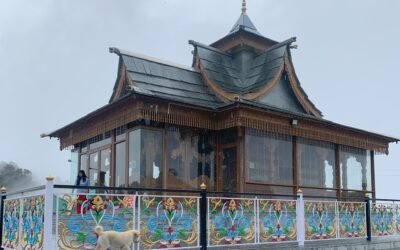
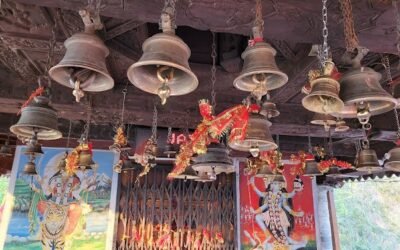
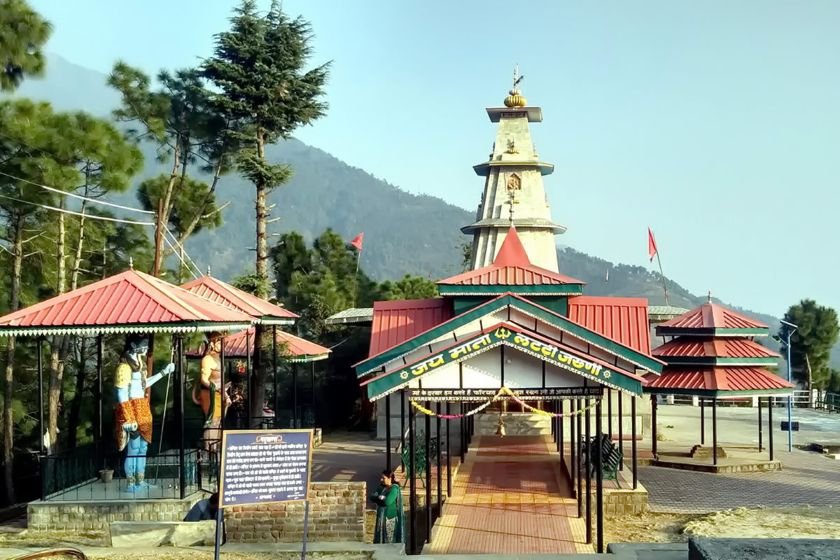
Jakhani Mata Temple is built in traditional Himachali style: sloping slate roofs, wooden beams, and painted mythological murals give it a distinctly regional character rather than the more elaborate stonework seen at larger Shakti shrines. The stone sanctum houses a colorful idol of the goddess, adorned in red and gold, and the temple complex includes smaller shrines to other deities alongside the main sanctum — a common pattern at hilltop temples that accumulate secondary devotional spaces over time.
What sets this temple apart, though, is the courtyard view: a genuinely panoramic sweep across the Dhauladhar range, the Kangra Valley, Palampur’s tea estates, and the scattered rural settlements below. Visitors consistently describe the setting itself — pine forest, isolation, wind, wide-open sky — as inseparable from the devotional experience, and photographers and early-risers make the climb specifically for sunrise views over the snow-covered peaks. It’s a temple where the architecture is modest but the setting does a great deal of the spiritual work.
📜 Regional Context: A Quieter Shrine in a Dense Pilgrimage District
Kangra district is thick with major Shakti temples — Chamunda Devi, Brajeshwari Devi, Jwala Devi, Chintpurni among them — most of which draw pilgrims from across North India and carry centuries of recorded royal patronage. Jakhani Mata Temple sits in a very different register: a hyper-local hilltop shrine without dynastic backing or a documented founding date, valued specifically by the people of Chandpur and Palampur rather than by a wider pilgrimage circuit. That local scale isn’t a limitation so much as the point — this is a temple that exists because a community chose to build and maintain it on a specific hill, not because a king or empire decided it should exist.
🎉 Festivals and Devotion
- Navratri (spring and autumn): The temple’s major devotional occasions, marked by devta processions, folk dances, and night-long bhajans.
- Ashtami and Ram Navami: Special pujas and offerings held on these occasions throughout the year.
- Daily worship: Regular prayer and offerings from local devotees and visiting pilgrims, given the temple’s daily opening hours.
🏞️ While You’re in the Area
- Bundla Mata Temple: About 7 km away, a natural pairing for those already making the climb into this part of Kangra district.
- Palampur Tea Gardens: Roughly 4–5 km away, offering a complete change of pace with rolling green tea estates and Himalayan backdrops.
- Neugal Khad and Bundla Stream: Scenic picnic and walking spots a short drive from the temple.
- Chamunda Devi Temple: A well-known riverside Shaktipeeth around 25 km away, worth combining if you’re touring Kangra’s major Shakti shrines.
- Andretta Artist Village: About 17 km away, a cultural detour centered on pottery and art rather than temples.
❓ Quick Questions Travellers Ask
Is it better to drive or hike up to the temple? Most visitors drive, since the road up is steep and winding; the hike through pine forest is a popular alternative for those who are reasonably fit and want the walk itself as part of the experience, but it’s a genuine climb, not a casual stroll.
Is there an entrance fee? No — the temple is free to enter, though voluntary donations are customary, and a small parking fee may apply near the temple or in Chandpur village during peak periods.
What are the temple’s opening hours? Generally around 6:00 AM to 8:00 PM daily, though one or two sources list slightly earlier opening around 5:00 AM — either way, early morning is considered the best time for views and quieter darshan.
Which origin story is more likely to be the “real” one — the sage’s dream or the mother’s vow? The sage-and-forest-dream version is by far the more widely repeated account and is treated here as the primary tradition; the mother-and-child story appears in far fewer sources and is best understood as a secondary, less-attested variant rather than an equally established alternative.
Can this be combined with other treks or attractions nearby? Yes — a trek from the temple onward to Birni is a known extension for those wanting more walking, and the temple pairs naturally with Palampur’s tea gardens, Neugal Khad, and Bundla Mata Temple for a fuller day in the area.
A Last Word
There’s a particular kind of quiet at Jakhani Mata that comes from earning the view rather than being handed it — the steep road or the forest trail, the wind at the top, the goddess who, depending on which story you believe, was found by a searching sage or called into being by a mother’s fear for her child. Either way, this is a temple that rewards the climb as much as the prayer, and the Dhauladhars looking back at you from the courtyard are, in their own way, as much a part of the devotion as anything inside the sanctum.
Fact-check note: The sage-discovers-idol-in-a-forest-dream origin story is the most widely repeated account across sources and is treated here as the primary tradition. A second account, in which a mother built the temple in gratitude for the goddess saving her child, appears in only one source found during research and is presented as a secondary, less-verified variant rather than an equally established legend. No official founding date, exact GPS coordinates, or priest/contact details could be verified, and none are stated or invented here. Distance and access figures (5 km from Palampur, 7 km from Bundla Mata Temple) and opening hours (approximately 6:00 AM–8:00 PM) are consistent across multiple sources, though minor variations in exact timing exist and are noted rather than resolved.