In Kinnaur, the gods are not distant strangers to each other — they are brothers and sisters who once split a valley between them, and Chandika got the biggest share.
Most hill deities in Himachal arrive alone — a wandering ascetic, a stone that wouldn’t stop bleeding, a girl who vanished into a rock. Chandika Devi’s story is different, and stranger, because she didn’t arrive alone at all. She came as the eldest of eighteen children born to a demon king and a demoness, and when the time came, those siblings didn’t fight over the land — they parceled it out, village by village, peak by peak, until nearly every ridge in Kinnaur answered to one god or another from the same family. Chandika, ambitious even by divine standards, didn’t take a ridge. She took the heart of the valley itself, and the temple that holds her today, in the quiet village of Kothi near Kalpa, still carries the memory of exactly how she earned it.
🌄 Location & How to Reach It
Kothi is a small, old settlement — locally also called Koshtampi — sitting just below the better-known village of Kalpa in Kinnaur district, on the same slope of the Sutlej valley that looks straight across at the Kinner Kailash massif. It’s the kind of place you pass through rather than seek out on a map: a cluster of slate-roofed houses and apple orchards roughly 3 kilometres from Reckong Peo, the district headquarters, and just a couple of kilometres below Kalpa itself.
Google Maps: Get Directions
GPS Coordinates: no independently verified pin exists for the temple itself; Kalpa village, immediately above Kothi, sits at approximately 31.53°N, 78.25°E and is a reliable nearby reference point.
Elevation: Reckong Peo sits at about 2,670 metres; Kalpa’s elevation is variously given as 2,759 to 2,960 metres depending on the source — Kothi, between the two, falls somewhere in that band.
- By road: Regular buses and taxis run between Reckong Peo and Kalpa via NH-5 (the old Hindustan-Tibet Road), and Kothi is a short local hop off this route — most visitors combine it with a Kalpa or Reckong Peo stay rather than travelling for it alone.
- By rail: The nearest railhead is Shimla, itself around 220–235 km away by road, so onward travel is entirely by road regardless of how you arrive.
- By air: Shimla Airport (Jubbarhatti) is the nearest, roughly 220–235 km away and thinly connected; most travellers fly into Chandigarh and drive from there.
This isn’t a temple that demands a trek or a permit — it’s a short, easy detour for anyone already making the long drive up to Kalpa, nothing like the effort required for Kinnaur’s more remote shrines further up the valley.
🌸 Best Time to Visit
Kinnaur’s short summer, June to September, is when the roads are clearest and the temple’s own festival calendar is at its busiest. Winters here are long and hard — October through May — and while the temple itself isn’t seasonally shut the way high-altitude trekking shrines are, travel becomes considerably harder once snow sets into the region. If your visit can coincide with the Koshme-Shukud fair in July, when the goddess’s palanquin is carried from Kothi to Kalpa village itself, you’ll see the temple doing what it was actually built for, rather than standing quiet for a photo.
🕉️ The Family That Split a Valley
Local Kinnauri oral tradition — preserved partly in old folk songs still sung in villages like Sungra — tells of the demon king Banasura and his forced marriage to a demoness named Hirma at a place called Molotdhar. Their union produced eighteen children, and this is where the story becomes distinctly Kinnauri rather than a stock Puranic tale: those eighteen sons and daughters didn’t remain a single unruly household. They fanned out across the region, and in village after village, one of Banasura’s children became the presiding devi or devta — Chagaon Maheshwar in one settlement, Mathi Devi guarding Chitkul at the valley’s far end, and others besides. Chandika, the eldest, took Sairag, the historic name for the fertile stretch of land at Kinnaur’s core — not a peripheral outpost, but the heart of the whole territory.
That inheritance wasn’t handed to her quietly, though.
📜 The Beetle That Ended a War
According to the temple’s own oral history, Chandika’s claim on Sairag wasn’t secure until she’d dealt with a demon who ruled the area under the protection of the local Thakur of Chini. With help from a trickster figure named Byche, the demon was lured into trapping his own long hair between the grinding stones of a water mill — but even pinned, he proved impossible to kill outright. Every time Chandika’s sword took his head, another grew back, laughing at her, until she stood exhausted in what the old telling describes as a rising sea of blood. She finally called on her brothers for help. It was Chagaon Maheshwar who told her the demon’s real weakness: a small beetle hovering above his head that was somehow sustaining his life. Kill the beetle, he said, and the heads would stop returning. She did, and the demon finally died — a small, almost throwaway detail (a beetle, not a weapon or a boon) doing what brute force alone couldn’t. It’s worth saying plainly: this is oral legend, not verified history, though its persistence across generations of retelling says something about how deeply it’s woven into local identity.
🙏 What the Goddess Is Known For
Chandika is worshipped today as a kuldevi — a clan goddess — for many Kinnauri families, and her reputation leans less toward the gentle, wish-granting end of the goddess spectrum and more toward justice. Disputes in the area were traditionally brought before her; local gurs (oracles) still go into trance during her festivals to interpret her judgments and wishes. She’s also spoken of, only half-jokingly by some accounts, as one of the wealthier deities in the region — her temple holds gold and silver offerings accumulated over generations from devotees seeking her protection or a favourable ruling in some long-running family or land dispute.
🏛️ The Temple Itself
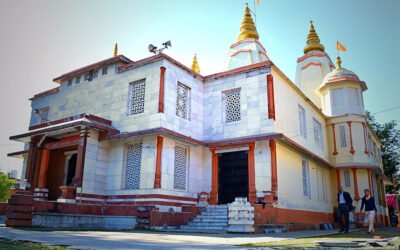
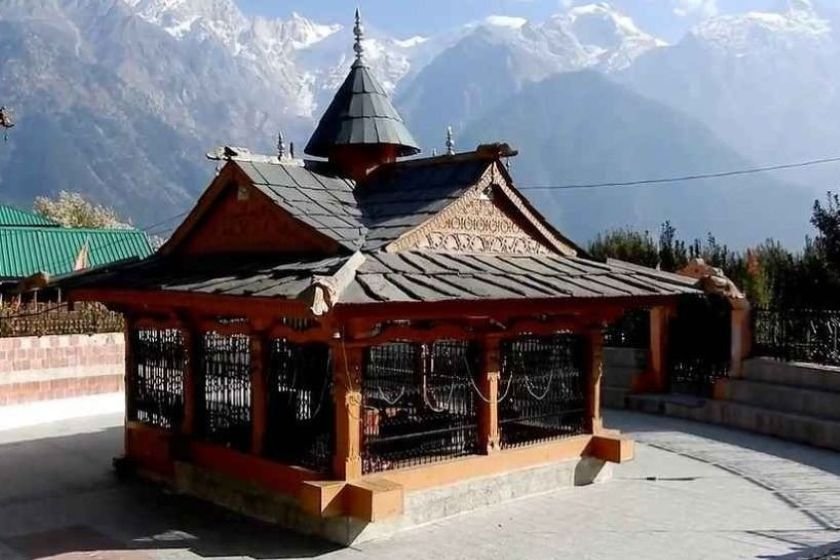
The temple at Kothi is often described locally as older than Reckong Peo itself — a claim impossible to verify precisely but consistent with how old the settlement predates the modern district headquarters nearby. Physically, it’s built around two peaked towers of wood and stone, one visibly older than the other; the newer tower houses a number of images wrapped in unusual coverings that, oddly, resemble tall fur caps rather than any typical temple ornamentation. Inside, a golden image of the goddess is kept seated in an ark — a palanquin-like structure — which four bearers lift and rock rhythmically during worship, rather than carrying it still. The overall style blends the timber-and-slate vocabulary common across Kinnaur with the Tibetan Buddhist influence that runs through the whole valley, a reminder that in this part of Himachal, Hindu and Buddhist practice have coexisted in the same architecture, sometimes the same temple, for centuries.
🎉 Festivals and Devotion
Chandika’s calendar runs through most of the year rather than peaking at a single big fair:
- Sazo (January): marks the devi/devta’s symbolic departure to Indralok, with palanquins ceremonially opened
- Faguli (March): honours the region’s hilltop goddesses more broadly, with week-long rituals across Kinnaur
- Koshme-Shukud (July): the most direct expression of Chandika’s own presence — her palanquin is carried in procession from Kothi to Kalpa village
- Fulaich (roughly September): the region-wide flower festival honouring ancestral spirits, in which Kothi’s temple takes part along with others
- Navratri and Dussehra: marked with devta processions, folk dance, and community feasting, as at most Devi shrines in the hills
Beyond the calendar, Chandika’s institution has a modern, almost civic footprint too: during the 2020 pandemic, the Devi Chandika temple committee at Kothi contributed roughly ₹51,000 to Himachal Pradesh’s COVID relief fund — a small but telling sign that these village deity institutions still function as real community bodies, not just objects of ritual.
🏞️ While You’re in the Area
- Kalpa village: a few minutes above Kothi, with classic Kinnauri wooden architecture and the region’s best straight-on views of Kinner Kailash
- Narayan-Nagini Temple, Kalpa: a Vishnu-Nagini shrine known for its craftsmanship and views
- Suicide Point, Roghi: a dramatic cliff-edge viewpoint a short drive from Kalpa
- Brelengi Gompa, Reckong Peo: a Buddhist monastery built for the Dalai Lama’s 1992 Kalachakra visit, home to a large standing Buddha
- Reckong Peo’s bazaar: for Kinnauri woollens, handmade topis, and chilgoza (pine nuts) — worth an hour even if temples aren’t the draw
🙏 Getting in Touch
There’s no publicly listed booking process, priest contact, or visiting-hours number for this temple — it functions as a living clan shrine managed by the village and temple committee rather than a tourist-facing institution. If you’re planning a visit around a specific festival date, your best bet is asking locally in Reckong Peo or Kalpa, where hotel staff and taxi drivers are generally well informed about the temple’s calendar.
❓ Quick Questions Travellers Ask
Is Chandika Devi Temple open to non-Kinnauri visitors? Yes — it’s a working village temple, not a restricted or exclusively clan-only shrine, and visitors are generally welcome to view the sanctum and grounds respectfully.
How far is Kothi from Kalpa or Reckong Peo? It’s roughly 3 km from Reckong Peo and about 1–2 km below Kalpa — an easy short trip by taxi or on foot if you’re already staying in either place.
Is there an entry fee? No fee is documented anywhere; like most Kinnauri village temples, it operates on customary offerings rather than ticketed entry.
What’s the best festival to time a visit around? The Koshme-Shukud fair in July gives you the clearest look at the temple in active use, with the goddess’s palanquin carried between Kothi and Kalpa.
Can I combine this with a Spiti Valley trip? Yes — Reckong Peo, right next door, is where travellers stop for Inner Line Permits before continuing north toward Nako, Tabo, and Kaza.
A Last Word
There’s something quietly different about a goddess whose founding story isn’t really about her alone, but about a family working out, sibling by sibling, who gets which mountain. Chandika didn’t inherit the easiest patch of ground in that division — Sairag had to be fought for, and even then, won by outsmarting a demon rather than simply overpowering him. Stand at Kothi today, with the ark resting inside its old wooden tower and Kinner Kailash visible across the valley, and it’s worth remembering that this is one node in a much larger, still-living network of siblings scattered across Kinnaur’s villages — and that whatever these hills believe about justice, they seem to have decided long ago that it starts, quite literally, at home.
Fact-check note: Cross-checked across the district government tourism site, Wikipedia’s Kalpa entry, Lonely Planet, and an academic paper on Kinnaur’s devi-devta institutions (which supplied the Sazo/Faguli/Koshme-Shukud festival calendar and the folk-song material on Banasura and Hirma — not otherwise available on tourism sites). Deliberately omitted the “three pindis — Maha Kali, Maha Lakshmi, Maha Saraswati” line that appears in the existing site article on this same temple; that framing belongs to a Tridevi-style Kali shrine and doesn’t match Chandika’s actual lineage as Banasura’s daughter, so it’s been left out here rather than carried forward. No independently verified GPS pin exists for the temple itself, so Kalpa village’s coordinates are given as a nearby reference only, clearly flagged as such. Elevation figures for Kalpa (2,759 m vs. 2,960 m) and distances from Shimla to Reckong Peo (220–267 km depending on source) conflict across sources and are presented as ranges rather than picked arbitrarily. No priest name, phone number, or formal visiting hours could be verified anywhere, so the Getting in Touch section says so directly rather than inventing them.