Two tiger statues guard a temple in Kalpa dedicated to Vishnu and a serpent goddess — and tigers, in this part of the world, belong to somebody else entirely.
Temples rarely announce their own history honestly. Names get updated, deities get swapped in and out as communities change, and old symbols get left behind simply because nobody thought to remove them. The Narayan-Nagini Temple in Kalpa, one of Kinnaur’s most-photographed wooden shrines, is a good example of exactly this kind of quiet layering. On paper, it’s a temple to Lord Narayan and the serpent goddess Nagini — a tidy pairing of divine order and primal nature. But carved into its entrance are two tiger statues, and in Kinnaur, tigers are not Vishnu’s symbol or the serpent goddess’s. They belong to a fiercer, older goddess entirely, and their presence here raises a question the temple’s current name doesn’t answer.
🌄 Location & How to Reach It
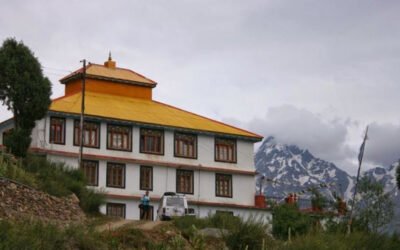
The temple sits on a hill at the center of Kalpa, in what was historically known as Chini village (the same “Chini” that gave the old British-era tehsil its name), a short and pleasant walk from the Hu-Bu-Lan-Kar Gompa — an ancient Buddhist monastery said to have been founded around the 11th century by the translator-monk Rinchen Zangpo. Kalpa itself sits above Reckong Peo, Kinnaur’s district headquarters, on the old Hindustan-Tibet Road.
Google Maps: Get Directions
GPS Coordinates: no independently verified pin exists for the temple itself; Kalpa village is documented at approximately 31.53°N, 78.25°E and serves as a reliable nearby reference.
Elevation: Kalpa’s elevation is recorded anywhere from 2,759 to 2,960 metres depending on the source, with one estimate placing the temple itself closer to 3,000 metres (around 10,000 feet) — treat this as an approximate band rather than an exact figure.
- By road: Kalpa is well connected to Reckong Peo (about 7 km away) by regular taxis and buses along NH-5; the temple itself is a short walk once you’re in the village.
- By rail: The nearest railhead is Shimla, roughly 220–235 km away, meaning the rest of the journey is by road regardless of how you arrive.
- By air: Shimla Airport is the closest, at a similar distance; most travellers fly into Chandigarh instead and drive up.
Like its neighbour Chandika Devi Temple in nearby Kothi, this is an easy stop rather than a demanding trek — the kind of place you fold into a Kalpa evening walk, not a destination requiring its own expedition.
🌸 Best Time to Visit
June through September gives you the clearest roads and the mildest weather for exploring Kalpa on foot. Winters here run long, from October to May, with regular snowfall and hard cold that make travel considerably tougher, though the temple itself isn’t seasonally closed. Visitors should also know going in that the inner sanctum is generally not open to non-worshippers — you can view the courtyard, the carvings, and the exterior structure freely, but entry into the garbhagriha itself is restricted, a detail several visitors have noted only after arriving.
🕉️ The Temple’s Current Story: Vishnu and the Serpent Goddess
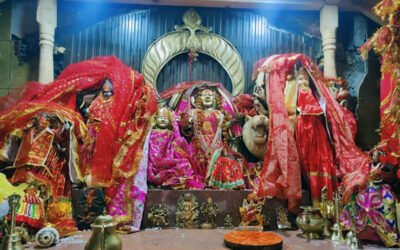
As it stands today, the temple is dedicated to Lord Narayan — a form of Vishnu, preserver of cosmic order — alongside Nagini Devi, a serpent goddess associated with fertility, rainfall, and protection from harm. Local telling holds that Narayan descended to help the people of the region through a period of hardship, and that Nagini joined him in guarding the valley and holding its balance in place. It’s a clean, symbolically neat legend — divine order and primal nature working in partnership — and it’s the story most visitors and guides will repeat today.
📜 The Older Story the Tigers Seem to Tell
But look at the entrance itself, and the story gets more complicated. The two tiger figures flanking the temple’s threshold are a recognisable emblem of Chandika, the fierce form of Durga worshipped a short distance away in Kothi — not of Vishnu or a serpent goddess, who have no traditional association with tigers at all. Some local accounts go further, holding that this hilltop shrine in Kalpa was originally Chandika’s own main seat before her worship, over generations, gave way to the current Narayan-Nagini dedication. It’s an honest, unresolved thread rather than a settled fact — nobody has produced a documented date for when or why the shift might have happened, and it may simply be that both traditions have coexisted here for so long that their symbols blurred together. But the tigers are real, carved and standing at the door, and they’re not nothing.
🙏 What the Temple Is Known For
Devotees visit for blessings tied to protection, fertility, and household harmony — offerings of red flags, coconuts, and sweets are typical here, as at most Kinnauri shrines. As with many village temples in the district, disputes and personal dilemmas are sometimes brought before the deities through local oracles known as mali or gur, whose trance-pronouncements carry real weight in community decision-making, not just ceremonial ones.
🏛️ The Temple Itself
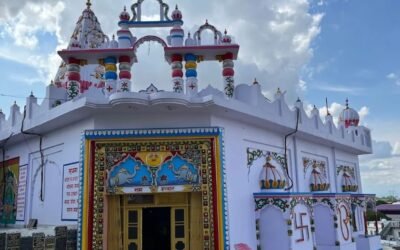
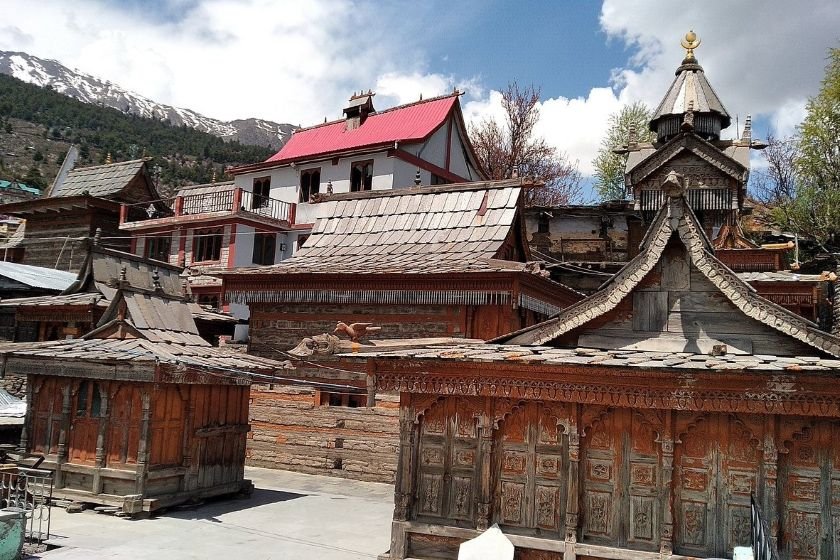
The Narayan-Nagini complex is built using the traditional Kath-Kuni technique — alternating layers of timber and dry stone, locked together without mortar, a method prized across the western Himalaya for flexing rather than cracking during earthquakes. Visitors describe two temples standing side by side on the same platform, their multi-tiered, pagoda-style roofs a clear sign of the Tibetan Buddhist influence running through Kinnauri architecture generally. The wooden beams are worked with dragon carvings, a motif tied to wisdom and strength in the region’s shared Hindu-Buddhist visual language, alongside serpent motifs that nod more directly to Nagini herself. Brass doors at the entrance are etched with images of the temple’s deities, and the whole structure looks out over one of the best unobstructed views of the Kinnaur Kailash range available anywhere in the village.
🎉 Festivals and Devotion
- Fulaich (around September): the region-wide flower festival honouring ancestral spirits, observed here as at most Kinnauri temples
- Navratri: marked with special pujas, offerings, and community feasting
- Daily worship: morning and evening aartis, incense, and recitation of hymns to both Vishnu and the goddess — a quieter, everyday rhythm alongside the bigger annual events
- Visitors have also noted night-time festival music audible from nearby homestays even when the temple itself was closed to outsiders during the observance — a reminder that these events are lived practice, not staged for tourists
🏞️ While You’re in the Area
- Hu-Bu-Lan-Kar Gompa: an ancient monastery just a short walk away, among the oldest Buddhist sites in the district
- Chandika Devi Temple, Kothi: a short drive below Kalpa, and worth visiting together given the tiger-emblem connection between the two sites
- Suicide Point, Roghi: a dramatic cliffside viewpoint nearby
- Kinnaur Kailash Viewpoint: for the clearest view of the sacred Shivling rock face
- Reckong Peo market: for Kinnauri woollens, topis, and chilgoza pine nuts
🙏 Getting in Touch
There’s no formal visiting-hours schedule, priest contact, or booking process documented for this temple, and as noted above, the inner sanctum isn’t generally open to non-worshippers regardless of timing. If you’re hoping to catch a festival or understand what’s accessible on a given day, ask locally in Kalpa or Reckong Peo — homestay hosts and local guides are typically well informed.
❓ Quick Questions Travellers Ask
Can visitors go inside the Narayan-Nagini Temple? The courtyard and exterior are open to view, but the main sanctum is generally restricted to worshippers — most visitors experience the temple from outside rather than entering the garbhagriha.
How far is the temple from Hu-Bu-Lan-Kar Gompa? It’s a short walk, well under ten minutes, making the two easy to combine on the same short outing through Kalpa.
Is the temple really 5,000 years old? That figure circulates in local lore and ties the site to Mahabharata-era mythology, but it isn’t independently verifiable; other estimates place it at anywhere from a century old to over a thousand years, so treat the age as genuinely unsettled.
Is there an entry fee? No fee is documented; like most Kinnauri village temples, it runs on customary offerings rather than ticketed entry.
What’s the connection to Chandika Devi Temple in Kothi? The tiger statues at the entrance here are a traditional Chandika emblem, leading some locals to believe this hill may once have been her primary seat before the site’s dedication shifted — an interesting, unresolved thread rather than settled history.
A Last Word
Most temple stories move in one direction — a deity arrives, a shrine is built, the story sets. Narayan-Nagini feels less settled than that, and more honest for it. Whatever actually happened on this hill generations ago, the tigers at the door are still there, quietly contradicting the tidy version of events told to visitors today. Standing on that threshold, with Kinnaur Kailash catching the light across the valley, it’s worth remembering that even a temple’s identity can be layered — one dedication resting quietly on top of another, both still present if you know to look.
Fact-check note: Cross-checked across Tripadvisor visitor accounts, Wikipedia’s Kalpa entry, and independent travel/heritage sites, alongside the existing site article on this same temple. Two errors from that existing article were deliberately not carried forward here: the “three pindis — Maha Kali, Maha Lakshmi, Maha Saraswati” line (a Tridevi/Kali-shrine template that doesn’t fit a Vishnu-Nagini dedication), and the “stone carried by bees” Jagatipatt legend, which on checking belongs to a distinct, separately documented temple — the Jagatipatt Temple inside Naggar Castle, Kullu district — and was mistakenly applied to this temple instead. The temple’s age is disputed across sources by orders of magnitude (from “century-old” to “5,000 years old, tied to the Mahabharata”) and is presented here as unsettled rather than picked arbitrarily. The claim that this site was originally a Chandika Devi shrine is based on the tiger-statue iconography noted by an independent travel writer, not on any documented historical record, and is flagged in the text as an unresolved local theory rather than fact. No independently verified GPS pin, priest contact, or formal visiting hours exist for this temple, so those gaps are stated directly rather than invented.