A stone slab, a swarm of bees, and a valley that still believes its deities gather here when trouble comes
Most temples ask you to believe in a god. Jagatipatt asks something stranger: that an entire valley’s worth of gods once agreed to hold their meetings here, and some believers say they still do. Tucked into a corner of Naggar Castle’s upper courtyard, this is easily the smallest and least conventional sacred site in a village otherwise known for its grander temples — and yet locals will tell you, quite matter-of-factly, that this modest wooden shrine outranks all of them in one particular way: it’s where the Kullu Valley’s deities settle their disputes.
There’s no idol here in the usual sense. No painted murti, no ornate bronze figure. Just a large stone slab, set behind a carved wooden lattice, that the valley’s oral tradition insists was never quarried by human hands at all.
🌄 Location & How to Reach It
- Location: Inside Naggar Castle, Naggar, Kullu District, Himachal Pradesh – 175130
- GPS Coordinates: 32.1122° N, 77.1645° E
- Google Maps: Get Directions
- Altitude: Roughly 1,800 metres
- Distance: About 23 km from Kullu town, 21 km from Manali, and a short walk from the Naggar bus stand
Naggar itself sits on well-paved roads, connected by regular buses and taxis from both Kullu and Manali. Once you’re in the village, the castle — and the temple within it — is an easy five-minute walk uphill from the main bazaar, following the same cobbled lane most visitors take to reach the Roerich Gallery. The nearest airport is Bhuntar (~35 km), and the nearest railheads are Joginder Nagar (~125 km) or Pathankot (~270 km), both a considerable journey away — this is very much hill-station territory rather than anywhere near a train line.
Because Jagatipatt sits inside the castle complex, entry is bundled with the castle’s own ticket — a nominal fee (around ₹50 for Indian nationals, per current visitor reports) that gets you into the grounds where several small shrines, including this one, are found.
🌸 Best Time to Visit
Naggar is comfortable for most of the year, but each season changes the experience. March through June brings mild weather and blooming orchards on the surrounding hillsides, making it easy to combine a temple visit with a longer walk around the village. September to November offers the clearest mountain air and views, without the risk of monsoon rain making the cobbled lanes slippery. If you enjoy snow, winter transforms Naggar into something close to a postcard, though a few roads can get icy — worth checking conditions before you set out in January or February.
Temple timings: Generally open 8:00 AM to 6:00 PM, though several visitors report the inner sanctum itself being locked outside of specific hours or ritual occasions, even when the castle grounds are open. If seeing inside the sanctum matters to you, it’s worth asking locally, or timing your visit around mid-morning when caretakers are more likely to be present.
🕉️ What’s Actually Inside
The object at the centre of Jagatipatt is a stone slab — sources describe it as roughly 5 feet by 8 feet, with reported thickness ranging from 6 inches to 6 feet depending on the account, which suggests some confusion in how it’s been measured and recorded over the years rather than a single settled figure. It sits inside a small, closed sanctum, visible mostly through a carved wooden lattice rather than up close, which only adds to the sense of quiet mystery around the place.
According to the valley’s oral tradition, this slab wasn’t carried here by anyone. Long ago, when the gods of the Kullu Valley wanted a single place to anchor their collective authority, they are said to have taken the form of a swarm of bees — strong enough, in that form, to cut a slab clean from a Himalayan peak and fly it here to Naggar. Which peak exactly depends on who’s telling the story: some accounts point to Deo Tibba, the tallest peak in Kullu district; others specify a particular outcrop on Bhrigu Tung, near Bahang village, sometimes named locally as “Dram-Dhog” or “Drag Dhank.” Rather than pick one version and present it as settled history, it’s worth knowing both circulate, and neither has a clear claim to being the “correct” one — this is oral legend, not archaeology, and that’s part of its character.
What the slab represents matters more than where it came from. It’s treated as a seat of collective divine authority — not one god’s shrine, but a kind of meeting point for all of them. Local tradition holds that the Atharah Kardu, the eighteen principal deities of the Kullu Valley, convene here through their gurs — the human mediums through whom Himachal’s local devtas are traditionally believed to speak — particularly in moments of crisis: earthquakes, floods, disputes that need resolving, or major decisions affecting the wider valley. It’s a strikingly democratic idea for a religious tradition — a divine parliament rather than a single ruling deity — and it reflects how deeply the concept of the devta system, with its many local gods each carrying real social authority, runs through Kullu life even today.
Devotees visiting on ordinary days bring simpler offerings — red flags, coconuts, sweets — and the temple carries a particular reputation locally for helping childless couples and those seeking resolution to disputes or injustices, though as with most such traditions, this is a matter of local faith rather than anything that can be independently verified.
🏛️ A Small Temple With Serious Craftsmanship
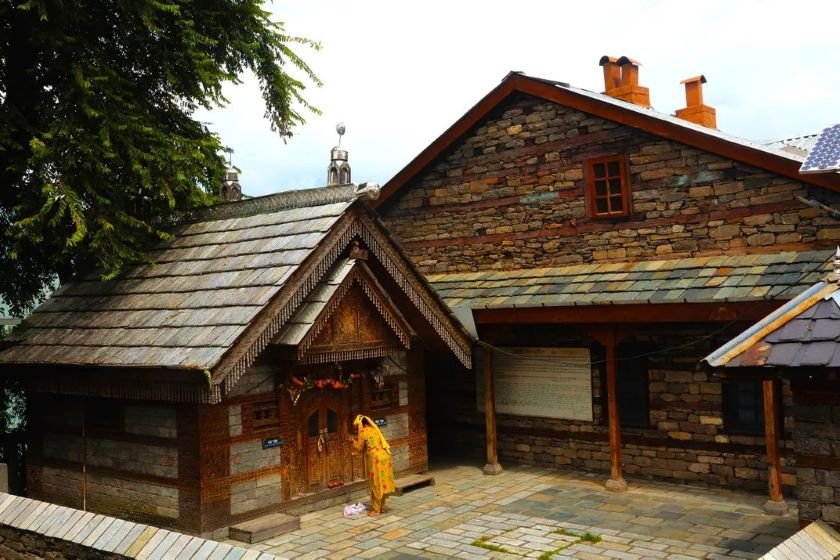
Architecturally, Jagatipatt is unassuming from a distance — a modest wooden structure with a distinctive triangular roofline, set within the castle’s stone-walled upper courtyard. Look closer, though, and the woodwork is genuinely fine: the doors and beams carry detailed carving in flowing, traditional Himachali motifs, and the ceiling panels show the same craftsmanship tradition found across Kullu’s older wooden temples — closely related to the carving style you’ll see at nearby Tripura Sundari, though on a much smaller scale here.
The temple’s setting inside Naggar Castle adds a layer most visitors don’t immediately clock: this wasn’t just a village shrine. Naggar served as the capital of the old Kullu kingdom for well over a millennium before the seat of power shifted to Sultanpur, near modern Kullu town, under Raja Jagat Singh around 1460 CE. That means Jagatipatt sat, quite literally, inside the seat of political power in the valley for most of its history — and the ruling family is recorded as having consulted the temple’s divine council before major undertakings, blurring the line between spiritual authority and royal governance in a way that’s rare to see so physically preserved. Older accounts of the castle also mention that animal sacrifice was historically practiced in front of this temple, a custom that, like many across the region, is no longer part of contemporary worship here.
📜 A Signal Fire for Diwali
One detail that rarely makes it into shorter write-ups: this small temple is said to have played a specific ceremonial role in Kullu’s own version of Diwali, known locally as Koli-ri-Diali. According to regional accounts, it was from Jagatipatt that the signal was traditionally given to mark the start of these celebrations — a small but telling sign of how central this modest shrine once was to the rhythm of civic and religious life in the old capital, not merely a curiosity tucked inside a castle wall.
🎉 Festivals and Ritual Life
- Sharhi Jatra and Dussehra: Jagatipatt plays a symbolic role during these major valley-wide festivals, tied to its identity as a meeting point for the region’s deities.
- Emergency and crisis rituals: Unlike temples with a fixed festival calendar, some of Jagatipatt’s most significant moments are unscheduled — convened, according to tradition, in response to natural disasters or serious local disputes requiring divine consensus.
- Daily worship: Flowers, incense, and quiet devotional offerings continue from local priests and visiting villagers, independent of any larger event.
🏞️ While You’re in the Area
- Naggar Castle: The temple’s own setting — a genuinely striking 15th-century Kathkuni fort, now partly a heritage hotel and museum, worth exploring in its own right.
- Tripura Sundari Temple: A short uphill walk away, one of Naggar’s principal goddess shrines, built in the same wooden pagoda tradition.
- Murlidhar Krishna Temple: Naggar’s oldest surviving shrine, on a ridge above the village, standing on ground even older than Naggar itself.
- Gauri Shankar Temple: A Shiva temple near the castle bazaar, known for its stone carving.
- Nicholas Roerich Art Gallery: The former home and studio of the Russian painter, within easy walking distance.
🙏 Getting in Touch
There’s no independent phone number or contact listed for Jagatipatt Temple specifically — it operates as part of the wider Naggar Castle complex, which is managed as a heritage property (now partly run as a hotel). If you want to confirm whether the sanctum will be open on the day you visit, your best options are checking with the Naggar Castle reception directly, or asking locally in the village, since several visitors report the sanctum being locked even during general opening hours.
❓ Quick Questions Travellers Ask
Is there an entry fee? Yes, indirectly — since the temple sits inside Naggar Castle, you’ll typically pay the castle’s standard entry fee (reported at around ₹50 for Indian nationals; rates for foreign visitors and any recent changes are worth confirming locally) to access the grounds.
Will I actually get to see the stone slab up close? Not always. The inner sanctum is frequently kept locked, and many visitors report only being able to view the slab through the carved wooden lattice from outside. A few report getting lucky when a caretaker happened to be present. Don’t count on a close-up view, but do enjoy the woodwork either way.
How long does a visit take? The temple itself takes only a few minutes to see, but most visitors pair it with a broader visit to Naggar Castle, which comfortably fills 45 minutes to an hour.
Is this a goddess temple? No — this is a common point of confusion. Jagatipatt isn’t dedicated to a specific goddess; it centres on a sacred stone slab representing the collective authority of the Kullu Valley’s many local deities, not any single deity in particular.
Can I combine this with other Naggar sights in one visit? Very easily. Naggar Castle, Jagatipatt, Tripura Sundari, Gauri Shankar Temple, and the Roerich Gallery are all within a comfortable walk of each other and can realistically be covered in half a day.
A Last Word
Naggar has no shortage of temples with grander stories — gods who slay demons, goddesses who protect entire valleys. Jagatipatt’s legend is quieter, but in its own way stranger: not a temple built to honour one deity’s power, but a place where the valley’s many gods are said to set that power aside and simply talk. Standing in front of that closed wooden lattice, catching only a glimpse of the stone behind it, there’s something oddly fitting about not being able to see the whole thing clearly. Some of what this temple represents was never meant to be fully visible — just trusted, the way the people of this valley have trusted it for centuries.
Fact-check notes: The earlier draft of this article, published on the site, included a paragraph describing the deity as worshipped through “three pindis — Maha Kali, Maha Lakshmi, Maha Saraswati.” This is incorrect for two reasons: Jagatipatt isn’t a goddess temple at all, and this appears to be the same copy-paste error found in the site’s Murlidhar Temple article, likely carried over from a template used for Devi shrines — worth checking other temple posts on the site for the same recurring mistake. It has been removed here. Sources genuinely disagree on which peak the stone slab came from (Deo Tibba vs. Bhrigu Tung/Dram-Dhog) and on its exact dimensions — both are presented honestly as disputed rather than resolved. Verified GPS coordinates and current opening hours were pulled directly from live location data; note that several visitor reports describe the inner sanctum as frequently locked regardless of posted hours.