On a forested ridge just west of Shimla’s crowded center, a goddess still keeps the hilltop a small hill kingdom’s ruler once gave her, long after that kingdom itself stopped existing.
Most of Himachal’s old temples outlasted the kings who built them, but few do it as quietly as this one. Before Shimla was a hill station, before the British ever summered here, this stretch of ridge belonged to a modest Rajput hill state with its own court, its own capital, and its own name — a name almost nobody visiting the temple today has any reason to know. The state is gone, folded into the district decades ago, but the shrine its ruler raised on Prospect Hill is still very much alive, still visited daily, still doing exactly what it was built to do: hearing out whoever climbs up to ask something of the goddess.
🌄 Location & How to Reach It
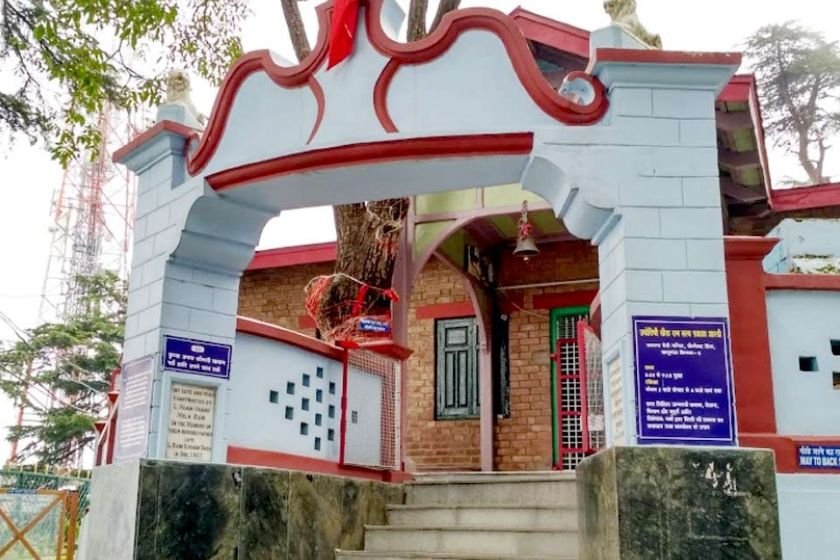
Kamna Devi Temple sits atop Prospect Hill, one of the seven hills that make up Shimla, just above the Boileauganj neighbourhood on the Shimla–Bilaspur highway, a short distance west of the city’s main bazaar. Estimates of the exact distance from central Shimla vary by source — anywhere from about 3 to 6 kilometres depending on which landmark you measure from — but in practical terms it’s a quick local trip rather than a separate excursion.
Google Maps: Get Directions
No independently confirmed GPS pin was available for this piece, so use Boileauganj on the Shimla–Bilaspur highway as your reference point — it’s a well-known, easily located spot, and the temple sits directly above it.
Altitude: approximately 2,200 metres above sea level.
- By road: Local buses and taxis run to Boileauganj from anywhere in Shimla; from there, a private vehicle can continue partway up the steep link road, or you can walk
- On foot: Roughly a 10-minute uphill walk from Boileauganj covers the final stretch to the temple
- By rail: Shimla’s own railway station is only a few kilometres away
- By air: Jubbarhatti Airport, about 23 km from Shimla
This is one of the more convenient hilltop shrines in the state — close enough to the city that it works as a half-day outing, but wooded and quiet enough at the top that it doesn’t feel like an extension of the Mall Road crowd.
🌸 Best Time to Visit
Shimla’s general climate calendar applies well here: March through June offers clear, pleasant weather for the climb, and the stretch from October through February brings crisper air and quieter forest paths, though winter mornings can be genuinely cold at this elevation. The monsoon months of July through September are best avoided if possible — the approach road and forest paths get slick, and the views that make the climb worthwhile tend to vanish into cloud. Early morning visits bring a calmer, more contemplative atmosphere with the day’s first aarti; if you’re coming specifically for the festival energy, Navratri and Durga Puja in October are when the temple is at its most animated.
🕉️ The Legend: A Wish Given a Name, and a Name Given a Hill
Unlike temples built around a dramatic battle or a divine apparition in a cave, the story here is disarmingly plain: a local ruler, remembered simply as the Rana of Junga, built a temple on this hilltop and dedicated it to the goddess as a place where wishes — kamna, in Sanskrit — could be brought and answered. No precise date survives for when this happened; historical accounts place it broadly in the 18th century, but the exact year of consecration isn’t recorded anywhere that has come down to us. What is consistent across local memory is the goddess’s own identity here: she’s worshipped as a form of Kali, herself an aspect of Durga, and the name Kamna Devi describes not a separate deity with her own distinct mythology but Kali specifically in her role as wish-granter on this particular hill. Locally she’s also known as Creeda Devi, a second name whose exact origin and meaning wasn’t something this research could pin down with confidence.
There’s a natural temptation, writing about a temple like this, to reach for a grander founding story — a sage in meditation, a demon defeated, a dream that changed a kingdom’s fate. None of that appears to be genuinely attached to Kamna Devi’s temple in any source this piece could verify, and it’s worth resisting the urge to borrow that kind of drama from elsewhere. What this temple actually offers is quieter and, in its own way, just as telling: a ruler who wanted his people to have somewhere to bring their hopes, and a goddess who has apparently been doing exactly that ever since, without needing a more elaborate origin story to justify the climb.
🙏 What the Deity Is Known For
Kamna Devi is approached, true to her name, for the fulfillment of heartfelt wishes — devotees climb specifically believing that sincere prayer here, offered with real conviction, has a way of being answered. As a form of Kali, she carries the fiercer, more protective register within Durga’s wider identity, and locals describe turning to her not just for granted wishes but for a general sense of strength and safeguarding as well. This isn’t a temple built around one narrow specialty or a single unusual ritual; it functions much like many of Shimla’s hill shrines do, as a dependable, everyday point of devotion for residents of the surrounding neighbourhoods as much as a destination for visiting pilgrims.
🏛️ The Temple Itself
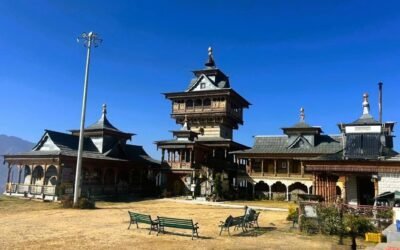
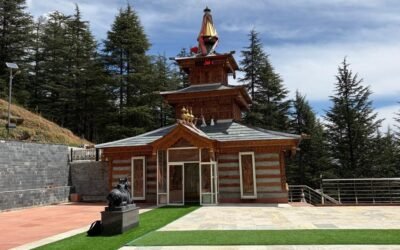
The temple is built in a local hill architectural idiom, though — as even the most detailed available sources are careful to note — not strictly in the layered Kathkuni or pagoda styles seen at some of Himachal’s older and more elaborate shrines. It’s a modest, unpretentious structure, standing on a hilltop encircled by deodar, pine, oak, and rhododendron, the kind of mixed high-altitude forest that gives this part of Shimla its noticeably cooler, resin-scented air even in summer. There’s no dramatic architectural set piece here — no towering gopuram, no famous carved sanctum — and that plainness is arguably part of the experience: you come here as much for the setting as the structure, standing on a forested hilltop with the whole southern sweep of Shimla and the Tara Devi ridge spread out below.
📜 Junga, Keonthal, and a Kingdom the Map No Longer Shows
The “Rana of Junga” credited with building this temple ruled from a small hill state properly known as Keonthal, whose capital sat at Junga — a town that still exists today, about 26 kilometres from Shimla, though almost entirely known now for the ruins and remnants of that old princely estate rather than any administrative importance. Keonthal was one of roughly two dozen small Rajput-ruled principalities collectively remembered as the Shimla Hill States, tracing its royal line back to a branch of the Sen dynasty that migrated into these hills centuries before the British ever arrived, and its rulers held sway over the very ridge where Shimla itself would later be built. By the time the British began developing Shimla as their summer capital in the early 19th century, much of what’s now central Shimla still fell within Keonthal’s territory, before parcels of it were transferred to colonial administration. Keonthal, like all the Shimla Hill States, acceded to India in 1948 and was absorbed into the new district structure — meaning Kamna Devi’s temple is, in effect, one of the last visible threads connecting present-day Shimla to a hill kingdom that governed this exact ground before the city around it existed.
🎉 Festivals and Devotion
- Navratri (spring and autumn) — the temple’s most animated period, marked by special pujas and a steady flow of devotees up the hill
- Durga Puja (October) — celebrated with community aartis and gatherings, in keeping with the goddess’s identity here
- Daily worship — a morning aarti around 6:00 a.m. and an evening aarti around 6:00 p.m., maintained year-round outside the major festival dates
🏞️ While You’re in the Area
- Tara Devi Temple — another of Shimla’s hilltop Devi shrines, visible from Kamna Devi’s own vantage point, and a natural point of comparison for anyone touring the city’s Shakti temples
- Manorville Mansion — a British-era building close to the temple, notable as one of the places Mahatma Gandhi stayed during extended visits to Shimla between 1935 and 1946
- Indian Institute of Advanced Study — a striking colonial-era building a short distance away, worth a look for its architecture alone
- Summer Hill — a quieter, leafy Shimla neighbourhood nearby, offering its own views away from the main tourist crush
- Jakhu Temple — Shimla’s best-known hilltop shrine, home to a towering Hanuman statue, for anyone wanting to compare the city’s different hill-devotion traditions in one trip
❓ Quick Questions Travellers Ask
Is there an entrance fee? No. Kamna Devi Temple is free to visit, with no ticket or booking required.
Can I drive all the way to the temple? A private vehicle can generally manage a good part of the climb from Boileauganj, though the final stretch is often covered on foot; the walk itself, at roughly ten minutes from Boileauganj, isn’t a serious trek by regional standards.
What are the temple’s timings? The temple is generally open from around 6:00 a.m. to 8:00 p.m., though exact hours can shift slightly with the season, so it’s worth confirming locally if you’re planning a very early or late visit.
Is this a good spot for families or older travellers? Yes — the walk is short and moderate rather than strenuous, and the site is often recommended as a picnic and short-outing destination as much as a pilgrimage stop.
Why is it also called Creeda Devi Temple? Local sources use this alternate name consistently, though a clearly documented explanation for its origin wasn’t something this research could confirm — it appears to be a long-standing local name running alongside “Kamna Devi” rather than a separate tradition.
A Last Word
It’s easy to walk up to a hilltop shrine like this thinking only of the view at the top — and Kamna Devi’s certainly delivers one. But there’s something worth sitting with in the fact that this particular patch of forest, quiet and unremarkable-looking as it is, once belonged to a functioning kingdom with its own ruler, its own court, and its own claim on this exact ridge, long before Shimla existed as the city it is now. Kingdoms fold into districts, capitals become footnotes, and yet the wish a Rana of Junga made centuries ago — that people would have somewhere on this hill to bring their own hopes — is still, every day, being quietly kept.
Fact-check note: The temple’s location atop Prospect Hill above Boileauganj, its dedication to Kali as Kamna Devi (also locally called Creeda Devi), and its construction by the Rana of Junga are corroborated across Wikipedia and multiple independent regional sources. The temple’s precise founding date is not recorded anywhere found in research and is described only broadly as 18th century; this piece has not invented a more specific date. The historical background on Keonthal State and its capital at Junga is drawn from Wikipedia and regional historical sources and is presented as established background rather than temple-specific legend. No independently verified GPS coordinates were available, so Boileauganj has been used as a landmark reference instead. Distance figures from central Shimla vary across sources (3–6 km) and have been presented as a range rather than a single false-precise number. One prior account of this temple describes Prospect Hill as “once revered by sages,” a claim this piece could not independently verify in any source and has therefore deliberately left out.