On the bank of the Pabbar River, Hatkoti’s ancient Devi temple keeps a strange local memory alive — of sacred vessels, hidden maya, floodwater, and one ghada still held by chains before the Mother.
Some temples are remembered through their idols. Some through kings. Some through architecture. Hateshwari Mata Temple at Hatkoti is remembered through all of these, but also through something more unusual: a chained vessel in front of the temple and the local belief that it once tried to move towards the Pabbar River. That story gives Hatkoti a different kind of mystery. The temple is dedicated to Maa Hateshwari, worshipped as a powerful form of Goddess Durga / Mahishasuramardini, but the place is not only about the goddess inside the sanctum. It is also about the river beside her, the old stone temple complex, the Pandava-linked memory of the valley, and the belief that sacred objects here are not always still.
🌄 Location & How to Reach It
Hateshwari Mata Temple is located at Hatkoti village in the Jubbal region of Shimla district, Himachal Pradesh. The temple stands on the right bank of the Pabbar River, in the upper Shimla hills, about 100–102 km from Shimla. The setting is very different from central Shimla: the road moves into the apple-growing belt of Jubbal, Rohru, and Pabbar Valley, where river, orchards, old settlements, and temple traditions sit close together.
Google Maps: Get Directions
Elevation: around 1,440 metres, based on commonly cited Hatkoti village elevation.
- By road: The usual approach is from Shimla – Theog – Kotkhai – Jubbal – Hatkoti, or from Rohru side depending on the starting point. Hatkoti is road-connected, but the journey is long and should be planned with hill-road timing in mind.
- By rail: The nearest convenient railway access is Shimla Railway Station on the Kalka–Shimla heritage line, followed by road travel to Hatkoti. For broader train connectivity, travellers usually use Kalka or Chandigarh.
- By air: The nearest practical airport is Shimla Airport, though Chandigarh Airport is usually more reliable for wider flight connectivity, followed by road travel into the Pabbar Valley.
This is a proper valley journey, not a quick in-town temple visit. It can be done as a long day trip from Shimla only if started early, but Hatkoti is better understood slowly, along with Jubbal, Rohru, and the Pabbar Valley.
🌸 Best Time to Visit
The best time to visit Hatkoti is usually March to June and September to November. Spring and early summer are good for road travel, temple darshan, and valley views. Autumn is especially beautiful in the apple belt, with clearer weather and a quieter mountain atmosphere after the monsoon.
The temple is important during Navratri, especially Chaitra Navratri and Ashwin Navratri, when devotees visit in larger numbers. Local references mention that the temple sees fair-like activity during Navratri periods, and the shrine becomes much busier than on ordinary days.
Monsoon should be approached with caution. The Pabbar Valley is beautiful in rain, but landslides, road damage, falling stones, and river swelling can affect travel. Winter can be cold, and routes through the upper Shimla hills may face snow or frost depending on the season.
For ordinary darshan, arrive during daylight. If you are planning around Navratri, a special puja, or a local fair, confirm the current arrangements locally in Hatkoti, Jubbal, or Rohru.
🕉️ The Goddess of Hatkoti
Maa Hateshwari is worshipped as a powerful form of Goddess Durga, often identified with Mahishasuramardini, the goddess who slays the buffalo demon Mahishasura. This identity gives the temple a strong Shakti character. The goddess here is not merely gentle and maternal; she is protective, fierce, and victorious.
The temple belongs to the old sacred geography of the Pabbar Valley. Local people hold Hateshwari Mata in deep reverence, and the temple is one of the most important Devi shrines in the upper Shimla region. The place is also associated with older legends of the Pandavas, ancient temple-building traditions, and the belief that the site has been spiritually important for many centuries.
What makes Hatkoti special is the way the goddess is tied to the land around her. The Pabbar River is not just scenery. The river appears again and again in the temple’s stories. The temple complex, the riverbank, the old stone structures, and the chained vessel all work together to create Hatkoti’s sacred personality.
🕉️ The Chained Ghada and the Story of Hidden Maya
One of the most unusual stories of Hateshwari Mata Temple is connected with the large vessel kept in front of the temple. Locally, it is often described as a ghada, kalash, or Charu. The story has several versions, but the heart of it remains the same: there were once two large vessels, and both were believed to contain hidden maya or mysterious sacred power.
According to local belief, these vessels were not ordinary metal objects. They were alive in a sacred sense. At some point, they began moving by themselves towards the Pabbar River. One vessel is said to have escaped or been lost into the river, while the other was recovered and tied with chains so it could not leave again. The chained vessel seen near the temple is connected with this memory.
Another version says that during a flood or swelling of the Pabbar, one of the vessels became loose and moved towards the river. One was lost, and one remained. Some tellings describe the vessel as containing maya; others speak of a demon-like force named Charu, or a mysterious energy bound inside the vessel. The details change, but the meaning is clear: this object is not treated as a simple antique. It is part of the temple’s living mystery.
This story should be handled respectfully and carefully. It is not a museum-confirmed historical record. It is oral tradition. But oral tradition is often how Himalayan temples preserve their deepest identity. The chained ghada tells us how local people understand Hatkoti: as a place where the goddess’s power is active, where the river has its own pull, and where even objects associated with the temple may need to be restrained.
🔱 The River That Keeps Returning in the Story
The Pabbar River is central to Hatkoti. The temple stands beside it, and the vessel story cannot be separated from it. If the ghada tried to move, it moved towards the river. If one vessel disappeared, it disappeared into the river. If the remaining one is chained, it is chained because the river once claimed or nearly claimed the other.
This makes the Pabbar more than a geographical feature. In Hatkoti’s sacred imagination, the river behaves like a force. It receives, pulls, hides, and remembers. Many old Himalayan temples are built near rivers, but Hatkoti’s legend gives the river a more active role.
There is a practical truth inside this too. Mountain rivers are not passive. The Pabbar changes with snowmelt, rain, and season. Its water can look calm at one time and dangerous at another. A story about a vessel being carried away or drawn towards the river may be miraculous in form, but it also reflects a real mountain understanding: the river is powerful, and anything near it must be respected.
🏛️ The Temple Complex and Its Ancient Stone Memory
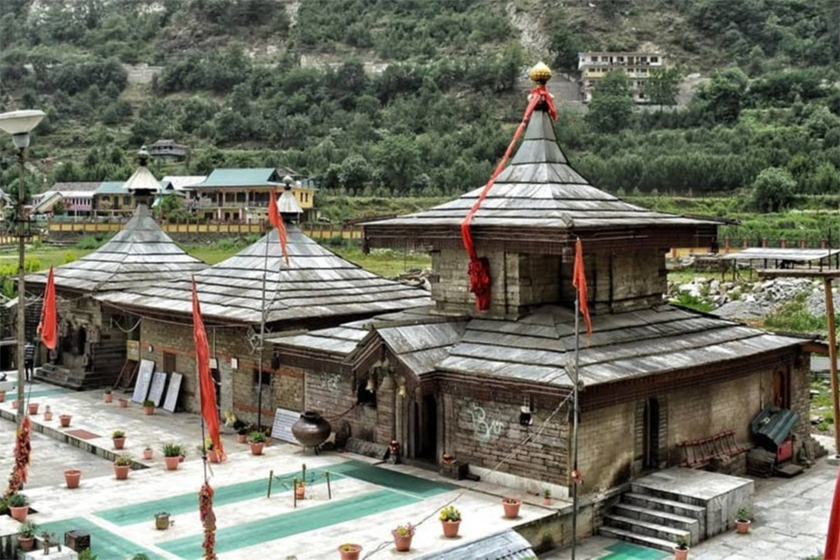
Hateshwari Mata Temple is not a new roadside shrine. It is an ancient temple complex, and its architecture is one of the reasons Hatkoti is so important. The complex is often described as a stone temple group built in a style typical of the valley, with strong links to older north Indian temple forms.
The main temple is associated with shikhara-style architecture, but like many Himalayan shrines, it also carries local adaptations. The stone work, wooden elements, roof form, and temple setting all reflect a mountain environment where architecture had to respond to weather, material, and terrain.
The complex includes the main shrine of Hateshwari Mata and other associated shrines. The presence of a Shiva temple in the complex is also important, because many old Himalayan temple groups bring Shaiva and Shakti elements close together. In such places, the goddess is not worshipped in isolation. She belongs to a larger sacred order.
A visitor may notice that the temple does not feel like a single isolated building. It feels like a layered sacred compound. Stone, river, bells, old carvings, flags, the chained vessel, and the flow of local devotees all form the atmosphere. The place carries age without needing to shout about it.
📜 Pandavas, Pratiharas, and the Difficulty of Dating Hatkoti
Hatkoti’s history is not easy to reduce to one clean date. Local tradition connects the temple with the Pandavas, as many old Himalayan temples are connected with the Mahabharata period in oral memory. Some accounts also associate the site with Adi Shankaracharya or later restorations. Architectural references often place the older temple complex broadly around the 8th to 9th century, sometimes connecting it with the Gurjara-Pratihara period.
The safest way to understand Hatkoti is not to force all of these into one neat origin story. The temple is old. Its architecture belongs to an early medieval sacred world. Its legends are older in feeling and have travelled through local memory. Its present form has likely seen repair, renewal, and continued worship over time.
That layered nature is part of Hatkoti’s strength. The temple does not depend on one single historical claim. It stands at the meeting point of architecture, oral tradition, Devi worship, river geography, and local faith.
🙏 What Hateshwari Mata Temple Is Known For
Hateshwari Mata Temple is known for its worship of Maa Hateshwari / Mahishasuramardini, its ancient stone temple architecture, its location beside the Pabbar River, and its unusual chained vessel legend.
Devotees visit for blessings, protection, family welfare, fulfilment of vows, and Devi darshan. During Navratri, the temple becomes more active, with larger numbers of devotees arriving from nearby valleys and other parts of Himachal.
The chained ghada adds a special layer to the temple’s identity. It gives visitors something to ask about, but more importantly, it gives local people a way to speak about the goddess’s power. The vessel is a visible reminder that Hatkoti is not only an old temple. It is a place where stories still attach themselves to objects, and objects still carry sacred weight.
For travellers, this is what makes Hatkoti memorable. Many temples have bells and courtyards. Few have a vessel tied in chains because people remember that another one once moved towards the river and disappeared.
🎉 Festivals and Devotion
- Chaitra Navratri: One of the main devotional periods at Hateshwari Mata Temple, drawing devotees for special worship and fair-like activity.
- Ashwin Navratri: Another important period for Devi worship, when the temple sees increased pilgrim movement.
- Durga Puja / Dussehra Season: As the goddess is worshipped as a Durga form, the autumn Devi season is especially meaningful.
- Daily Worship: The temple remains an active local shrine where devotees come for darshan, offerings, and family prayers.
- Local Storytelling: The chained ghada / Charu vessel story is one of the temple’s most distinctive oral traditions and should be heard from local people if possible.
🏞️ While You’re in the Area
- Pabbar River: The river beside Hatkoti is central to the temple’s setting and to the vessel legend, making it part of the sacred experience rather than just a view.
- Jubbal: A historic town of the region, useful for understanding the old hill-state setting around Hatkoti and the wider apple belt.
- Rohru: A major town of the Pabbar Valley, often used as a base for travellers exploring Hatkoti, Chanshal, and nearby areas.
- Kharapathar: A high route point between Shimla and the Pabbar side, known for forests, apple country, and access towards Giriganga.
- Giriganga: A sacred and scenic site above the Kharapathar side, often combined with Pabbar Valley travel if time and weather allow.
- Chanshal Pass: A high mountain pass beyond Rohru, suitable only in the right season and with current road confirmation.
- Jubbal Palace: A useful heritage stop for travellers interested in the region’s princely-state history and traditional hill architecture.
🙏 Getting in Touch
There is no single widely verified official temple website or public visitor office for Hateshwari Mata Temple that travellers should depend on without local confirmation. For special puja, Navratri arrangements, fair dates, or local restrictions, ask in Hatkoti, Jubbal, or Rohru.
Because Hatkoti lies in a mountain valley, road conditions should be checked before travelling during monsoon, winter, or after heavy snowfall in the upper Shimla hills. For ordinary darshan, arrive during daylight, respect temple customs, and ask before photographing the inner sanctum, deity, ritual objects, or the chained vessel closely.
❓ Quick Questions Travellers Ask
Where is Hateshwari Mata Temple located?
It is located at Hatkoti village in the Jubbal region of Shimla district, on the bank of the Pabbar River.
Which goddess is worshipped at Hatkoti?
The temple is dedicated to Maa Hateshwari, worshipped as a powerful form of Goddess Durga / Mahishasuramardini.
What is the story of the chained ghada at Hatkoti?
Local tradition says there were once two large vessels containing mysterious maya or sacred force. They began moving towards the Pabbar River; one was lost, and the remaining one was recovered and tied with chains near the temple.
Is the ghada story historically proven?
No. It is best understood as local oral tradition. It is important because it shows how people of Hatkoti understand the sacred power of the temple and river.
How far is Hatkoti from Shimla?
Hatkoti is roughly 100–102 km from Shimla, depending on the exact route and starting point.
A Last Word
Hateshwari Mata Temple stays in the mind because it does not give itself away all at once. First, you see the old temple beside the Pabbar. Then you notice the stone, the river, the goddess, the valley, and the quiet weight of age. And then someone tells you about the chained ghada.
That story changes the place. The temple is no longer only an ancient shrine with architecture and worship. It becomes a place where the river tried to take something, where one vessel vanished, and where another was held back before the Mother. Whether one reads the story as miracle, memory, warning, or sacred imagination, it belongs to Hatkoti.
At Hateshwari Mata, the goddess is inside the sanctum, but her mystery reaches beyond it — into metal, chain, stone, water, and the old pull of the Pabbar River.
Fact-check note: Hateshwari Mata Temple’s location at Hatkoti in Shimla district, on the right bank of the Pabbar River, and its distance of about 100–102 km from Shimla are supported by official and local references. The temple is widely associated with Maa Hateshwari / Mahishasuramardini, a form of Goddess Durga, and with an ancient stone temple complex generally dated by architectural tradition to the early medieval period, though exact construction dates vary. The chained ghada / Charu vessel story, including the belief that two vessels once contained maya and moved towards the Pabbar River, is treated here as important local oral tradition rather than confirmed historical fact. A previous article on this site already covers the temple in a broader sacred-jewel style, so this article uses the chained vessel and river legend as its central angle.